You open Facebook Ads Manager expecting clarity. Instead, you find numbers that don't match your CRM, conversions that seem to have vanished, and a nagging question: are you actually making good decisions with this data? If this sounds familiar, you're not alone. Marketers running paid campaigns on Facebook are increasingly confronting a gap between what the platform reports and what's actually happening in their business.
This isn't a minor reporting quirk you can safely ignore. When conversion data goes missing, Facebook's algorithm loses the signal it needs to optimize effectively. You end up cutting campaigns that are quietly driving revenue and scaling ones that look good on paper but aren't delivering real results. The financial cost compounds quickly, and the damage to your ad account's learning phase can set you back weeks.
The good news is that losing conversion data on Facebook Ads is a solvable problem. It requires understanding why the data disappears in the first place, what it's costing your business, and which technical and strategic fixes actually work. This article walks you through all of it: the root causes, the downstream consequences, and a practical roadmap to reclaim accurate tracking and make smarter decisions with your ad spend.
Why Facebook Can't See Your Full Funnel Anymore
The tracking environment Facebook relied on for years has fundamentally changed. Three separate forces have converged to create the data loss problem most advertisers are experiencing today, and understanding each one helps you address them systematically.
Apple's App Tracking Transparency (ATT) framework was the most disruptive shift. Introduced with iOS 14.5 in April 2021, ATT requires apps to explicitly ask users for permission before tracking their activity across other apps and websites. Opt-in rates have been widely reported as low, meaning a large portion of Facebook's iOS user base opted out of tracking entirely. The result: Facebook simply stopped receiving conversion signals from a significant segment of its audience. Purchases, sign-ups, and other valuable actions taken by iOS users became invisible to the pixel. To understand the full scope of this disruption, explore why Facebook Ads stopped working after iOS 14.
Facebook's response was to introduce Aggregated Event Measurement (AEM), which limits advertisers to optimizing for a maximum of eight conversion events per domain, ranked by priority. This constraint forces difficult tradeoffs and further limits the granularity of data available for optimization.
Browser-level tracking restrictions compound the problem. Safari's Intelligent Tracking Prevention (ITP) and Firefox's Enhanced Tracking Protection block third-party cookies by default. Since the Facebook pixel relies on cookies to track user behavior across sessions, these restrictions mean conversions that happen after a user closes their browser or returns days later often go unrecorded. Google Chrome has also been moving toward reduced reliance on third-party cookies, a shift that will affect tracking across the broader web.
Ad blockers add another layer of interference. A meaningful portion of internet users run ad blockers that prevent the Facebook pixel from firing at all. If the pixel can't load, no conversion data gets sent, regardless of whether the user actually converted.
Attribution window changes are the third factor, and one that's easy to overlook. Facebook reduced its default attribution window from 28-day click and 1-day view to 7-day click and 1-day view. For businesses with longer buying cycles, this matters enormously. A prospect who clicks your ad, spends two weeks evaluating options, and then converts on day 10 simply won't appear in your Facebook conversion data. From the platform's perspective, that sale never happened. Campaigns that are genuinely driving revenue in longer sales cycles look like underperformers, and that misread shapes every budget decision you make. For a deeper dive into this topic, read about Facebook Ads attribution and how to track real revenue.
Taken together, these three forces mean that the pixel-only tracking setup that worked reliably a few years ago now captures only a fraction of your actual conversions. The gap between Facebook-reported results and real-world outcomes is not a glitch. It's a structural limitation of how tracking currently works.
What Incomplete Conversion Data Actually Costs Your Business
It's tempting to treat conversion discrepancies as a reporting inconvenience rather than a strategic crisis. But the downstream effects of missing conversion data are serious, and they compound over time in ways that quietly drain your ad budget.
Facebook's algorithm optimizes on the signals it receives, not the ones it doesn't. When large portions of your conversion events go unreported, the algorithm operates with an incomplete picture of who actually converts. It can't learn effectively, which means ad delivery becomes less efficient. You're essentially paying for a sophisticated optimization engine and then starving it of the fuel it needs to work. This is a core reason behind underreporting conversions in Facebook Ads.
The budget misallocation cycle this creates is particularly damaging. Consider a campaign that's driving real conversions but whose data is heavily affected by iOS opt-outs and cookie restrictions. It looks like an underperformer in Ads Manager. A reasonable marketer, seeing weak reported ROAS, cuts the budget or pauses it entirely. Meanwhile, a different campaign with better pixel coverage looks stronger on paper and gets scaled. The result is that you're systematically rewarding campaigns that happen to be more trackable, not necessarily more effective.
The damage extends to your audience quality over time. Lookalike audiences are built from conversion event data. If the conversion signals you're feeding Facebook are incomplete or skewed, your lookalikes reflect that distorted picture. You end up targeting people who resemble the subset of converters Facebook can see, not your actual best customers. Retargeting pools suffer the same degradation. Users who visited your site or engaged with your content but weren't captured by the pixel simply fall out of your retargeting audiences.
There's also a compounding effect on the learning phase. Facebook's algorithm requires a minimum number of conversion events per week to exit the learning phase and optimize efficiently. When conversion data is suppressed, campaigns struggle to accumulate enough signals, which keeps them stuck in an inefficient state longer. Every week a campaign spends in extended learning is a week of suboptimal delivery. This is one of the key reasons marketers find themselves wasting money on Facebook Ads.
The bottom line is straightforward: losing conversion data on Facebook Ads doesn't just affect your reports. It affects your algorithm's performance, your audience quality, and ultimately your return on every dollar you spend.
Pixel-Only Tracking vs. Server-Side Tracking: The Core Difference
To fix the problem, you need to understand the fundamental difference between how traditional pixel tracking works and what server-side tracking actually does differently.
The Facebook pixel is browser-based. When a user lands on your website and takes an action, a small piece of JavaScript code fires in their browser and sends that event data to Facebook. This approach worked well when browsers were permissive and users didn't block tracking. Today, as we've covered, browser restrictions, ad blockers, and iOS privacy changes intercept or block that signal before it ever reaches Facebook. The pixel doesn't fail because it's poorly configured. It fails because the environment it was designed for no longer exists. Understanding why Facebook Ads are not tracking conversions starts with recognizing this fundamental shift.
Server-side tracking works differently at a fundamental level. Instead of relying on the user's browser to send conversion data, server-side tracking sends events directly from your web server to Facebook's servers. The user's browser never has to do the heavy lifting. Ad blockers can't intercept a server-to-server call. Safari's ITP has no effect on it. The signal travels through a channel that privacy restrictions and browser limitations don't touch.
Facebook's own solution for this is the Conversions API (CAPI). CAPI allows advertisers to send conversion events server-side, complementing or replacing the pixel. In theory, this should close the data gap. In practice, CAPI alone has meaningful limitations if it's not implemented carefully. For a thorough walkthrough, see our guide on setting up Conversion API for Facebook.
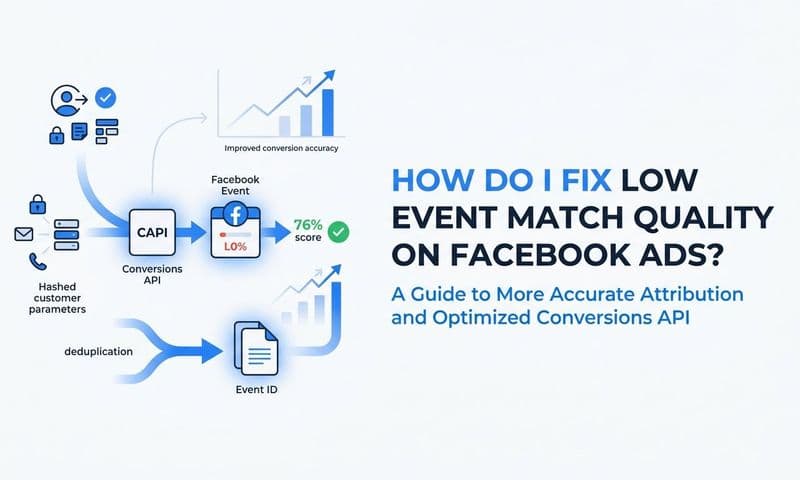
The most common implementation problem is deduplication. If you're running both the pixel and CAPI simultaneously, which is the recommended approach for maximum coverage, the same conversion event can be sent twice: once from the browser via the pixel and once from the server via CAPI. Without proper deduplication logic, Facebook counts both, inflating your conversion numbers and corrupting your optimization data in a different direction.
Proper CAPI implementation also requires enriched event data. Facebook uses parameters like email addresses, phone numbers, and other customer identifiers to match conversion events to users in its system. If your server-side events are sent without this enrichment, Facebook's match rate suffers and many events fail to attribute correctly.
Third-party server-side tracking solutions, including dedicated attribution platforms, address these gaps by handling deduplication automatically and enriching events with the customer data needed for high match rates. They also provide a layer of independence from Facebook's own reporting, giving you a cross-reference point that doesn't rely on the platform grading its own homework.
Five Practical Steps to Recover Your Lost Conversion Data
Knowing why conversion data goes missing is useful. Having a clear action plan to recover it is what actually moves the needle. Here are five concrete steps to close the gap.
Step 1: Audit your current tracking gap. Before you fix anything, quantify the problem. Pull your Facebook-reported conversions for the last 30 to 90 days and compare them against your CRM, payment processor, or backend sales data for the same period. The difference between these two numbers is your tracking gap. This audit serves two purposes: it tells you how serious the problem is, and it gives you a baseline to measure improvement against after you implement fixes. Many marketers are surprised to find the gap is much larger than they expected.
Step 2: Implement server-side tracking. Once you've quantified the gap, the most impactful fix is moving beyond pixel-only tracking. Set up Facebook's Conversions API or use a third-party server-side tracking solution that integrates with your existing stack. The goal is to capture conversion events at the server level, where browser restrictions can't interfere. Prioritize your highest-value conversion events first: purchases, qualified leads, or whatever actions directly connect to revenue in your business. Our Conversion API implementation tutorial walks through the technical details step by step.
Step 3: Configure proper event deduplication. Running the pixel and server-side tracking simultaneously gives you the best coverage, but only if deduplication is set up correctly. Use a unique event ID for every conversion event and pass that same ID through both the pixel and your server-side implementation. Facebook uses this ID to recognize that two incoming events represent the same conversion and counts it only once. Skipping this step means your reported conversion numbers will be inflated, which creates a different but equally damaging set of problems for your algorithm.
Step 4: Use UTM parameters consistently across all campaigns. UTM parameters give you an independent tracking layer that doesn't depend on Facebook's reporting at all. When every ad, every campaign, and every ad set is tagged with consistent UTM parameters, you can track performance in Google Analytics or your attribution platform regardless of what Facebook reports. This cross-reference capability is invaluable for identifying discrepancies and understanding where your traffic is actually coming from and what it's doing after it arrives. Learn more about tracking Facebook Ads accurately with layered measurement approaches.
Step 5: Feed enriched and offline conversions back to Facebook. Many valuable conversions happen outside the immediate click-to-purchase window. A prospect clicks your ad, books a sales call, and converts two weeks later after a series of follow-up emails. That conversion is real revenue, but Facebook's standard tracking never sees it. Use Facebook's offline conversions feature or your attribution platform's conversion sync capability to send these delayed and offline events back to Facebook. The more complete the conversion signal you provide, the better Facebook's algorithm can optimize toward the users most likely to become real customers.
How Attribution Platforms Close the Data Gap
Server-side tracking and proper CAPI implementation recover a significant portion of lost conversion data. But they don't solve the full picture problem, which is understanding how all your marketing channels work together to drive a conversion. That's where dedicated attribution platforms come in.
Attribution platforms connect your ad accounts, website, and CRM into a single view of the customer journey. A user might click a Facebook ad, visit your site three times over two weeks, open a few emails, and then convert after clicking a Google search ad. Facebook's reporting gives you credit for the first touch. Google claims the last click. Neither platform shows you the complete sequence of events that actually led to the sale. An attribution platform captures every touchpoint in that journey and maps them together, giving you a view that no single ad platform can provide on its own. For a comprehensive look at the tools available, explore the top Facebook Ads tracking platforms that connect clicks to revenue.
This matters for budget allocation in a concrete way. When you can see the full path to conversion, you stop making decisions based on whichever platform happens to claim credit most aggressively. You can see which channels are introducing new customers, which ones are nurturing consideration, and which ones are closing the deal. That visibility allows you to allocate budget based on actual contribution to revenue rather than platform-reported ROAS.
The feedback loop created by sending enriched data back to ad platforms is where attribution platforms generate compounding value. Tools like Cometly capture enriched conversion events from across the customer journey and sync them back to Facebook, Google, and other ad platforms. This enriched data includes customer identifiers and behavioral signals that improve Facebook's ability to match events to users and optimize delivery toward high-value audiences.
When Facebook's algorithm receives better data, it makes better decisions about who to show your ads to. Better targeting produces higher-quality conversions, which generates more useful data, which further improves targeting. This positive feedback loop is the opposite of the degradation cycle that happens when conversion data is incomplete.
Multi-touch attribution models give you a more honest picture than Facebook's default last-click approach. Last-click attribution assigns all credit to the final touchpoint before conversion, which systematically undervalues upper-funnel channels that introduce and nurture prospects. Multi-touch models, whether linear, time-decay, or data-driven, distribute credit across the touchpoints that actually influenced the decision. For marketers running campaigns across Facebook, Google, email, and other channels, this shift in perspective often reveals that the channel mix driving results looks quite different from what single-platform reporting suggests.
From Accurate Data to Scalable Growth
Here's what changes when your conversion data is actually accurate: you stop guessing and start making decisions with confidence. The campaigns you scale are the ones genuinely driving revenue. The ones you cut are the ones that genuinely aren't working. That sounds obvious, but it's a fundamentally different operating mode from what most marketers are stuck in when their tracking is broken.
The compounding benefit is real and worth emphasizing. When you feed Facebook complete, enriched conversion data, the algorithm gets smarter about who to target. Smarter targeting means better results. Better results generate more conversion events. More conversion events give the algorithm even richer signal to work with. Over time, this compounding effect means your cost per acquisition trends down while your campaign performance trends up, not because you got lucky, but because you gave the system the inputs it needs to function as designed. This is the foundation of effective Facebook Ads optimization.
Accurate data also changes how you think about testing. When you know your tracking is reliable, you can run creative tests, audience experiments, and budget shifts with confidence that the results you see reflect reality. You stop second-guessing whether a winning campaign is actually winning or just tracking better. That clarity accelerates your ability to learn and iterate, which is ultimately the competitive advantage in paid advertising.
Marketers who solve their conversion tracking problems don't just fix a reporting issue. They unlock the full potential of the platforms they're already paying for.
The Bottom Line: Your Data, Your Decisions
Losing conversion data on Facebook Ads is not something you have to accept as the inevitable cost of a privacy-first internet. The tracking environment has changed, but the tools and strategies to adapt to it exist right now. The gap between what Facebook reports and what's actually happening in your business is measurable, and it's closeable.
Start with an honest audit of how much data you're currently losing. Implement server-side tracking to capture conversions that the pixel misses. Configure deduplication correctly so your data is clean. Use UTM parameters as an independent verification layer. Feed enriched and offline conversions back to Facebook to improve its optimization. And use a dedicated attribution platform to see the full customer journey across every channel.
Each of these steps on its own improves your situation. Together, they give you something most advertisers are currently operating without: a reliable, complete picture of what's actually driving your results.
Cometly is built to help marketers do exactly this. It captures every touchpoint from ad click to CRM event, syncs enriched conversion data back to Facebook and other ad platforms to improve algorithmic performance, and gives you multi-touch attribution so you can see the full story behind every conversion. If you're ready to stop making budget decisions based on incomplete data, Get your free demo today and start capturing every touchpoint to maximize your conversions.