

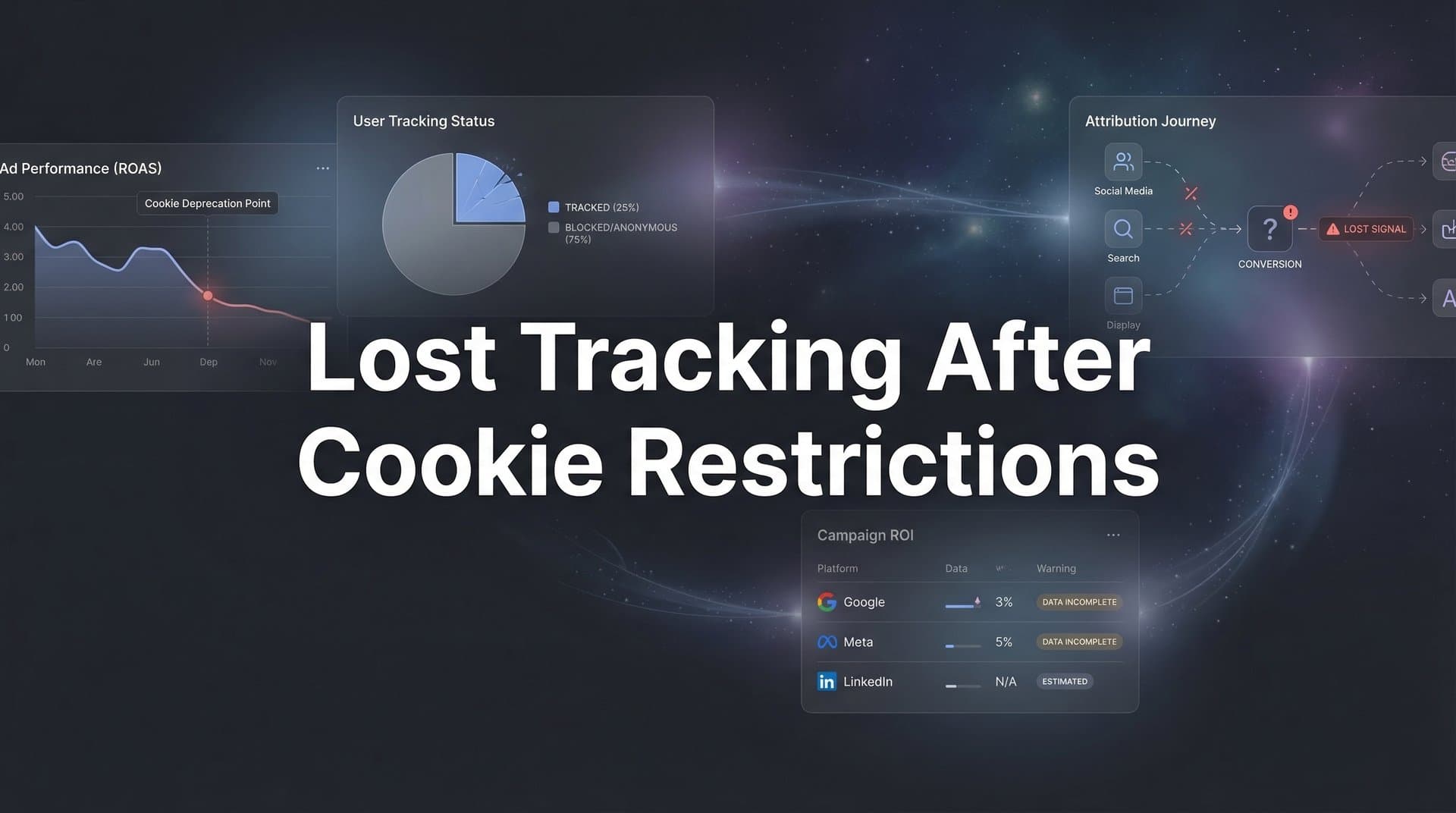
You've been running the same campaigns for months. Your budget hasn't changed. Your targeting is solid. Your creative is performing. Yet when you check your dashboard, something feels off. Conversions are down 30%, maybe 40%. Your Facebook Ads Manager shows half the purchases your Shopify store recorded. Google Analytics reports fewer form fills than your CRM actually received. The numbers don't add up anymore.
This isn't a glitch in your tracking setup. It's the new reality of digital marketing in a world where browsers have systematically dismantled the tracking infrastructure we relied on for over a decade.
Cookie restrictions have fundamentally changed how marketing attribution works. What started with Safari's privacy updates in 2017 has evolved into a comprehensive reshaping of data collection across every major browser and platform. For marketers, the impact is clear: the tracking methods that once showed you exactly which ads drove revenue now leave massive gaps in your data. You're making decisions with incomplete information, scaling campaigns based on partial visibility, and wondering why your ROI calculations feel like guesswork.
The good news? This problem is solvable. Understanding what changed, why traditional tracking broke, and how modern attribution approaches restore accuracy will give you the clarity you need to make confident marketing decisions again.
The Cookie Crumble: What Changed in Marketing Tracking
Third-party cookies were the backbone of digital marketing attribution for years. These small text files allowed advertisers to follow users across different websites, connecting the ad someone clicked on Monday with the purchase they made on Friday. When a user visited your site after clicking a Facebook ad, a cookie would be placed in their browser. Days later, when they returned directly and converted, that cookie told Facebook to claim credit for the conversion.
This system worked beautifully until browsers decided user privacy mattered more than advertiser convenience.
Safari fired the first shot in 2017 with Intelligent Tracking Prevention (ITP). Apple's browser started limiting how long third-party cookies could persist, eventually reducing their lifespan to just seven days, then 24 hours, and in some cases blocking them entirely. If a user clicked your ad but didn't convert within that shrinking window, the attribution connection was severed. Understanding cookie deprecation impact on tracking has become essential for modern marketers.
Firefox followed in 2019 with Enhanced Tracking Protection (ETP), blocking third-party cookies by default for all users. Mozilla positioned this as a fundamental privacy right, not an optional feature. Suddenly, millions of Firefox users became invisible to traditional cross-site tracking.
Chrome, which commands over 60% of global browser market share, initially resisted. But by 2020, Google announced plans for Privacy Sandbox, a suite of APIs designed to replace third-party cookies with privacy-preserving alternatives. While Chrome has delayed full cookie deprecation multiple times, the writing is on the wall. The browser that marketers depended on most is moving away from the tracking methods we built our measurement systems around.
Then came iOS 14.5 in 2021, and the impact multiplied. Apple's App Tracking Transparency framework required apps to ask explicit permission before tracking users across other apps and websites. When presented with a prompt asking if they want to be tracked for advertising purposes, most users said no. Opt-in rates hover around 25% globally, meaning three-quarters of iOS users are now invisible to cross-app attribution. Many marketers experienced lost conversion data after iOS update changes took effect.
The compounding effect of these changes is staggering. Browser restrictions limit web tracking. iOS restrictions limit mobile app tracking. Ad blockers and privacy extensions add another layer of data loss. What you're left with is a fragmented view of customer journeys, where the first touchpoint, middle interactions, and final conversion often exist in separate data silos that never connect.
Symptoms of Broken Attribution: How to Know If You're Affected
The signs of attribution breakdown aren't always obvious at first. You might notice small discrepancies between platforms and dismiss them as normal variance. But over time, the gaps widen, and the symptoms become impossible to ignore.
The most common indicator is declining reported conversions despite stable or growing revenue. Your Stripe dashboard shows sales increasing month over month, but Facebook claims conversions dropped by 35%. Google Ads reports fewer leads, yet your sales team is closing more deals than ever. This disconnect creates a crisis of confidence. If your ad platforms can't see the conversions they're driving, how do you know which campaigns to scale?
You'll also see widening gaps between ad platform data and your CRM or backend systems. Facebook might report 50 purchases this week. Your ecommerce platform recorded 85. Google Analytics shows 120 form submissions. Your CRM logged 160. These aren't rounding errors or attribution window differences. They're fundamental tracking failures where conversions happen but never get reported back to the platforms that drove them. When you can't track conversions after cookie changes, budget decisions become increasingly difficult.
Another symptom is the inability to see complete customer journeys. You know someone clicked a Facebook ad, visited your site three times, read your email campaign, and eventually purchased. But your attribution system only sees the final direct visit. The Facebook ad that started the journey gets zero credit. The email that nudged them closer goes untracked. You're making budget decisions based on last-click data in a world where customer journeys span multiple touchpoints across days or weeks.
Multi-touch attribution becomes nearly impossible when cookies expire after 24 hours. If a customer's journey spans a week, you'll only capture the touchpoints that happened in the final day. Everything before that vanishes into a data black hole labeled "direct traffic" or "unknown source."
Perhaps most frustrating is the inconsistency across devices. A user clicks your Instagram ad on their iPhone, browses your site on their work laptop, and converts on their iPad. Without persistent identifiers connecting these sessions, your attribution system sees three different anonymous users, not one customer journey.
Why Traditional Pixel-Based Tracking No Longer Works
The Facebook Pixel, Google Tag, and every other browser-based tracking snippet you've installed share a fundamental limitation: they depend entirely on browser cooperation. When browsers decide to block, restrict, or expire the cookies these pixels rely on, the entire tracking infrastructure collapses.
Client-side tracking works by executing JavaScript in the user's browser. When someone visits your site after clicking an ad, the tracking pixel fires, drops a cookie, and sends data back to the ad platform. This approach assumes the browser will allow the cookie to persist, allow the JavaScript to execute, and permit the data transmission. Increasingly, browsers are saying no to all three. Understanding pixel tracking cookie limitations is the first step toward finding better solutions.
Safari's ITP doesn't just limit cookie lifespan. It also restricts how tracking scripts can set cookies, classifies certain domains as known trackers and blocks them entirely, and purges cookies more aggressively when it detects tracking behavior. Your Facebook Pixel might fire successfully, but if Safari decides the cookie should expire in seven days instead of the 30 days Facebook needs for attribution, your data is incomplete by design.
Ad blockers compound the problem. Browser extensions like uBlock Origin and Privacy Badger actively prevent tracking scripts from loading at all. If your pixel never fires, you never capture the visit, the click, or the conversion. Estimates suggest 25-30% of desktop users run some form of ad blocking, creating an instant blind spot in your data.
Privacy-focused browsers like Brave take this further by blocking trackers and fingerprinting attempts at the browser level. No extension required. The browser itself is designed to prevent the tracking mechanisms that client-side pixels depend on.
The core issue is control. With client-side tracking, you're asking the user's browser to collect and transmit data on your behalf. When browsers prioritize user privacy over advertiser needs, that request gets denied. You have no recourse. You can't override Safari's cookie restrictions. You can't force Firefox to allow third-party cookies. You can't make iOS users opt in to tracking. This is why so many marketers report their cookie tracking not working as expected.
This dependency on browser cooperation made sense when browsers were neutral platforms. But as privacy has become a competitive differentiator for Apple, Mozilla, and others, that neutrality has evaporated. Browsers are now actively working against the tracking methods marketers built their measurement systems on.
Server-Side Tracking: The Foundation for Accurate Data
Server-side tracking flips the entire model. Instead of relying on the user's browser to collect and transmit data, your server handles the job. When a conversion happens, your backend sends the event directly to the ad platform's API. No cookies required. No browser restrictions to navigate. No client-side JavaScript that can be blocked.
Here's how it works in practice. A user clicks your Facebook ad and lands on your site. They browse, add items to cart, and complete a purchase. Your ecommerce platform processes the transaction and records the order details. At this point, instead of hoping a browser-based pixel captured everything correctly, your server sends the conversion data directly to Facebook's Conversions API. You're transmitting first-party data from a system you control to Facebook's servers, with no browser intermediary.
The difference between first-party and third-party data collection is critical here. First-party data is information you collect directly from customer interactions on your own properties. When someone fills out a form on your website, that's first-party data. When they make a purchase in your app, that's first-party data. You collected it with the user's knowledge and consent, and you control how it's stored and used. This is why accurate ad tracking without cookies is now possible through server-side methods.
Third-party cookies, by contrast, track users across sites they don't own. When Facebook drops a cookie on your site to track users as they browse other websites, that's third-party tracking. Browsers are blocking this because users never explicitly consented to being followed across the web.
Server-side tracking uses first-party data, which browsers don't restrict. You're sending information about actions that happened on your property, using data you legitimately collected. Safari can't block your server from making an API call. Firefox can't expire a cookie that doesn't exist. Ad blockers can't prevent server-to-server communication.
This approach captures touchpoints that client-side tracking misses entirely. If a user has an ad blocker installed, your Facebook Pixel never fires, and Facebook never knows the visit happened. But if your server sends the conversion data via the Conversions API, Facebook receives the event regardless of what's happening in the user's browser.
The same logic applies to cookie restrictions. If Safari expires your tracking cookie after 24 hours, you lose attribution for any conversion that happens on day two or later. But if your server sends conversion data with a click ID or other identifier that persists in your own database, you maintain the attribution connection regardless of browser cookie policies.
Server-side tracking also enables better data quality. You can enrich conversion events with information from your CRM, order value from your ecommerce platform, or customer lifetime value from your analytics system. This enriched data helps ad platforms optimize more effectively because they understand not just that a conversion happened, but the quality and value of that conversion.
Rebuilding Your Attribution Strategy for a Cookieless World
Restoring accurate attribution requires connecting all your marketing touchpoints into a unified system that doesn't depend on browser cookies. This means integrating your ad platforms, CRM, website analytics, and backend systems so conversion data flows seamlessly between them. A comprehensive cookieless tracking implementation guide can help you navigate this transition.
Start by implementing server-side tracking for your critical conversion events. Connect your ecommerce platform, lead forms, or signup flows to send conversion data directly to ad platform APIs. Meta's Conversions API and Google's Enhanced Conversions are built specifically for this purpose. They accept server-side event data and match it to ad clicks using identifiers like email addresses, phone numbers, or click IDs.
The key is capturing user information at the point of conversion. When someone fills out a lead form, you collect their email address. When they make a purchase, you have their contact details and order information. Your server can send this data to ad platforms, which then match it to the user who clicked your ad, even if cookies have expired or been blocked.
Conversion sync takes this a step further by feeding enriched conversion data back to ad platforms continuously. Instead of just telling Facebook that a conversion happened, you're sending detailed information about conversion quality, customer value, and post-conversion behavior. This helps ad platforms optimize toward high-value customers, not just conversion volume.
Think about how this changes your Facebook campaign optimization. With only pixel data, Facebook sees that 100 people converted, but it doesn't know that 20 of them became repeat customers worth $5,000 each while the other 80 never purchased again. With conversion sync feeding CRM data back to Facebook, the algorithm learns to find more of those high-value customers and fewer one-time buyers. Implementing cookieless attribution tracking gives you this competitive advantage.
Multi-touch attribution becomes possible again when you're tracking the complete customer journey in a centralized system. Instead of relying on cookies to connect touchpoints, you're using your own database to link the Facebook ad click on Monday, the Google search on Wednesday, the email open on Thursday, and the purchase on Friday. You own the data. You control the attribution logic. Browser restrictions don't matter.
Comparing attribution models helps you understand which channels truly drive revenue versus which ones simply get last-click credit. First-click attribution shows which channels start customer journeys. Last-click shows which ones close deals. Linear attribution distributes credit across all touchpoints. Time-decay gives more weight to recent interactions. When you can see the same customer journey through multiple attribution lenses, you make smarter budget allocation decisions.
The platforms that excel in this new environment do more than just implement server-side tracking. They connect every data source into a complete view of customer behavior, apply AI to identify patterns and optimization opportunities, and sync enriched conversion data back to ad platforms to improve targeting and performance.
Cometly captures every touchpoint from ad clicks to CRM events, giving you a complete, enriched view of every customer journey. Instead of seeing fragmented data across disconnected platforms, you know exactly which ads and channels drive leads and revenue. The platform connects your ad platforms, CRM, and website to track the entire customer journey in real time, then uses AI to identify high-performing ads and campaigns across every channel so you can scale with confidence.
Feeding better conversion data back to Meta, Google, and other platforms improves their targeting and optimization algorithms. When ad platforms receive enriched, conversion-ready events instead of incomplete pixel data, their machine learning models make better predictions about who to target and how to bid. This creates a compounding advantage where better data leads to better performance, which generates more conversions to feed back into the system.
Putting It All Together: Your Path to Restored Tracking Confidence
The shift from cookie-dependent tracking to server-side, first-party data approaches isn't just about recovering lost visibility. It's about building a more accurate, reliable attribution system than what existed before browser restrictions.
Cookie-based tracking was always imperfect. It missed conversions that happened across devices. It couldn't track users who cleared their cookies regularly. It struggled with attribution windows and gave disproportionate credit to last-click touchpoints. We accepted these limitations because cookies were the only option available.
Server-side tracking with first-party data solves many of these historical problems while also bypassing browser restrictions. You capture conversions that client-side pixels miss. You maintain attribution connections regardless of cookie lifespan. You enrich conversion data with backend information that pixels never had access to. You feed better data to ad platforms, improving their optimization and your ROI.
The competitive advantage goes to marketers who adapt quickly. While others struggle with declining reported conversions and make scaling decisions based on incomplete data, you'll have clear visibility into what's actually driving revenue. You'll know which campaigns to scale, which channels to invest in, and which customer segments deliver the highest lifetime value.
This clarity enables confident decision-making. When your attribution system shows that a Facebook campaign drove 50 conversions but your CRM only logged 30 deals, you hesitate to scale. When your attribution system connects every touchpoint and shows that the campaign actually drove 75 conversions worth $150,000 in revenue, you scale aggressively. Accurate data removes doubt.
The foundation of this confidence is a modern attribution platform that doesn't rely on browser cooperation, connects all your marketing touchpoints into a unified view, and continuously syncs enriched conversion data back to ad platforms to improve performance.
Moving Forward with Clear Marketing Visibility
Lost tracking after cookie restrictions is a solvable problem, not a permanent limitation. The solution isn't hoping browsers reverse course or waiting for a magic fix. It's adapting your attribution infrastructure to work with first-party data and server-side tracking that browsers can't restrict.
Marketers who make this transition will have clearer insights than ever before. You'll see the complete customer journey across every touchpoint. You'll understand which channels truly drive revenue, not just which ones get last-click credit. You'll feed better data to ad platforms, improving their targeting and optimization. You'll make scaling decisions with confidence instead of guesswork.
The tracking landscape has changed fundamentally, but the opportunity to gain competitive advantage through better attribution has never been greater. While others struggle with incomplete data and declining visibility, you can build a measurement system that captures every touchpoint and connects them into actionable insights.
Ready to elevate your marketing game with precision and confidence? Discover how Cometly's AI-driven recommendations can transform your ad strategy. Get your free demo today and start capturing every touchpoint to maximize your conversions.



