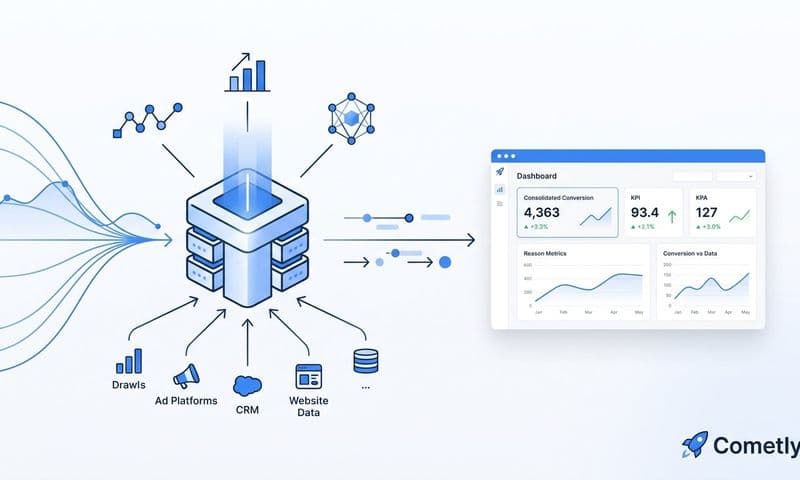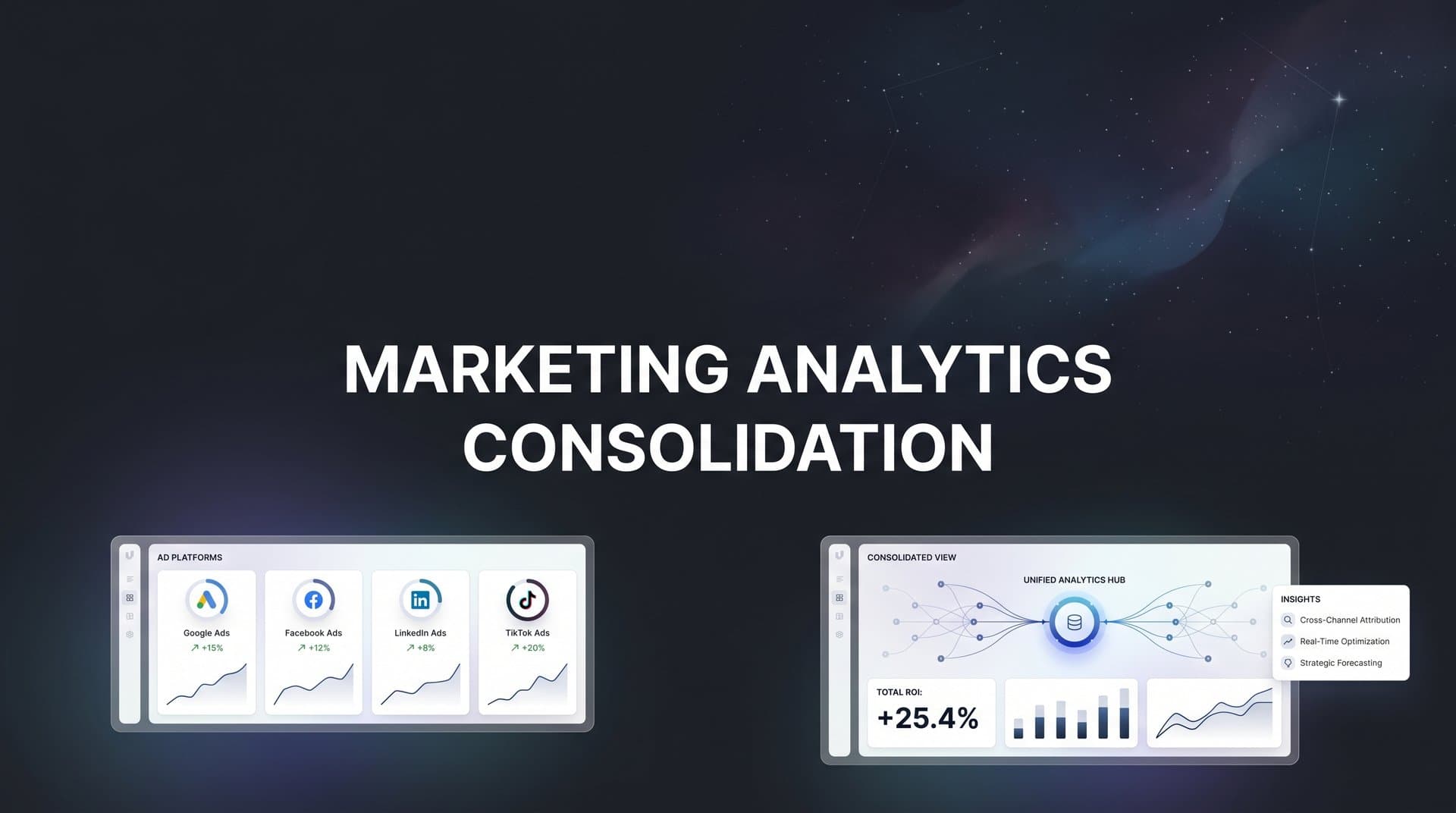
If you are running paid campaigns across Meta, Google, TikTok, LinkedIn, and other platforms, you already know the pain of jumping between dashboards. Each ad platform tells a slightly different story about performance. Your CRM has its own version of the truth. And your spreadsheets are held together with formulas that break every Monday morning.
Marketing analytics consolidation is the process of bringing all of that scattered data into a single, reliable source so you can see the full customer journey, compare channels accurately, and make confident budget decisions. Without it, teams waste hours pulling reports, misattribute revenue, and end up scaling the wrong campaigns.
Here is the core problem with fragmented data: every ad platform is incentivized to claim credit for conversions. Meta says it drove the sale. Google says it drove the sale. And when you add them up, your total attributed revenue is somehow three times your actual revenue. That is not a reporting quirk. That is a structural problem that leads to genuinely bad budget decisions.
Privacy changes have made this worse. Apple's App Tracking Transparency and the ongoing deprecation of third-party cookies have reduced the reliability of browser-based pixel tracking, meaning even the data you do collect is increasingly incomplete. The gaps in your reporting are getting wider, not narrower.
This guide walks you through the exact steps to consolidate your marketing analytics, from auditing your current data sources to building a unified reporting framework that actually drives better decisions. Whether you manage campaigns for your own brand or for clients at an agency, these steps will help you move from fragmented dashboards to a clear, consolidated view of what is really driving revenue.
Step 1: Audit Every Data Source and Tracking Touchpoint
Before you can consolidate anything, you need a complete picture of what you are working with. Most marketing teams are surprised by how many data sources they have accumulated over time. Ad platforms, website analytics tools, CRM systems, email marketing platforms, call tracking software, landing page builders with their own analytics. Each one is collecting data, defining metrics differently, and presenting a partial view of performance.
Start by creating a full inventory. List every platform and tool your team uses to measure marketing performance. For each one, document what it measures, how it tracks conversions, and what its known limitations are. This is not glamorous work, but it is the foundation everything else is built on.
Pay close attention to how each platform defines conversions. Meta might count a view-through conversion if someone saw your ad and purchased within seven days, even if they never clicked. Google might only count click-through conversions. Your CRM might count a lead when a form is submitted. These definitions are not wrong in isolation, but when you stack them on top of each other without reconciling them, you get a wildly inflated picture of total performance. Teams dealing with this challenge often struggle with unreliable marketing analytics data that undermines their decision-making.
Look for three specific issues during your audit:
Double-counting: Identify touchpoints where two platforms are claiming credit for the same conversion. This is extremely common when running campaigns across Meta and Google simultaneously.
Tracking gaps: Find places in the customer journey where data simply disappears. Common gaps include offline conversions, phone call leads, CRM pipeline stages, and post-click events that happen after someone leaves your landing page.
Conflicting definitions: Document every instance where the same term means something different across platforms. "Conversion," "lead," "click," and even "impression" can have different definitions depending on where you look.
The output of this step is a single spreadsheet or document that lists every data source your team uses, what it measures, how it tracks, and its known limitations. It does not need to be pretty. It needs to be honest. This document becomes your reference point for every decision you make in the steps that follow.
When you complete this audit, you will likely find more fragmentation than you expected. That is normal. The goal here is not to fix anything yet. The goal is to see the full scope of the problem clearly before you start solving it.
Step 2: Define Your Single Source of Truth and Core KPIs
Once you know what you are working with, the next step is deciding where the truth lives. A single source of truth is the one system your team agrees to trust when there is a discrepancy between platforms. Without it, every performance conversation turns into a debate about which dashboard is right rather than a conversation about what to do next.
Choose one central platform or system that will serve as your consolidated analytics hub. This does not mean you stop using your ad platforms or your CRM. It means you designate one place where all that data comes together and where final performance judgments are made. Understanding what marketing analytics truly involves can help you make this decision with greater clarity.
This is where purpose-built attribution platforms like Cometly become genuinely valuable. Rather than trying to manually reconcile five different dashboards, Cometly connects your ad platforms, CRM, and website data into one unified view with consistent definitions. It is designed specifically for this use case, which means you are not forcing a general analytics tool to do a job it was not built for.
Alongside choosing your central platform, align your team on a shared set of core KPIs. At minimum, agree on how you will measure and define these four metrics across every channel:
Revenue: What counts as revenue, when it is recorded, and which source gets credit for it.
Cost Per Acquisition (CPA): How you calculate the total cost to acquire a customer, including all channel spend, not just the last-click channel.
Return on Ad Spend (ROAS): How you calculate return, using a consistent revenue definition rather than each platform's self-reported conversion value.
Customer Lifetime Value (LTV): How you factor long-term customer value into channel performance assessments, especially important if you run subscription or repeat-purchase businesses.
Standardizing these definitions sounds straightforward, but it requires real alignment across your team. A media buyer and a CFO often have different ideas about what counts as a conversion. Getting everyone to agree before you build your consolidated system prevents the definitions from drifting apart again once reporting is automated.
Document your agreed-upon definitions in writing and store them somewhere your whole team can access. This living document becomes the rulebook your consolidation framework is built on. When a new channel is added or a new campaign type is launched, you return to this document to decide how it fits into your existing definitions rather than creating new ones that fragment your data again.
Step 3: Connect Your Ad Platforms, CRM, and Website Tracking
With your definitions aligned and your central platform chosen, it is time to actually connect the data. This is the technical core of marketing analytics consolidation, and it is where most teams either get it right or create new problems by cutting corners.
Start with your paid ad channels. Every platform you spend money on, including Meta, Google, TikTok, LinkedIn, Pinterest, and any others, should feed spend and performance data automatically into your central analytics platform. Manual exports and copy-paste reporting are not a consolidation strategy. They are a temporary fix that breaks the moment someone forgets to run the export.
Next, connect your CRM. This is the step that separates surface-level reporting from real revenue attribution. When your CRM is connected, downstream events like qualified leads, opportunities, and closed deals can be tied back to the original ad click that started the customer journey. Without this connection, you are measuring clicks and form fills, not actual business outcomes.
If your CRM is HubSpot, Salesforce, Pipedrive, or a similar platform, look for native integrations with your central analytics tool. Cometly, for example, is built to connect CRM data directly to ad performance so you can see which campaigns are generating revenue, not just leads. Choosing the right unified marketing analytics platform makes this integration process significantly smoother.
The third and most critical technical step is implementing server-side tracking. Here is the problem with relying only on browser-based pixels: ad blockers block them, iOS privacy restrictions limit them, and third-party cookie deprecation is making them increasingly unreliable. Many conversions that happen in your business are simply not being captured by pixel-based tracking alone.
Server-side tracking solves this by sending conversion data from your server directly to ad platforms and your analytics system, bypassing the browser entirely. This means conversions that would have been missed by a pixel are now captured and attributed correctly. The result is a more complete, more accurate picture of what is actually driving results.
Cometly's server-side tracking is designed specifically for this purpose, filling the gaps that browser-based pixels leave behind and ensuring your consolidated data reflects reality rather than a privacy-filtered approximation of it.
When all three layers are connected, your ad spend, your CRM pipeline, and your website tracking, you have the infrastructure for genuine marketing analytics consolidation. Every touchpoint in the customer journey now has a path back to your central system.
Step 4: Map the Full Customer Journey With Multi-Touch Attribution
Here is where consolidation starts to pay off in ways that actually change how you allocate budget. With all your data flowing into one place, you can finally see the full customer journey instead of isolated snapshots from each platform.
Most ad platforms default to last-click attribution, which gives all the credit for a conversion to the final touchpoint before purchase. This model is simple, but it consistently undervalues the channels that introduce customers to your brand and nurture them through the consideration phase. If you are using last-click attribution across all your channels, you are almost certainly underfunding top-of-funnel campaigns and overfunding retargeting. Exploring visual marketing funnel analytics can help you see exactly where these imbalances occur.
Multi-touch attribution distributes credit across every touchpoint that influenced a conversion. The specific model you choose will depend on your business and your sales cycle:
Linear attribution: Distributes credit equally across all touchpoints. Good for getting a baseline view of which channels are involved in conversions without favoring any particular stage.
Time-decay attribution: Gives more credit to touchpoints that happened closer to the conversion. Useful for shorter sales cycles where recent interactions are genuinely more influential.
Position-based attribution: Gives the most credit to the first and last touchpoints, with the remaining credit distributed across the middle. Works well for businesses where brand discovery and final decision moments are both strategically important.
Data-driven attribution: Uses your actual conversion data to assign credit based on which touchpoints statistically correlate with conversions. This is the most accurate model but requires sufficient conversion volume to produce reliable results. The growing role of machine learning in marketing analytics is making data-driven models more accessible to teams of all sizes.
Once your attribution model is in place, use your consolidated data to visualize common conversion paths. You will start to see patterns: which channels consistently appear at the top of the funnel, which ones drive consideration in the middle, and which ones close. This view is impossible to get when your data is fragmented across separate platforms.
The success indicator for this step is straightforward. You should be able to trace a specific customer from their first ad impression, through every interaction with your brand, to their final purchase or signup, all within a single view. When you can do that, you have real attribution. Everything before that is an educated guess.
Step 5: Build Unified Dashboards and Automate Reporting
With your data consolidated and your attribution model in place, the next step is making that data accessible and actionable for everyone on your team. Unified dashboards are how consolidation translates from a technical achievement into a daily operational advantage.
The core principle of a unified dashboard is that it shows cross-channel performance side by side using consistent metrics. You should be able to compare Google Ads ROAS to Meta ROAS to TikTok ROAS on equal footing, using the same conversion definitions and the same attribution model for all three. If your dashboards are pulling from each platform's native reporting, you are not comparing apples to apples. You are comparing three different fruits and calling it analysis. Reviewing the leading marketing analytics dashboard companies can help you find the right solution for your team's needs.
Design your dashboards with your audience in mind. Different stakeholders need different views of the same data:
Executive dashboards: High-level revenue, total ROAS, cost per acquisition, and trend lines. Executives need to see whether marketing is growing the business, not granular campaign details.
Media buyer dashboards: Campaign-level and ad-level performance, broken down by channel, audience, and creative. These users need enough detail to make daily optimization decisions.
Agency client dashboards: Clean, branded summaries that show campaign performance against agreed-upon KPIs. Clients need clarity and confidence, not raw data dumps.
Automate report generation wherever possible. Many marketing teams spend a significant portion of their week pulling data from multiple platforms and assembling it into reports. That time is not being spent on strategy or optimization. Automated reporting eliminates the manual work and ensures your team is always working from current data rather than last week's export. The benefits of real-time marketing analytics extend well beyond convenience, enabling faster and more confident decision-making.
Start with three to five key dashboard views rather than trying to build everything at once. Identify the decisions each report needs to support, build the minimum view that supports those decisions, and expand from there as your team identifies what else they need.
Step 6: Use Consolidated Data to Optimize Spend and Scale Campaigns
This is the step where all the infrastructure work you have done translates into real business impact. With all your data in one place and a consistent attribution model applied across channels, you can finally answer the question that matters most: which campaigns are actually driving revenue?
The answer is often different from what native platform dashboards suggest. When you look at Meta's reporting in isolation, certain campaigns will appear to perform well because Meta is attributing conversions generously using its own model. When you look at the same campaigns through your consolidated attribution system, some of those high performers turn out to be capturing credit for conversions that were already going to happen. Meanwhile, some campaigns that look mediocre in native reporting are actually contributing significantly to conversions that close through other channels.
Use your consolidated data to make budget reallocation decisions based on unified attribution rather than siloed platform metrics. Move spend away from campaigns that only look good in their native dashboards and toward campaigns that show genuine contribution to revenue in your consolidated view. Understanding the impact of marketing analytics on business success reinforces why this shift from siloed to consolidated decision-making matters so much.
The next layer of optimization involves feeding enriched conversion data back to your ad platforms. This practice, often implemented through Conversion APIs or server-side event tracking, sends accurate, complete conversion signals back to Meta, Google, and other platforms so their bidding algorithms can optimize on better data. When the algorithm knows which clicks actually converted into paying customers rather than just form fills, it improves targeting and often reduces cost per acquisition over time.
Cometly's Conversion Sync feature is built specifically for this, sending enriched conversion events back to ad platforms so their algorithms receive the high-quality signals they need to improve performance. This closes the loop between your consolidated analytics and your ad platform optimization, turning better data into better results automatically.
Finally, leverage AI-powered recommendations to surface optimization opportunities you might miss when reviewing data manually. When you are managing campaigns across multiple channels with thousands of data points, AI can identify patterns and opportunities that a manual review would overlook. Cometly's AI Ads Manager and AI Chat features are designed to do exactly this, giving you actionable recommendations based on your actual consolidated data rather than generic best practices. To learn more about this approach, explore how teams are leveraging AI marketing analytics to drive results.
Step 7: Maintain Data Quality and Iterate on Your Consolidation Framework
Marketing analytics consolidation is not a project you complete and move on from. It is an ongoing practice. The teams that get the most value from consolidated data are the ones that treat maintenance as a core responsibility rather than an afterthought.
Schedule monthly data audits to verify that your integrations are working correctly. Ad platforms update their APIs. CRM configurations change. New campaigns are launched that do not automatically inherit your tracking setup. Without regular audits, these small breaks accumulate into significant data gaps that you might not notice until they have been affecting your reporting for weeks.
During each audit, check the following:
Integration health: Are all your ad platform connections pulling data correctly? Are there any sync errors or gaps in the data timeline?
Tracking coverage: Are new campaigns and new channels being captured by your consolidated system? Are conversion events firing correctly across your website and landing pages?
Definition drift: Have any of your core KPI definitions changed informally without being updated in your documentation? This happens more often than teams expect, especially when new team members start making their own interpretations.
Update your attribution models and KPI definitions as your marketing mix evolves. If you add a new channel, decide how it fits into your attribution framework before you launch your first campaign on it. Staying informed about the future of marketing analytics can help you anticipate changes and adapt your framework proactively. If your sales cycle changes, revisit whether your current attribution model still reflects how customers actually make decisions.
Document everything. Your consolidation setup should be documented clearly enough that a new team member or agency partner can understand and maintain it without needing to reverse-engineer it from scratch. This documentation is not just a nice-to-have. It is what prevents your consolidated system from fragmenting again the moment someone changes a setting without understanding the downstream impact.
The most common pitfall at this stage is treating consolidation as a one-time project. Teams invest significant effort in getting everything set up, then neglect maintenance as priorities shift. Over time, integrations break, definitions drift, and the fragmentation that consolidation was meant to solve quietly returns. Treating data quality as an ongoing practice is what separates teams that sustain a reliable analytics foundation from those that end up starting over every eighteen months.
Your Consolidated Analytics Checklist
Bringing your marketing analytics into a single, consolidated view is not just a nice-to-have. It is the foundation for making confident, data-driven decisions about where to spend your budget and how to scale. Here is your quick-reference checklist to keep you on track:
1. Audit all data sources and tracking touchpoints, documenting what each measures and where definitions conflict.
2. Define your single source of truth and standardize core KPIs so that revenue, CPA, ROAS, and LTV mean the same thing across every channel.
3. Connect ad platforms, CRM, and website tracking with server-side data capture to fill the gaps that browser-based pixels miss.
4. Map the full customer journey using multi-touch attribution so you can see every touchpoint that contributed to a conversion, not just the last click.
5. Build unified dashboards and automate reporting so your team spends time on strategy instead of manual data assembly.
6. Use consolidated data to optimize spend and scale winning campaigns, feeding enriched conversion data back to ad platform algorithms for better targeting.
7. Maintain data quality with regular audits, updated documentation, and ongoing iteration as your marketing mix evolves.
Platforms like Cometly are designed to handle this entire workflow, connecting your ad channels, CRM, and website into one unified analytics hub with AI-powered insights and conversion syncing that feeds better data back to your ad platforms. The sooner you consolidate, the sooner you stop guessing and start scaling with clarity.
Ready to elevate your marketing game with precision and confidence? Discover how Cometly's AI-driven recommendations can transform your ad strategy. Get your free demo today and start capturing every touchpoint to maximize your conversions.