You're running campaigns across Meta, Google, TikTok, and three other platforms. Your CRM is full of leads. Your analytics dashboard shows thousands of clicks. But when your CEO asks which campaigns actually drove revenue last quarter, you're piecing together spreadsheets and making educated guesses.
This is the reality for most marketers in 2026. We're drowning in data but starving for answers.
Marketing analytics bridges this gap. It transforms scattered numbers into clear insights that tell you exactly what's working, what's wasting budget, and where to invest next. This isn't about creating prettier reports—it's about connecting every dollar spent to actual business outcomes so you can scale with confidence instead of crossing your fingers.
This guide breaks down what marketing analytics really means today, how it works across your entire marketing ecosystem, and how to use it to make decisions that directly impact your bottom line. Whether you're managing a six-figure ad budget or building your first multi-channel strategy, you'll walk away understanding how to turn data chaos into revenue clarity.
The Foundation: Understanding Marketing Analytics in 2026
Marketing analytics is the practice of measuring, managing, and analyzing marketing performance data to maximize effectiveness and optimize ROI. It's the systematic approach to understanding which marketing activities drive results and why they work.
Here's what makes it different from basic reporting: marketing metrics tell you what happened, but marketing analytics tells you why it happened and what to do next.
Think of it this way. A metric tells you that your Facebook ads generated 500 leads last month. Marketing analytics tells you that those leads came primarily from retargeting campaigns targeting cart abandoners, that they converted at 12% compared to 4% from cold traffic, and that increasing budget to similar audiences could drive 40% more qualified leads without raising cost per acquisition.
The discipline has evolved dramatically over the past few years. We've moved through three distinct phases:
Descriptive Analytics: This is where most marketers started—basic reporting that shows what happened. Your ad platform dashboards showing impressions, clicks, and conversions fall into this category.
Diagnostic Analytics: This digs deeper to explain why something happened. It connects multiple data points to reveal patterns and relationships. This is where you start understanding that your best customers come from organic search, not paid ads, even though paid ads get more credit.
Predictive and Prescriptive Analytics: This is where AI enters the picture in 2026. Predictive analytics forecasts what will likely happen based on historical patterns. Prescriptive analytics goes further—it recommends specific actions to achieve your goals. Modern platforms can now tell you which campaigns to scale, which audiences to test, and where to shift budget before you manually analyze the data.
The shift to AI-powered analytics matters because marketing complexity has exploded. You're not just running Google Ads anymore—you're orchestrating campaigns across eight platforms, each with its own tracking pixel, conversion event, and reporting dashboard. Manual analysis can't keep pace.
This is why modern marketing analytics platforms focus on unification and automation. They connect all your data sources, apply intelligent analysis, and surface insights that would take hours to discover manually. The goal isn't to replace your strategic thinking—it's to give you the complete picture so you can make smarter decisions faster.
The Core Components Every Marketer Needs to Track
Effective marketing analytics rests on three foundational pillars. Each one answers a critical business question, and together they form the complete picture of your marketing performance.
Customer Acquisition Data: Where Your Growth Actually Comes From
This tracks how prospects enter your ecosystem and what it costs to convert them. You need visibility into which channels generate leads, how those leads behave, and what you're paying for each customer.
The key metrics here include cost per acquisition (CPA), lead source breakdown, and conversion paths. But here's where most marketers stop too early: they track the first click or the last click, missing everything in between.
Real customer acquisition analysis shows you that someone might discover you through a LinkedIn post, research you via organic search, click a retargeting ad, and finally convert after reading an email. Each touchpoint plays a role, and understanding that sequence helps you invest in the right places.
You also need to track acquisition quality, not just quantity. A channel that delivers 100 leads at $50 each sounds better than one delivering 40 leads at $75 each—until you realize the first channel's leads convert at 2% while the second converts at 15%. Suddenly, the "expensive" channel is your most profitable source.
Channel Performance: The Truth About What's Working
This component compares effectiveness across all your marketing channels: paid advertising, organic search, email campaigns, social media, content marketing, and everything else in your mix.
The challenge is that each channel measures success differently. Facebook counts a conversion if someone clicks your ad and converts within 7 days. Google Ads uses a 30-day window. Your email platform tracks opens and clicks but doesn't always connect to revenue. Without unified analytics, you're comparing apples to oranges to pineapples.
Strong channel performance tracking normalizes these differences. It applies consistent measurement across platforms so you can genuinely compare how $1,000 spent on Meta performs against $1,000 on Google or TikTok. A multi-channel marketing analytics dashboard brings all this data together in one view.
This is also where you discover surprising truths. Many marketers find that their highest-volume channel isn't their most profitable one. Or that channels they considered "supporting" actually drive more revenue than their primary focus. You can't optimize what you can't accurately measure.
Revenue Attribution: Connecting Marketing to Money
This is the holy grail—directly linking marketing activities to revenue and customer lifetime value. It answers the question every CEO asks: "What return are we getting on our marketing investment?"
Revenue attribution goes beyond tracking leads or conversions. It follows customers through your entire funnel, from first touchpoint through closed sale and beyond. This means connecting your marketing platforms to your CRM, payment processor, or whatever system records actual revenue.
The power here is seeing which marketing activities generate customers who stick around and spend more. You might discover that customers acquired through organic search have 3x higher lifetime value than those from paid ads, even though paid ads generate more initial conversions. That insight completely changes your budget allocation strategy.
Attribution also reveals the true cost of customer acquisition. If you're only tracking lead cost, you might think you're profitable. But when you factor in how many leads actually become paying customers and how much they spend, you get the real picture of what each customer costs to acquire and whether your marketing is actually profitable.
How Marketing Analytics Transforms Campaign Performance
The difference between marketing with analytics and marketing without it is like the difference between flying with instruments versus flying blind. Both might get you somewhere, but only one gives you confidence about where you're going and how to adjust course.
From Gut Feelings to Data-Backed Decisions
Most marketers start with intuition. You think a certain ad creative will work better, or that a particular audience segment is your ideal customer. Sometimes you're right. Often you're not.
Marketing analytics replaces guesswork with evidence. Instead of debating whether your new video ad outperforms your static image ad, you test both and let the data decide. Instead of assuming your target audience is 25-34 year olds, you discover that 35-44 year olds convert at twice the rate and have 50% higher average order value.
This shift matters most when scaling. A gut feeling might work when you're spending $5,000 per month. But when you're investing $50,000 or $500,000, you need certainty. Analytics shows you exactly which campaigns, ads, audiences, and channels drive profitable growth so you can confidently pour fuel on the fire.
The transformation happens when you stop asking "What do we think will work?" and start asking "What does the data show is working?" That mindset shift eliminates wasted spend and accelerates growth. Understanding how data analytics can improve marketing strategy is essential for making this transition.
Real-Time Optimization: Adjusting While Campaigns Run
Traditional marketing worked in monthly cycles. You'd launch campaigns, wait four weeks, analyze results, then adjust. By the time you made changes, you'd already spent the budget.
Modern marketing analytics enables real-time optimization. You can monitor campaign performance daily or even hourly, identifying what's working and what's not while you still have time and budget to adjust.
This looks like checking your dashboard on a Wednesday afternoon and noticing that one ad set is generating conversions at half your target cost. You immediately shift more budget to that winner. Or you see that a campaign that performed well last week is suddenly underperforming, so you pause it before wasting more spend.
Real-time visibility also helps you catch problems fast. If your tracking breaks, your conversion rate suddenly drops, or a technical issue affects your landing page, you know within hours instead of weeks. The faster you spot issues, the less money you lose. The benefits of real-time marketing analytics extend far beyond simple monitoring.
AI-powered platforms take this further by automatically flagging anomalies and suggesting optimizations. Instead of manually checking every campaign daily, you get alerts when something needs attention and recommendations for what to do about it.
Cross-Platform Visibility: Understanding the Complete Journey
Your customers don't live on a single platform. They see your Instagram ad, Google your brand, read your blog post, get your email, and click a Facebook retargeting ad before buying. Each platform wants to take credit for the conversion, but the reality is more complex.
Cross-platform analytics connects these dots. It tracks individual customer journeys across all touchpoints, showing you how different channels work together to drive conversions.
This reveals patterns you'd never see looking at platforms in isolation. You might discover that people who engage with your organic content before clicking a paid ad convert at 4x the rate of cold traffic. Or that email subscribers who also follow you on social media have twice the lifetime value of email-only subscribers.
These insights change how you allocate budget. Instead of treating each channel as independent, you invest in the combinations that work best together. You stop cutting budgets for channels that look weak in isolation but actually play crucial supporting roles in your customer journey.
Attribution Models: The Key to Accurate Marketing Analytics
Attribution is the logic that determines which marketing touchpoints get credit for conversions. It's arguably the most important—and most misunderstood—aspect of marketing analytics.
Understanding Different Attribution Models
Every attribution model distributes credit differently, and the model you choose dramatically affects what your data tells you.
First-Touch Attribution: Gives 100% credit to the first interaction. If someone discovers you through an organic blog post, then later clicks three ads before converting, the blog post gets all the credit. This model favors top-of-funnel activities and helps you understand what's driving awareness.
Last-Touch Attribution: Gives 100% credit to the final touchpoint before conversion. In the same scenario, the last ad clicked gets all the credit. Most ad platforms use this model by default, which is why they all claim credit for the same conversions. This model favors bottom-of-funnel activities and conversion-driving channels.
Multi-Touch Attribution: Distributes credit across multiple touchpoints in the customer journey. Different multi-touch models weight touchpoints differently—linear gives equal credit to all, time-decay gives more credit to recent interactions, and position-based emphasizes first and last touches while giving some credit to middle interactions.
Which model is right? It depends on your business and what you're trying to optimize. If you're focused on awareness and early-stage pipeline, first-touch helps you invest in channels that introduce new prospects. If you're optimizing for conversions, last-touch shows what closes deals. If you want the complete picture, multi-touch reveals how channels work together throughout the journey.
Many sophisticated marketers use different models for different purposes. They might use first-touch to evaluate content performance, last-touch to optimize conversion campaigns, and multi-touch for overall budget allocation. The key is understanding what each model shows you and what it hides. For a deeper dive, explore the differences between marketing attribution software and traditional analytics.
The Privacy Challenge: Tracking in 2026
Attribution has become significantly more challenging in recent years. iOS privacy changes limit ad platform tracking. Third-party cookies are being phased out. Regulations like GDPR and CCPA restrict data collection. The tracking methods that worked perfectly in 2020 are increasingly unreliable.
This creates a gap between what actually happened and what your analytics platforms can see. Someone might click your Facebook ad on their iPhone, research you on their laptop, and convert on their iPad. Traditional cookie-based tracking sees these as three different people, fragmenting the customer journey and undercounting conversions.
Many marketers now operate with incomplete data, making decisions based on a partial picture. This leads to undervaluing channels that can't track effectively and overinvesting in channels that still have strong tracking capabilities—not because they perform better, but because their performance is more visible. These common attribution challenges in marketing analytics require new approaches to solve.
Server-Side Tracking as the Solution
Server-side tracking has emerged as the solution to privacy-related tracking limitations. Instead of relying on browser cookies and pixels that users can block, server-side tracking captures conversion data on your server and sends it directly to ad platforms.
This approach is more reliable because it doesn't depend on browser-based tracking. When someone converts on your website, your server records the conversion and shares that data with your ad platforms through their APIs. This maintains data accuracy even when browser tracking is limited.
Server-side tracking also improves data quality. You can send enriched conversion data—including customer lifetime value, subscription tier, or other business-specific metrics—that helps ad platforms optimize more effectively. This feeds better information to platform algorithms, improving targeting and conversion optimization.
For marketers serious about accurate attribution in 2026, server-side tracking isn't optional—it's essential for maintaining visibility into campaign performance and ensuring your analytics reflect reality.
Building Your Marketing Analytics Stack
The right analytics infrastructure makes the difference between having data and having insights. Your marketing analytics stack should connect all your data sources, analyze performance across channels, and surface actionable recommendations.
Essential Capabilities for Modern Marketing Analytics
Your analytics platform needs three core capabilities to deliver real value.
Ad Platform Integration: Direct connections to every advertising platform you use—Meta, Google, TikTok, LinkedIn, and others. This eliminates manual data exports and ensures you're working with real-time performance data. The integration should pull in spend, impressions, clicks, and conversion data automatically.
CRM Connection: Your analytics platform must connect to your CRM or customer database to track what happens after the lead comes in. This is how you move from tracking clicks to tracking revenue. Without this connection, you're optimizing for lead volume without knowing if those leads actually become customers.
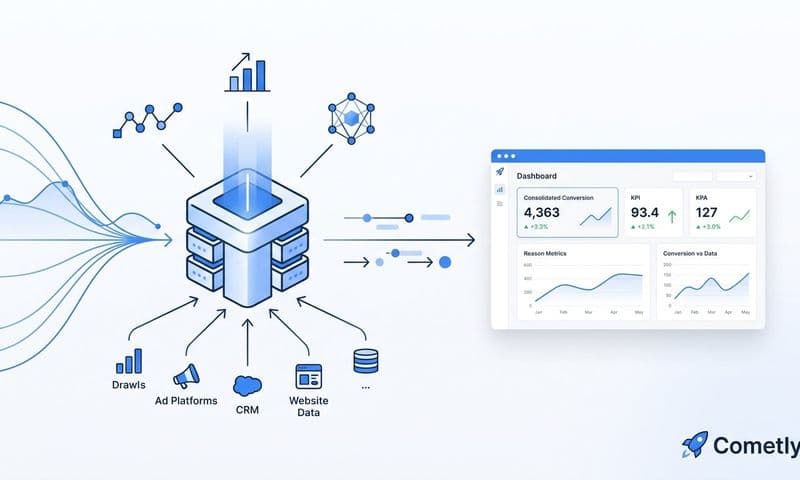
Unified Dashboard Reporting: All your data should flow into a single dashboard where you can compare performance across channels, analyze customer journeys, and track progress toward goals. Jumping between five different platforms to piece together your marketing story wastes time and introduces errors.
The goal is eliminating data silos. When all your marketing data lives in one place, you can answer complex questions like "Which channel drives the highest lifetime value customers?" or "What's my true return on ad spend when I factor in all touchpoints?" without building complicated spreadsheets. Choosing the right marketing analytics platform is critical to achieving this unified view.
The Role of AI in Modern Marketing Analytics
AI has transformed marketing analytics from a reporting tool into a strategic advisor. Modern platforms use machine learning to identify patterns, predict outcomes, and recommend actions.
AI-powered analytics can automatically flag anomalies—like a sudden drop in conversion rate or an unexpected spike in cost per acquisition. Instead of discovering problems weeks later during your monthly review, you get alerts the moment something changes.
Predictive capabilities help you forecast performance. The platform can estimate how much revenue you'll generate next month based on current trends, or predict which campaigns are likely to hit their goals and which need adjustment.
Prescriptive recommendations take it further. Instead of just showing you data, AI suggests specific actions: "Increase budget 30% on Campaign A," "Test this new audience segment," or "Pause this underperforming ad set." These recommendations are based on analyzing thousands of data points and identifying optimization opportunities you might miss manually.
The value isn't replacing human judgment—it's augmenting it. AI handles the heavy lifting of data analysis and pattern recognition, freeing you to focus on strategy and creative decisions. You make better decisions faster because you're working with processed insights instead of raw data. The impact of data science on marketing analytics continues to reshape how teams operate.
Feeding Better Data Back to Ad Platforms
Here's a capability most marketers overlook: modern analytics platforms don't just pull data from ad platforms—they push enriched data back to them.
Ad platform algorithms optimize based on the conversion data you provide. If you only tell Facebook that someone converted, it optimizes for any conversion. But if you tell Facebook that someone converted and spent $500, or that they're a high-value customer likely to make repeat purchases, the algorithm can optimize for valuable conversions instead of just any conversion.
This is called conversion sync or enhanced conversion tracking. Your analytics platform enriches conversion data with additional context—purchase value, customer segment, lifetime value predictions—and sends that back to ad platforms through their APIs.
The result is smarter ad platform optimization. Google and Meta's algorithms get better training data, so they can find more customers like your best customers instead of just more customers like your average customers. This improves targeting efficiency and increases return on ad spend without changing your creative or strategy.
Putting Marketing Analytics Into Action
Understanding marketing analytics conceptually is one thing. Actually using it to drive better results requires a systematic approach. Here's how to implement analytics that actually improves performance.
Start With Clear Goals
Before diving into data, define what success looks like. Are you optimizing for lead volume, revenue, customer acquisition cost, return on ad spend, or something else? Your goals determine which metrics matter and how you interpret your data.
Vague goals like "improve marketing performance" don't work. Specific goals like "reduce customer acquisition cost by 20% while maintaining lead quality" or "increase revenue from paid ads by 30% in Q2" give you clear targets to measure against. Understanding the two primary goals of marketing analytics can help you frame your objectives.
Your goals should also align with business objectives, not just marketing metrics. If your company's priority is expanding into a new market segment, your analytics should track penetration in that segment, not just overall lead volume. If profitability is the focus, optimize for customer lifetime value and contribution margin, not just revenue.
Clear goals also help you choose the right attribution model and decide which channels deserve investment. Everything flows from knowing what you're trying to achieve.
Focus on Revenue-Driving Metrics
Not all metrics are created equal. Many marketers get distracted by vanity metrics—numbers that look impressive but don't connect to business outcomes.
Impressions, reach, and website traffic are vanity metrics. They measure activity, not results. A campaign that generates 10 million impressions but zero sales is a failure, regardless of how impressive the impression count looks.
Revenue-driving metrics connect directly to business outcomes. These include customer acquisition cost, return on ad spend, conversion rate, average order value, and customer lifetime value. These metrics tell you whether your marketing is actually profitable and sustainable.
The shift from vanity to value metrics changes how you evaluate performance. Instead of celebrating a campaign that drove 50,000 clicks, you evaluate whether those clicks converted and whether the conversions were profitable. Instead of optimizing for maximum reach, you optimize for reaching the right people who actually buy.
This doesn't mean ignoring top-of-funnel metrics entirely. Awareness and engagement matter, but they should be viewed as leading indicators that eventually connect to revenue. Track them, but don't let them distract from the metrics that actually determine whether your marketing succeeds.
Create a Regular Analysis Rhythm
Marketing analytics works best as an ongoing practice, not a one-time project. Establish regular review cadences that match your business pace.
Weekly performance reviews keep you on top of campaign execution. Check which campaigns are hitting targets, which need adjustment, and whether you're on track for monthly goals. These reviews should be tactical—focused on immediate optimizations and budget shifts.
Monthly strategic assessments provide the bigger picture. Look at trends over time, evaluate channel performance, analyze customer acquisition costs, and assess whether your overall marketing strategy is working. These reviews should inform budget allocation for the coming month and identify opportunities for testing. Effective marketing analytics and reporting practices make these reviews more actionable.
Quarterly deep dives examine long-term trends and strategic shifts. This is when you evaluate attribution models, assess customer lifetime value trends, and make major decisions about channel mix or strategy pivots. These reviews connect marketing performance to business outcomes and inform annual planning.
The key is consistency. Regular analysis becomes routine, insights compound over time, and you develop a deep understanding of what drives results in your specific business. Marketing analytics isn't a destination—it's a continuous practice of learning, optimizing, and improving.
The Path Forward: Making Marketing Analytics Work for You
Marketing analytics isn't optional anymore. In 2026, it's the foundation of every successful marketing strategy. The marketers who win are the ones who can see the complete picture, understand what's actually driving revenue, and make confident decisions based on data instead of hope.
The goal isn't to drown in more data—it's to connect every touchpoint to revenue so you know exactly what's working and where to invest next. When you can see which ads drive conversions, which channels generate your best customers, and how your entire marketing ecosystem works together, you stop guessing and start scaling with confidence.
This requires the right infrastructure. You need unified tracking across all platforms, accurate attribution that survives privacy limitations, and AI-powered insights that surface opportunities you'd never find manually. You need a system that doesn't just show you what happened, but tells you why it happened and what to do next.
Most importantly, you need to feed better data back to your ad platforms. When Google and Meta's algorithms understand which conversions are actually valuable, they optimize for the customers you want instead of just any customer. This is how you improve targeting, increase conversion rates, and maximize return on ad spend without increasing budget.
The transformation happens when you stop treating analytics as a reporting exercise and start using it as a strategic advantage. Every campaign becomes a learning opportunity. Every dollar spent generates insights. Every optimization compounds into better performance over time.
Ready to elevate your marketing game with precision and confidence? Discover how Cometly's AI-driven recommendations can transform your ad strategy—Get your free demo today and start capturing every touchpoint to maximize your conversions.