

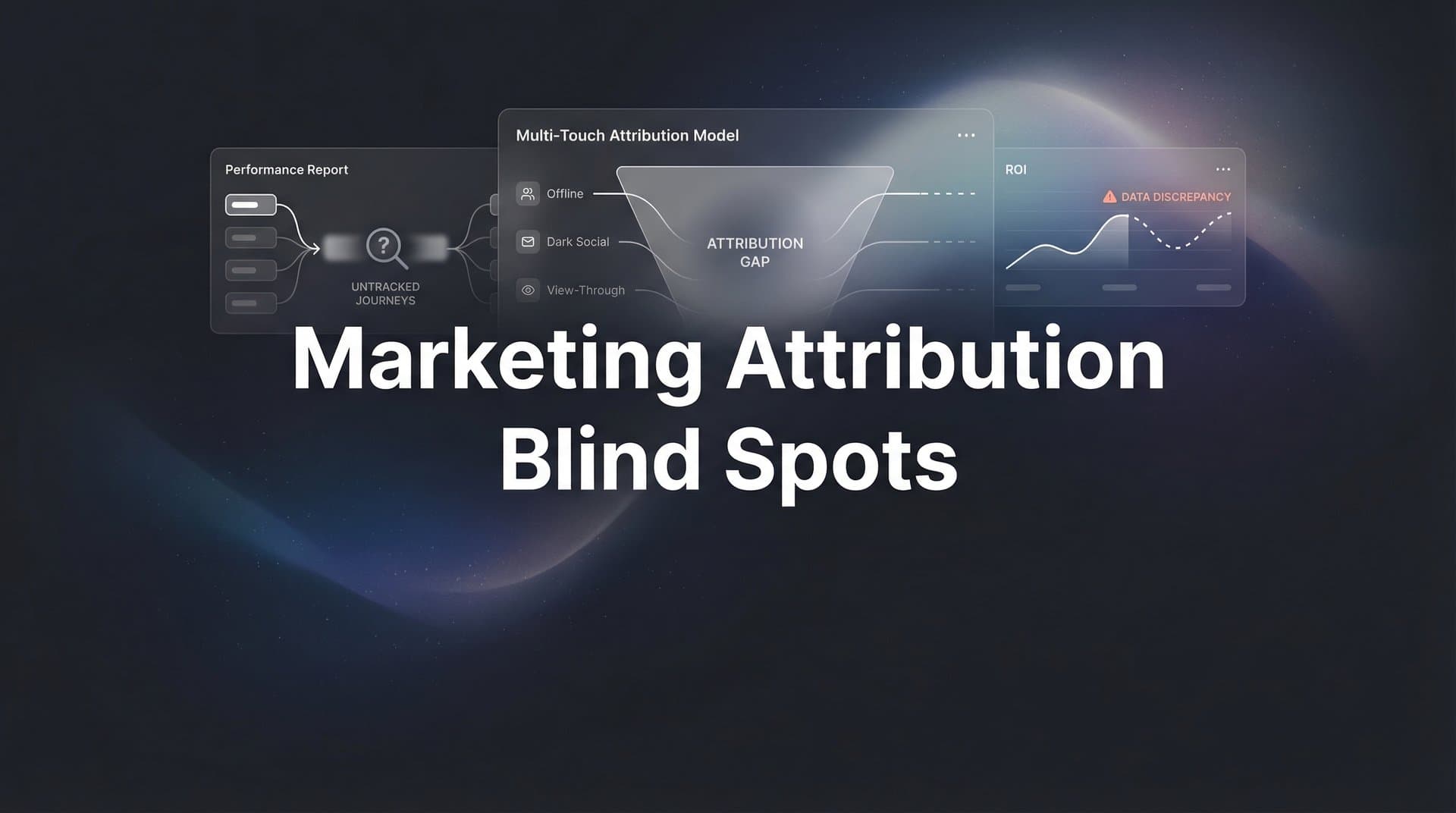
You're looking at your ad dashboard, and everything looks great. Facebook says your campaign drove 150 conversions. Google Ads claims 120. Your retargeting platform reports another 80. You add them up, check your bank account, and something doesn't match. Your actual revenue is nowhere near what these numbers suggest.
This is the frustrating reality of marketing attribution blind spots. These are the hidden gaps in your tracking where customer journey data gets lost, misattributed, or simply never captured in the first place. While your ad platforms confidently report their success, the real story of what's driving revenue is scattered across disconnected systems, blocked by privacy settings, and lost in the complexity of modern customer journeys.
The cost isn't just confusion. Attribution blind spots cause you to pour budget into channels that look like winners but aren't actually closing deals. Meanwhile, the touchpoints that truly influence conversions get ignored and underfunded. For marketers managing serious ad spend, these gaps can mean the difference between scaling profitably and burning cash on phantom results.
This guide will help you identify where your attribution blind spots are hiding, understand why they exist, and build a tracking system that captures the complete picture. Because when you can see the entire customer journey clearly, every decision becomes smarter and every dollar works harder.
The Hidden Gaps Costing You Budget and Clarity
Attribution blind spots are the places in your customer journey where data simply disappears. A user clicks your ad, browses your site, downloads a resource, comes back three days later from a different device, and finally converts after a phone call with your sales team. How much of that journey can you actually see in your analytics?
For most marketers, the answer is: not nearly enough. These gaps occur when tracking breaks between touchpoints, when conversions happen offline, when users switch devices, or when privacy settings block your pixels from firing. Each missing piece makes your attribution less accurate, and less accurate attribution leads to worse decisions.
The stakes are real. When you can't see which channels are actually driving revenue, you end up overinvesting in the ones that just happen to get last-click credit. That Facebook ad might look like your top performer because it gets the final touch before conversion, but what about the Google search that introduced the user to your brand? Or the email that brought them back when they were ready to buy? Understanding channel attribution in digital marketing is essential for answering these questions.
The symptoms of attribution blind spots are often obvious once you know what to look for. Your platform-reported conversions don't match the actual revenue in your CRM. You see unexplained drops in conversion tracking after iOS updates or browser changes. Different tools give you conflicting reports about the same campaign. Your cost per acquisition looks great in Google Ads but terrible when you calculate it based on actual closed deals.
These discrepancies aren't just annoying. They're actively misleading you. When your attribution data has blind spots, you're essentially making budget decisions with incomplete information. It's like trying to navigate with a map that's missing entire roads. You might eventually reach your destination, but you'll waste a lot of time and money taking wrong turns along the way.
The good news? Attribution blind spots aren't inevitable. They're the result of outdated tracking methods, siloed data systems, and privacy changes that many marketers haven't fully adapted to yet. Once you understand where these gaps exist and why they happen, you can build a tracking infrastructure that captures the complete customer journey and gives you the clarity you need to scale with confidence.
Five Common Attribution Blind Spots Marketers Overlook
Cross-Device Journey Breaks: Your customer doesn't live on a single device, so why does your attribution assume they do? Users routinely research products on mobile during their commute, compare options on their tablet at home, and finally convert on desktop at work. Each device switch is a potential break in your tracking. Cookie-based attribution can't follow users across devices, so you end up with fragmented data that makes a single customer look like three different people taking three separate journeys.
This blind spot is massive. When someone clicks your Instagram ad on their phone, browses your site, leaves, and comes back two days later on their laptop to purchase, most tracking systems will miss that initial mobile touchpoint entirely. Your desktop retargeting campaign gets all the credit, while the awareness campaign that actually started the journey gets none. You end up cutting budgets from channels that are working and doubling down on ones that are just catching people at the finish line. Exploring mobile attribution marketing analytics can help you address these cross-device challenges.
Offline and CRM Disconnects: Not every conversion happens with a click of a button. Phone calls, in-person meetings, sales team conversations, and deals closed in your CRM represent real revenue, but they often exist in a completely separate universe from your ad tracking. A prospect might click your LinkedIn ad, fill out a form, have three calls with your sales team, and sign a contract two weeks later. If that revenue never connects back to the original LinkedIn click, your attribution is blind to one of your most valuable channels.
This disconnect is especially painful for B2B companies and high-ticket services where the customer journey involves human interaction. Your ad platforms report leads, but they have no idea which leads actually closed. You're optimizing for form fills when you should be optimizing for revenue. The result? You keep running campaigns that generate lots of leads that never convert, while underfunding the channels that bring in leads that actually turn into customers.
iOS Privacy Restrictions and Browser Limitations: Apple's App Tracking Transparency framework and browser cookie restrictions have fundamentally changed what marketers can track. When users opt out of tracking on iOS, your Facebook pixel loses visibility into a huge portion of your mobile audience. Safari's Intelligent Tracking Prevention limits cookie lifespan to seven days, meaning any conversion that happens after a week won't connect back to the original ad click. Firefox and Brave block third-party cookies entirely.
These privacy changes create blind spots that grow larger every year. You're not just missing a small percentage of conversions—you're potentially missing the majority of your mobile traffic and anyone using privacy-focused browsers. Your reported conversion rates drop, your cost per acquisition appears to rise, and you have no way of knowing how much of that is real performance decline versus just tracking loss. Many marketers respond by cutting budgets when the real problem is measurement, not results.
Multi-Touch Complexity and Model Limitations: The customer journey isn't a straight line, but most attribution models pretend it is. First-click attribution gives all credit to the initial touchpoint, ignoring everything that happened afterward. Last-click attribution does the opposite, crediting only the final interaction before conversion. Both approaches create blind spots by completely disregarding the middle of the funnel.
Think about your own buying behavior. You probably don't see one ad and immediately purchase. You see multiple ads, visit the website several times, read reviews, compare alternatives, and finally decide to buy. Every touchpoint along that journey influenced your decision, but single-touch models can only see the beginning or the end. This means you're either over-investing in awareness campaigns that don't close deals or over-investing in retargeting campaigns that are just capturing people who were going to convert anyway.
Platform Self-Reporting Bias: Every ad platform wants to prove its value, and their attribution models reflect that incentive. Facebook uses a 28-day click and 1-day view window. Google Ads uses a 30-day click window. LinkedIn uses a 90-day window. When you add up the conversions each platform claims, you often get a number that's significantly higher than your actual total conversions. That's because they're all taking credit for the same purchases using different attribution windows and methodologies.
This creates a blind spot where you can't trust any individual platform's reporting, but you also can't simply add them together to get the truth. Each platform is showing you a version of reality that makes them look good, and without a unified view that deduplicates conversions and shows the actual customer journey across all channels, you're making decisions based on inflated, overlapping data. You think you're scaling winners, but you're actually just scaling the platforms that happen to use the most generous attribution windows.
Why Traditional Tracking Falls Short
The tracking methods that worked five years ago are increasingly unreliable in the current privacy-first landscape. Client-side pixels—those little pieces of JavaScript code that fire when someone visits your website—used to be the standard for tracking conversions. But today, they're blocked more often than they fire successfully.
Browser privacy features treat third-party cookies and tracking pixels as threats to user privacy. Safari blocks them by default. Firefox blocks them. Chrome is phasing them out. Ad blockers eliminate them entirely. Even users who don't actively seek out privacy tools are protected by default browser settings that limit tracking capabilities. The result is that a significant portion of your conversions simply never get recorded because the pixel that's supposed to fire gets blocked before it can send data back to the ad platform.
Platform-native attribution makes the problem worse by operating in complete isolation. Facebook only knows about Facebook touchpoints. Google only knows about Google touchpoints. LinkedIn only knows about LinkedIn touchpoints. None of them can see the complete customer journey across channels, so they each construct their own version of reality based on incomplete data. When a customer interacts with ads on multiple platforms before converting, each platform uses its own attribution model and window to decide whether they deserve credit. This is why understanding marketing attribution software vs traditional analytics matters for modern marketers.
This siloed approach means you're not getting a unified view of performance. You're getting multiple conflicting views that can't be reconciled without a system that sits above all your channels and tracks the complete journey. Trying to make budget decisions by comparing platform-native reports is like asking three witnesses to describe an accident they each saw from different angles—you'll get three different stories, and the truth is somewhere in between.
Manual UTM tracking was supposed to solve this by letting you tag every link and track traffic sources in Google Analytics. But UTM parameters have their own blind spots. They break when users clear cookies, switch devices, or share links that strip parameters. They don't persist across sessions if someone visits your site multiple times before converting. And they require perfect execution—one forgotten UTM tag or one inconsistent naming convention creates gaps in your data.
The fundamental issue is that traditional tracking was built for a world where cookies were permanent, users stayed on one device, and privacy wasn't a primary concern. That world no longer exists. Marketers who continue relying on these methods are essentially flying blind, making decisions based on data they know is incomplete but using anyway because they don't have a better alternative.
Building a Blind Spot-Free Attribution System
Eliminating attribution blind spots requires a fundamentally different approach to tracking—one that doesn't rely on browser cookies or client-side pixels that can be blocked. Server-side tracking captures data at the server level, where browser privacy settings and ad blockers can't interfere. Instead of depending on JavaScript that fires in the user's browser, server-side tracking sends conversion data directly from your server to ad platforms and analytics tools.
This approach bypasses the most common causes of tracking loss. When someone converts on your website, your server records that conversion and sends the data to Facebook, Google, and other platforms through their server-side APIs. Even if the user has tracking prevention enabled, even if they're using an ad blocker, even if they've cleared their cookies, the conversion still gets recorded because the data transmission happens server-to-server, not browser-to-platform. The best software for tracking marketing attribution leverages this server-side approach.
But server-side tracking alone isn't enough to eliminate blind spots. You also need unified customer journey mapping that connects every touchpoint into a single view. This means integrating your ad platforms, website analytics, CRM, and any other system where customer interactions happen. When all these data sources feed into one platform, you can see the complete path from first ad impression to closed deal.
Unified tracking solves the cross-device problem by using persistent identifiers that follow users across devices. When someone clicks your ad on mobile and converts on desktop, the system recognizes it's the same person and connects both touchpoints. When someone fills out a form and later closes a deal in your CRM, the system links that revenue back to the original ad that started the journey. You stop seeing fragmented data and start seeing complete customer journeys.
Multi-touch attribution models are the final piece of a blind spot-free system. Instead of giving all credit to the first or last touchpoint, these models distribute credit across every interaction that influenced the conversion. Linear attribution splits credit evenly. Time-decay attribution gives more credit to recent touchpoints. Position-based attribution emphasizes the first and last interactions while still crediting the middle of the funnel. Learning what is a marketing attribution model helps you choose the right approach for your business.
The specific model matters less than the principle: every touchpoint that contributed to a conversion should receive appropriate credit. This prevents the blind spot where awareness campaigns get ignored because they rarely get last-click credit, or where retargeting campaigns look artificially successful because they're always the last touch before conversion. Multi-touch attribution shows you which channels work together to drive results, not just which one happened to be present at the moment someone clicked "buy."
Cometly captures every touchpoint from ad clicks to CRM events, providing a complete, enriched view of every customer journey. By connecting all your data sources and using server-side tracking, it eliminates the blind spots that cause misattribution and helps you see which sources actually convert. This unified approach means you're no longer guessing which channels drive revenue—you're seeing the complete picture and making decisions based on accurate, comprehensive data.
Turning Better Data Into Smarter Decisions
Accurate attribution isn't valuable because it makes pretty dashboards. It's valuable because it changes what you do with your budget. When you can see the complete customer journey without blind spots, you stop making decisions based on partial data and start making decisions based on what actually drives revenue.
The first impact is identifying true top performers. That Facebook campaign that looks mediocre in platform reporting might actually be your best awareness driver when you see it in the context of the full customer journey. That Google search campaign that seems expensive might be worth every penny when you realize it's the touchpoint that brings back high-intent users who first discovered you through other channels. Accurate attribution reveals which channels are genuinely moving the needle versus which ones are just taking credit for conversions they didn't cause.
This clarity lets you scale with confidence. Instead of cautiously testing budget increases while hoping your tracking is accurate, you can aggressively fund the channels and campaigns you know are working. You can cut spending on the ones that look good in isolation but don't actually contribute to the customer journey. Every budget decision becomes more confident because it's based on complete data rather than platform-reported estimates. Using marketing attribution analytics transforms how you approach budget allocation.
But better attribution doesn't just help you make smarter decisions—it also helps ad platforms make smarter decisions. When you feed enriched conversion data back to Facebook, Google, and other platforms through their Conversion APIs, you're giving their algorithms better information to optimize with. Instead of the platforms only seeing conversions that made it through cookie restrictions and tracking blocks, they see every conversion that actually happened.
This creates a feedback loop where better data leads to better targeting. Ad platforms use conversion data to understand which audiences are most likely to convert and automatically optimize toward those users. When your conversion data is incomplete due to blind spots, the platforms are optimizing based on a skewed sample. When your conversion data is complete, they're optimizing based on reality. The result is better ad delivery, lower cost per acquisition, and improved return on ad spend.
Cometly's AI identifies high-performing ads and campaigns across every ad channel by analyzing the complete customer journey and providing recommendations on what to scale. By feeding enriched, conversion-ready events back to Meta, Google, and other platforms, it improves their targeting, optimization, and ad ROI. This two-way data flow means you're not just seeing better attribution—you're also getting better ad performance because the platforms have better data to work with.
The ongoing practice of validating platform data against actual revenue becomes your quality control system. When you regularly compare what ad platforms report to what actually closed in your CRM, you can spot new blind spots as they emerge. If Facebook's reported conversions suddenly diverge from CRM revenue, you know something in your tracking broke and needs fixing. If Google's cost per acquisition looks great but closed deal costs are climbing, you know the platform is optimizing for the wrong thing.
This validation habit keeps your attribution system healthy. Blind spots don't just appear once and stay fixed forever. Privacy changes continue, tracking methods evolve, and new gaps can emerge as platforms update their systems. By continuously checking platform data against revenue reality, you catch these issues early and maintain the clear visibility you need to keep making smart decisions.
Your Attribution Clarity Checklist
Start by auditing your current tracking setup with these questions. Do your platform-reported conversions match the actual conversions in your CRM or sales system? If there's a significant gap, you have blind spots. Can you trace individual conversions back to their original source across multiple touchpoints and devices? If not, your tracking isn't capturing the complete journey. Do your conversion numbers drop significantly after iOS updates or browser changes? That's a sign you're too dependent on client-side tracking that's being blocked.
Are you using server-side tracking, or are you still relying entirely on browser pixels? If you're only using client-side tracking, you're missing a substantial portion of conversions. Do you have a unified view that shows the complete customer journey across all channels, or are you looking at each platform in isolation? Siloed data means you can't see how channels work together. Are you using multi-touch attribution, or are you giving all credit to first or last click? Single-touch models create blind spots by ignoring most of the customer journey. Reviewing the common attribution challenges in marketing analytics can help you identify gaps in your current setup.
Priority action one: implement server-side tracking to bypass browser limitations and capture conversions that client-side pixels miss. This is the foundation of blind spot-free attribution. Priority action two: unify your data sources by connecting ad platforms, website analytics, and CRM into a single system that tracks the complete customer journey. Fragmented data means fragmented understanding. Priority action three: adopt multi-touch attribution models that credit every touchpoint proportionally instead of giving all credit to one interaction.
The ongoing practice that matters most is validating platform data against actual revenue. Make it a weekly habit to compare what your ad platforms report to what actually closed in your CRM or sales system. When you see discrepancies, investigate why. Is tracking breaking somewhere? Is a platform using an attribution window that doesn't match your actual sales cycle? Are conversions being double-counted across platforms? Regular validation helps you catch blind spots before they lead to bad budget decisions. Implementing a robust multi-touch marketing attribution platform makes this validation process much easier.
See the Complete Picture and Scale With Confidence
Attribution blind spots aren't an inevitable cost of doing digital marketing. They're solvable problems that emerge when tracking methods can't keep up with privacy changes, multi-device journeys, and the complexity of modern customer behavior. The marketers who eliminate these blind spots gain a decisive advantage: they know what's actually working, they can scale confidently, and they don't waste budget on channels that only look good because of flawed attribution.
The path to clarity starts with recognizing where your blind spots exist. Cross-device breaks, offline disconnects, privacy restrictions, single-touch models, and platform self-reporting bias all create gaps in your data. Traditional tracking methods fall short because they rely on browser cookies and client-side pixels that are increasingly blocked. The solution is a unified system that uses server-side tracking, connects all your data sources, and applies multi-touch attribution to show the complete customer journey.
When you can see every touchpoint that leads to a conversion, every decision becomes easier. You know which channels to scale, which campaigns to cut, and where to focus your optimization efforts. You stop second-guessing your data and start trusting it. And when you feed that better data back to ad platforms, their algorithms optimize more effectively, creating a virtuous cycle where better tracking leads to better performance leads to better results.
Accurate attribution is the foundation of confident scaling. It's the difference between hoping your campaigns work and knowing they work. It's the difference between spreading budget across channels because you're not sure which ones matter and concentrating budget on the channels you've proven drive revenue. It's the difference between making decisions based on what platforms want you to believe and making decisions based on what actually happens in your business.
Ready to elevate your marketing game with precision and confidence? Discover how Cometly's AI-driven recommendations can transform your ad strategy—Get your free demo today and start capturing every touchpoint to maximize your conversions.


