You're running ads across Meta, Google, TikTok, and maybe a few other platforms. A prospect clicks your Google ad, reads a blog post, watches a YouTube video, sees your retargeting ad on Facebook, and finally converts after clicking an email link. Which channel gets credit? If you're using last-click attribution, the email wins—even though every other touchpoint played a role in convincing that customer to buy.
This is the problem modern marketers face every day. The average customer now interacts with 20 or more touchpoints before converting. Manually determining which channels actually drive revenue becomes impossible when you're dealing with thousands of customer journeys happening simultaneously across multiple platforms.
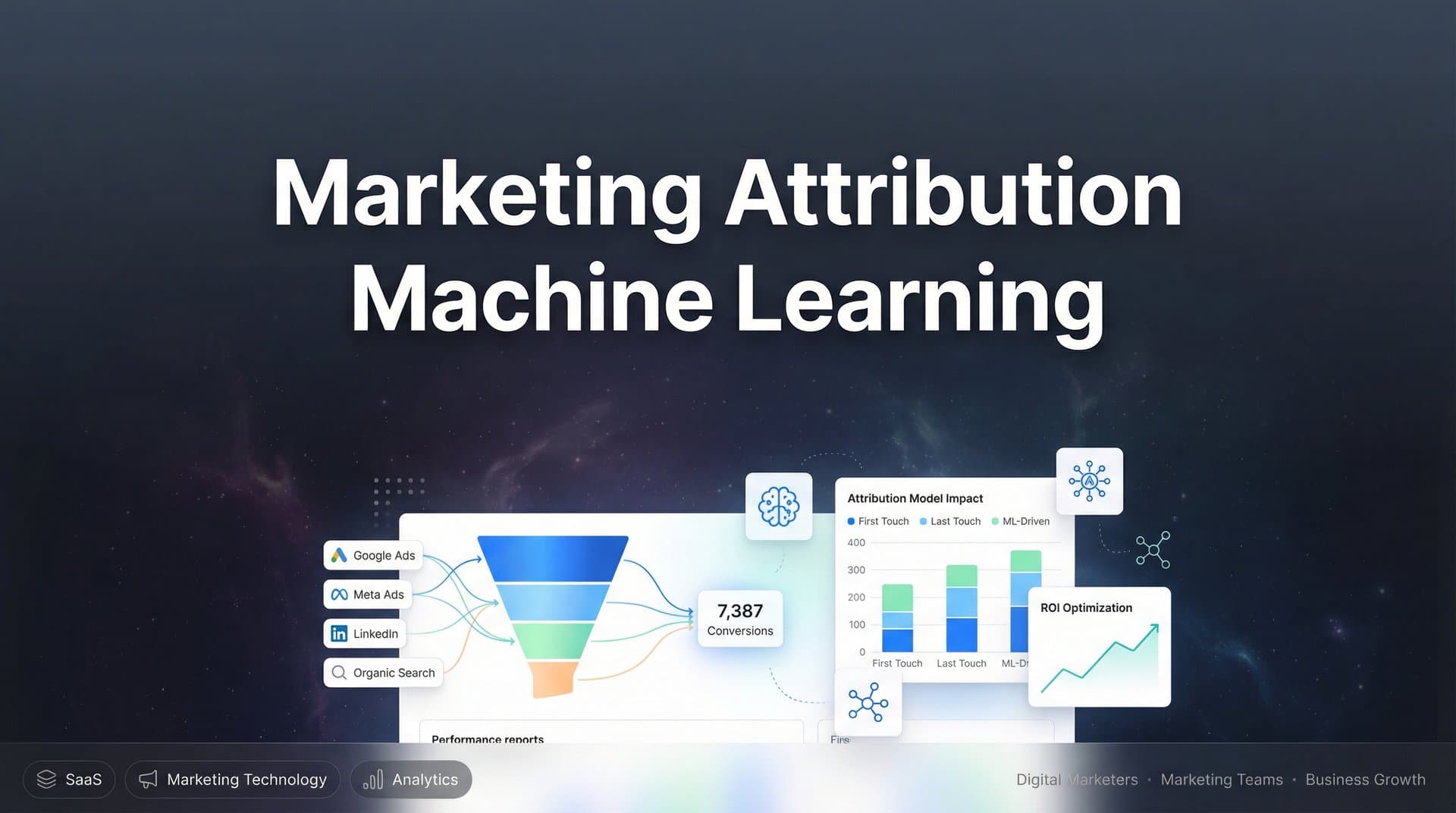
Marketing attribution machine learning solves this by analyzing complex customer journeys and assigning accurate credit to each touchpoint based on actual behavior patterns—not arbitrary rules. Instead of guessing which ads work, you get data-driven insights that show exactly where your budget should go. This article breaks down how ML attribution works, why it matters for paid advertising teams, and how to implement it effectively.
From Static Rules to Adaptive Intelligence
Traditional attribution models operate on fixed rules that treat every customer journey the same way. First-touch attribution gives 100% credit to the initial interaction. Last-touch gives everything to the final click. Linear attribution splits credit equally across all touchpoints. These approaches share a fundamental flaw: they ignore how customers actually behave.
Think about it. A customer who clicks your brand awareness ad, then returns directly to your site a week later, then converts after seeing a retargeting ad—that journey tells a story. The awareness ad introduced them to your product. The direct visit showed genuine interest. The retargeting ad provided the final push. But first-touch attribution would give all credit to the awareness ad, while last-touch would credit only the retargeting campaign.
Machine learning attribution takes a completely different approach. Instead of applying static rules, ML algorithms analyze thousands of actual conversion paths to identify patterns. They examine which combinations of touchpoints most frequently lead to conversions, which sequences matter most, and how different channels contribute at various stages of the customer journey.
The key difference is adaptability. Traditional models stay the same regardless of how customer behavior evolves or how channel performance shifts. ML attribution continuously learns from new data. When iOS privacy changes affect Facebook tracking, the model adjusts. When video content becomes more influential in your customer journeys, the algorithm picks up on that pattern and updates attribution accordingly.
This matters because marketing channels don't perform in isolation. A prospect might see your LinkedIn ad but not click it—yet that impression influences their decision to search for your brand later. Traditional attribution models miss these assist touchpoints entirely because they only track clicks and direct interactions. Machine learning models can identify patterns where certain impressions or early-stage interactions consistently appear in paths that lead to conversions, even when those touchpoints don't generate clicks.
The shift from rules-based to algorithmic attribution represents a fundamental change in how marketers understand campaign performance. Instead of asking "which channel got the last click?" you start asking "which combination of touchpoints most effectively drives conversions?" Understanding what a marketing attribution model is provides the foundation for making this transition.
How Algorithms Decode Customer Journeys
Machine learning attribution starts with data—lots of it. The algorithm needs to see ad impressions, clicks, website visits, CRM events, and conversion data across every channel you use. Each customer journey becomes a data point: a sequence of interactions that either leads to a conversion or doesn't.
Picture a dataset containing 10,000 customer journeys. Some journeys convert, others don't. The ML model analyzes these paths to answer a critical question: which touchpoints increase the probability of conversion? This is where different algorithmic approaches come into play.
Markov chain models treat customer journeys as a series of state transitions. A customer starts in an "awareness" state, moves to "consideration" after certain interactions, and eventually reaches "conversion." The algorithm calculates transition probabilities—how likely is a customer to convert after moving from touchpoint A to touchpoint B? By comparing conversion paths to non-conversion paths, the model identifies which transitions matter most.
Here's a simplified example. Say 70% of customers who see a Google ad, then visit your blog, then see a retargeting ad end up converting. But only 30% of customers who see the Google ad and go directly to your pricing page convert. The Markov model recognizes that the blog visit increases conversion probability and assigns higher attribution credit to that touchpoint.
Shapley value attribution takes a different approach rooted in game theory. Imagine each marketing channel as a player on a team. The Shapley value calculates each player's fair contribution by examining all possible combinations of channels and measuring how much each one increases the likelihood of conversion when added to the mix.
This approach answers questions like: "How much does adding Facebook ads to a campaign that already includes Google and email improve conversion rates?" By testing every possible combination—Google alone, email alone, Google + email, Google + Facebook, and so on—the algorithm determines each channel's true marginal contribution. Exploring machine learning approaches used in marketing attribution helps you understand which method fits your business needs.
Probabilistic models take yet another angle. These algorithms build a statistical model that predicts conversion probability based on the presence and sequence of touchpoints. They account for both converting and non-converting paths, learning which patterns indicate high intent versus low intent.
The training process works like this: the algorithm ingests historical conversion data and looks for patterns. It identifies that customers who interact with three or more touchpoints convert at higher rates than single-touch customers. It notices that certain channel sequences—like paid search followed by organic social followed by direct traffic—correlate strongly with conversions. It learns that touchpoints occurring within 7 days of conversion tend to have more influence than those occurring 30 days prior.
As the model processes more data, it refines its understanding. It might discover that mobile ad clicks followed by desktop conversions represent a common pattern in your customer base. Or that customers who watch video content before visiting your pricing page convert at twice the rate of those who don't. These insights get baked into the attribution model, making credit assignment more accurate over time.
What makes this powerful is that the algorithm doesn't need you to tell it which touchpoints matter. It figures that out by analyzing actual customer behavior. You're not imposing assumptions about how customers should behave—you're letting the data reveal how they actually behave.
Practical Applications for Campaign Optimization
Machine learning attribution transforms how paid advertising teams make budget decisions. Instead of shifting spend based on last-click conversions or gut feelings, you optimize based on true channel contribution across the entire customer journey.
Cross-platform budget optimization becomes data-driven. Let's say your last-click data shows Google Ads generating 60% of conversions, Facebook generating 30%, and LinkedIn generating 10%. But ML attribution reveals that LinkedIn plays a critical role in introducing high-value prospects who later convert through other channels. The algorithm might show LinkedIn deserves 25% attribution credit because it consistently appears early in high-value customer journeys.
This insight changes everything. Instead of cutting your LinkedIn budget because it doesn't generate many last-click conversions, you recognize its value as a top-of-funnel channel and maintain or even increase investment. Meanwhile, you might discover that certain Google campaigns only convert customers who've already been introduced to your brand through other channels—making them less valuable than last-click data suggests.
Identifying undervalued touchpoints becomes straightforward with ML attribution. Many channels assist conversions without receiving last-click credit. Organic social posts, display ads, YouTube videos, and email campaigns often nurture prospects through the consideration phase but rarely capture the final click.
Machine learning models surface these assist touchpoints by analyzing conversion paths. You might discover that customers who engage with your educational content convert at rates 40% higher than those who don't—even though blog posts rarely get last-click credit. Or that display ad impressions, while not generating many clicks, consistently appear in the paths of customers who eventually convert through paid search. Implementing channel attribution for revenue tracking helps you capture these insights systematically.
The third major application is feeding better conversion data back to ad platforms. Meta, Google, and other platforms use conversion signals to optimize their targeting algorithms. When you send conversion data based on last-click attribution, you're essentially telling the algorithm "only optimize for customers who click this ad and immediately convert."
But with ML attribution, you can send enriched conversion data that reflects true channel contribution. If a Facebook ad introduced a customer who later converted through Google, you can send a partial conversion signal back to Facebook—informing its algorithm that this ad interaction contributed to revenue even though it wasn't the last click.
This creates a virtuous cycle. Better conversion data helps ad platforms target more effectively. More accurate targeting drives better results. Better results generate more data for your ML attribution model. Your campaigns become more efficient over time as both your attribution and the platforms' algorithms learn from real performance patterns.
Budget recommendations based on ML attribution often reveal surprising opportunities. You might find that increasing spend on mid-funnel retargeting campaigns generates better ROI than adding more top-of-funnel prospecting budget. Or that certain audience segments respond better to specific channel combinations, allowing you to customize your approach for different customer types.
Navigating Data Quality and Privacy Challenges
Machine learning attribution only works when you have accurate, complete data. This is where many marketers hit roadblocks. iOS privacy changes, cookie deprecation, and ad blockers have made it harder to track customer journeys end-to-end.
The iOS 14.5 update fundamentally changed Facebook tracking. Users can now opt out of cross-app tracking, which means a significant portion of mobile traffic no longer provides complete conversion data. Google's plan to phase out third-party cookies will create similar challenges for display advertising and cross-site tracking.
Server-side tracking has emerged as the solution. Instead of relying on browser-based pixels that can be blocked, server-side tracking captures conversion data at the server level and sends it directly to ad platforms. This approach bypasses many privacy restrictions while still respecting user consent preferences.
Here's why it matters for ML attribution: incomplete data creates blind spots in your customer journey analysis. If you can't track mobile conversions accurately, your attribution model might undervalue mobile ads. If you lose visibility into cross-site behavior, you can't identify how display ads assist conversions on other channels. Understanding common attribution challenges in marketing analytics prepares you to address these obstacles proactively.
Connecting fragmented data sources presents another challenge. Your ad platform data lives in Meta and Google. Your CRM tracks leads and deals. Your website analytics shows visitor behavior. Your email platform has engagement metrics. Machine learning attribution requires all of this data in one place.
Integration becomes critical. You need a system that can pull conversion data from your CRM, match it to ad clicks from multiple platforms, and connect it to website behavior—all while maintaining user identity across these touchpoints. Without proper integration, you end up with incomplete customer journeys that produce inaccurate attribution.
Minimum data requirements matter too. Machine learning models need sufficient conversion volume to identify meaningful patterns. If you're only generating 50 conversions per month, the algorithm doesn't have enough data points to reliably distinguish which touchpoint combinations drive results versus which ones appear by chance.
What do you do when conversion volume is low? Start by ensuring your data collection is accurate. Even if you can't implement full ML attribution yet, setting up proper tracking infrastructure now means you'll have clean historical data when you're ready to scale. Focus on capturing every touchpoint—ad clicks, website visits, email opens, CRM events—even if you're using simpler attribution models in the meantime.
Consider expanding your definition of conversions. Instead of only tracking purchases, include qualified leads, demo requests, or high-intent actions like pricing page visits. This gives your ML model more data points to learn from while you build toward higher conversion volume. Learning how to setup a datalake for marketing attribution ensures your data infrastructure scales with your needs.
Data quality often matters more than data quantity. A thousand accurately tracked customer journeys provide more value than ten thousand incomplete or misattributed paths. Invest time in validation: check that your tracking fires correctly, that user IDs persist across sessions, and that conversion events match between your CRM and analytics platforms.
Choosing the Right ML Attribution Platform
Not all machine learning attribution solutions deliver the same value. Some platforms offer sophisticated algorithms but limited integrations. Others connect to every data source but provide opaque attribution logic. Knowing what to evaluate helps you choose a solution that actually improves decision-making.
Integration depth should be your first consideration. Can the platform connect directly to your ad accounts—not just pull generic data, but actually access campaign, ad set, and creative-level performance? Does it integrate with your CRM to track leads and revenue, not just conversions? Can it capture website behavior and match it to ad interactions?
Surface-level integrations don't cut it. You need a platform that can follow a customer from initial ad click through multiple website visits, email interactions, and CRM events, all the way to closed revenue. This requires deep integration with every system in your marketing stack.
Model transparency matters more than most marketers realize. Some platforms treat attribution as a black box—you get credit assignments without understanding why. This creates problems when stakeholders question the data or when you need to explain budget decisions to leadership.
Look for platforms that explain their attribution logic. How does the algorithm assign credit? What factors influence attribution weight? Can you see which customer journey patterns led to specific credit assignments? Transparency builds trust and helps you validate that the model's conclusions make sense for your business. Reviewing questions for marketing attribution vendors helps you evaluate platforms effectively.
Actionable outputs separate useful platforms from data visualization tools. Dashboards showing attribution credit across channels are interesting, but they don't tell you what to do differently. The most valuable platforms provide specific recommendations: "Increase Facebook prospecting budget by 15% and shift $2,000 from Google brand search to YouTube video campaigns."
AI-generated recommendations take this further. Instead of just showing you attribution data and expecting you to figure out the implications, advanced platforms analyze the data and suggest concrete actions. They might identify underperforming audience segments, recommend budget reallocation across channels, or flag campaigns that consistently appear in high-value customer journeys. Exploring AI-powered marketing attribution tools shows you what's possible with modern solutions.
Real-time processing capability affects how quickly you can act on insights. Some attribution platforms process data in daily batches, meaning you're always looking at yesterday's performance. Real-time processing allows you to see how current campaigns influence customer journeys as they happen, enabling faster optimization.
Historical data analysis is equally important. You want a platform that can reprocess past conversion data using updated attribution models. This lets you compare how different attribution approaches would have evaluated the same campaigns, helping you understand the impact of switching from last-click to ML attribution.
Support for multiple attribution models provides flexibility. Even when using ML attribution as your primary model, being able to compare results against first-touch, last-touch, or linear models helps validate insights and communicate with stakeholders who are familiar with traditional approaches.
Implementation Strategy for Marketing Teams
Moving to machine learning attribution isn't a flip-the-switch decision. Start with data infrastructure. Before implementing any ML model, ensure you're accurately capturing every touchpoint across all channels. Set up server-side tracking for conversions. Connect your CRM to your ad platforms. Implement proper UTM parameters and tracking codes.
This foundation work isn't glamorous, but it's essential. An ML attribution model trained on incomplete or inaccurate data will produce unreliable insights. Spend time validating that your tracking works correctly before you start analyzing attribution.
Run parallel attribution models during your transition period. Keep using your current attribution approach while implementing ML attribution alongside it. This lets you compare insights and identify discrepancies without risking your entire budget allocation on a new model you haven't validated yet.
Look for quick wins in the comparison data. You might discover that ML attribution identifies certain campaigns as far more valuable than last-click attribution suggests. Test small budget increases to these campaigns and measure results. If performance improves, you've validated the ML model's insights and built confidence in the approach. Understanding how marketing attribution software compares to traditional analytics clarifies what improvements to expect.
Use AI-generated recommendations as a starting point for testing, not gospel truth. Even sophisticated algorithms can miss context that you understand about your business. When the platform suggests shifting budget from Channel A to Channel B, start with a small test. Move 10-15% of the budget and monitor results before making larger changes.
Document your learnings throughout the process. Track which ML attribution insights led to successful optimizations and which ones didn't pan out. This helps you understand how to interpret the model's outputs and builds institutional knowledge about what works for your specific business.
Educate stakeholders about how ML attribution differs from traditional models. Leadership and team members accustomed to last-click reporting might question why attribution credit has shifted. Prepare clear explanations of how the ML model works and why it provides more accurate insights into true channel contribution. For B2B companies, reviewing B2B marketing attribution fundamentals provides context for these conversations.
The Competitive Edge of Algorithmic Attribution
Marketing attribution machine learning represents more than a technical upgrade to your analytics stack. It's a fundamental shift in how you make budget decisions—from guessing based on incomplete data to optimizing based on comprehensive customer journey analysis.
The competitive advantage is real. While your competitors optimize based on last-click conversions, you're identifying the true drivers of revenue across every touchpoint. While they cut budgets to channels that don't generate immediate conversions, you're investing in the full customer journey. While they feed incomplete data to ad platforms, you're helping algorithms target more effectively with enriched conversion signals.
This advantage compounds over time. Better attribution leads to better budget allocation. Better budget allocation drives better results. Better results generate more data for your ML model. Your marketing becomes more efficient while competitors struggle with the same attribution challenges they've always faced.
The shift to machine learning attribution isn't optional anymore—it's becoming table stakes for serious marketing teams. Customer journeys are too complex for manual analysis. Traditional attribution models are too simplistic for multi-channel campaigns. The only way to truly understand what's driving conversions is to let algorithms analyze the patterns humans can't see.
Ready to elevate your marketing game with precision and confidence? Discover how Cometly's AI-driven recommendations can transform your ad strategy—Get your free demo today and start capturing every touchpoint to maximize your conversions.