

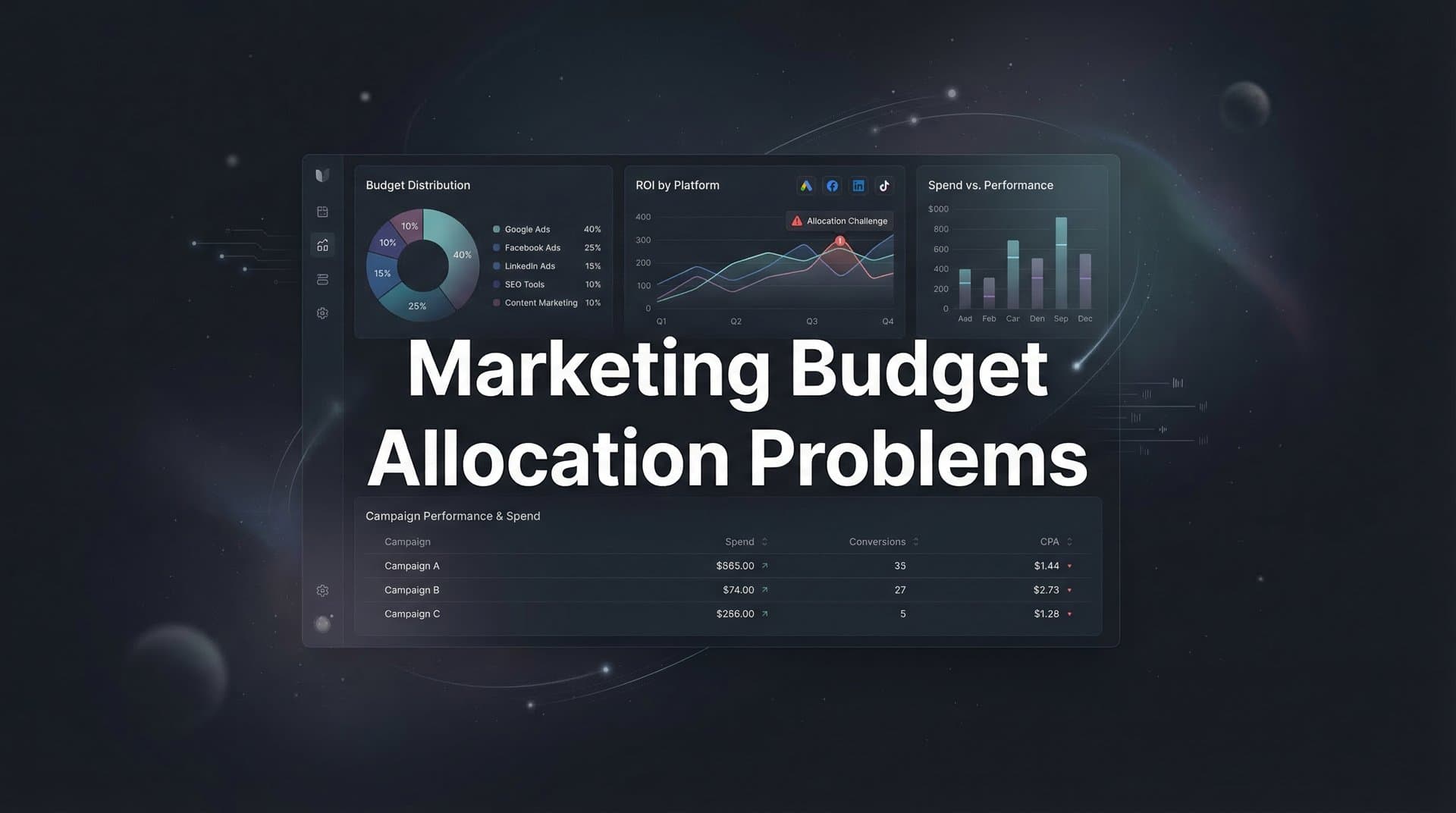
Marketing budget allocation remains one of the most challenging decisions for digital marketers and agencies managing multi-platform campaigns. When you're splitting spend across Meta, Google, TikTok, and other channels, even small misallocations can drain thousands in wasted ad spend while starving your best-performing campaigns.
The core issue? Most marketers lack visibility into which channels actually drive revenue versus which ones just generate clicks and vanity metrics.
You might see Meta reporting 500 conversions, Google claiming 400, and TikTok showing 200—but when you check your CRM, you only closed 300 deals total. This attribution overlap creates a false picture of performance, leading you to overinvest in channels that aren't pulling their weight.
This guide walks you through seven battle-tested strategies to diagnose and fix budget allocation problems, helping you shift from gut-feel decisions to data-driven confidence. Whether you're struggling with siloed platform data, unclear attribution, or simply not knowing where your next dollar should go, these approaches will help you allocate budget based on real business outcomes.
1. Implement Multi-Touch Attribution
The Challenge It Solves
Last-click attribution gives all the credit to the final touchpoint before conversion, completely ignoring the awareness and consideration stages that made that final click possible. When you rely solely on last-click data, you systematically undervalue top-of-funnel channels like display ads, social media, and content marketing that introduce prospects to your brand.
This creates a dangerous cycle: you cut budget from channels that appear ineffective in last-click reports, even though they're essential for generating qualified traffic that later converts through branded search or direct visits.
The Strategy Explained
Multi-touch attribution tracks every interaction a prospect has with your marketing across all channels, then assigns credit based on how each touchpoint contributed to the final conversion. Instead of seeing a conversion as a single moment, you see it as a journey with multiple influences.
Think of it like a basketball team. Last-click attribution gives all the credit to whoever scores the basket, ignoring the assists, screens, and defensive plays that made the shot possible. Multi-touch attribution recognizes every player's contribution to the win.
The most effective approach uses multiple attribution models in digital marketing simultaneously. First-touch shows which channels are best at generating new prospects. Linear attribution gives equal credit to every touchpoint. Time-decay weighs recent interactions more heavily. Position-based splits credit between first and last touch while acknowledging middle interactions.
Implementation Steps
1. Deploy tracking that captures every marketing touchpoint across all channels, including ad clicks, organic visits, email opens, and social media interactions. This requires a unified tracking system that can follow users across devices and sessions.
2. Connect your tracking to conversion events in your CRM or sales system so you can map the complete journey from first touch to closed deal. This connection is critical for understanding which paths actually lead to revenue.
3. Compare different attribution models side by side to understand how credit distribution changes your perception of channel performance. You'll often discover that channels you thought were underperforming are actually essential parts of high-value customer journeys.
Pro Tips
Start by analyzing your highest-value customers to identify common touchpoint patterns. These patterns reveal which channel combinations consistently drive quality conversions, helping you allocate budget to replicate successful journeys rather than optimizing individual channels in isolation.
2. Connect Ad Platforms to Revenue Data
The Challenge It Solves
Ad platforms optimize toward the conversion events you tell them to track, but if you're only tracking form submissions or demo requests, the algorithms have no idea which leads actually turn into paying customers. This disconnect means platforms waste spend on lead sources that feel productive but don't generate revenue.
You might celebrate 200 qualified leads from a campaign, only to discover weeks later that none of them closed. By then, you've already spent thousands more on the same targeting strategy because your optimization signal was wrong from the start.
The Strategy Explained
Connecting ad platforms to actual revenue data means tracking conversions beyond the initial lead capture all the way through to closed deals and customer lifetime value. This gives you and your ad platform algorithms visibility into which campaigns, audiences, and creatives attract prospects who actually buy.
For side-by-side comparisons, see our best AI UGC generator roundup.
The key is implementing a feedback loop that sends revenue data back to your ad platforms. When Meta or Google knows which clicks led to $10,000 customers versus which ones led to tire-kickers, their algorithms can optimize for the right outcomes.
This approach transforms your optimization strategy from volume-based to value-based. Instead of maximizing leads at a target cost per lead, you're maximizing revenue at a target cost per acquisition or return on ad spend. Proper marketing revenue attribution makes this transformation possible.
Implementation Steps
1. Set up conversion tracking that extends beyond form submissions to include qualified opportunities, closed deals, and revenue amounts. Use your CRM or sales system as the source of truth for these downstream events.
2. Implement server-side tracking to pass conversion data back to ad platforms even when browser-based tracking fails due to privacy settings or ad blockers. This ensures your platforms receive complete conversion signals for optimization.
3. Configure value-based optimization in your ad platforms by sending actual revenue amounts with conversion events. This allows algorithms to prioritize audiences and placements that drive higher-value customers rather than just more conversions.
Pro Tips
Create custom audiences based on revenue tiers to help ad platforms find more high-value customers. Upload lists of your best customers as seed audiences for lookalike targeting, and exclude low-value converters from retargeting campaigns to avoid wasting budget on prospects unlikely to generate meaningful revenue.
3. Use Incrementality Testing
The Challenge It Solves
Platform-reported conversions often include people who would have converted anyway without seeing your ads. When someone searches for your brand name and clicks a paid search ad before converting, did the ad cause the conversion, or were they already coming? This attribution inflation makes channels appear more effective than they actually are.
Without incrementality testing, you're making budget decisions based on correlation rather than causation. You might be pouring money into channels that take credit for conversions they didn't actually influence.
The Strategy Explained
Incrementality testing measures the true lift your marketing creates by comparing outcomes between groups exposed to your ads and control groups that aren't. The difference in conversion rates between these groups reveals the actual impact of your marketing spend.
Think of it like testing a new medication. You need a control group that doesn't receive the treatment to know if improvements in the treatment group are actually caused by the medication or would have happened naturally. The same logic applies to marketing channels.
Holdout tests work by randomly excluding a percentage of your audience from seeing specific campaigns, then comparing their conversion behavior to the exposed group. Geo-testing applies the same principle by running campaigns in some geographic markets while holding others as controls. These methods help you measure marketing campaign effectiveness accurately.
Implementation Steps
1. Design holdout experiments that randomly exclude 10-20% of your audience from specific channels or campaigns. Make sure your holdout group is large enough to generate statistically significant results but small enough that you're not sacrificing too much potential revenue during the test.
2. Run tests for at least two full purchase cycles to account for delayed conversions and seasonal variations. Quick tests often miss the full impact of awareness-stage touchpoints that take time to influence buying decisions.
3. Compare conversion rates, revenue per user, and customer acquisition costs between exposed and holdout groups to calculate true incremental lift. Use this data to adjust your budget allocation toward channels that create real incremental value.
Pro Tips
Start incrementality testing with your largest budget channels first, since even small efficiency improvements in high-spend areas generate significant savings. Test branded search campaigns early, as these often show the largest gap between reported conversions and true incremental impact.
4. Adopt Unified Analytics
The Challenge It Solves
When your campaign data lives in separate platforms, each with different tracking methodologies, conversion windows, and attribution models, you can't fairly compare channel performance. Meta might use a 28-day click window while Google uses 30 days, and your email platform only tracks 7 days, making apples-to-apples comparisons impossible.
This fragmentation forces you to jump between platforms to piece together a complete picture, wasting hours in manual reporting while still missing the cross-channel interactions that matter most. By the time you've exported and reconciled data from five platforms, the insights are already outdated.
The Strategy Explained
Unified analytics centralizes data from all your marketing channels into a single platform with consistent tracking, attribution rules, and conversion windows. This creates a level playing field where you can accurately compare the true performance of each channel against the same standards.
Picture trying to compare the speed of different cars when each one is measured with a different speedometer calibration. Unified analytics recalibrates everything to the same measurement system so you know which vehicle is actually fastest.
The best unified analytics solutions don't just aggregate platform-reported data. They track conversions independently using first-party data, then show you both the platform's claimed performance and the verified performance based on actual customer journeys. A solid marketing campaign attribution platform makes this possible.
Implementation Steps
1. Implement a centralized tracking system that captures user interactions across all channels using consistent identifiers. This typically involves deploying tracking pixels or server-side integrations that feed data into a unified database.
2. Standardize your conversion definitions and attribution windows across all channels so you're measuring the same events with the same rules. Decide whether a conversion window should be 7, 14, or 30 days, then apply that consistently.
3. Build dashboards that display cross-channel performance side by side with the ability to drill down into specific campaigns, audiences, and creative variations. Focus on metrics that matter for budget decisions like cost per acquisition, return on ad spend, and customer lifetime value.
Pro Tips
Use your unified analytics to identify channel synergies where combinations of platforms drive better results than either would alone. You might discover that prospects who see both display ads and social media campaigns convert at twice the rate of those exposed to just one channel, revealing opportunities for coordinated budget allocation.
5. Feed Better Data to Ad Platforms
The Challenge It Solves
Ad platform algorithms need accurate conversion data to optimize delivery, but browser-based tracking has become increasingly unreliable due to iOS privacy updates, cookie restrictions, and ad blockers. When platforms only see 60-70% of actual conversions, their algorithms optimize toward incomplete signals, wasting budget on targeting strategies that appear effective but miss the full picture.
This data loss creates a vicious cycle where platforms can't identify your best audiences, leading to poor optimization, higher costs, and frustrated marketers who blame the platforms when the real issue is tracking infrastructure. These marketing data accuracy problems undermine every budget decision you make.
The Strategy Explained
Server-side tracking captures conversion data on your servers rather than relying on browser pixels that can be blocked or fail due to privacy settings. This approach sends complete, accurate conversion signals directly to ad platforms through their APIs, giving algorithms the clean data they need to optimize effectively.
Think of browser-based tracking like trying to hear a conversation through a wall. You catch some words but miss crucial context. Server-side tracking is like being in the room where the conversation happens, hearing everything clearly.
When ad platforms receive complete conversion data, their machine learning algorithms can identify patterns in your best customers and find more people like them. This improves targeting precision, reduces wasted spend, and lowers your overall cost per acquisition.
Implementation Steps
1. Deploy server-side tracking infrastructure that captures conversion events on your backend systems and sends them to ad platforms through Conversions API integrations. This requires technical implementation but dramatically improves data accuracy.
2. Enrich conversion events with additional data points like customer lifetime value, product categories, and custom parameters that help platforms understand what makes a valuable conversion. The more context you provide, the better algorithms can optimize.
3. Validate that your server-side tracking is working correctly by comparing conversion counts between browser-based pixels and server-side events. You should see significantly higher conversion volumes through server-side tracking, revealing the data you were previously missing.
Pro Tips
Use Cometly's Conversion Sync feature to automatically send enriched conversion data back to Meta, Google, and other platforms. This ensures ad algorithms always have the most complete, accurate signals for optimization without requiring you to manually configure multiple API integrations.
6. Establish Regular Reallocation Cycles
The Challenge It Solves
Most marketers set their budget allocation at the beginning of the quarter and rarely adjust it until the next planning cycle. This rigid approach means you're stuck with the same distribution even when channel performance shifts dramatically due to seasonal trends, competitive changes, or creative fatigue.
By the time you realize a channel is underperforming, you've already wasted weeks or months of budget that could have been reallocated to better opportunities. Meanwhile, high-performing channels hit their budget caps early in the month and stop delivering results while underperformers continue burning cash.
The Strategy Explained
Regular reallocation cycles create a systematic process for reviewing performance data and shifting budget toward channels and campaigns that are working. Instead of treating your budget as fixed, you build flexibility into your planning that allows you to capitalize on opportunities and cut losses quickly.
This approach treats budget allocation as an ongoing optimization process rather than a set-it-and-forget-it decision. You're constantly testing, learning, and adjusting based on what the data tells you about current performance. Implementing real-time marketing budget allocation strategies helps you stay agile.
The key is establishing clear decision criteria and a regular cadence for reviews. Weekly or bi-weekly cycles work well for most teams, giving you enough data to spot trends without overreacting to daily fluctuations.
Implementation Steps
1. Schedule weekly or bi-weekly budget review meetings where you analyze performance data across all channels using your unified analytics platform. Make these meetings non-negotiable so budget optimization becomes a consistent practice rather than an occasional activity.
2. Define clear reallocation rules based on performance thresholds. For example, increase budget by 20% for channels exceeding your target return on ad spend, decrease by 20% for channels underperforming, and pause campaigns that fall below minimum efficiency standards.
3. Maintain a flexible budget reserve of 10-20% that you can deploy quickly when opportunities emerge. This buffer lets you scale winning campaigns immediately without waiting for the next planning cycle or robbing budget from channels that are performing adequately.
Pro Tips
Create a simple scorecard that ranks channels by key metrics like return on ad spend, cost per acquisition, and contribution to pipeline. This visual ranking makes reallocation decisions obvious and helps you communicate changes to stakeholders who need to understand why you're shifting budget mid-cycle.
7. Leverage AI Recommendations
The Challenge It Solves
As your campaigns scale across multiple platforms, audiences, and creative variations, the number of optimization decisions you need to make grows exponentially. Manually analyzing performance data for hundreds of campaigns to identify which ones deserve more budget becomes impossible without sacrificing speed or accuracy.
You might spot obvious winners and losers, but you miss subtle patterns in the data that reveal emerging opportunities or early warning signs of declining performance. By the time problems become obvious, you've already wasted significant budget.
The Strategy Explained
AI-powered budget allocation recommendations analyze your complete marketing data to identify optimization opportunities that human analysts would miss or take too long to discover. These systems continuously monitor performance across all campaigns, detecting patterns, anomalies, and scaling opportunities in real time.
Modern AI goes beyond simple rules-based alerts to provide intelligent recommendations that consider multiple factors simultaneously. Instead of just flagging campaigns with high cost per acquisition, AI understands context like seasonality, audience maturity, and cross-channel effects that influence performance.
The best AI recommendation systems don't just identify problems—they suggest specific actions like which campaigns to scale, which audiences to test, and how much budget to reallocate. This transforms AI from a reporting tool into an active optimization partner.
Implementation Steps
1. Implement an AI-powered analytics platform that continuously monitors your marketing performance and generates optimization recommendations based on your specific goals and constraints. Look for systems that learn from your decisions to improve recommendation quality over time.
2. Configure your AI system with clear parameters about your business goals, budget constraints, and risk tolerance so recommendations align with your strategy. Tell the system whether you're optimizing for growth, efficiency, or a balance of both.
3. Review AI recommendations daily and act on high-confidence suggestions quickly while testing lower-confidence recommendations on a small scale. Track which recommendations drive results to build trust in the system and refine its learning.
Pro Tips
Use Cometly's AI Chat feature to ask natural language questions about your marketing data and receive instant insights about optimization opportunities. This conversational interface makes it easy to explore your data deeply without building complex reports or waiting for analyst support.
Putting It All Together
Solving marketing budget allocation problems isn't about finding a magic formula. It's about building systems that give you clear visibility into what's actually driving revenue across your entire marketing mix.
Start by implementing multi-touch attribution to understand your full customer journey rather than giving all credit to the last touchpoint. Then connect your ad platforms to actual revenue data so algorithms can optimize for the conversions that matter most to your business, not just the ones that are easiest to track.
Use incrementality testing to validate your assumptions about channel performance. Many channels that look effective in platform dashboards are simply taking credit for conversions that would have happened anyway. Testing reveals which channels create real incremental value worth investing in.
Adopt unified analytics to centralize your cross-channel data with consistent tracking and attribution rules. This creates a level playing field where you can fairly compare channel performance and make confident reallocation decisions based on complete information.
Feed better data back to ad platform algorithms through server-side tracking. When platforms receive accurate, complete conversion signals, their optimization improves dramatically, lowering your costs and improving targeting precision.
Establish regular reallocation cycles with weekly or bi-weekly reviews. Budget allocation should be an ongoing optimization process, not a quarterly planning exercise. Build flexibility into your approach so you can capitalize on opportunities quickly and cut losses before they compound.
Finally, leverage AI recommendations to identify optimization opportunities at scale. As your campaigns grow more complex, AI becomes essential for spotting patterns and suggesting actions that human analysts would miss or discover too slowly.
The marketers who master budget allocation don't just save money on wasted spend. They compound their returns by consistently investing in what works while quickly identifying and fixing what doesn't.
Ready to see exactly which ads and channels drive your revenue? Cometly's attribution platform captures every touchpoint in your customer journey, connects ad spend to actual revenue outcomes, and uses AI to identify your best scaling opportunities. Get your free demo today and start allocating budget with confidence based on what's really driving results.



