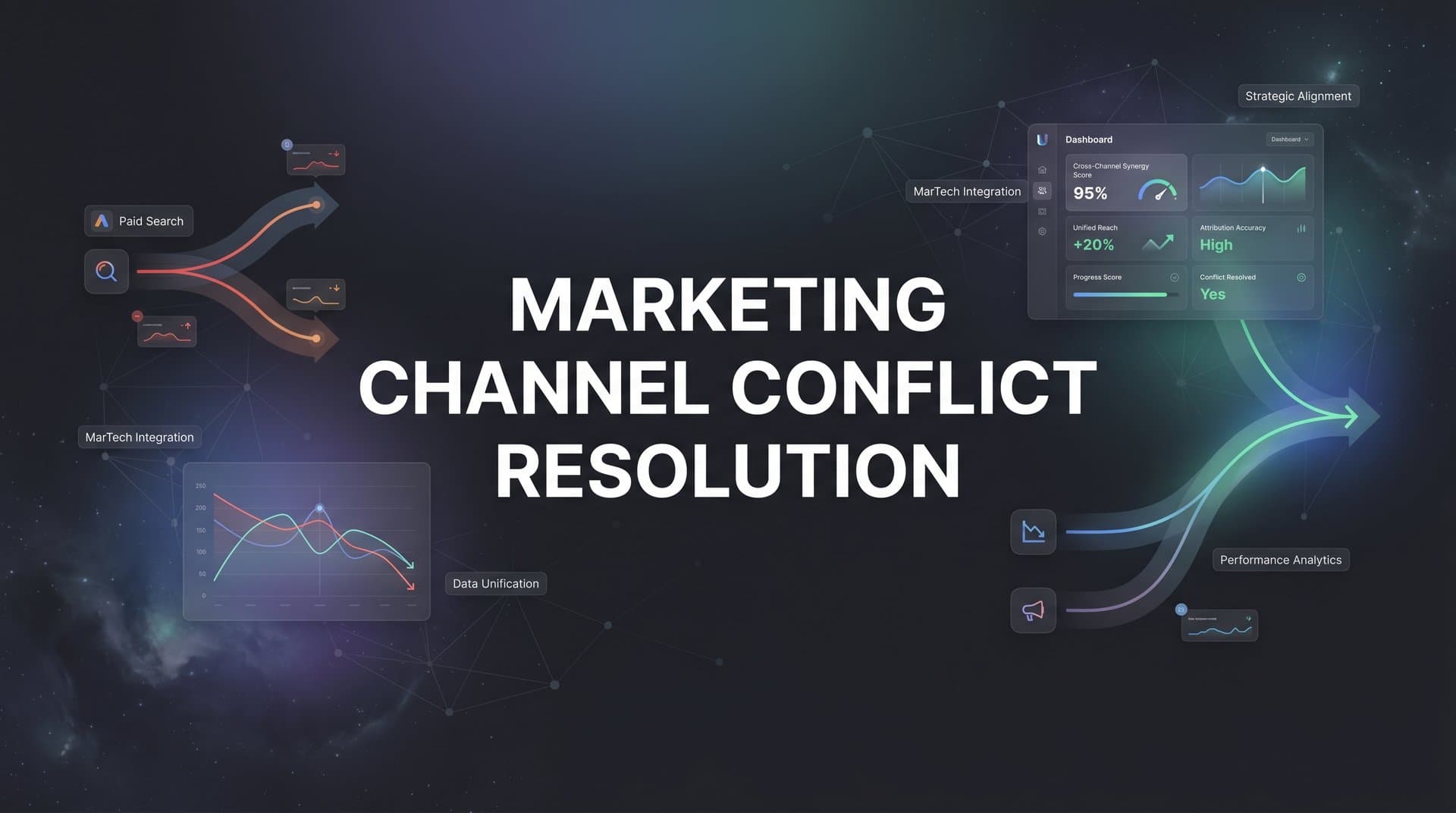
Your paid search team is celebrating a 30% increase in conversions. Your organic team is frustrated because traffic is down. Your social ads manager swears their retargeting campaigns are driving the best results. Meanwhile, your CFO is looking at the overall marketing budget and asking why customer acquisition costs keep climbing despite all these "wins."
This is marketing channel conflict in action.
When your channels compete instead of collaborate, you end up with inflated costs, duplicated efforts, and teams fighting over credit for the same conversions. One channel intercepts another's traffic. Retargeting campaigns overlap across platforms. Paid ads bid on keywords your organic content already ranks for. The result? You are paying multiple times to reach the same customer.
The fix is not about choosing winners and losers among your channels. It is about creating a system where each channel plays a specific role in the customer journey, attribution reflects reality, and your team works toward shared goals instead of competing metrics.
This guide walks you through a practical, step-by-step process to identify where your channels are stepping on each other, establish clear attribution rules, and build a unified strategy. You will learn how to map your channel ecosystem, diagnose the root causes of conflict, implement accurate tracking, and reallocate budget based on what actually drives revenue.
Let's resolve the conflicts holding your marketing performance back.
Step 1: Map Your Current Channel Ecosystem and Touchpoints
You cannot fix channel conflicts until you see the full picture of how your channels interact. Start with a complete audit of every active marketing channel. This includes paid search, paid social, display ads, organic search, email marketing, affiliate programs, referral sources, and any other channel currently receiving budget or driving traffic.
Document each channel's targeting parameters. What audience segments is paid search reaching? Which demographics do your Meta campaigns target? What keywords is your organic content ranking for? Where do your email campaigns fit in the customer journey? Write this down in a shared document that all teams can access.
Next, identify overlap zones. Look for areas where multiple channels are targeting the same audience segments. Check if your paid search campaigns are bidding on branded keywords that your organic listings already dominate. Review whether your retargeting audiences on Meta include people who are also in your Google retargeting pools. Examine if your email nurture sequences are reaching the same prospects who are seeing your paid ads. Understanding marketing channel overlap issues is essential for diagnosing these problems.
Create a visual customer journey map showing how people typically move between channels before converting. Pull data from your analytics platform to identify common paths. You might discover that most customers first encounter your brand through organic search, then see a retargeting ad on Meta, and finally convert after clicking a paid search ad. Or perhaps email drives initial awareness, followed by multiple paid social touchpoints before conversion.
Pay special attention to branded keyword conflicts. If your paid search team is bidding on your company name while your organic listing ranks first, you are likely paying for clicks you would have gotten anyway. This is one of the most common and expensive forms of channel conflict.
Document your findings in a channel interaction matrix. List each channel down one side and across the top. In each cell, note whether channels collaborate, compete, or operate independently. This matrix becomes your baseline for measuring improvement as you resolve conflicts.
The goal here is visibility. You need to see where channels overlap, where they complement each other, and where they are fighting for the same conversions. Only then can you make informed decisions about how to coordinate them.
Step 2: Identify the Root Causes of Your Channel Conflicts
With your channel map in hand, it is time to diagnose what is actually causing the conflicts. Start by analyzing your attribution data to find channels claiming credit for the same conversions. Pull reports showing the full conversion path, not just last-click attribution. You will likely discover multiple channels touching the same customer before conversion.
Look specifically for cannibalization patterns. Check if your paid search traffic dropped when you paused branded keyword campaigns. If it did not drop significantly, those paid ads were probably intercepting organic clicks you would have received anyway. Review whether your paid social campaigns are targeting people who are already on your email list and would likely convert through that channel. Understanding when marketing channels are cannibalizing each other helps you identify wasted spend.
Examine audience overlap in your retargeting campaigns. Export your retargeting audience lists from Meta, Google, and any other platforms you use. Calculate the overlap percentage. If 80% of your Meta retargeting audience is also in your Google retargeting pool, you are hitting the same people with multiple ads across platforms. That is not necessarily bad, but it needs to be intentional, not accidental.
Check your conversion tracking setup for discrepancies. If your paid search dashboard shows 100 conversions while your analytics platform shows 75 from that channel, you have a measurement problem creating false conflicts. Browser-based tracking limitations, particularly on iOS devices, often create attribution gaps that make channels appear to be competing when the real issue is incomplete data. When your marketing dashboard shows conflicting numbers, resolving the data discrepancy must come first.
Review your team incentive structures with brutal honesty. If your paid search manager gets a bonus based on paid search conversions, and your organic manager gets rewarded for organic conversions, you have built-in incentives for channel competition. Each team will naturally optimize for their metrics, even if it hurts overall performance.
Interview your channel managers to understand their perspective. Ask what success looks like for their channel. Ask how they decide on targeting parameters. Ask if they coordinate with other channel teams. You will often discover that conflicts stem from lack of communication rather than malicious competition.
Document the specific conflicts you identify. Be precise. Instead of "paid and organic compete," write "paid search bidding on branded term 'company name' intercepts 40% of organic clicks based on pause test data." Specific problems lead to specific solutions.
The root causes usually fall into three categories: measurement problems where attribution is unclear, structural problems where team incentives encourage competition, or tactical problems where targeting parameters overlap unnecessarily. Identifying which category each conflict falls into helps you prioritize solutions.
Step 3: Establish a Unified Attribution Framework
Channel conflicts persist when teams work from different versions of the truth. The solution is a unified attribution framework that everyone agrees on and uses for decision-making. This is where accurate, comprehensive tracking becomes critical.
Start by choosing an attribution model that reflects your actual customer journey complexity. If your sales cycle involves multiple touchpoints over weeks or months, last-click attribution will systematically undervalue awareness and consideration channels. Multi-touch attribution models distribute credit across the entire journey, giving you a more accurate picture of how channels work together. A comprehensive marketing channel attribution modeling guide can help you select the right approach.
Common multi-touch models include linear attribution, which gives equal credit to every touchpoint; time-decay attribution, which gives more credit to recent interactions; and position-based attribution, which emphasizes first and last touches while acknowledging middle interactions. The right model depends on your business, but any multi-touch approach is better than last-click for resolving channel conflicts.
Set up cross-channel tracking that captures every touchpoint in the path to conversion. This requires tracking that works across devices, survives browser limitations, and connects your ad platforms to your CRM and revenue data. Server-side tracking has become essential here because browser-based tracking faces increasing restrictions, particularly on iOS devices.
When your tracking captures the full customer journey from first ad click through CRM events and revenue, you can see which channels truly drive incremental value versus which ones are taking credit for conversions that would have happened anyway. Learning how to measure cross channel marketing attribution accurately is foundational to this process.
Define clear rules for how credit is distributed across channels. Document these rules in writing and get buy-in from all channel managers. The rules might specify that awareness channels receive credit for introducing new prospects, consideration channels get credit for engagement, and conversion channels receive credit for closing the deal. Whatever rules you choose, consistency matters more than perfection.
Ensure all teams are working from the same data source. If your paid search team pulls data from Google Ads, your organic team uses Google Analytics, and your executive team looks at CRM reports, you will have three different versions of performance. Choose one platform as your source of truth for attribution and revenue data.
Feed accurate conversion data back to your ad platforms. When Meta, Google, and other platforms receive complete, accurate conversion information, their optimization algorithms work better. This creates a positive feedback loop where better data leads to better targeting, which leads to better results, which generates more accurate data.
Review your attribution framework quarterly. Customer journeys evolve, new channels emerge, and what worked six months ago may need adjustment. The framework should be stable enough to enable consistent decision-making but flexible enough to adapt to changing reality.
The goal is not perfect attribution. It is good enough attribution that everyone trusts and uses for decisions. When your team stops arguing about who deserves credit and starts collaborating on what drives revenue, you have succeeded.
Step 4: Reallocate Budget Based on True Channel Performance
With unified attribution in place, you can finally see which channels actually drive incremental revenue versus which ones are expensive victory laps. Now comes the hard part: reallocating budget based on what the data shows, not what teams want to believe.
Use your multi-touch attribution data to identify channels that drive incremental revenue. Look for channels that introduce new customers to your brand, assist conversions even when they do not get last-click credit, and show positive return on ad spend when measured across the full journey. These are your high-value channels that deserve continued or increased investment. Understanding incremental revenue from marketing channels separates true performers from credit-takers.
Reduce spend on channels that primarily cannibalize other efforts. If your branded search campaigns show strong last-click conversions but pause tests reveal minimal impact on total conversions, that budget is better allocated elsewhere. If your retargeting campaigns on multiple platforms are hitting the same small audience repeatedly, consolidate to the most efficient platform.
Increase investment in channels that assist conversions even if they rarely get last-click credit. Awareness channels like display advertising or top-of-funnel content often introduce prospects who later convert through paid search or direct traffic. Multi-touch attribution reveals their true value. If a channel consistently appears early in high-value customer journeys, it deserves budget even if it does not get final-click credit.
Test budget shifts incrementally and measure impact on overall revenue, not just channel metrics. Move 10-15% of budget from a cannibalizing channel to an assisting channel. Monitor total conversions and revenue for two to four weeks. If overall performance improves or holds steady while costs decrease, continue the shift. If performance drops, investigate whether you cut too much or too fast. Effective marketing budget allocation across channels requires this iterative testing approach.
Watch for downstream effects when you reallocate budget. Cutting branded search spend might reduce paid search conversions but increase organic conversions, resulting in lower overall CAC. Reducing retargeting frequency might decrease retargeting conversions but improve email conversion rates as prospects are less fatigued. Measure the whole system, not isolated channels.
Document your reallocation decisions and the data behind them. When you cut a channel's budget, the team managing that channel will want to understand why. Show them the attribution data. Explain that you are optimizing for total revenue, not channel-specific metrics. Make it clear that this is about efficiency, not performance judgment.
Review budget allocation monthly based on updated attribution data. Customer behavior changes, competitive dynamics shift, and channel effectiveness evolves. What worked last quarter may not work next quarter. Stay flexible and data-driven.
The goal is not to eliminate channels but to right-size investment based on true contribution to revenue. Every channel should earn its budget by driving incremental value, not by taking credit for conversions other channels generated.
Step 5: Create Channel-Specific Roles and Targeting Rules
Now that you understand how channels interact and where budget should go, establish clear roles for each channel in your marketing ecosystem. When every channel knows its job, conflicts decrease and collaboration increases.
Assign each channel a primary role in the customer journey. Some channels excel at awareness, introducing new prospects to your brand. Others work best for consideration, providing information and building trust with people already familiar with you. Still others specialize in conversion, closing deals with prospects ready to buy. Match channel strengths to funnel stages.
For example, display advertising and top-of-funnel content might own awareness. Retargeting campaigns and email nurture sequences handle consideration. Branded search and bottom-of-funnel landing pages focus on conversion. When channels have clear roles, they stop competing and start complementing each other. Implementing effective multi channel marketing strategies depends on this role clarity.
Set exclusion rules to prevent channels from competing for the same audience at the same funnel stage. If someone is already in your email nurture sequence and engaging with content, exclude them from cold prospecting ads. If a prospect has visited your pricing page, move them out of awareness campaigns and into conversion-focused retargeting. Use your CRM and marketing automation data to create exclusion audiences that prevent overlap.
Establish branded versus non-branded keyword ownership between paid and organic teams. A common approach is to let organic own branded terms while paid search focuses on non-branded keywords where organic rankings are weaker. If you do run branded paid search, set strict budget caps and monitor whether it is truly incremental or just expensive insurance against competitors.
Document targeting parameters to prevent audience overlap in retargeting campaigns. Specify which platform retargets which segments. For instance, Meta might retarget people who engaged with social content but have not visited your website, while Google retargets website visitors who have not converted. Define frequency caps across platforms so prospects are not bombarded with ads from multiple channels simultaneously. Proper marketing channel overlap measurement helps you enforce these boundaries.
Create channel playbooks that document these roles and rules. The playbook should specify what each channel is responsible for, who it targets, what exclusions apply, and how it coordinates with other channels. Make these playbooks accessible to everyone on the marketing team.
Hold quarterly channel planning sessions where teams review their roles and adjust targeting rules based on performance data. Customer journeys evolve, and your channel roles should evolve with them. What worked as an awareness channel last year might be more effective for consideration now.
The goal is intentional channel coordination. When paid search knows it owns non-branded keywords, organic knows it owns branded terms, and retargeting knows it handles website visitors who have not converted, everyone can optimize for their specific role without stepping on each other.
Step 6: Align Team Incentives Around Unified Revenue Goals
You can implement perfect attribution and clear channel roles, but if your team members are still rewarded for channel-specific metrics, conflicts will persist. The final step is aligning incentives around shared goals that encourage collaboration over competition.
Shift KPIs from channel-specific metrics to shared revenue and efficiency targets. Instead of measuring the paid search team on paid search conversions alone, measure them on contribution to total revenue and overall marketing efficiency. Instead of rewarding the organic team for organic traffic growth, reward them for their role in customer acquisition cost reduction across all channels. Understanding which marketing channel drives revenue helps establish fair contribution metrics.
Create cross-functional reporting that shows how channels work together. Build dashboards that display the most common conversion paths, showing how awareness channels feed consideration channels, which feed conversion channels. Highlight examples where multiple channels collaborated to close a high-value customer. Make collaboration visible and measurable. A multi channel marketing analytics dashboard provides this unified visibility.
Implement shared team goals that require cross-channel coordination to achieve. Set a target for overall customer acquisition cost that can only be hit if channels work together efficiently. Establish a revenue goal that demands every channel playing its optimal role. When success requires collaboration, teams find ways to collaborate.
Hold regular cross-channel meetings where teams share insights and coordinate campaigns. Monthly or bi-weekly sessions where paid, organic, email, and other channel managers discuss what is working, what is not, and how they can support each other. These meetings should focus on problem-solving and coordination, not blame or competition.
Celebrate wins that demonstrate effective channel collaboration. When a customer journey shows paid social introducing a prospect, email nurturing them, and organic search closing the conversion, recognize all three teams. When overall CAC drops because channels stopped competing and started coordinating, celebrate the collective achievement.
Restructure bonuses and performance reviews to reward collaboration. If individual bonuses are tied to individual channel performance, you incentivize competition. If bonuses are tied to team performance and overall marketing efficiency, you incentivize collaboration. Align financial incentives with the behavior you want to see.
The cultural shift from channel-focused to revenue-focused thinking takes time. Some team members will resist giving up their channel-specific metrics. Be patient but persistent. Keep bringing the conversation back to what drives revenue and efficiency for the business, not what makes individual channels look good in isolation.
Moving Forward with Confidence
Resolving marketing channel conflict is not a one-time project. It is an ongoing practice of measurement, coordination, and optimization. Customer behavior changes, new channels emerge, and what worked last quarter may need adjustment next quarter. The difference is that now you have a framework for addressing conflicts when they arise.
Start by mapping your channels and identifying where conflicts exist. You cannot fix what you cannot see. Implement unified attribution so everyone works from the same data and the same understanding of what drives revenue. Reallocate budget based on true channel performance, not last-click vanity metrics. Define clear channel roles and targeting rules that prevent unnecessary competition. Align your team incentives around shared goals that reward collaboration.
Review your channel performance monthly to catch new conflicts early. Run pause tests quarterly to verify that channels are driving incremental value. Update your attribution framework as customer journeys evolve. Keep communication open between channel teams so coordination happens naturally, not just in formal meetings.
The payoff is significant and measurable. Lower customer acquisition costs because you stop paying multiple times for the same conversion. Better ad platform optimization because you feed accurate conversion data back to Meta, Google, and other platforms. Higher overall revenue because channels work together instead of competing. A marketing team that collaborates instead of arguing over credit.
Most importantly, you gain clarity and confidence in your marketing decisions. When you know which channels drive incremental value, where budget should go, and how channels work together, you can scale with confidence instead of guessing.
Ready to elevate your marketing game with precision and confidence? Discover how Cometly's AI-driven recommendations can transform your ad strategy. Get your free demo today and start capturing every touchpoint to maximize your conversions.