

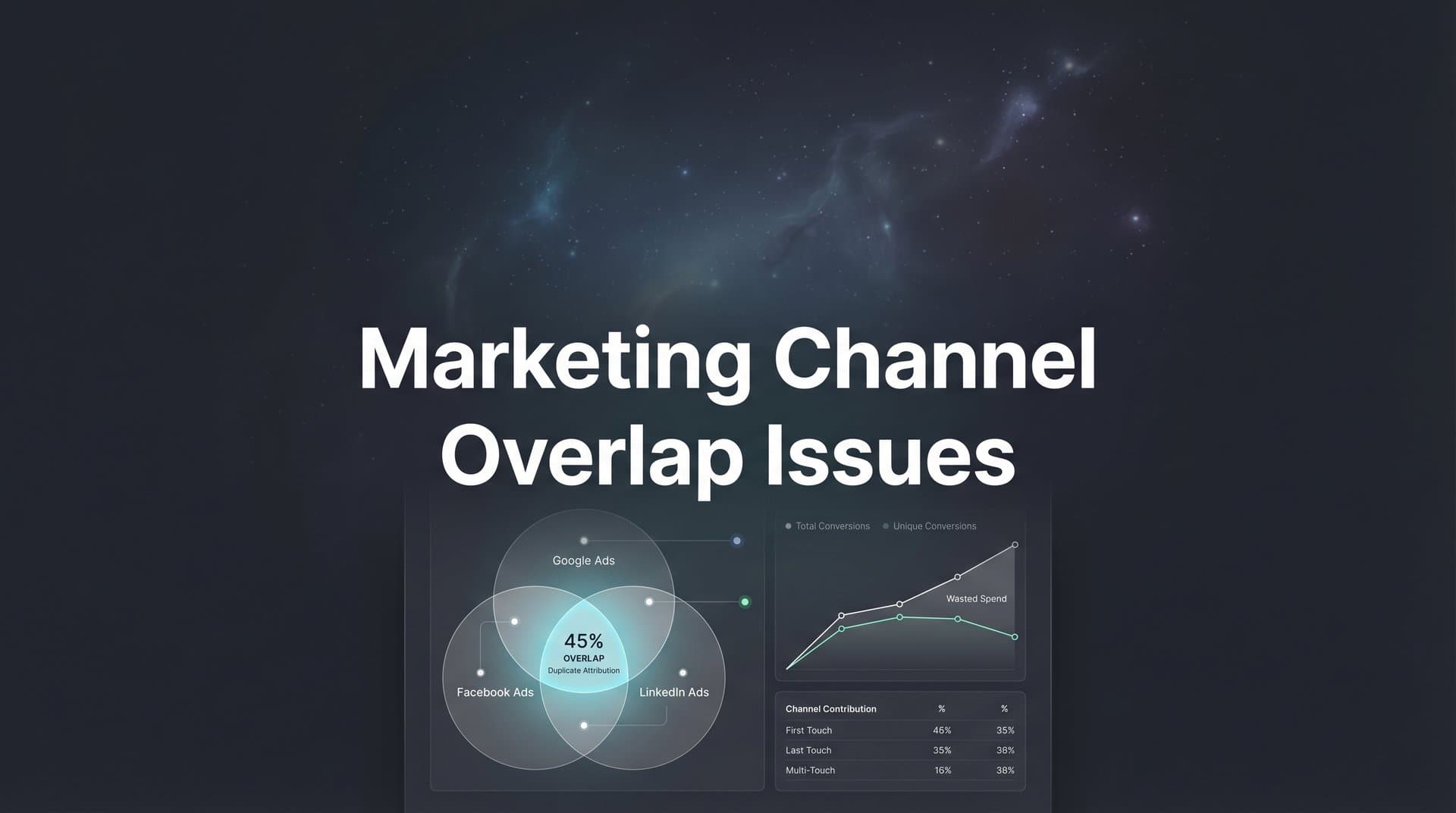
You're staring at your monthly marketing dashboard, and something doesn't add up. Facebook Ads Manager shows 200 conversions this month. Google Ads claims 180. Your email platform reports 95. When you tally it all up, you should be celebrating 475 sales. But your CRM tells a very different story: only 150 actual purchases.
Welcome to the frustrating world of marketing channel overlap, where every platform fights to claim credit for your conversions, your metrics inflate like a balloon, and your budget decisions rest on a foundation of lies. This isn't a minor reporting quirk. It's a fundamental flaw that causes marketers to waste thousands on channels they think are performing when they're actually just stealing credit from each other.
The math should be simple: add up your conversions, calculate your ROAS, allocate budget accordingly. But when multiple platforms claim the same sale, you're not optimizing your marketing. You're playing a shell game where everyone wins except you. In this guide, we'll expose exactly why your attribution data is lying to you and show you how to build a system that tells the truth.
The Real Price of Counting Every Conversion Twice
Marketing channel overlap happens when multiple advertising platforms claim credit for the same conversion because they each touched the customer somewhere in their journey. Think of it like three different salespeople all claiming commission on the same deal because they each had a conversation with the buyer.
Here's the problem: when Facebook says it drove 200 conversions and Google says it drove 180, they're not talking about 380 different sales. They're often describing the same 150 people who happened to interact with both platforms before purchasing. Each platform tracked the conversion independently, applied its own attribution rules, and proudly claimed the win.
The immediate consequence is inflated ROAS across every channel. Your Facebook campaigns show a 4x return. Google Ads reports 3.5x. Email claims 5x. Based on these numbers, every channel looks profitable and worth scaling. But when you calculate true ROAS against actual revenue, the real number might be 2x across all channels combined.
This inflation creates a dangerous feedback loop. You see strong ROAS on Facebook, so you increase the budget. Facebook's numbers keep looking good because it's still touching customers who would have converted anyway through other channels. You're spending more money without generating proportionally more sales, but the metrics keep telling you everything is working.
The budget impact compounds quickly. If you're allocating $50,000 monthly across channels based on inflated performance data, you might be overspending $15,000-20,000 on channels that appear profitable but are actually riding on the effectiveness of your brand awareness, organic search, or other foundational marketing efforts. That's $180,000-240,000 annually wasted on false signals. Understanding marketing budget waste on wrong channels is critical to avoiding this trap.
Even worse, overlap masks which channels genuinely drive incremental conversions versus which ones simply capture demand that already exists. Your retargeting campaigns might show amazing ROAS because they target people who already visited your site through organic search. Your branded search campaigns might look incredibly efficient because they intercept customers who were going to buy anyway. You're paying for conversions you would have earned for free.
The strategic cost extends beyond wasted budget. When you can't trust your attribution data, you can't make confident optimization decisions. Should you scale Facebook or Google? Which creative performs best? What's your true customer acquisition cost? Every answer is compromised by overlapping credit claims that distort the truth.
The Platform Attribution Game: Why Everyone Claims Victory
Every ad platform operates its own tracking system with its own rules for claiming conversions. Meta uses a default 7-day click and 1-day view attribution window. Google Ads defaults to 30 days for search clicks. TikTok, LinkedIn, Pinterest—each has different lookback periods and conversion counting methodologies.
What does this mean in practice? If someone clicks your Facebook ad on Monday, clicks your Google ad on Wednesday, and purchases on Thursday, both platforms will claim that conversion. Facebook says, "They clicked our ad within the 7-day window before converting." Google says, "They clicked our ad within the 30-day window before converting." Both statements are technically true, but only one sale actually happened.
View-through conversions multiply the overlap problem exponentially. These conversions count when someone simply sees your ad without clicking, then converts later through any channel. Meta might count a conversion if someone scrolled past your ad in their feed, even if they never engaged with it, then searched your brand name and purchased three days later. This marketing channel attribution confusion plagues marketers across industries.
Cross-device tracking creates additional scenarios where the same person appears as multiple converters. Someone might see your ad on their phone during their morning commute, research on their tablet during lunch, and purchase on their desktop that evening. Depending on how each platform handles cross-device matching, this single customer journey could register as multiple conversions across different platforms.
Here's the uncomfortable truth: platforms are incentivized to claim credit broadly rather than accurately. Their business model depends on advertisers believing their ads work. The more conversions they can attribute to their platform, the better their reported performance looks, and the more likely you are to increase your budget.
This isn't necessarily malicious. Each platform genuinely believes its touchpoint contributed to the conversion. But when every platform applies this generous interpretation simultaneously, the collective result is a massively inflated conversion count that bears little resemblance to your actual sales volume.
The situation has intensified since iOS privacy changes and cookie deprecation forced platforms to rely more heavily on modeled conversions. When direct tracking becomes limited, platforms use statistical modeling to estimate conversions. These models tend toward optimistic assumptions because conservative estimates would show declining performance, and no platform wants to report that their ads are becoming less effective.
Three Overlap Scenarios Burning Your Budget Right Now
The Retargeting Trap: A potential customer discovers your product through an organic blog post. They visit your site but don't purchase. Over the next week, they see your retargeting ads on Facebook and Instagram multiple times. Finally, they search your brand name on Google, click the paid search ad, and convert. Facebook claims the conversion because their retargeting ad was clicked within the attribution window. Google claims it because the final click came from their platform. But the real question is whether either paid channel actually created incremental value, or if they simply captured someone who was already moving toward a purchase.
This scenario plays out thousands of times daily in most marketing accounts. Retargeting campaigns often show exceptional ROAS numbers because they target high-intent audiences who already know your brand. But when retargeting overlaps with brand search, email nurture sequences, and direct traffic, you're paying multiple channels to claim credit for the same inevitable conversion. Learning to measure incremental revenue from marketing channels helps you identify which touchpoints actually matter.
Brand Search Cannibalization: Your brand has strong organic presence. When people search your company name, you rank first organically. But you also run paid brand search campaigns to "protect" your brand terms. A customer who learned about you from a Facebook ad searches your brand name, sees both your organic listing and paid ad, and clicks the paid ad because it appears first. Google Ads claims this conversion with stellar ROAS metrics.
The reality? This customer would have clicked your organic result if the paid ad didn't exist. You're paying Google to intercept traffic you would have received for free. Meanwhile, Facebook also claims this conversion because their ad initiated the brand awareness that led to the search. Two platforms claiming credit, one conversion that might have happened organically anyway.
Multi-Touch Journey Chaos: A B2B buyer's journey touches multiple channels over several weeks. They first encounter your brand through a LinkedIn ad. They download a whitepaper after clicking a Google search ad. They attend a webinar promoted via email. They visit your pricing page after clicking a Facebook retargeting ad. Finally, they request a demo through direct traffic and convert three days later.
LinkedIn claims the conversion (first touch within their attribution window). Google claims it (they clicked a search ad). Facebook claims it (retargeting ad click before conversion). Email claims it (webinar registration led to engagement). Each platform reports 100% credit for one conversion, creating the illusion of four successful conversions when only one actual customer exists.
These scenarios aren't edge cases. They represent the typical customer journey in modern marketing, where multiple touchpoints across different channels all contribute to a single outcome. The problem isn't that these touchpoints exist—it's that every platform claims full credit instead of acknowledging their role in a larger journey.
Finding the Overlap Hiding in Your Data
The first diagnostic step is brutally simple: add up all the conversions your platforms claim, then compare that number to your actual sales or leads in your CRM or transaction system. If Facebook reports 200 conversions, Google reports 180, and email reports 95, that's 475 total claimed conversions. If your CRM shows 150 actual customers, you have 325 phantom conversions created by overlap. Proper marketing channel overlap measurement starts with this basic comparison.
This gap tells you the magnitude of your overlap problem. A 10-20% difference might be acceptable, attributable to timing delays or legitimate tracking discrepancies. But when platforms claim 2-3x more conversions than actually occurred, you're making budget decisions based on fiction.
Next, apply incrementality thinking to each channel. Ask yourself: if I completely paused this channel for two weeks, would my total conversions drop by the number this channel claims? If Facebook claims 200 conversions monthly, would pausing Facebook actually cost you 200 sales, or would most of those customers still convert through other channels?
Many marketers discover that pausing certain channels barely impacts total conversions because those channels were capturing demand rather than creating it. Your brand search campaigns might claim 150 conversions monthly, but pausing them might only reduce total conversions by 20-30 because most brand searchers would click your organic listing instead.
Look for correlation patterns where multiple channels spike together. If Facebook conversions, Google conversions, and email conversions all increase during the same week, they're likely targeting overlapping audience segments or responding to the same external factors like seasonality or brand awareness campaigns.
Examine your retargeting audiences specifically. If 80% of your retargeting conversions come from people who also clicked a brand search ad within the same timeframe, you have massive overlap between these channels. They're fighting over the same high-intent audience rather than reaching distinct customer segments. Understanding which marketing channel drives sales requires separating these overlapping signals.
Review your attribution windows across platforms. If you're using 30-day windows on Google and 7-day windows on Facebook, but your average sales cycle is 3 days, you're allowing platforms to claim credit for touchpoints that happened weeks before the actual decision-making process began.
How Unified Attribution Stops the Double-Counting
Server-side tracking fundamentally changes the attribution game by capturing the complete customer journey in one centralized system rather than relying on fragmented platform data. Instead of each platform independently tracking conversions through its own pixel or cookie, server-side tracking creates a single source of truth that records every touchpoint a customer has with your brand across all channels.
Here's how it works: when someone clicks your Facebook ad, that click gets recorded in your unified tracking system. When they later click a Google ad, that interaction is also recorded and connected to the same user profile. When they finally convert, the system knows exactly which touchpoints this specific person encountered, in what order, and can apply attribution rules consistently across the entire journey.
This approach eliminates the scenario where Facebook and Google both independently claim 100% credit for the same conversion. Instead, your unified system sees that both platforms touched this customer and can distribute credit appropriately based on the attribution model you choose. A comprehensive multi-channel marketing attribution approach makes this possible.
Multi-touch attribution models solve the credit distribution problem by acknowledging that multiple channels contribute to conversions and allocating credit proportionally. A linear model might give 33% credit to the Facebook ad that created awareness, 33% to the Google search that drove consideration, and 33% to the email that prompted the final purchase.
More sophisticated models like time decay give more credit to touchpoints closer to conversion, while position-based models emphasize both the first touch (awareness) and last touch (conversion) while distributing remaining credit to middle interactions. The specific model matters less than the fundamental shift from "everyone gets 100%" to "credit is distributed based on actual contribution."
The real power emerges when you feed this deduplicated conversion data back to ad platforms. Instead of letting Facebook's pixel and Google's tag independently fire conversion events, your unified system sends a single, accurate conversion event to each platform based on your attribution model. If your model assigns 30% credit to Facebook for a conversion, you can send Facebook a conversion event with a value weighted at 30% of the actual sale.
This approach improves ad platform optimization algorithms because they receive more accurate signals about which audiences and creative actually drive conversions versus which ones simply touch customers who would have converted anyway. Over time, platforms learn to target genuinely incremental audiences rather than just remarketing to people already moving toward purchase.
The result is a marketing system where your total attributed conversions might actually decrease, but your understanding of true channel contribution improves dramatically. You'll see which channels genuinely create new demand versus which ones capture existing demand, enabling smarter budget allocation toward incremental growth.
Creating Your Single Source of Marketing Truth
Building accurate attribution starts with connecting every marketing touchpoint into one unified view. This means integrating your ad platforms, CRM, email system, website analytics, and transaction data into a centralized system that can track individual customer journeys from first touch to final conversion.
The technical foundation requires consistent tracking protocols across all channels. Use standardized UTM parameters for every campaign, following a naming convention that allows you to identify channel, campaign, ad set, and creative in your unified system. When Facebook, Google, email, and organic all use the same parameter structure, you can accurately map the customer journey regardless of which platforms they touch. Learn how to track multi-channel marketing effectively with proper parameter structures.
Server-side tracking provides the infrastructure to capture these touchpoints reliably, especially as browser-based tracking becomes less effective due to privacy changes and cookie restrictions. By processing tracking data on your server rather than relying on client-side pixels, you gain more complete visibility into the customer journey and reduce data loss from ad blockers or privacy settings.
Connect your CRM or transaction system as the ultimate source of truth for conversions. This integration allows you to compare platform-reported conversions against actual customers who paid money or became qualified leads. The gap between these numbers reveals the extent of overlap and attribution inflation across your channels.
Establish regular data audits where you compare platform reports against actual revenue. Monthly reviews should examine total conversions claimed across all platforms versus actual sales, ROAS calculated from platform data versus true ROAS based on actual revenue, and channel performance trends to identify whether apparent improvements reflect genuine growth or attribution drift. A multi-channel marketing analytics dashboard simplifies these comparisons.
Use your unified system to analyze customer journeys at the individual level. Look at actual paths to conversion: how many touchpoints do customers typically have? Which channels appear early in the journey versus late? Which combinations of channels correlate with higher conversion rates or customer lifetime value? This journey-level analysis reveals patterns that platform-level reporting obscures.
Document your attribution methodology and share it across your marketing team. When everyone understands how credit is distributed and why total attributed conversions might not sum to actual sales, you prevent confusion and align decision-making around accurate performance data rather than inflated platform claims.
Stop Optimizing on Lies, Start Scaling on Truth
Marketing channel overlap isn't a minor reporting annoyance you can ignore while focusing on "big picture" strategy. It's a fundamental threat to accurate decision-making that causes you to waste budget on channels that appear profitable but deliver minimal incremental value. Every dollar you allocate based on inflated ROAS is a dollar that could be generating actual growth if directed toward genuinely effective channels.
The diagnostic process is straightforward: compare total platform-reported conversions against actual sales to quantify your overlap problem. Apply incrementality thinking to challenge whether each channel's claimed conversions would actually disappear if you paused that channel. Look for correlation patterns that reveal multiple channels fighting over the same audience.
The solution requires moving from fragmented platform tracking to unified attribution that captures the complete customer journey in one system. Implement server-side tracking to create a single source of truth. Use multi-touch attribution models that distribute credit proportionally instead of giving 100% to every touchpoint. Feed deduplicated conversion data back to ad platforms to improve their optimization algorithms.
Build a connected system where ad platforms, CRM, and website tracking flow into one unified view. Use consistent UTM parameters across all channels. Establish regular audits comparing platform reports against actual revenue. Make attribution methodology transparent across your team so everyone optimizes based on the same accurate data.
The marketers who solve overlap first gain a decisive competitive advantage. While competitors waste budget scaling channels based on inflated metrics, you'll allocate resources toward genuinely incremental growth. While they celebrate phantom conversions, you'll optimize based on actual customer acquisition cost and true ROAS. While they struggle to understand why increased ad spend doesn't proportionally increase revenue, you'll know exactly which channels drive real business outcomes.
The path forward is clear: stop accepting attribution data at face value. Question every conversion claim. Demand proof that your channels create incremental value rather than just capturing demand that would have converted anyway. Build systems that tell the truth about marketing performance, even when that truth is less flattering than platform-reported metrics.
Ready to elevate your marketing game with precision and confidence? Discover how Cometly's AI-driven recommendations can transform your ad strategy. Get your free demo today and start capturing every touchpoint to maximize your conversions.


