Every marketing dollar you spend tells a story—but only if you know how to read it. Right now, your campaigns are generating thousands of data points across Meta, Google, your CRM, and your website. Each click, conversion, and customer interaction contains clues about what's working and what's draining your budget. Yet most marketers look at this data and see noise instead of narrative.
Marketing data analysis transforms raw numbers into actionable insights that reveal what's actually driving revenue. Without proper analysis, you're essentially flying blind, making decisions based on gut feelings rather than evidence. You might think your Facebook prospecting campaigns are your growth engine when your data shows they're actually your most expensive customer acquisition channel. Or you could be overlooking a Google Search campaign that consistently delivers your highest-value customers.
This guide walks you through the complete process of analyzing your marketing data effectively, from setting up your data infrastructure to extracting insights that improve campaign performance. Whether you're analyzing paid ad performance across multiple platforms, tracking customer journeys through your funnel, or trying to understand which touchpoints deserve credit for conversions, you'll learn a systematic approach that turns overwhelming data into clear direction.
The difference between marketers who scale profitably and those who burn through budgets often comes down to one thing: their ability to extract meaning from their data. By the end of this guide, you'll have a repeatable framework for making confident, data-backed marketing decisions that compound in value over time.
Step 1: Define Your Analysis Goals and Key Questions
Before you open a single dashboard or export any reports, you need absolute clarity on what you're trying to learn. This sounds obvious, but most marketing data analysis fails at this exact step. Marketers dive into their analytics tools, get overwhelmed by the sheer volume of available metrics, and emerge hours later with interesting observations but no actionable direction.
Start by identifying the specific business questions you need to answer. Not "How are my campaigns performing?" but "Which channel is driving customers with the highest lifetime value?" or "Where exactly are prospects dropping off in my funnel?" or "Why did my cost per acquisition spike 40% last month?"
Your analysis goals should align directly with business objectives. If your company needs to reduce customer acquisition costs by 20% this quarter, your analysis should focus on identifying inefficient spend and finding lower-cost conversion paths. If you're trying to scale revenue, you need to understand which campaigns can handle increased budget without degrading performance.
Document three to five primary questions your analysis must answer before you touch any data. Write them down. Be specific. "Improve ROAS" isn't a question—it's a vague aspiration. "Which audience segments convert at under $50 CPA so we can shift budget from our $120 CPA campaigns?" gives you something concrete to investigate.
Think about the decisions this analysis will inform. Will you reallocate budget between channels? Pause underperforming campaigns? Change your targeting strategy? If you can't articulate the potential actions that might result from your analysis, you're not ready to start analyzing.
Here's your success indicator for this step: You can explain to a colleague in one sentence exactly what business decision this analysis will help you make. If you're stumbling through a paragraph of maybes and possibilities, go back and sharpen your focus. The clearer your questions, the more valuable your answers will be.
Step 2: Audit and Connect Your Data Sources
Now that you know what questions you're trying to answer, you need to ensure you have the data to answer them. This means taking inventory of every place your marketing data lives and understanding how—or if—those sources connect to each other.
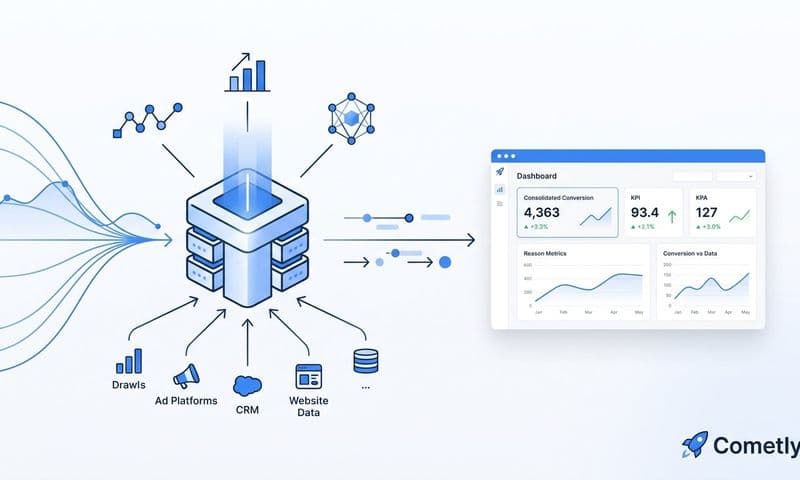
Map all your data sources systematically. Your ad platforms like Meta Ads Manager and Google Ads contain campaign performance metrics. Your CRM holds lead and customer data. Your website analytics shows user behavior and conversions. Your attribution platform tracks the customer journey across touchpoints. Each source tells part of the story, but none tells the complete narrative alone.
The critical question is: Can you connect a specific ad click to the actual revenue it generated? Many marketers can tell you their Facebook campaign drove 500 clicks and their sales team closed $50,000 in deals last week, but they can't definitively say which clicks turned into which deals. This disconnect makes it impossible to optimize effectively. Understanding how to connect all marketing data sources is essential for solving this challenge.
Identify gaps where customer journey data may be missing or disconnected. Common blind spots include offline conversions that never get tracked back to their digital source, phone calls that bypass your analytics setup, or CRM data that never flows back to your ad platforms. If a prospect clicks your ad, fills out a form, gets nurtured through email, and eventually purchases, can you see that complete path in one place?
Server-side tracking has become essential for capturing accurate data in the face of browser restrictions and privacy changes. Browser-based tracking misses conversions due to ad blockers, cookie deletion, and cross-device journeys. If you're still relying entirely on pixel-based tracking, you're likely underreporting conversions by 20-30% or more.
Ensure your tracking captures the full journey from first click to revenue event. This means implementing proper UTM parameters on all campaign links, setting up conversion tracking that fires reliably, and connecting your ad platforms to your CRM so conversion data flows bidirectionally. When you can see which initial touchpoint led to which final sale, you can make intelligent decisions about where to invest.
The most common pitfall at this stage is accepting siloed data that can't connect ad clicks to actual sales. Your Facebook Ads Manager might show great conversion rates, but if those conversions are form fills that your sales team never closes, you're optimizing for the wrong outcome. Addressing the marketing data silos problem should be a priority before diving into analysis.
Step 3: Clean and Organize Your Marketing Data
Raw marketing data is messy. Campaign names follow different conventions depending on who created them and when. Dates appear in multiple formats. The same audience might be labeled "Retargeting" in one campaign and "Remarketing" in another. Before you can analyze anything meaningful, you need to clean and standardize this chaos.
Start by removing duplicates and fixing obvious errors. If the same conversion is being counted twice because it's tracked by both your pixel and your server-side integration, your analysis will overstate performance. If campaign spend data imported incorrectly and shows you spent $100,000 on a campaign that actually cost $10,000, your ROI calculations will be wildly wrong.
Standardize naming conventions across all campaigns and data sources. Create a consistent taxonomy so "Facebook_Prospecting_Jan," "FB-Prospecting-January," and "Meta Prospecting 01/2026" all get recognized as the same thing. This might seem tedious, but inconsistent naming is one of the biggest obstacles to effective analysis. When you're trying to compare performance across time periods or channels, you need apples-to-apples data.
Segment your data by relevant dimensions that align with your analysis goals. Common dimensions include channel (Meta, Google, LinkedIn), campaign type (prospecting vs. retargeting), audience segment, geographic region, and time period. The key is organizing data in ways that let you quickly filter and compare across any dimension that matters to your business questions.
Fix date formatting issues so all your data uses the same standard. Mixing MM/DD/YYYY with DD/MM/YYYY formats will create errors when you try to analyze trends over time. Ensure timezone consistency too—if your ad platform reports in UTC but your analytics tool uses your local timezone, you'll see discrepancies that aren't real.
Create calculated fields for metrics you'll analyze repeatedly. If you always evaluate campaigns based on customer acquisition cost, blended ROAS, or cost per qualified lead, build those calculations into your data structure once rather than recreating them every time you run analysis. Following marketing data integration best practices will help you establish these foundations correctly.
Your success indicator for this step: You can quickly filter and compare performance across any dimension without confusion. If you can pull up "all prospecting campaigns across Meta and Google for Q4 2025" in seconds and trust the data is accurate and complete, you've organized your data properly. If you're still manually combining spreadsheets and guessing which campaigns belong in which category, keep cleaning.
Step 4: Choose the Right Attribution Model for Your Analysis
Attribution determines which touchpoints get credit for conversions, and choosing the wrong model can completely distort your understanding of what's working. This isn't just a technical decision—it fundamentally shapes how you interpret your data and where you invest your budget.
First-touch attribution gives all credit to the initial interaction that brought someone into your funnel. If a prospect first clicked a Facebook ad, then later clicked a Google ad before purchasing, Facebook gets 100% credit. This model makes your top-of-funnel awareness campaigns look incredibly effective while undervaluing everything that happened afterward.
Last-touch attribution does the opposite, giving all credit to the final touchpoint before conversion. In the same scenario, Google gets 100% credit. This model makes your bottom-of-funnel campaigns and retargeting look like heroes while ignoring the awareness campaigns that introduced prospects to your brand in the first place.
Multi-touch attribution distributes credit across multiple touchpoints in the customer journey. Different multi-touch models weight touchpoints differently—linear attribution splits credit evenly, time-decay gives more weight to recent interactions, and position-based models emphasize both first and last touches while giving some credit to middle interactions.
Match your attribution model to your business reality. If you're running direct response campaigns where people typically convert immediately after their first click, last-touch attribution might accurately reflect your funnel. But if you have a longer sales cycle where prospects interact with multiple channels over weeks or months before purchasing, you need multi-touch visibility to understand the complete journey. Understanding the attribution challenges in marketing analytics will help you navigate these complexities.
Here's why this matters: The wrong model can make your best-performing channels look ineffective. Imagine you run brand awareness campaigns on Meta that introduce prospects to your product, then retargeting campaigns that close the sale. Last-touch attribution will show your retargeting campaigns as wildly profitable while your prospecting campaigns appear to generate no value. You might cut prospecting budget based on this analysis, only to watch your retargeting performance crater because you've stopped feeding it new prospects.
Compare results across different attribution models to understand how credit shifts between channels. If a campaign looks amazing under last-touch but mediocre under first-touch, that tells you something important about its role in your funnel. Channels that perform well across multiple attribution models are genuinely driving value, while those that only shine under one specific model may be getting credit they don't deserve.
The most sophisticated approach is using data-driven attribution that analyzes your actual conversion paths and assigns credit based on statistical analysis of which touchpoints correlate most strongly with conversions. This requires substantial conversion volume to work effectively, but it removes the arbitrary assumptions built into rule-based models. Leveraging data science for marketing attribution can help you implement these advanced approaches.
Step 5: Analyze Performance Patterns and Identify Insights
Now you're ready for the actual analysis work. This is where you move beyond surface-level metrics and start uncovering the patterns that will inform your optimization decisions. The goal isn't just to know what happened—it's to understand why it happened and what you should do about it.
Look beyond vanity metrics like clicks, impressions, and engagement rates. These numbers might make you feel good, but they don't pay the bills. Connect ad engagement to actual revenue outcomes. A campaign with a 5% click-through rate but a $200 cost per acquisition isn't performing better than one with a 2% CTR and a $50 CPA. Focus relentlessly on metrics that tie to business results.
Identify patterns across multiple dimensions. Which audience segments convert fastest? Which campaigns consistently deliver customers with the highest lifetime value? Where is your spend generating clicks but no conversions? Which creative formats drive the most efficient customer acquisition? These patterns reveal optimization opportunities that aren't visible when you just look at top-line numbers.
Compare performance across time periods to spot trends and seasonality. Did your cost per acquisition spike last month because your targeting got worse, or because you entered a seasonally competitive period where everyone in your industry increases their ad spend? Understanding temporal patterns helps you distinguish signal from noise and set realistic expectations.
Segment your analysis by customer value, not just acquisition cost. A channel that delivers customers at $100 CPA might seem expensive compared to one that acquires customers at $50 CPA, but if the $100 CPA customers have 3x higher lifetime value, that "expensive" channel is actually your most profitable. Always connect acquisition metrics to downstream revenue and retention data.
Use cohort analysis to understand how customer behavior evolves post-acquisition. Customers acquired through different channels often behave differently over time. Some channels might deliver customers who make an immediate purchase then never return, while others bring customers who start small but expand their spending over months. This insight should influence how you value different acquisition sources.
Look for inflection points where performance changed significantly. When did your cost per click suddenly increase? What happened right before your conversion rate improved? These inflection points often reveal cause-and-effect relationships that aren't obvious from aggregate data. Maybe your CPA spiked when you expanded into a new geographic market, or your conversion rate improved after you revised your landing page messaging. Using the right marketing analysis tools makes identifying these patterns much easier.
Analyze the complete funnel, not just the endpoints. Where are prospects dropping off? Is your issue low click-through rates, meaning your ads aren't resonating? Or are people clicking but not converting, suggesting a disconnect between ad messaging and landing page experience? Understanding where the funnel breaks helps you focus optimization efforts where they'll have the most impact.
Cross-reference your marketing data with external factors. Did your performance change because of your actions, or because of market conditions outside your control? A competitor launching a major promotion, seasonal demand shifts, or broader economic trends can all impact your metrics. Understanding context prevents you from over-optimizing for temporary conditions.
Step 6: Turn Insights Into Actionable Recommendations
Analysis without action is just expensive reporting. This step is where you translate your findings into specific, prioritized recommendations that will actually improve performance. The difference between a good analyst and a great one is the ability to move from "here's what the data shows" to "here's exactly what we should do about it."
Translate each finding into a specific action. Don't say "Facebook prospecting campaigns are underperforming." Say "Pause the 'Broad Interest Targeting' campaign that's spending $500/day at $180 CPA when our target is $100 CPA, and reallocate that budget to the 'Custom Audience Lookalike' campaign that's consistently delivering $65 CPA." Specificity makes recommendations actionable.
Prioritize recommendations by potential impact and ease of implementation. Rank opportunities using a simple framework: Will this move the needle significantly? How quickly can we implement it? How confident are we in the data supporting it? Focus on high-impact, high-confidence changes first, then move to longer-term strategic shifts that require more substantial changes.
Create a testing plan to validate insights before making major budget shifts. If your analysis suggests a particular audience segment converts more efficiently, don't immediately shift 80% of your budget there. Run a controlled test with a meaningful budget increase and measure results over a statistically significant period. Implementing data-driven marketing strategies requires this kind of disciplined experimentation.
Quantify the expected impact of each recommendation. "Increase budget on Campaign X" is less compelling than "Increase Campaign X budget from $1,000/day to $2,000/day, which based on current $50 CPA should deliver an additional 20 customers per day and $4,000 in daily revenue at our average customer value of $200." Stakeholders need to understand not just what to do, but what results to expect.
Document findings in a format stakeholders can quickly understand and act on. Executives don't need to see every data table and calculation that led to your conclusions. They need to see: What did we learn? What should we do about it? What results should we expect? How will we measure success? Present recommendations with clear next steps and success metrics. Effective data visualization tools for marketing analytics can help communicate these insights clearly.
Address potential objections proactively. If you're recommending cutting budget from someone's favorite campaign, explain why the data supports that decision and what alternative approach will deliver better results. If you're suggesting a significant strategic shift, acknowledge the risks and explain how you'll monitor and adjust if results don't match expectations.
Build accountability into your recommendations by assigning owners and deadlines. "Someone should optimize our landing pages" never happens. "Sarah will revise the prospecting campaign landing page by Friday and implement A/B test to measure conversion rate impact" actually gets done. Clear ownership and timelines turn recommendations into results.
Putting It All Together: Your Marketing Data Analysis Checklist
Marketing data analysis is a systematic process, not a random exploration. Use this checklist to ensure you're covering all the essential steps every time you analyze your performance:
Before You Start: Define 3-5 specific business questions your analysis must answer. Identify what decisions this analysis will inform.
Data Preparation: Audit all data sources for completeness and accuracy. Verify tracking captures the full customer journey from first click to revenue. Clean data by removing duplicates and standardizing naming conventions. Segment data by relevant dimensions aligned with your analysis goals.
Analysis Framework: Choose attribution model(s) appropriate for your sales cycle and business model. Compare performance across multiple attribution models to understand credit distribution. Focus on revenue-connected metrics, not vanity metrics. Analyze patterns across channels, audiences, time periods, and customer segments.
Insight Development: Identify inflection points where performance changed significantly. Understand why changes occurred, not just what changed. Connect findings to business outcomes and customer lifetime value.
Action Planning: Translate insights into specific, prioritized recommendations. Quantify expected impact of each recommendation. Create testing plan to validate major changes before full implementation. Document findings with clear next steps and success metrics.
Establish a consistent analysis cadence that matches your business rhythm. Weekly performance checks help you catch issues early and capitalize on opportunities quickly. Monthly deep dives provide time to identify longer-term trends and patterns. Quarterly strategic reviews ensure your overall marketing approach aligns with business objectives and market conditions.
Build a continuous improvement loop where each analysis informs the next. Document what you learned, what actions you took, and what results you achieved. This creates institutional knowledge and helps you refine your analysis process over time. The questions you ask in month six should be more sophisticated than the ones you asked in month one, because you're building on accumulated insights. Understanding why marketing data accuracy matters for ROI will reinforce the importance of maintaining this discipline.
Your Path to Data-Driven Marketing Excellence
Marketing data analysis isn't a one-time project—it's an ongoing practice that compounds in value over time. As you consistently apply this framework, you'll develop intuition for spotting opportunities and catching problems early. Patterns that took hours to identify in your first analysis will jump out at you instantly after you've been through the process a dozen times.
The marketers who win aren't necessarily those with the biggest budgets; they're the ones who understand their data well enough to make every dollar work harder. They know which channels drive their highest-value customers, where their funnel breaks down, and which campaigns can scale without degrading performance. This knowledge doesn't come from gut feelings or best practices borrowed from other companies—it comes from rigorous, systematic analysis of their own data.
Start with your most pressing business question. Work through these steps systematically. Let the data guide your next move. Don't try to analyze everything at once—focus on the questions that matter most to your business right now, get clear answers, take action, and measure results. Then move to the next question.
The difference between hoping your marketing works and knowing it works is systematic analysis. Every campaign you run generates data. Every customer interaction reveals patterns. The question is whether you're extracting the insights buried in that data or letting them go to waste.
Ready to elevate your marketing game with precision and confidence? Discover how Cometly's AI-driven recommendations can transform your ad strategy—Get your free demo today and start capturing every touchpoint to maximize your conversions.