You're tracking clicks. You're monitoring impressions. You're watching conversion rates tick up and down across Meta, Google, TikTok, and LinkedIn. Your spreadsheets are full of numbers, your dashboards are color-coded, and your weekly reports are packed with charts.
But here's the uncomfortable question: Do you actually know which campaigns are driving revenue?
Most marketers can tell you their cost per click. Far fewer can confidently explain which touchpoints in the customer journey matter most, or why their ad spend isn't translating into predictable growth. The problem isn't a lack of data—it's that the data lives in disconnected silos, each platform claiming credit for the same conversions while your actual revenue story remains hidden.
Marketing data and analytics should answer one fundamental question: What's actually working? This guide cuts through the noise to show you what marketing data really tells you, how to connect the pieces across your entire analytics stack, and how to turn raw numbers into confident budget decisions that drive real business results.
Beyond Vanity Metrics: What Marketing Data Actually Tells You
Let's start with a reality check. Not all data carries the same weight.
When you open your ad platform dashboards, you're immediately hit with behavioral data: clicks, impressions, page views, video completion rates. These metrics show engagement—people are interacting with your content. That's useful, but it's surface-level.
Dig one layer deeper and you find conversion data: form submissions, add-to-cart actions, email signups, demo requests. This data shows intent. Someone didn't just scroll past your ad—they took a specific action that signals interest. This is where most marketers stop tracking.
But there's a third layer that changes everything: revenue data. This includes actual purchases, closed deals, customer lifetime value, and repeat purchase behavior. This is the data that connects marketing activity to business outcomes. It's the difference between knowing someone clicked your ad and knowing that click led to a customer who spent $5,000.
Here's why this matters: behavioral metrics can look fantastic while your revenue stays flat. You might celebrate a campaign with a 3% click-through rate and 200 conversions, only to discover later that none of those conversions became paying customers. Platform-reported metrics measure activity. Business outcomes measure value.
The customer journey is a data story that spans multiple touchpoints. Someone might see your Instagram ad on Monday, click a Google search result on Wednesday, read three blog posts on Thursday, and finally convert through a retargeting ad on Friday. Each platform sees its own piece of this story. Instagram claims the conversion because it started the journey. Google claims it because the search showed intent. Your retargeting platform claims it because it delivered the final click.
They're all technically correct about their role—and all potentially wrong about their importance. Without connecting these data points into a complete journey, you're making budget decisions based on partial stories. You might cut spending on awareness campaigns because they don't show direct conversions, not realizing they're essential to starting the journeys that eventually drive revenue.
The shift from vanity metrics to meaningful insights starts with asking better questions. Instead of "How many clicks did we get?" ask "Which touchpoints appear in the journeys of customers who actually buy?" Instead of "What's our cost per lead?" ask "What's our cost per customer, and which channels drive the highest-value buyers?" Understanding what data analytics in marketing truly means is the first step toward this transformation.
The Analytics Stack: Connecting Your Data Sources
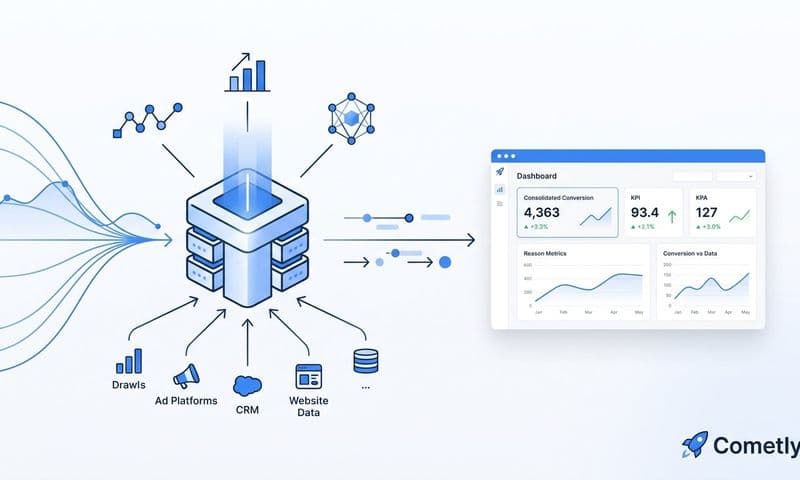
Think of your marketing data ecosystem as a puzzle where the pieces live in different rooms. You've got ad platforms reporting performance in their own dashboards. Website analytics tracking visitor behavior. Your CRM holding lead and opportunity data. And somewhere in your finance system, the actual revenue numbers that matter most.
Each system captures valuable information, but they don't naturally talk to each other. This creates blind spots that cost you money.
Your ad platforms—Meta Ads Manager, Google Ads, LinkedIn Campaign Manager—know what you spent and what actions people took immediately after clicking. They're excellent at tracking their own performance, but they can't see what happens after someone leaves their ecosystem. Did that lead become a qualified opportunity? Did they eventually purchase? These platforms don't know, so they optimize for actions they can measure, which might not align with actions that drive revenue.
Website analytics tools track on-site behavior: which pages visitors view, how long they stay, where they drop off. This helps you understand the user experience, but it typically can't connect a specific visitor back to the ad campaign that brought them there—especially after iOS privacy changes and cookie restrictions fragmented tracking capabilities.
Your CRM holds the gold: lead quality, sales cycle progression, deal values, customer lifetime value. This is where marketing activity transforms into business outcomes. But most CRMs don't automatically connect back to the original marketing touchpoints. Your sales team knows they closed a $50,000 deal, but they can't tell you which combination of ads, content, and channels influenced that customer's journey. Bridging this gap requires robust sales and marketing analytics integration.
Here's where it gets technical—but stay with me because this matters. Traditional pixel-based tracking relies on browser cookies to follow users across the web. When iOS introduced App Tracking Transparency and browsers started blocking third-party cookies, this approach broke down. Suddenly, a significant portion of your traffic became invisible to your tracking pixels.
Server-side tracking offers a more reliable alternative. Instead of depending on browser cookies that can be blocked or deleted, server-side tracking sends data directly from your server to your analytics platforms. This approach isn't affected by browser restrictions, providing more complete and accurate data about user behavior and conversions.
The goal isn't to implement every possible tracking tool—it's to connect the essential data sources so you can see the complete picture. When your ad platforms, website analytics, and CRM communicate through a unified attribution system, you stop guessing about what works and start knowing. The right marketing data analytics software makes this connection possible.
Attribution Models: Giving Credit Where It's Due
Here's a scenario that plays out in marketing teams everywhere: Your Meta campaigns show 100 conversions this month. Your Google Ads dashboard also claims 100 conversions. But your CRM only recorded 120 total new leads. How did two platforms generate 200 conversions when you only got 120 leads?
Welcome to the attribution puzzle.
Attribution models are the rules that determine which touchpoint gets credit for a conversion. Different models tell radically different stories about campaign performance, and understanding these differences helps you ask smarter questions about what's actually working. Many teams struggle with attribution challenges in marketing analytics before finding the right approach.
First-touch attribution gives all the credit to the initial interaction. If someone first discovered your brand through a Facebook ad, then later searched for you on Google and converted through a retargeting campaign, first-touch gives 100% credit to that original Facebook ad. This model highlights what's driving awareness and starting customer journeys. It's valuable for understanding top-of-funnel performance, but it ignores everything that happened between discovery and conversion.
Last-touch attribution does the opposite—it credits the final interaction before conversion. Using the same example, last-touch would give all the credit to the retargeting campaign because it delivered the final click. Ad platforms love last-touch attribution because it makes their performance look strong. But it completely ignores the awareness and consideration phases that made that final click possible.
Multi-touch attribution distributes credit across multiple touchpoints in the customer journey. There are several variations: linear models split credit evenly, time-decay models give more weight to recent interactions, and position-based models emphasize both the first and last touchpoints while acknowledging the middle. Multi-touch approaches provide a more complete picture, but they're also more complex to implement and interpret.
So which model is correct? Here's the truth: there's no universally right answer. The best attribution model depends on your business goals and what questions you're trying to answer.
If you're focused on growing brand awareness and want to understand which channels introduce new audiences to your brand, first-touch attribution tells that story. If you're optimizing bottom-of-funnel campaigns and want to know what finally convinces people to convert, last-touch provides those insights. If you run complex, multi-channel campaigns and need to understand how different touchpoints work together, multi-touch models reveal those patterns.
The real power comes from comparing different attribution models side by side. When you see how credit shifts between channels under different models, you start understanding the actual role each channel plays in your customer journey. You might discover that your search campaigns look incredible under last-touch attribution but are actually just capturing demand created by your social and content efforts. Or you might find that your awareness campaigns don't show direct conversions but consistently appear early in the journeys of your highest-value customers.
Smart marketers don't pick one attribution model and call it truth. They use multiple models to ask better questions: Which channels start valuable customer journeys? Which channels are best at converting people who are already aware? How do different touchpoints complement each other? This nuanced understanding leads to smarter budget allocation than any single attribution model could provide.
From Raw Numbers to Revenue Insights
You've got the data. You've connected your sources. You understand attribution models. Now comes the part that actually matters: turning all those numbers into insights that drive revenue.
The shift from tracking metrics to understanding revenue impact requires connecting two data streams that most marketing teams keep separate: ad performance data and CRM outcomes. This connection transforms how you evaluate campaign success.
Consider a typical scenario without this connection. Your paid social campaigns generated 500 leads last month at $40 per lead. Your search campaigns generated 200 leads at $75 per lead. Which channel performed better? Most marketers would say social—it delivered more leads at a lower cost.
But now add CRM data to the story. Those 500 social leads converted to 25 customers with an average deal value of $2,000, generating $50,000 in revenue. The 200 search leads converted to 40 customers with an average deal value of $5,000, generating $200,000 in revenue. Suddenly, search isn't just performing better—it's performing four times better in terms of actual business impact. This is why marketing analytics and reporting must go beyond surface-level metrics.
This is the difference between lead-level optimization and revenue-level optimization. When you only track lead volume and cost per lead, you optimize for quantity. When you connect ad data to revenue outcomes, you optimize for value.
The implications extend beyond channel comparison. Revenue-connected data reveals which campaigns attract your best customers, which ad creative resonates with high-intent buyers, which audiences have the highest lifetime value, and which touchpoint combinations consistently appear in high-value customer journeys.
This level of insight becomes even more powerful when you layer in AI-powered analysis. Human marketers excel at asking questions and interpreting context, but AI excels at identifying patterns across massive datasets that would take weeks to analyze manually. Exploring AI marketing analytics can dramatically accelerate your ability to surface actionable insights.
AI can surface insights like: customers who interact with both video content and case studies before converting have 40% higher lifetime value than those who don't, or campaigns targeting specific geographic regions consistently drive lower-quality leads despite strong conversion rates. These patterns exist in your data—AI helps you find them faster so you can act on them while they're still relevant.
The goal isn't to replace human decision-making with algorithms. It's to augment your strategic thinking with pattern recognition that spots opportunities and risks you might otherwise miss. When AI identifies that a specific campaign type consistently appears in high-value customer journeys, you can confidently allocate more budget there. When it flags declining lead quality from a previously strong channel, you can investigate and adjust before wasting significant spend.
Moving from raw numbers to revenue insights fundamentally changes your relationship with marketing data. You stop asking "How many conversions did we get?" and start asking "Which investments drive the most valuable customer relationships?" That shift in perspective is what separates marketers who report on activity from marketers who drive business growth.
Feeding Better Data Back to Ad Platforms
Here's something most marketers don't fully appreciate: your ad platforms are only as smart as the data you feed them.
When you run campaigns on Meta, Google, TikTok, or LinkedIn, you're not just buying ad space—you're partnering with machine learning algorithms that constantly optimize to find the people most likely to convert. These algorithms learn from every conversion signal they receive, using that data to refine audience targeting, adjust bidding strategies, and predict which users are worth showing your ads to.
But there's a catch. If the conversion data you send back to these platforms is incomplete, delayed, or inaccurate, their algorithms optimize based on flawed information. They might think they're finding great customers when they're actually finding people who take surface-level actions but never buy.
Think about the standard setup: You install a platform's tracking pixel on your website, and it fires when someone completes a form or makes a purchase. The platform receives a basic signal: "Conversion happened." That's useful, but it's also extremely limited.
The platform doesn't know if that conversion was a $50 impulse purchase or a $50,000 enterprise deal. It doesn't know if that lead became a qualified opportunity or immediately bounced. It doesn't know if the customer who converted will be worth $100 or $10,000 over their lifetime. Without this context, the algorithm treats all conversions equally and optimizes for volume rather than value. Learning how to use data analytics in marketing effectively means understanding these platform dynamics.
This is where enriched conversion events change the game. Instead of sending back a simple "conversion occurred" signal, you can send back detailed information: the actual revenue value, lead quality score, product category, customer lifetime value prediction, or whether the lead became a qualified sales opportunity.
When ad platforms receive this enriched data, their algorithms can optimize for outcomes that actually matter to your business. Instead of just finding more people who fill out forms, they can learn to find people who fill out forms and become high-value customers. The difference in performance can be substantial.
The feedback loop works like this: You run campaigns and collect conversion data. Instead of keeping that data siloed in your CRM, you send enriched conversion signals back to your ad platforms. Those platforms use the enriched data to refine their targeting and bidding. Over time, they get better at identifying and reaching your most valuable potential customers. Your cost per valuable conversion decreases while your campaign ROI increases.
This approach is particularly powerful for businesses with longer sales cycles. In B2B marketing, someone might convert to a lead today but not become a customer for weeks or months. By sending back delayed conversion events when leads become opportunities or close as customers, you teach the ad platform what a truly valuable conversion looks like. The algorithm learns to prioritize audience segments that drive not just quick conversions, but conversions that turn into revenue.
The technical term for this is "conversion value optimization" or "value-based bidding," and most major ad platforms now support it. But support doesn't mean automatic implementation. You need the infrastructure to track conversions through to revenue, enrich those conversion events with value data, and send that information back to your ad platforms in a format they can use. Understanding data science for marketing attribution helps you build this infrastructure correctly.
When you nail this feedback loop, something remarkable happens: your ad platforms start working harder for you. Their algorithms become aligned with your actual business goals rather than proxy metrics. Your campaigns become more efficient not because you're working harder, but because the machines optimizing your campaigns finally have the right information to do their job well.
Building Your Marketing Analytics Foundation
If you've made it this far, you understand the theory. Now let's talk about practical next steps for marketers ready to upgrade their analytics approach.
Start by auditing your current data capabilities. Ask yourself these questions: Can you track a customer from their first ad click through to their final purchase? Do you know which marketing touchpoints appear most frequently in your highest-value customer journeys? Can you compare the revenue impact of different channels, not just their lead volume? When you allocate more budget to a campaign, do you know with confidence that it will drive more revenue, or are you making an educated guess?
If you answered "no" or "not really" to most of these questions, you're not alone. Most marketing teams have significant gaps in their analytics foundation. The good news is that identifying these gaps is the first step toward closing them.
Next, map your data ecosystem. List every platform where marketing data lives: ad platforms, website analytics, CRM, email marketing tools, marketing automation systems. Then document what data each system captures and whether that data connects to the other systems. Where are the gaps? Where does the customer journey story break down? A comprehensive guide on understanding marketing data can help you navigate this mapping process.
Common gaps include: ad clicks that don't connect to website sessions, website conversions that don't sync to your CRM, CRM opportunities that don't trace back to original marketing sources, and revenue data that exists in isolation from campaign data. Each gap represents a blind spot in your understanding of what drives results.
Prioritize closing the gaps that matter most for your business model. If you're an e-commerce business with short sales cycles, connecting ad data directly to purchase data is critical. Implementing marketing analytics for ecommerce brands requires this direct connection. If you're a B2B company with long sales cycles, connecting ad data through to CRM opportunities and closed deals becomes essential. Focus on the connections that will most dramatically improve your decision-making.
Consider implementing server-side tracking if you haven't already. Browser-based tracking limitations aren't going away—they're getting stricter. Server-side tracking provides more reliable data capture and better privacy compliance. It's a technical lift, but it's becoming a necessary foundation for accurate marketing analytics.
Evaluate your attribution approach. Are you relying on a single attribution model, or are you comparing multiple models to understand the full story? Set up the infrastructure to view your performance through different attribution lenses. This doesn't require perfect data—even imperfect multi-touch attribution provides more insight than single-touch models alone.
Build the feedback loop to your ad platforms. Identify which conversion events carry the most business value, ensure you're tracking those events accurately, and set up conversion value optimization in your major ad platforms. This might require working with your development team or analytics provider to implement the necessary tracking and data passing.
The shift from reporting on the past to making confident decisions about future spend happens when you stop treating analytics as a reporting function and start treating it as a strategic capability. You're not building dashboards for the sake of having dashboards—you're building the infrastructure to answer the questions that drive growth. Following best practices for using data in marketing decisions ensures you're building on a solid foundation.
Turning Data Into Your Competitive Advantage
Marketing data and analytics isn't about collecting more numbers. It's about connecting the right data to understand what actually drives business results.
The marketers who win in the coming years won't be the ones with the most data—they'll be the ones who can connect ad spend to revenue outcomes with confidence. They'll know which campaigns start valuable customer journeys, which touchpoints convert high-intent buyers, and which budget allocations drive the strongest ROI. They'll feed their ad platforms the enriched data that makes machine learning algorithms work in their favor rather than against it.
This level of clarity doesn't happen by accident. It requires intentionally building an analytics foundation that connects your ad platforms, website, CRM, and revenue systems into a unified view of customer journeys. It requires moving beyond platform-reported metrics to understand actual business outcomes. It requires asking better questions about which investments drive value, not just activity.
The gap between having data and having insights is where most marketing budgets go to waste. Closing that gap transforms how you make decisions. Instead of hoping your campaigns will work, you know what works because you can see the complete picture from ad click to revenue.
If you're ready to stop guessing and start knowing, it's time to audit your current analytics capabilities and identify where the blind spots are costing you money. Cometly helps marketers see the complete picture by capturing every touchpoint across your customer journey and connecting that data to actual revenue outcomes. Our AI-powered platform surfaces the insights that drive confident budget decisions and feeds enriched conversion data back to your ad platforms to improve their optimization. Ready to elevate your marketing game with precision and confidence? Discover how Cometly's AI-driven recommendations can transform your ad strategy—Get your free demo today and start capturing every touchpoint to maximize your conversions.