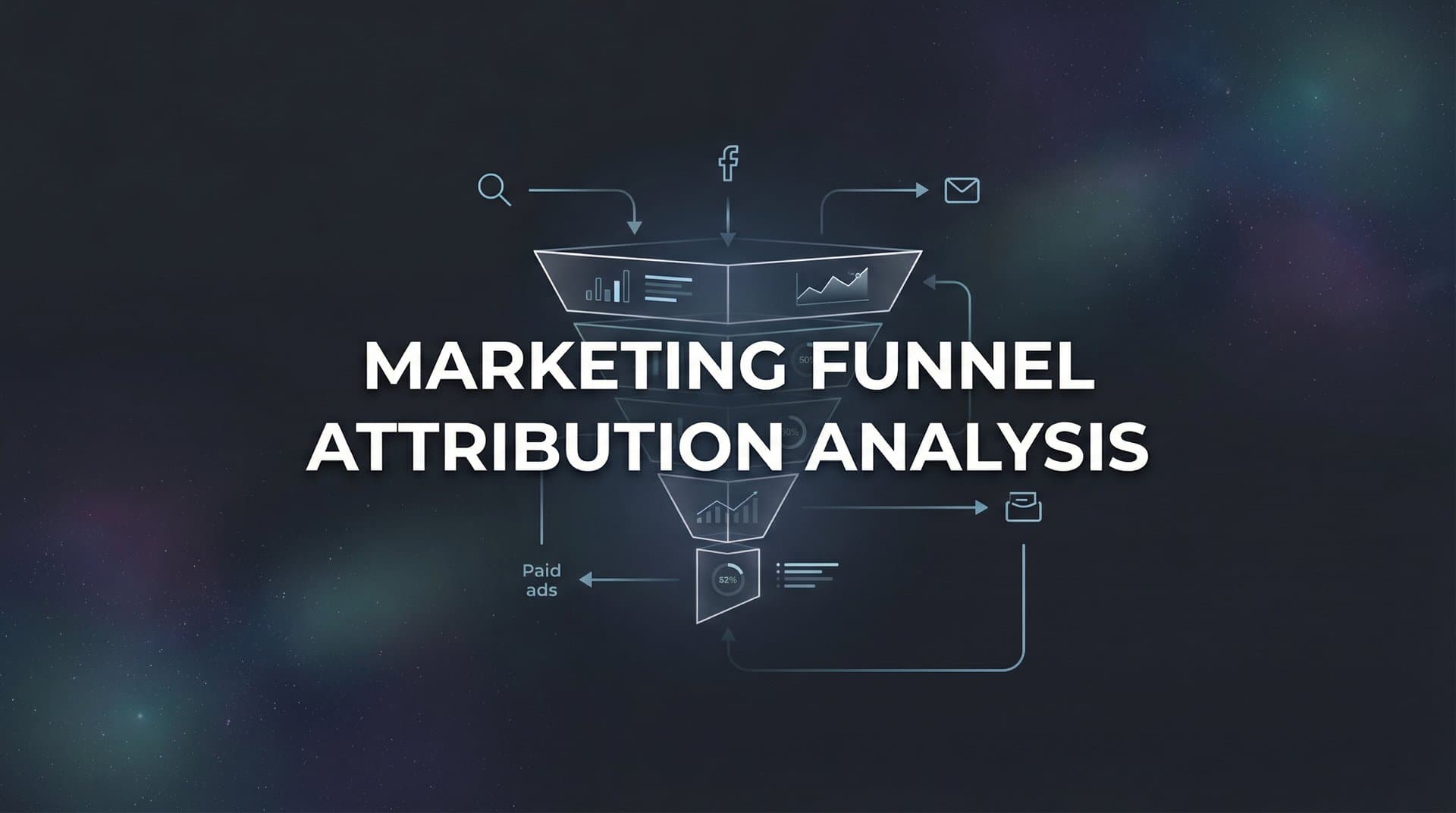
Understanding which marketing touchpoints actually drive conversions is one of the biggest challenges facing digital marketers today. With customers interacting across multiple channels—from initial ad click to final purchase—knowing where to credit your revenue can feel like solving a complex puzzle. Marketing funnel attribution analysis gives you the framework to connect every touchpoint to real business outcomes, so you can stop guessing and start scaling what works.
In this guide, you'll learn exactly how to set up, execute, and act on funnel attribution analysis that reveals your true marketing performance. Whether you're running campaigns across Meta, Google, TikTok, or multiple platforms simultaneously, these steps will help you build a clear picture of your customer journey and make confident budget decisions.
Step 1: Map Your Current Marketing Funnel Stages
Before you can analyze attribution, you need a clear map of how customers actually move through your funnel. This isn't about creating an idealized customer journey—it's about documenting the reality of how people discover, evaluate, and buy from you.
Start by defining your specific funnel stages based on your business model. A B2B SaaS company might have stages like awareness, consideration, demo request, trial, and purchase. An e-commerce brand might use awareness, interest, cart addition, and checkout. Your stages should reflect meaningful milestones in your actual sales process, not generic marketing theory.
Next, identify every active marketing channel feeding into each stage. At the awareness stage, you might have Meta ads, Google Search, TikTok, YouTube, podcasts, and organic social. At consideration, perhaps retargeting ads, email sequences, and content marketing play larger roles. At the decision stage, maybe product comparison pages, sales calls, and demo videos become critical.
Document the typical paths customers take from first touch to conversion. Pull data from your CRM, analytics platform, and ad accounts to see real customer journeys. You'll likely discover that customers rarely follow a linear path—they might see a Meta ad, visit via organic search days later, receive an email, click a retargeting ad, and finally convert through a direct visit.
Create a visual representation of this funnel map. Using the right marketing funnel analysis tools can help you build this visualization effectively. The key is having one document that captures all the ways customers interact with your marketing before converting.
Success indicator: You should have a complete visual map showing all channels feeding into each funnel stage, with notes about typical customer journey patterns. If you can't clearly explain how someone moves from awareness to purchase through your marketing ecosystem, you're not ready for attribution analysis yet.
Step 2: Set Up Cross-Platform Tracking Infrastructure
Attribution analysis is only as good as the data feeding it. If your tracking infrastructure has gaps, your attribution insights will be fundamentally flawed—and you'll make budget decisions based on incomplete information.
Connect all your ad platforms to a centralized tracking system that can follow customers across their entire journey. This means linking Meta, Google Ads, TikTok, LinkedIn, and any other platforms you're using to a single source of truth. Most marketers stop at installing platform pixels, but that's where the problems begin.
Implement server-side tracking alongside your browser-based pixels. Here's why this matters: iOS privacy changes and browser restrictions have made pixel tracking increasingly unreliable. When someone opts out of tracking or uses Safari with intelligent tracking prevention, traditional pixels miss significant portions of your customer journey. Server-side tracking captures data on your server before it reaches the browser, bypassing many of these limitations and giving you more complete visibility.
Link your CRM to track post-click events that happen outside the browser. When a lead books a demo, starts a trial, or makes a purchase, that information needs to flow back into your attribution system. Without CRM integration, you're only seeing half the story—you know someone clicked an ad, but you don't know if they became a customer or what they were worth.
Common pitfall: Many marketers rely solely on platform pixels and wonder why their attribution data doesn't match reality. Meta might report 100 conversions while Google claims credit for 80 of those same conversions, and your actual sales are only 60. This happens because platforms use different attribution windows, tracking methods, and definitions of conversions. A centralized system with server-side tracking eliminates this confusion. Understanding the attribution challenges in marketing analytics helps you avoid these common mistakes.
Test your tracking setup by completing a conversion yourself through different channels. Click a Meta ad on your phone, then convert on your desktop. Check if the system captured both touchpoints. Try it with ad blockers enabled. The more scenarios you test, the more confident you'll be in your data quality.
Success indicator: All touchpoints should flow into a single source of truth where you can see complete customer journeys from first ad impression through final conversion, regardless of device or browser settings. If you're still reconciling data across multiple platforms manually, your infrastructure isn't ready.
Step 3: Choose Your Attribution Model Based on Funnel Goals
Attribution models determine how credit gets distributed across the touchpoints in a customer journey. The model you choose fundamentally shapes which channels look successful and which appear to underperform—so this decision matters more than most marketers realize.
First-touch attribution credits the initial interaction. If someone sees your Meta ad, then later converts through a Google search, Meta gets 100% of the credit. This model helps you understand which channels are best at generating awareness and bringing new people into your funnel. Use it when you're trying to scale your top-of-funnel reach.
Last-touch attribution credits the final touchpoint before conversion. In the same scenario, Google would get 100% of the credit. Most ad platforms default to last-touch because it makes their performance look better. The problem? It completely ignores the awareness and consideration work that earlier touchpoints did to warm up that customer.
Linear attribution distributes credit equally across all touchpoints. If someone had five interactions before converting, each gets 20% of the credit. This model treats every touchpoint as equally important, which rarely reflects reality but can be useful for getting a balanced view when you're just starting with attribution. You can explore linear model marketing attribution software options to implement this approach.
Time-decay attribution gives more credit to touchpoints closer to conversion. The theory is that recent interactions matter more than older ones. This works well for longer sales cycles where early touchpoints might have less influence on the final decision.
Position-based attribution (also called U-shaped) gives significant weight to both the first and last touches—typically 40% each—while distributing the remaining 20% across middle interactions. This model acknowledges that both discovery and conversion moments matter while not ignoring the nurturing that happens in between.
Match your model selection to your specific analysis question. If you're trying to understand which channels acquire new customers most efficiently, first-touch makes sense. If you want to know which channels are best at closing deals, last-touch or position-based might be better. For complex B2B sales or high-consideration purchases where customers research extensively, multi-touch marketing attribution software reveals the full story.
Here's a powerful tip: Run the same data through multiple attribution models to spot channels that perform differently under each. A channel that looks weak under last-touch might be a top performer under first-touch, revealing it's excellent at awareness but needs support from other channels to drive conversions. These insights help you understand each channel's true role in your funnel.
Success indicator: You should have a clear rationale for why your chosen model fits your business goals and sales cycle. If you picked a model because it was the default or because you heard it was "best," you're making a critical mistake. Learning what a marketing attribution model is will help you make informed decisions.
Step 4: Analyze Touchpoint Performance by Funnel Stage
Now comes the insight generation phase where you discover which channels actually drive results at each stage of your funnel. This is where marketing attribution analysis transforms from theoretical exercise into actionable intelligence.
Segment your data to see which channels excel at top-of-funnel awareness versus bottom-of-funnel conversion. You'll often find that the channels generating the most clicks or impressions aren't the ones closing deals. TikTok might be phenomenal at awareness, driving thousands of first touches, but Instagram retargeting might be what actually converts those people weeks later. Without stage-specific analysis, you'd never see this dynamic.
Calculate assisted conversions to reveal undervalued touchpoints. An assisted conversion is when a channel appears in the customer journey but doesn't get last-click credit. For example, if someone sees your YouTube ad, later clicks a Meta retargeting ad, and converts through organic search, YouTube and Meta both assisted that conversion even though organic search got the last touch. Channels with high assisted conversion rates are often doing critical work that last-touch attribution completely misses.
Identify drop-off points where prospects exit the funnel. If you see strong performance at awareness but weak conversion rates, something's breaking down in the middle of your funnel. Maybe your landing pages aren't aligned with your ad messaging. Maybe your retargeting isn't aggressive enough. Maybe you're attracting the wrong audience at the top. Understanding channel attribution in digital marketing revenue tracking helps you pinpoint exactly where the leak is.
Look for patterns in high-value customer journeys versus low-value ones. Pull data on your most valuable customers and analyze their journey patterns. Do they interact with more touchpoints before converting? Do they engage with specific content types? Do they follow different channel sequences than average customers? These patterns reveal the optimal customer journey you should try to replicate.
Compare time-to-conversion across different channel combinations. Some journey patterns might convert quickly while others take weeks or months. Understanding these timelines helps you set realistic expectations and avoid cutting off campaigns that need more time to mature.
Success indicator: You should have a clear performance ranking of channels at each funnel stage, with data showing which channels drive awareness, which nurture consideration, and which close conversions. If all your channels look equally effective at every stage, your analysis isn't granular enough.
Step 5: Calculate True Cost Per Acquisition Across the Full Journey
Platform-reported CPA numbers are often misleading because they only account for last-touch conversions and ignore the cost of assisted touchpoints. Calculating true attributed CPA gives you an accurate picture of what you're actually spending to acquire customers.
Start by moving beyond platform-reported CPA to calculate blended, attributed CPA. If Meta reports a $50 CPA but those customers also interacted with your Google ads and email campaigns before converting, your real CPA is higher. Add up the total spend across all channels that touched those customers, then divide by the number of conversions. This blended CPA reflects reality.
Factor in assisted touches when allocating costs. If your attribution model gives Google 40% credit for a conversion, allocate 40% of that customer's acquisition cost to Google. Do this across all channels and touchpoints to see true cost distribution. This prevents you from over-investing in last-touch channels while starving the awareness channels that feed your funnel.
Compare attributed revenue against spend for each channel combination. Some channel sequences might have higher CPA but generate customers with much higher lifetime value. A customer who comes through organic search and converts immediately might cost less to acquire than one who sees multiple ads, but the multi-touch customer might spend twice as much over their lifetime. Implementing marketing revenue attribution helps you factor in customer quality, not just acquisition cost.
Common pitfall: Over-crediting last-touch channels while undervaluing awareness drivers. When you only look at last-touch CPA, retargeting and branded search always look like your best performers because they're capturing people who are already warmed up by other channels. Then you cut budget from the awareness channels feeding that retargeting audience, and suddenly your "efficient" retargeting performance collapses because there's no one left to retarget.
Calculate ROAS (return on ad spend) using attributed revenue rather than platform-reported revenue. If your attribution model shows that Meta contributed to 60% of your conversions but only got last-touch credit for 30%, your true Meta ROAS is much higher than the platform reports. Understanding cross channel attribution marketing ROI prevents you from cutting channels that are actually performing well.
Success indicator: You should have accurate CPA and ROAS figures that account for multi-touch journeys, showing the true cost and return of each channel when its full contribution is considered. If your attributed metrics match your platform-reported metrics exactly, you're not doing real attribution analysis.
Step 6: Optimize Budget Allocation Based on Attribution Insights
Attribution analysis is worthless if you don't act on it. This final step is where your insights transform into improved marketing performance and better ROI.
Shift spend toward channels that drive attributed revenue, not just reported conversions. If your analysis reveals that YouTube drives significant assisted conversions but low last-touch conversions, increasing YouTube budget makes sense—even though the platform itself won't show improved performance immediately. You're investing in the touchpoints that make your other channels work better.
Feed enriched conversion data back to ad platforms to improve their optimization algorithms. When you send more complete conversion data to Meta or Google—including conversions they didn't originally track due to iOS limitations or cross-device journeys—their machine learning algorithms get better training data. This helps them find more customers who look like your actual converters, not just the ones their limited tracking captured. Proper attribution marketing tracking makes this process seamless.
Test budget changes incrementally rather than making dramatic shifts. If attribution analysis suggests increasing Meta budget by 50%, don't make that jump overnight. Increase by 10-15% first, monitor attributed performance for two weeks, then adjust again. Gradual changes let you validate your attribution insights without risking major budget waste if something in your analysis was off.
Set up ongoing monitoring to catch performance shifts quickly. Attribution patterns change as markets evolve, competitors adjust strategies, and customer behavior shifts. Weekly or monthly attribution reviews catch these changes faster than quarterly reviews, letting you adapt before performance deteriorates significantly.
Create channel-specific optimization strategies based on their funnel role. If a channel excels at awareness but struggles at conversion, optimize it for reach and frequency rather than immediate ROAS. If a channel dominates at closing but doesn't drive new audience growth, pair it with top-of-funnel channels to ensure it has enough prospects to convert. Reviewing your marketing attribution report regularly helps you make these strategic decisions.
Document your optimization decisions and their expected impact. When you reallocate budget based on attribution insights, write down what you're testing and what results you expect. This creates accountability and helps you learn which types of attribution-driven decisions actually improve performance versus which ones were based on misinterpreted data.
Success indicator: You should have a budget reallocation plan with expected impact projections, backed by your attribution data. If you're still allocating budget the same way you did before running attribution analysis, you wasted your time.
Putting It All Together
Marketing funnel attribution analysis transforms how you understand and optimize your campaigns. By mapping your funnel, connecting your data sources, choosing the right attribution model, and analyzing performance by stage, you gain the clarity needed to make confident scaling decisions.
The marketers who win aren't necessarily spending more—they're spending smarter because they know exactly which touchpoints drive revenue. Start with Step 1 today, and within a few weeks, you'll have attribution insights that fundamentally change how you allocate your marketing budget.
Quick Checklist:
✓ Funnel stages mapped with all active channels
✓ Cross-platform tracking connected (including server-side)
✓ Attribution model selected with clear rationale
✓ Touchpoint performance analyzed by funnel stage
✓ True attributed CPA calculated
✓ Budget optimization plan created
Ready to elevate your marketing game with precision and confidence? Cometly captures every touchpoint—from ad clicks to CRM events—giving you the complete, enriched view of customer journeys that makes attribution analysis actually work. Our AI analyzes your multi-touch data to identify high-performing ads and campaigns across every channel, then helps you feed better conversion data back to Meta, Google, and other platforms to improve their targeting algorithms. Get your free demo today and start making budget decisions based on what actually drives revenue, not just what gets last-click credit.