You've launched three campaigns this month. Facebook says you're crushing it. Google claims credit for the same conversions. Your CRM shows half the revenue came from sources neither platform tracked. Meanwhile, you're staring at your bank account wondering where all that ad spend actually went.
This is the reality for most marketers today. You're making decisions in the dark, trusting incomplete data from platforms that have every incentive to make themselves look good. Every dollar you spend without clear visibility into what's actually working is a dollar you're hoping—not knowing—will come back.
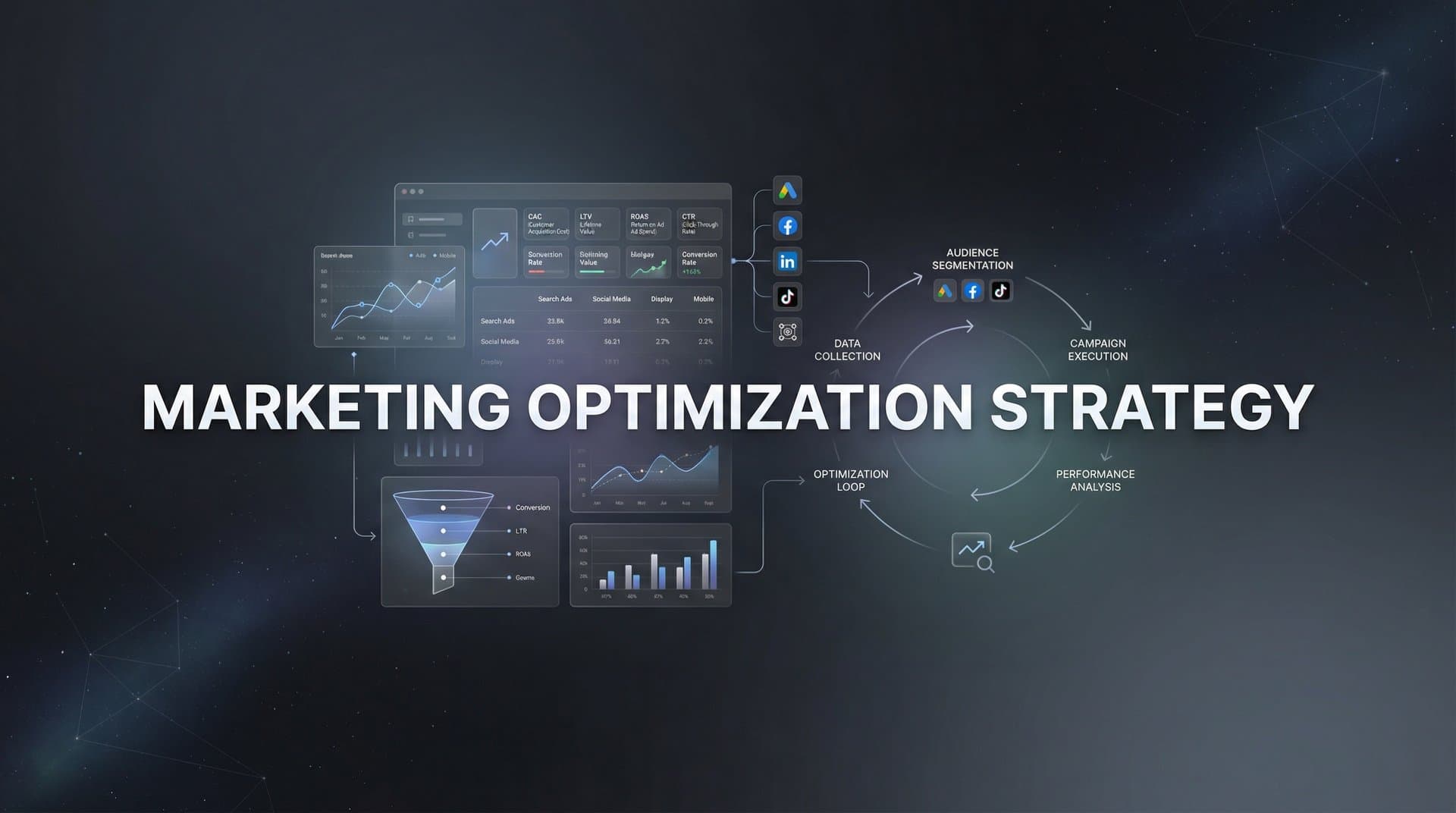
A marketing optimization strategy changes this equation entirely. It's the systematic approach to eliminating guesswork and maximizing ROI through data-driven decisions. Instead of relying on intuition or surface-level metrics, you build a foundation of accurate tracking, meaningful attribution, and continuous improvement based on what actually drives revenue. This guide will show you how to stop throwing money into a black box and start scaling with confidence.
The Revenue Leak Nobody Talks About
Here's what keeps experienced marketers up at night: the numbers don't add up.
Your Facebook Ads Manager shows 150 conversions. Google Analytics claims 120. Your CRM recorded 95 actual customers. Which number is real? More importantly, which campaigns actually deserve credit for those customers?
This disconnect between ad platform reporting and actual revenue is the silent killer of marketing budgets. Ad platforms use attribution windows that often overlap—Facebook might claim a conversion because someone clicked your ad three weeks ago, while Google takes credit because they searched your brand name yesterday. Both platforms report the same conversion, inflating your numbers and hiding the truth about what's really working.
The fragmentation goes deeper than just double-counting. Your customer journey spans multiple devices, platforms, and touchpoints. Someone might discover you through a LinkedIn ad on their phone, research on their laptop via Google, and convert three days later after reading your email. Traditional tracking captures fragments of this journey, leaving you with blind spots that cost real money. Understanding the digital marketing strategy that tracks users across the web is essential for closing these gaps.
These blind spots force you into impossible decisions. Do you increase budget on that Facebook campaign that "converted" 50 customers, even though you can't verify how many actually came from Facebook? Do you cut the Google campaign that shows fewer conversions, not knowing it might be the critical touchpoint that pushes prospects over the edge?
The modern standard has shifted from vanity metrics to revenue-focused optimization. Clicks, impressions, and even platform-reported conversions matter less than one question: which marketing activities actually drive revenue? Until you can answer that with confidence, you're optimizing in the dark.
Your Optimization Blueprint: Four Non-Negotiable Pillars
Building a marketing optimization strategy that actually works requires getting four fundamental elements right. Miss any of these, and you're still guessing.
Pillar 1: Unified Tracking Across Every Touchpoint
Your tracking infrastructure needs to capture everything—ad clicks, website visits, form submissions, CRM events, purchase data, and every interaction in between. This means implementing tracking that goes beyond basic pixel fires to capture enriched data about each touchpoint. Learning how to track marketing campaigns effectively is the foundation of any successful optimization effort.
Server-side tracking has become essential here. With iOS privacy changes limiting browser-based tracking, relying solely on pixels means you're missing a significant portion of your customer journey. Server-side tracking captures conversion data directly from your server, bypassing browser limitations and giving you a more complete picture.
The goal is creating a single source of truth. When a lead converts to a customer, that information should flow through your entire system—from your CRM back to your ad platforms, enriching every dataset with the full context of what happened.
Pillar 2: Attribution Modeling That Connects Actions to Revenue
Once you're capturing all the touchpoints, you need a way to assign credit. Attribution modeling is how you determine which marketing activities deserve recognition for driving conversions.
This isn't about picking the "right" model—it's about understanding what each model reveals. Different attribution approaches highlight different aspects of your marketing performance, and sophisticated marketers compare multiple models to get the full picture. A solid marketing attribution strategy helps you understand the true value of each channel.
The key is moving beyond last-click attribution, which gives all credit to the final touchpoint and ignores everything that came before. Your customer's journey includes awareness, consideration, and decision stages. Attribution modeling helps you value each stage appropriately.
Pillar 3: Real-Time Performance Analysis
Waiting until the end of the month to analyze campaign performance is like checking your bank account after you've already spent all your money. Real-time analysis lets you catch issues before they drain your budget.
This means having dashboards that update continuously, showing you which campaigns are performing and which are bleeding money. Implementing best practices for real-time marketing optimization ensures you can respond to performance changes immediately.
Real-time analysis also enables you to capitalize on opportunities quickly. When you spot a winning ad or audience segment, you can scale it while it's hot instead of discovering it in a post-mortem analysis.
Pillar 4: Continuous Testing and Iteration
Optimization isn't a one-time project. It's a discipline of constant improvement based on what the data tells you, not what you assume will work.
This means running structured tests—trying new audiences, creative approaches, bidding strategies, and channel combinations. But unlike random experimentation, your tests should be guided by insights from your attribution data. If you know that video content assists conversions even when it doesn't get last-click credit, you can test increasing video ad spend with confidence.
The iteration cycle should be systematic: analyze performance, form hypotheses based on data, test those hypotheses, measure results, and repeat. Each cycle compounds your understanding of what drives revenue for your specific business.
Attribution: Your Optimization Compass
Think of attribution as the GPS for your marketing budget. Without it, you're navigating by gut feel. With it, you can see exactly which roads lead to revenue.
Multi-touch attribution reveals the difference between channels that drive revenue and channels that simply assist. That distinction matters enormously for budget allocation. A channel might look mediocre on a last-click basis but be absolutely critical for introducing prospects to your brand. Cut that channel, and your "high-performing" last-click channels suddenly stop converting. Exploring different attribution models in digital marketing helps you understand each channel's true contribution.
Consider a typical B2B customer journey. A prospect discovers you through a LinkedIn ad, visits your website, downloads a whitepaper, receives several nurture emails, searches your brand name on Google, and finally converts through a direct visit. Which touchpoint deserves credit?
Last-click attribution would give all credit to that direct visit—completely ignoring the LinkedIn ad that started the relationship and the emails that kept you top of mind. First-click attribution would credit only LinkedIn, dismissing everything that happened after. Linear attribution would split credit equally across all touchpoints, treating that initial discovery the same as a routine email open.
Each model tells part of the story. Last-click shows you what closes deals. First-click reveals what starts relationships. Linear attribution highlights the full journey. Position-based models let you emphasize both the first and last touchpoints while acknowledging the middle.
Data-driven attribution takes this further by using machine learning to assign credit based on how each touchpoint actually influences conversion probability. If your data shows that prospects who engage with video content convert at twice the rate of those who don't, data-driven attribution will weight video touchpoints more heavily.
The real power comes from comparing multiple attribution models side by side. When you see a channel performing well across every model, you know it's genuinely driving results. When a channel only looks good in one model, you understand its specific role in the customer journey. The right multi-touch marketing attribution software makes this comparison seamless.
This insight transforms budget allocation decisions. Instead of simply increasing spend on whatever got the last click, you can invest strategically across the entire funnel. You might discover that your "expensive" top-of-funnel campaigns are actually your most profitable when you account for their role in starting high-value customer relationships.
Attribution also helps you identify diminishing returns before they eat your budget. If increasing spend on a channel stops generating proportional results, your attribution data will show it. You can reallocate that budget to underutilized channels that still have room to scale.
From Insights to Impact: Making Optimization Decisions
Data without action is just expensive noise. The real test of your optimization strategy is whether you can turn insights into decisions that improve performance.
Start by identifying your underperformers—but do it intelligently. A campaign with a high cost per acquisition isn't necessarily bad if it's targeting high-value customers or playing a critical role in your attribution model. Look at the full picture: What's the customer lifetime value? What role does this campaign play in the overall journey? Is it driving revenue or just burning budget? Developing a strong marketing analytics strategy helps you answer these questions with confidence.
When you do identify a genuinely underperforming campaign, make decisive cuts. Too many marketers let losing campaigns run "just a bit longer" hoping they'll turn around. Your data will tell you when something isn't working. Trust it.
The flip side is equally important: scale what works. But scaling requires more than just increasing budget. You need to feed your ad platforms better data so their algorithms can find more of your best customers.
This is where conversion sync becomes powerful. When you send enriched conversion data back to Meta, Google, and other platforms—including which conversions turned into high-value customers—their algorithms learn to optimize for quality, not just quantity. Instead of finding people who click, they find people who buy and stay.
Creating feedback loops between your CRM and ad platforms amplifies this effect. When a lead becomes a customer, that signal should flow back to your ad platforms immediately. When a customer churns or turns out to be low-value, that matters too. The more context your ad platforms have about what happens after the click, the better they can target.
Practical optimization also means getting granular. Don't just optimize at the campaign level—dig into ad sets, audiences, creative variations, and placements. Your data might reveal that a campaign performs brilliantly on Instagram but wastes money on Facebook. Or that one audience segment converts at three times the rate of another within the same campaign.
Set up automated alerts for significant changes. If your cost per acquisition spikes 50% overnight, you want to know immediately. If a new ad creative is outperforming everything else, you want to capitalize on it before the momentum fades. Using marketing campaign tracking software with alerting capabilities keeps you ahead of performance shifts.
Build optimization into your workflow as a regular discipline, not an occasional project. Weekly reviews of performance data, monthly deep dives into attribution insights, and quarterly strategic reassessments of your channel mix. Consistency compounds.
Scaling Without Hitting the Wall
You've optimized your campaigns. You know what works. Now comes the real question: how do you scale without destroying the performance that made those campaigns work in the first place?
Many marketers hit a wall when they try to scale. They double the budget on a winning campaign, and suddenly the cost per acquisition doubles too. The campaign that was profitable at $5,000 per month loses money at $10,000. This happens when you exhaust your best audience without realizing it.
Confident scaling requires understanding your audience depth. How large is the pool of high-intent prospects you're reaching? When you increase budget, are you reaching more of the same quality prospects, or are you expanding into colder audiences that convert at lower rates? Mastering marketing spend optimization helps you scale efficiently without wasting budget.
Your attribution data provides clues. If you're seeing longer customer journeys and more touchpoints required for conversion, you might be reaching prospects who need more nurturing. That's not necessarily bad—it just means you need to adjust your expectations and potentially your funnel strategy.
AI-powered recommendations help identify scaling opportunities you might miss manually. When you're managing campaigns across Meta, Google, LinkedIn, and other platforms, patterns emerge that are difficult to spot by hand. AI can analyze performance across all your channels simultaneously and surface insights like: "Your Google Search campaigns are hitting diminishing returns, but your LinkedIn audience is still undersaturated."
Smart scaling also means diversifying. Instead of just increasing budget on one winning campaign, look for opportunities to replicate that success across different channels, audiences, or creative approaches. If video ads work brilliantly on Facebook, test them on YouTube. If a specific audience segment converts well, look for similar segments on other platforms.
Build a sustainable optimization cadence that compounds results over time. This isn't about making dramatic changes weekly—it's about incremental improvements that stack. A 5% improvement in conversion rate doesn't sound exciting, but compound that across multiple campaigns over several months, and you're looking at transformational results. A comprehensive conversion optimization strategy ensures these gains accumulate systematically.
The key to sustainable scaling is maintaining the feedback loops that made your optimization work in the first place. As you scale, keep feeding better data to your ad platforms. Keep refining your attribution models. Keep testing and iterating. The discipline that got you to profitability is the same discipline that will keep you there as you grow.
Watch for the signals that indicate healthy scaling versus forced scaling. Healthy scaling maintains or improves efficiency metrics while increasing volume. Forced scaling degrades efficiency in exchange for volume. Know the difference, and be willing to pause scaling when the math stops working.
Building Your Optimization Engine
Marketing optimization strategy isn't a one-time project you complete and forget. It's an ongoing discipline that separates marketers who scale profitably from those who burn through budget hoping for the best.
The difference comes down to visibility. When you can see the complete customer journey—from first touchpoint through conversion and beyond—you make better decisions. You stop wasting money on campaigns that look good in platform reports but don't drive real revenue. You start investing confidently in the channels and strategies that actually move your business forward.
This requires building the right foundation: unified tracking that captures every touchpoint, attribution modeling that reveals true performance, real-time analysis that catches issues early, and a commitment to continuous improvement based on data rather than assumptions.
The marketers winning today aren't the ones with the biggest budgets. They're the ones with the clearest visibility into what's working. They're making decisions based on complete data, not fragmented reports from platforms with conflicting interests. They're feeding their ad algorithms better conversion data, creating a virtuous cycle where better tracking leads to better targeting and improved returns.
Your optimization strategy should evolve as your business grows. What works at $10,000 per month in ad spend looks different at $100,000. The channels that drive your first customers might not be the ones that scale. But with the right optimization framework in place, you can adapt confidently instead of guessing.
Ready to elevate your marketing game with precision and confidence? Discover how Cometly's AI-driven recommendations can transform your ad strategy—Get your free demo today and start capturing every touchpoint to maximize your conversions.