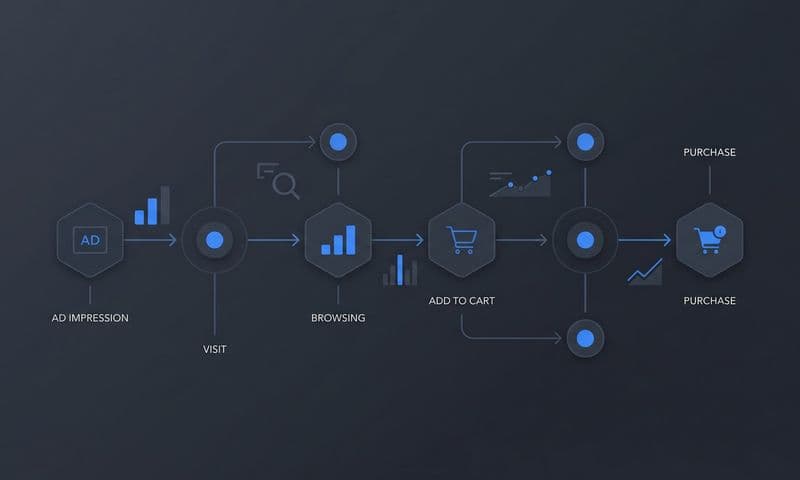
Selling across multiple marketplaces simultaneously creates one of the most frustrating attribution blind spots in modern digital marketing. You're running paid campaigns on Meta, Google, and TikTok to drive traffic to your Amazon listings, Etsy shop, or Walmart storefront, but the data trail goes cold the moment a buyer lands on the marketplace. Which campaign actually drove that sale? Which audience segment converts best on which platform? Without answers, you're left guessing.
The core problem is structural. Marketplace platforms like Amazon, Walmart, and Etsy control the buyer relationship and restrict access to granular customer data. You can't install a pixel directly on a marketplace product page. You often can't see which specific ad drove a specific purchase. The data gap between your ad spend and your actual marketplace conversions is real, and it's costly.
Layer in the privacy changes that have reshaped tracking over the past few years, including Apple's App Tracking Transparency framework and ongoing cookie deprecation trends, and browser-based tracking becomes even less reliable. The signals your ad platforms receive are increasingly incomplete, which means their algorithms are optimizing toward incomplete data.
These seven strategies address each piece of this puzzle. They build on each other progressively, from establishing a solid data foundation to validating your entire attribution model with controlled experiments. Whether you're a solo seller scaling your first ad campaigns or a multi-channel brand managing significant ad spend across several marketplaces, these approaches give you a practical roadmap for connecting your advertising efforts to actual marketplace revenue.
1. Build a Server-Side Tracking Foundation to Bypass Platform Limitations
The Challenge It Solves
Browser-based pixels have a fundamental weakness: they depend on the buyer's browser environment to fire correctly. Ad blockers, browser privacy settings, and iOS restrictions all interfere with client-side tracking. For marketplace sellers, this problem is compounded by the fact that you often can't place a pixel on the marketplace page at all. The result is a significant percentage of conversions that never get reported back to your ad platforms, leaving your campaigns flying partially blind.
The Strategy Explained
Server-side tracking moves the data collection process off the buyer's browser and onto your own server. Instead of relying on a pixel firing in a user's browser, your server directly communicates conversion events to ad platforms via their APIs: Meta's Conversions API, Google's Enhanced Conversions, TikTok's Events API, and others.
For marketplace sellers, this typically works in conjunction with bridge pages or intermediate landing pages that sit between your ad and your marketplace listing. When a buyer clicks your ad, they land on a page you control, which captures the attribution data server-side before redirecting them to the marketplace. Even if the buyer never completes the purchase on your bridge page, you've captured the critical touchpoint data. Understanding why server-side tracking is more accurate helps explain why this approach consistently outperforms browser-based methods.
Tools like Cometly's server-side tracking are specifically built to handle this kind of event collection at scale, capturing data that client-side methods consistently miss and feeding it into a centralized attribution view.
Implementation Steps
1. Audit your current tracking setup to identify which conversion events are being missed or underreported across each marketplace channel.
2. Set up server-side API connections to each ad platform you use, starting with Meta Conversions API and Google Enhanced Conversions as your highest-priority integrations.
3. Create bridge pages for each marketplace funnel so you have a server-controlled touchpoint to capture attribution data before the buyer reaches the marketplace listing.
4. Implement event deduplication to ensure the same conversion isn't counted by both your browser pixel and your server-side connection, which would inflate your reported results.
Pro Tips
Prioritize event match quality when setting up your server-side connections. The more customer data signals you can pass (hashed email, phone number, browser ID), the better your ad platforms can match events to real users. Higher match quality directly improves your campaign optimization and reduces wasted spend on audiences that aren't converting.
2. Unify Cross-Marketplace Data Into a Single Attribution Dashboard
The Challenge It Solves
Most marketplace sellers end up managing data across a fragmented stack: Amazon Seller Central, Etsy's analytics, Walmart's reporting tools, their own DTC Shopify dashboard, and separate ad platform dashboards for Meta, Google, and TikTok. Each platform speaks a different data language, uses different attribution windows, and reports conversions differently. Comparing performance across these sources manually is time-consuming and error-prone, and it makes identifying cross-platform patterns nearly impossible.
The Strategy Explained
Centralizing your data means pulling all marketplace sales data, ad platform spend data, and customer journey data into a single analytics layer where you can compare apples to apples. This unified view lets you see which ad channels drive the most revenue across all your marketplace channels simultaneously, rather than evaluating each in isolation. Choosing the right revenue attribution tracking tools is essential for making this consolidation work effectively.
The goal isn't just consolidation for convenience. When your data lives in one place, patterns that were previously invisible become obvious. You might discover that your Google campaigns consistently drive higher-value buyers to your Amazon listings, while your Meta campaigns perform better for your Etsy channel. That kind of insight only emerges when the data is unified.
A platform like Cometly's analytics dashboard is designed specifically for this kind of cross-platform consolidation, connecting ad platforms, marketplace data, and CRM information into one actionable view.
Implementation Steps
1. Map every data source in your current stack, including each marketplace, each ad platform, your CRM, and any email or SMS tools, so you know exactly what needs to be connected.
2. Standardize your conversion event naming and definitions across all platforms so that a "purchase" means the same thing whether it came from Amazon or Etsy.
3. Connect all data sources to a centralized attribution platform and set consistent attribution windows across channels to enable fair comparisons.
4. Build a reporting cadence around the unified dashboard so your team reviews cross-marketplace performance together rather than channel by channel.
Pro Tips
When unifying data, pay close attention to how each marketplace defines and reports revenue. Some platforms report gross merchandise value, others report net revenue after fees. Standardizing to a consistent revenue metric before analysis prevents you from making budget decisions based on mismatched numbers. If you notice discrepancies, learning about solving attribution data discrepancies can help you identify and fix the root causes.
3. Deploy UTM Architectures Designed for Marketplace Funnels
The Challenge It Solves
Standard UTM parameters work well for DTC funnels where the buyer stays on your website from click to conversion. Marketplace funnels break this model. When a buyer clicks your ad and lands on an Amazon listing, the UTM parameters in your URL often disappear or become inaccessible. You lose the thread that connects the ad click to the eventual purchase, which makes your campaign-level attribution data unreliable or completely absent.
The Strategy Explained
The solution is a marketplace-specific UTM architecture that uses bridge pages as the attribution capture point. Instead of sending traffic directly to your marketplace listing, your ads send traffic to a bridge page you control. That page captures the full UTM data server-side, stores the attribution information, and then redirects the buyer to the marketplace listing. For a deeper dive into how this compares to other approaches, explore the differences between UTM tracking vs server-side tracking to understand when each method is most effective.
Your UTM structure for marketplace funnels should be more granular than a typical DTC setup. You want to capture not just the source and medium, but the specific marketplace destination, the product category, and the campaign objective. This level of detail lets you analyze performance at a granular level and identify exactly which campaign-marketplace-product combinations generate the best returns.
Implementation Steps
1. Design a UTM naming convention that includes a marketplace-specific parameter (for example, utm_content=amazon-product-123 or utm_content=etsy-listing-456) so you can segment performance by destination marketplace.
2. Build bridge pages for each major marketplace channel, optimized for fast load times and minimal friction since the goal is to capture data quickly before redirecting the buyer.
3. Configure your server-side tracking to capture and store UTM data at the bridge page level, associating it with any customer identifiers available at that touchpoint.
4. Test your UTM tracking end-to-end by running test purchases through each funnel and verifying that the attribution data appears correctly in your analytics platform.
Pro Tips
Keep your bridge pages lightweight and purposeful. A bridge page that loads slowly or feels like a detour will increase bounce rates before the redirect happens. Consider adding a brief value statement or product highlight on the bridge page to reinforce the buyer's intent while the redirect loads. This small touch can improve the overall experience without sacrificing attribution capture.
4. Implement Multi-Touch Attribution Models That Reflect Marketplace Buying Cycles
The Challenge It Solves
Last-click attribution is the default setting for most ad platforms, and it's particularly misleading for marketplace sellers. Marketplace buyers often research products across multiple sessions, compare options from different sellers, and take days or weeks before completing a purchase. If you credit only the last ad click before the sale, you systematically undervalue the awareness and consideration campaigns that initiated the buyer's journey. Over time, this causes you to cut exactly the campaigns that are actually driving your pipeline.
The Strategy Explained
Multi-touch attribution distributes conversion credit across all the touchpoints in a buyer's journey rather than awarding it entirely to the last interaction. For marketplace sellers, this is particularly important because the journey often spans multiple channels: a buyer might discover your product through a TikTok ad, research it via a Google search, see a retargeting ad on Meta, and finally purchase on Amazon three days later. Understanding the difference between single source and multi-touch attribution is critical for choosing the right approach for your marketplace business.
Different multi-touch models distribute credit differently. Linear models split credit equally across all touchpoints. Time-decay models give more credit to touchpoints closer to the conversion. Position-based models give the most credit to the first and last touchpoints. The right model for your business depends on your product category, price point, and typical sales cycle length.
Cometly's multi-touch attribution capabilities let you compare different attribution models side by side so you can see how credit shifts across your campaigns depending on which model you apply. This comparison view is invaluable for understanding the true contribution of each channel.
Implementation Steps
1. Map your typical buyer journey by analyzing the sequence of touchpoints that precede marketplace purchases, identifying how many interactions buyers typically have before converting.
2. Select two or three attribution models to test simultaneously, starting with linear and time-decay as practical alternatives to last-click for most marketplace categories.
3. Run both models in parallel for at least 30 days before making budget decisions based on the results, giving yourself enough data to see meaningful patterns.
4. Review how credit distribution changes across your campaigns under different models and use those insights to adjust your channel mix and budget allocation.
Pro Tips
Resist the temptation to switch attribution models based on short-term results. The value of multi-touch attribution comes from consistent application over time. Pick a model that aligns with your sales cycle, apply it consistently, and adjust your campaigns based on what it reveals over multiple reporting periods.
5. Sync Enriched Conversion Data Back to Ad Platforms for Smarter Optimization
The Challenge It Solves
Ad platform algorithms are only as smart as the data they receive. When your conversion signals are incomplete because browser-based tracking is missing events or marketplace platforms aren't passing purchase data back to your pixels, the algorithms optimize toward incomplete information. This leads to campaigns that appear to perform well in the ad platform's dashboard but don't actually correlate with real marketplace sales. Understanding why conversion tracking numbers are wrong helps you diagnose these gaps before they erode your ad performance.
The Strategy Explained
Conversion syncing means taking your verified marketplace purchase data and feeding it back to ad platforms through their conversion APIs. Instead of relying solely on what the ad platform's pixel captures, you're supplementing that data with confirmed purchase events from your actual sales records. This gives the algorithm a more complete and accurate picture of which users actually bought.
The impact compounds over time. As you feed better data to Meta, Google, TikTok, and other platforms, their algorithms learn to find more buyers who resemble your actual converters rather than optimizing toward users who merely clicked or visited. This improves your targeting precision, reduces your cost per acquisition, and makes your ad spend work harder across every marketplace channel.
Cometly's Conversion Sync feature is built specifically for this workflow, sending enriched, conversion-ready events back to ad platforms to improve targeting, optimization, and overall ad ROI without requiring complex custom development work.
Implementation Steps
1. Identify your verified purchase events from each marketplace and establish a reliable data pipeline that captures confirmed sales with associated customer identifiers.
2. Connect your verified conversion data to each ad platform's conversion API, ensuring you're passing as many matching signals as possible to maximize event match quality.
3. Set appropriate conversion windows in each ad platform to align with your actual marketplace buying cycles, avoiding windows that are too short to capture delayed purchases.
4. Monitor your reported conversion volumes before and after implementing conversion sync to quantify how many additional events are now being captured and attributed.
Pro Tips
When syncing conversions, include revenue values with each purchase event rather than just signaling that a conversion occurred. Passing actual order values allows ad platforms to optimize toward higher-value buyers, not just any buyers, which can meaningfully improve your return on ad spend over time.
6. Use AI-Powered Analysis to Surface Hidden Marketplace Performance Patterns
The Challenge It Solves
When you're managing campaigns across multiple ad platforms and multiple marketplaces simultaneously, the volume of data becomes overwhelming. Manually analyzing performance across every campaign, ad set, creative, marketplace channel, and product combination to find meaningful patterns is a full-time job on its own. Most marketers end up reviewing only the most obvious metrics and missing the subtle cross-platform signals that reveal where real optimization opportunities exist.
The Strategy Explained
AI-powered analysis tools can process your entire dataset across all channels and marketplaces simultaneously, identifying patterns and correlations that would take a human analyst days to uncover. These tools look for anomalies, performance clusters, and optimization opportunities across dimensions you might not think to examine manually.
For marketplace sellers specifically, AI analysis can surface insights like which creative themes drive the highest conversion rates on specific marketplaces, which audience segments have shorter consideration cycles, which campaign types produce buyers with higher repeat purchase rates, and where your budget allocation is mismatched relative to actual revenue contribution by channel. Leveraging touchpoint tracking analytics alongside AI tools gives you the granular data foundation these systems need to generate actionable recommendations.
Cometly's AI Ads Manager and AI Chat features are designed for exactly this kind of analysis. The AI Chat lets you query your performance data in plain language, asking questions like "which campaigns drove the most Amazon revenue last month" and getting instant, data-backed answers. The AI Ads Manager surfaces budget reallocation recommendations based on actual performance patterns across all your connected channels.
Implementation Steps
1. Ensure your unified data foundation is in place before leaning on AI analysis, since the quality of AI insights is directly dependent on the completeness and accuracy of your underlying data.
2. Define the key questions you want AI to help answer, such as which channels drive the highest-value marketplace buyers or which products have the strongest cross-channel response.
3. Review AI-generated recommendations on a weekly cadence and implement the highest-confidence suggestions in controlled tests before applying them broadly across your campaigns.
4. Track the outcomes of AI-recommended changes to build a feedback loop that improves the quality of future recommendations over time.
Pro Tips
Treat AI recommendations as hypotheses to test rather than directives to follow blindly. The best way to use AI analysis is to let it identify the opportunities, then validate the most significant ones with controlled experiments before committing major budget shifts. This combination of AI speed and human judgment produces the most reliable optimization outcomes.
7. Establish Incrementality Testing to Validate Marketplace Attribution Accuracy
The Challenge It Solves
Even a well-constructed attribution model can mislead you if it's attributing conversions to ads that buyers would have completed anyway without seeing the ad. This is the incrementality problem. If a buyer was already searching for your product and would have found it organically, your retargeting ad that "closed" the sale isn't actually driving incremental revenue. It's just taking credit for a conversion that would have happened regardless. Without testing for incrementality, you can end up overvaluing certain channels and overspending on campaigns that aren't actually moving the needle.
The Strategy Explained
Incrementality testing measures the true lift that your advertising creates by comparing outcomes between an exposed group that sees your ads and a holdout group that doesn't. The difference in conversion rates between the two groups represents the genuine incremental impact of your campaigns.
For marketplace sellers, geo-holdout tests are often the most practical approach. You select comparable geographic markets, run your campaigns normally in the test markets, pause or suppress ads in the holdout markets, and then compare marketplace sales performance between the two groups over the test period. This gives you a clear, data-backed answer to the question of how much revenue your advertising is actually generating above what would have occurred organically. A proper attribution tracking setup is essential for ensuring your incrementality tests produce reliable, actionable results.
Incrementality testing is widely considered the gold standard for validating attribution accuracy, and it's particularly valuable for marketplace sellers who need to justify ad spend against organic marketplace traffic that's already converting.
Implementation Steps
1. Select a test period of at least two to four weeks to ensure you capture enough conversion volume for statistically meaningful results, avoiding periods with major seasonal events that could skew outcomes.
2. Define your test and holdout groups using geographic segmentation or audience segmentation, ensuring the groups are as comparable as possible in terms of historical purchase behavior and market size.
3. Run your campaigns normally in the test group while suppressing ads in the holdout group, then track marketplace sales in both groups throughout the test period.
4. Calculate the incremental lift by comparing conversion rates between groups and use that lift figure to calibrate your attribution model and validate your reported ROAS figures.
Pro Tips
Run incrementality tests on your highest-spend campaigns first, since those are the ones where overattribution has the biggest financial impact. A campaign that appears to generate strong ROAS in your attribution model but shows low incrementality in testing is a candidate for budget reallocation. Conversely, campaigns with high incrementality but modest attributed ROAS may be worth investing in more aggressively.
Putting It All Together: Your Marketplace Attribution Roadmap
Marketplace seller attribution tracking is not a single problem with a single solution. It's a layered challenge that requires building the right foundation, structuring your data correctly, applying the right analytical models, and continuously validating your conclusions. The seven strategies in this guide address each layer of that challenge progressively.
Start with server-side tracking as your foundation, since everything else depends on capturing accurate, complete conversion data in the first place. Then unify your cross-marketplace data into a single dashboard so you can see the full picture. Structure your UTMs for marketplace funnels using bridge pages to preserve attribution through the redirect. Apply multi-touch attribution models that reflect how your buyers actually research and purchase. Sync enriched conversion data back to your ad platforms so their algorithms optimize toward real buyers. Layer in AI-powered analysis to surface the patterns your manual reviews would miss. And validate everything with incrementality testing to confirm that your attribution model reflects reality.
This is not a one-time setup. Marketplace attribution is an ongoing optimization process. Privacy changes, platform updates, and shifts in buyer behavior all require you to revisit and refine your approach regularly. The marketers who build a systematic, data-driven attribution practice are the ones who consistently outperform competitors who are still guessing.
If you're looking for a centralized attribution layer that connects your ad platforms, marketplace channels, and CRM data into one actionable view, Cometly is built for exactly that. From server-side tracking and multi-touch attribution to AI-powered recommendations and conversion sync, it brings every piece of this roadmap together in one platform.
Ready to elevate your marketing game with precision and confidence? Discover how Cometly's AI-driven recommendations can transform your ad strategy. Get your free demo today and start capturing every touchpoint to maximize your conversions.