Your Meta ad campaigns are spending thousands of dollars daily, but here's the uncomfortable truth: you're probably missing 20-30% of your conversions. Not because your ads aren't working—but because your tracking can't see them anymore.
Since iOS 14.5 dropped in 2021, the digital marketing landscape shifted dramatically. Safari's Intelligent Tracking Prevention blocks third-party cookies by default. Firefox's Enhanced Tracking Protection does the same. Ad blockers are installed on millions of browsers. And when iPhone users see that tracking opt-in prompt? Most tap "Ask App Not to Track."
This isn't a temporary glitch—it's the new reality. And it's forcing a fundamental question: should you rely on browser-based pixel tracking, server-side events through Meta's Conversions API, or both? The answer directly impacts your attribution accuracy, your ad optimization, and ultimately, your ability to scale with confidence.
The Mechanics of Browser-Based Pixel Tracking
Let's start with what most marketers know: the Meta Pixel. You install a JavaScript snippet on your website, and it fires whenever someone takes an action—viewing a product, adding to cart, completing a purchase. The pixel captures these events in real time and sends them directly from the user's browser to Meta's servers.
This approach has powered Facebook and Instagram advertising for years because it's simple and immediate. The moment someone clicks "Buy Now," the pixel fires a Purchase event. Meta's algorithm sees it instantly and uses that signal to optimize your campaigns.
Browser events excel at tracking on-site behavior. They capture page views, scroll depth, button clicks, form submissions—anything that happens in the browser. For dynamic remarketing, they're particularly powerful. Someone views a specific product? The pixel sends that product ID to Meta, enabling you to show them that exact item in their Instagram feed an hour later.
The technical implementation is straightforward. You add the base pixel code to your site header, then configure standard events (ViewContent, AddToCart, Purchase) or custom events for specific actions. Most e-commerce platforms and website builders have native integrations that make this a 15-minute setup. Understanding what a tracking pixel is and how it works is essential before diving into more advanced configurations.
But here's where the cracks show. Browser-based tracking depends entirely on the user's browser cooperating. And increasingly, browsers don't cooperate.
Safari's ITP now limits first-party cookies to seven days of storage. If someone clicks your ad, browses your site, then returns nine days later to purchase—that conversion won't connect back to your original ad. Firefox's ETP blocks tracking scripts by default. Chrome is phasing out third-party cookies entirely.
Then there are ad blockers. Browser extensions like uBlock Origin and Ghostery actively prevent tracking pixels from loading. According to various industry estimates, roughly 25-40% of internet users have some form of ad blocking enabled. For these users, your pixel simply doesn't fire. You're blind to their entire journey.
The iOS App Tracking Transparency framework compounds these challenges. When users opt out of tracking, in-app browsers can't share data across apps and websites. This creates massive blind spots for mobile traffic—which, for many businesses, represents the majority of their audience.
The result? Your Meta Pixel is capturing fewer events than ever before. Your attribution is incomplete. Your optimization data is skewed. And you're making budget decisions based on partial information.
Server-Side Events: Tracking That Bypasses the Browser
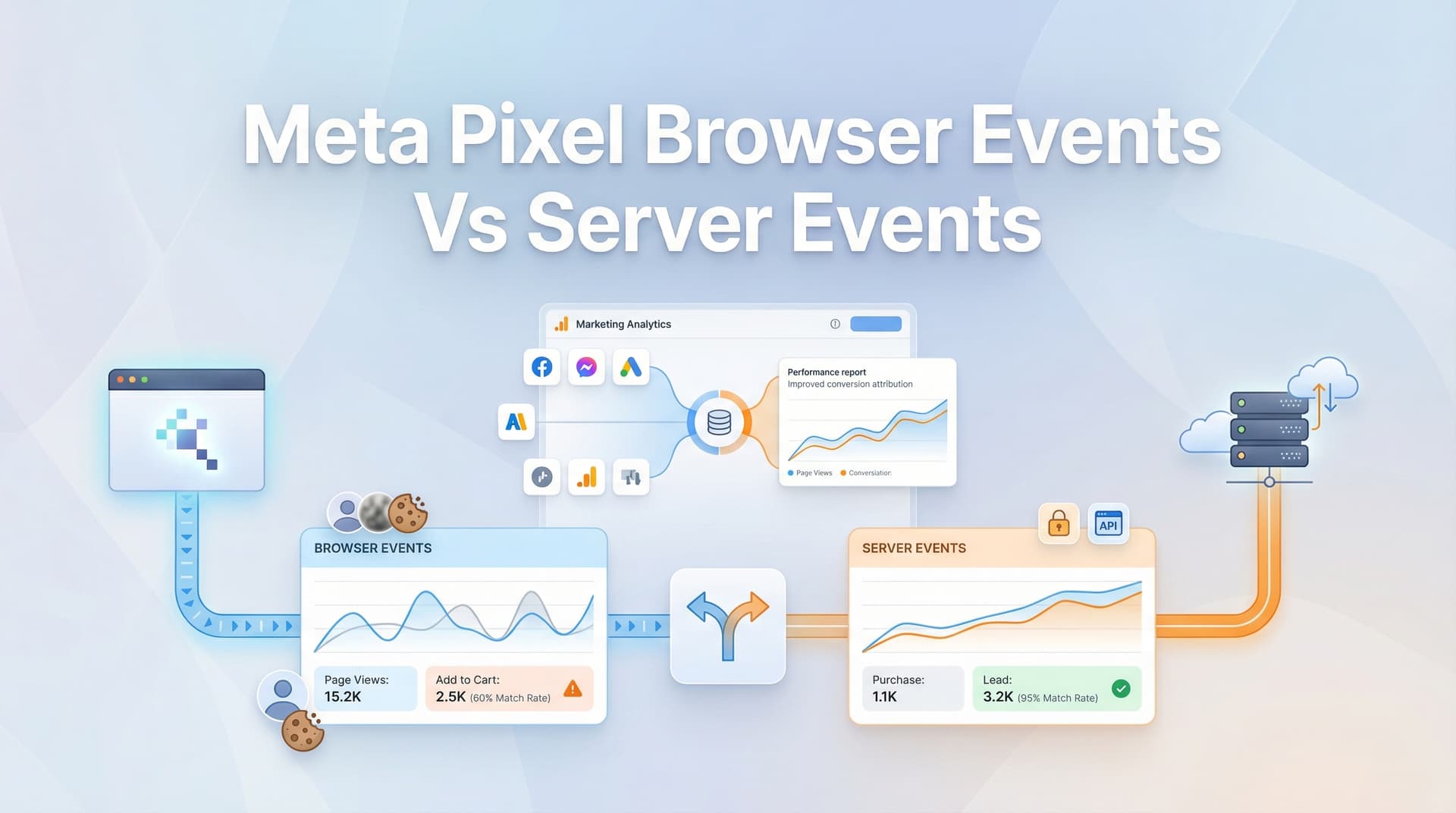
Meta's Conversions API (CAPI) takes a fundamentally different approach. Instead of relying on JavaScript in the user's browser, server-side events are sent directly from your server to Meta's server. The user's browser—and all its restrictions—never enters the equation.
Think of it like this: browser tracking is a messenger that has to cross through multiple checkpoints, any of which might stop them. Server-side tracking is a direct phone line between your systems and Meta's systems. No intermediaries, no browser privacy features, no ad blockers in the way.
For a deeper dive into this space, see our guide to Instagram advertising specs.
The technical architecture involves your server capturing conversion events—a purchase, a subscription signup, a lead form submission—then sending that data to Meta via API. This happens server-to-server, completely independent of what's happening in the user's browser. Understanding why server-side tracking is more accurate helps explain the growing shift toward this approach.
What makes server-side events particularly powerful is what they can include. Browser pixels are limited to information available in the browser: cookies, page URLs, referrer data. Server-side events can include enriched customer data from your CRM, payment processor, or database.
You can send customer email addresses (hashed for privacy), phone numbers, customer lifetime value, subscription status, purchase history, and offline conversion data. This enriched information dramatically improves Meta's ability to match events to specific user profiles—even when browser tracking fails.
Server events also capture conversions that happen outside the browser entirely. Phone call conversions tracked in your CRM? Send them via CAPI. In-store purchases linked to online campaigns? CAPI handles that. Subscription renewals that happen automatically? Those too.
For businesses with longer sales cycles, server-side tracking is transformative. Someone might click your ad, request a demo, then convert 30 days later after multiple touchpoints. Browser cookies would have expired. But with CAPI, you can connect that final conversion back to the original campaign because you're matching on stable identifiers like email addresses.
The implementation requires more technical lift than dropping a pixel snippet on your site. You need server-side code that captures conversion events and formats them for Meta's API. Many businesses use middleware platforms or server-side tracking tools to handle this complexity rather than building custom integrations.
But the payoff is tracking that actually works. Server-side events aren't affected by iOS updates, browser privacy features, or ad blockers. They deliver consistently, reliably, and with richer data than browser tracking alone could ever provide.
Direct Comparison: When Each Method Wins
Let's cut through the theory and compare these approaches on the metrics that actually matter: reliability, data quality, and practical use cases.
Reliability and Signal Loss: Browser-based tracking is experiencing increasing signal loss. Industry observations suggest that many marketers see 20-30% fewer tracked conversions compared to what their actual revenue shows. Server-side events maintain near-100% delivery because they're immune to client-side restrictions. If your server sends an event, Meta receives it. Period.
This reliability gap compounds over time. As more users enable privacy features and install ad blockers, browser tracking becomes less representative of your true performance. You're optimizing campaigns based on incomplete data, which means Meta's algorithm is learning from a skewed sample.
Speed and Real-Time Behavior: Browser events win on immediacy. The pixel fires the instant someone takes an action, enabling real-time dynamic remarketing. Someone abandons their cart? You can show them a reminder ad within minutes. This speed is nearly impossible to replicate with server-side events, which typically involve some processing delay.
For behavior-based remarketing—showing ads based on specific pages viewed or products considered—browser tracking remains superior. The pixel captures granular on-site behavior that your server might not even see.
Data Richness and Match Quality: Server-side events dominate here. Browser tracking is limited to what cookies and pixels can capture: device IDs, IP addresses, user agents. Server events can include hashed email addresses, phone numbers, customer IDs, purchase amounts, product categories, and customer lifetime value.
We break down the leading options in our AI advertising agent guide.
This enriched data significantly improves Event Match Quality (EMQ) scores in Meta's Events Manager. Higher match rates mean Meta can more accurately attribute conversions to specific users and campaigns, even when browser tracking fails. For conversion optimization campaigns, this improved matching translates directly to better targeting and performance. Learn more about enhancing Meta Event Match Quality to maximize your tracking effectiveness.
Attribution Window Challenges: Browser cookies have limited lifespans. Safari caps first-party cookies at seven days. If someone's purchase journey spans two weeks—common for considered purchases—browser tracking loses the connection. Server-side events can maintain attribution across longer windows because they're matching on stable identifiers rather than temporary cookies.
Offline and CRM Integration: Browser pixels can't track conversions that happen outside the browser. Server-side events excel here. Lead called your sales team and closed a deal? CAPI captures it. Customer renewed their annual subscription? You can attribute that back to the original acquisition campaign. This complete view of the customer journey is impossible with browser tracking alone.
Privacy Compliance and User Control: Both methods can be implemented in privacy-compliant ways, but server-side events offer more control. You're sending only the data you choose to include, and you can implement sophisticated consent management on your server. Browser pixels operate more as a black box—once loaded, they collect whatever data Meta's code is designed to capture.
Use Case Matching: Browser tracking is ideal for real-time remarketing, on-site behavior analysis, and campaigns focused on immediate actions. Server-side tracking is essential for accurate conversion measurement, long-term attribution, CRM integration, and feeding high-quality data to Meta's optimization algorithms.
The reality? Most successful advertisers need both. Each method compensates for the other's weaknesses, creating a more complete and reliable tracking foundation.
The Case for Hybrid Tracking: Why Both Methods Together Win
Here's the strategic insight many marketers miss: browser events and server events aren't competitors—they're complementary layers in a robust tracking system. Used together, they create redundancy, enrichment, and resilience that neither achieves alone.
The hybrid approach works like this: your Meta Pixel captures events in the browser (when it can), while your server simultaneously sends the same events via Conversions API with enriched data. Meta receives both signals and uses event deduplication to avoid counting the same conversion twice.
Event Deduplication Mechanics: The key is the event_id parameter. When you send both a browser event and a server event for the same conversion, you include an identical event_id in both. Meta recognizes these as the same event and counts it once. This prevents inflated conversion numbers while ensuring that if one method fails, the other still delivers.
For example: someone completes a purchase. Your pixel fires a Purchase event with event_id "order_12345". Your server also sends a Purchase event via CAPI with the same event_id "order_12345" plus enriched data like the customer's email and order value. Meta deduplicates these into a single conversion, but it has both the immediate browser signal and the enriched server data.
Redundancy as Reliability: This dual-tracking approach creates a safety net. If the user has an ad blocker, the pixel fails but CAPI succeeds. If your server experiences a brief delay, the pixel captures the immediate event. You're no longer dependent on a single point of failure.
Many businesses find that browser tracking captures 70-80% of conversions while server-side tracking captures 90-95%. The overlap ensures you're not missing events, while the server-side enrichment improves data quality across the board.
Strategic Event Allocation: Not every event needs dual tracking. A smart hybrid strategy prioritizes based on business value. High-value conversion events (Purchase, Lead, CompleteRegistration) should definitely be tracked both ways. Lower-value engagement events (PageView, ViewContent) might only need browser tracking.
Here's a practical framework: Track all revenue-generating events via both pixel and CAPI with deduplication. Track engagement and remarketing events via pixel only. Track CRM and offline events via CAPI only. This balances comprehensive coverage with implementation efficiency.
Data Enrichment Layer: The real power of hybrid tracking is using server events to enrich what browser events capture. The pixel fires immediately when someone purchases, giving Meta the real-time signal it needs. Then your server sends the same event with additional context: customer email, lifetime purchase count, product category, profit margin, subscription status.
Meta's algorithm now has both speed and depth. It can optimize in real time while learning from richer data about which customers are most valuable. This combination improves campaign performance in ways that neither method alone could achieve.
Implementation Priorities: Start with your most critical conversion events. Implement CAPI for Purchase and Lead events first, ensuring proper event deduplication with your existing pixel. Then expand to other high-value events. Use your pixel for broader engagement tracking and dynamic remarketing. For a complete walkthrough, review our server-side tracking implementation guide.
The goal isn't perfect tracking of every micro-interaction—it's reliable, enriched tracking of the conversions that matter most to your business. Hybrid tracking delivers exactly that.
How Your Tracking Choice Impacts Ad Performance
Let's connect the technical tracking discussion to what actually matters: your campaign results. The quality and completeness of your event data directly determines how well Meta's algorithms can optimize your ads.
Meta's machine learning systems are remarkably sophisticated, but they're only as good as the data they receive. When you're missing 30% of your conversions due to browser tracking limitations, Meta's algorithm is learning from an incomplete and biased sample. It's optimizing toward the conversions it can see—which skews toward users without ad blockers, desktop traffic, and Android devices.
Conversion Optimization Accuracy: Campaigns optimized for conversions rely on Meta's algorithm learning which users are most likely to convert. With incomplete browser data, the algorithm might conclude that certain audiences don't convert when they actually do—you just can't track them. Server-side events fill these gaps, giving Meta a more complete picture of who's actually buying.
This improved accuracy means Meta can find more people like your actual customers, not just people like the subset of customers you can track via browser pixels.
Event Match Quality Impact: Meta's Event Match Quality score measures how well your event data matches to specific user profiles. Higher match rates mean Meta can more accurately attribute conversions and optimize targeting. Server-side events with enriched customer data (email, phone, address) typically achieve match rates of 80-95%, compared to 60-75% for browser events alone.
Better matching translates to more accurate lookalike audiences. When Meta knows exactly who converted, it can find more people with similar characteristics. Weak matching creates lookalikes based on partial data, diluting their effectiveness.
Attribution and Budget Allocation: Incomplete tracking doesn't just hide conversions—it misattributes them. Browser tracking might credit the last touchpoint before conversion while missing earlier interactions. This leads to undervaluing top-of-funnel campaigns and overvaluing bottom-of-funnel retargeting.
Server-side events with proper customer matching enable more accurate attribution across the full funnel. You can see which campaigns truly drive new customer acquisition versus which ones capture demand that was already created. Leveraging ad attribution tools alongside server-side tracking provides even deeper visibility into your marketing performance.
Conversion Modeling and Estimation: When Meta can't track a conversion directly, it uses statistical modeling to estimate what happened. But modeling is only as good as the baseline data. With server-side events providing more complete conversion data, Meta's models become more accurate. You get better estimates for the conversions you still can't track directly.
Campaign Scaling Confidence: Perhaps the most practical impact: complete, reliable data gives you confidence to scale. When you trust your attribution, you can increase budgets knowing the performance data is real. When tracking is questionable, every scaling decision feels risky. Server-side events provide the data foundation that enables aggressive, confident growth.
The bottom line? Better tracking data feeds Meta's algorithms better information, which produces better targeting, more accurate optimization, and ultimately, stronger return on ad spend. This isn't just about measurement—it's about performance.
For a deeper dive into this space, see our ad optimization software comparison guide.
Building Your Tracking Strategy: Practical Next Steps
You understand the trade-offs. You see why hybrid tracking wins. Now let's talk about implementation—where to start and how to prioritize.
Audit Your Current Setup: Start by understanding what you're actually tracking today. Check your Meta Events Manager to see which events are firing, their volume, and their Event Match Quality scores. Compare your tracked conversions to your actual revenue. The gap between these numbers reveals your tracking blind spots.
If you're seeing low match quality scores (below 70%) or significant discrepancies between tracked and actual conversions, server-side events should be your priority. These gaps represent real money you're leaving on the table through poor optimization.
Identify High-Value Events: Not all events deserve equal attention. Focus your server-side implementation on the conversions that directly impact revenue: purchases, qualified leads, demo requests, subscription signups. These are the events that drive campaign optimization and deserve the most reliable tracking.
Lower-value engagement events can remain browser-only. You don't need server-side tracking for every PageView or AddToCart—focus your technical resources where they'll have the biggest impact.
Technical Implementation Path: If you have developer resources, implementing Meta Conversions API directly is the most flexible approach. If not, consider marketing attribution platforms that handle server-side tracking as part of their service. These tools often provide easier setup while delivering the same benefits.
The key requirement: your system needs to capture conversion events (from your checkout, CRM, or form submissions) and send them to Meta with proper event deduplication and customer matching parameters.
Enrichment Opportunities: As you implement server-side events, think about what additional data you can include. Customer email addresses (hashed), phone numbers, customer lifetime value, purchase frequency—any data that helps Meta better match and understand your customers. This enrichment is where server-side tracking truly outperforms browser pixels.
Testing and Validation: Use Meta's Test Events tool to verify your server events are firing correctly before rolling them out fully. Check that event deduplication is working—you should see the same conversion counted once, not twice. Monitor your Event Match Quality scores to ensure your customer data is improving match rates.
The goal is a tracking foundation that gives you complete visibility into your customer journey, reliable data for optimization, and confidence in your attribution. That foundation enables you to scale your campaigns aggressively, knowing your data reflects reality.
Building a Tracking Foundation You Can Trust
The browser events versus server events question isn't really a choice—it's about building a comprehensive tracking system that captures the complete picture. Browser tracking provides speed and granular behavior data. Server-side events deliver reliability and enriched conversion information. Together, they create a resilient foundation that works regardless of privacy updates, browser restrictions, or user opt-outs.
The marketers who win in this privacy-focused era aren't the ones clinging to outdated tracking methods. They're the ones who've adapted—implementing hybrid tracking strategies that combine the best of both approaches while maintaining privacy compliance.
Your tracking strategy directly determines your ability to scale. Incomplete data leads to conservative budgets and missed opportunities. Complete, reliable attribution data enables aggressive growth with confidence. The difference between these outcomes often comes down to whether you've implemented server-side events alongside your pixel.
The path forward is clear: audit your current tracking, identify your gaps, and implement server-side events for your most valuable conversions. Start with purchase and lead events, ensure proper deduplication, and enrich your data with customer information that improves match quality. This isn't just about better measurement—it's about feeding Meta's algorithms the data they need to optimize your campaigns effectively.
Ready to elevate your marketing game with precision and confidence? Discover how Cometly's AI-driven recommendations can transform your ad strategy—Get your free demo today and start capturing every touchpoint to maximize your conversions.