

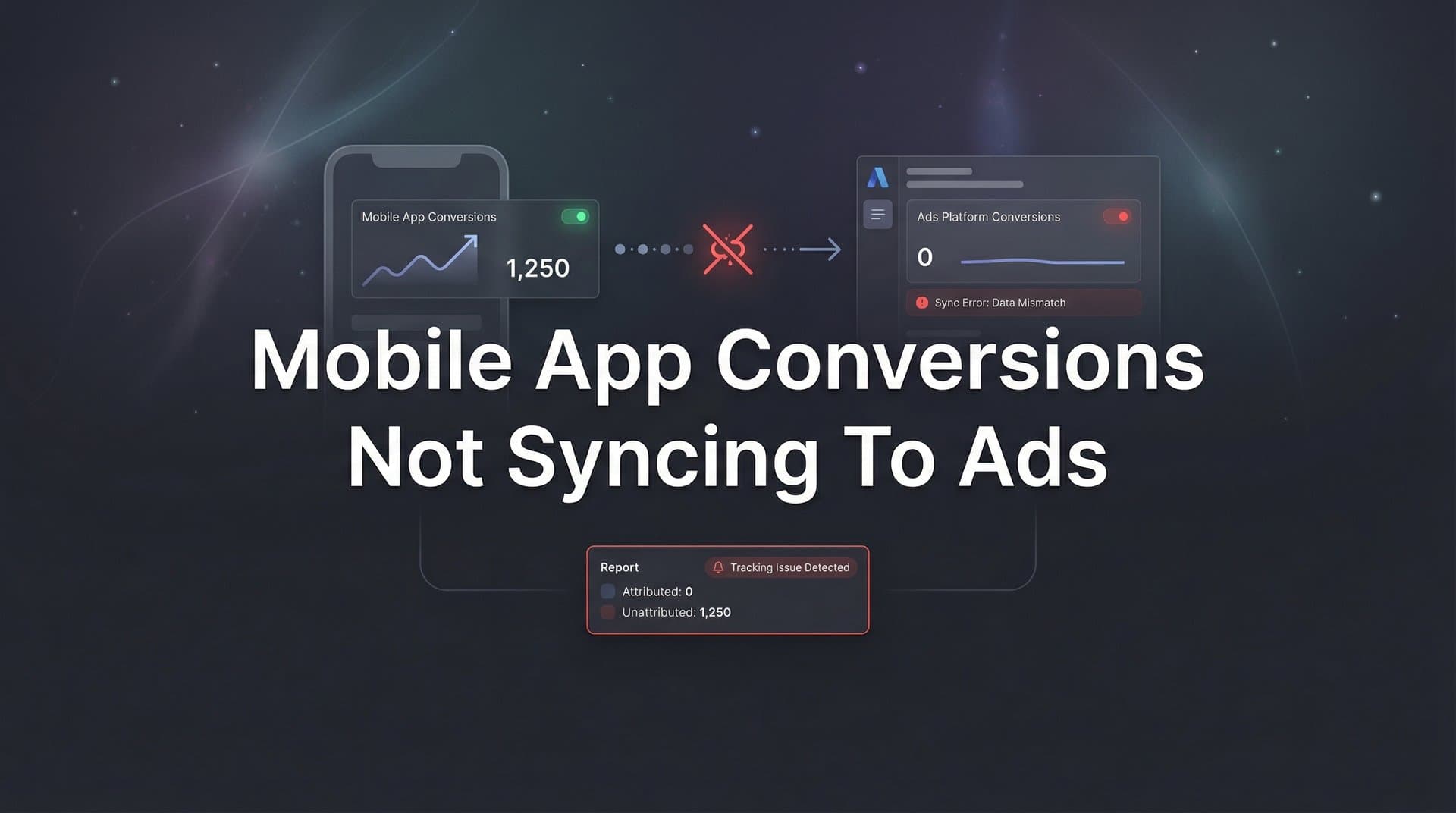
You have run the numbers three times now. Your mobile app shows 47 conversions from yesterday, but your ad platforms are reporting only 12. This disconnect between mobile app conversions and ad platform data is one of the most frustrating challenges marketers face today.
When conversions do not sync properly, you lose visibility into which campaigns actually drive results, your ad platform algorithms optimize on incomplete data, and your budget decisions become educated guesses at best.
The good news is that most syncing issues stem from a handful of common causes, and with the right diagnostic approach, you can identify and resolve them systematically. This guide walks you through each step of the troubleshooting process, from verifying your SDK implementation to testing your conversion events in real time.
By the end, you will have a clear action plan to restore accurate conversion tracking and give your ad platforms the data they need to optimize effectively.
Step 1: Verify Your Mobile SDK Installation and Configuration
Before diving into complex troubleshooting, you need to confirm the foundation is solid. Your mobile SDK is the bridge between your app and your ad platforms, and if it is not properly installed or configured, nothing downstream will work correctly.
Start by checking your app's codebase to verify the SDK is actually present and initializing when users launch your app. This sounds basic, but deployment issues happen more often than you might think. A developer may have installed the SDK in a staging environment but forgotten to push it to production, or an app update may have inadvertently removed the initialization code.
Open your platform's debug tools to see if the SDK is firing. Meta Events Manager and Google Ads conversion testing tools both provide real-time event logs that show whether your SDK is communicating with their servers. If you see no activity when you open your app, the SDK is not initializing.
Next, verify your API keys and app IDs match exactly between your app code and your ad platform settings. A single misplaced character will break the connection entirely. Copy the credentials directly from your ad platform dashboard and compare them character by character against what is in your code.
Pay special attention to environment settings. Many SDKs have separate modes for sandbox testing and production use. If your app is running in sandbox mode, conversions will not appear in your production ad account. Check your SDK configuration to ensure it is pointing to the production environment.
SDK version matters more than most marketers realize. Ad platforms regularly update their APIs and deprecate older versions. An SDK that worked perfectly six months ago may no longer be compatible with current platform requirements. Check the SDK version in your app against the latest version available from the platform, and update if you are running anything more than one major version behind.
Common permission issues can also block conversion tracking. On iOS, your app needs proper permissions declared in its Info.plist file. On Android, network permissions and Google Play Services must be configured correctly. Review the platform-specific setup documentation to ensure all required permissions are in place.
If everything checks out but conversions still are not syncing, create a simple test. Install your app on a clean device, trigger a conversion event manually, and watch the platform debug tools in real time. If the event appears immediately in the debug log, your SDK is working. If not, you have isolated the problem to the SDK layer. For a deeper dive into why your mobile app conversions may not be tracking, review your entire implementation stack.
Step 2: Audit Your Conversion Event Mapping and Parameters
Your SDK may be working perfectly, but if your conversion events are not configured correctly, the data will never reach your ad platforms in a usable format.
Start by listing every in-app event you want to track as a conversion. Common examples include purchases, account registrations, subscription starts, and key feature uses. Then verify each event is actually configured to fire when users complete those actions in your app.
Event naming is where many tracking setups break down. Ad platforms are extremely literal about event names. If your app code fires an event called "purchase_complete" but your ad platform is listening for "purchase_completed," the conversion will never register. Check that event names match character for character, including capitalization, underscores, and spacing.
Beyond names, parameter accuracy determines whether your conversion data is actionable. When a user makes a purchase, your event should pass the transaction ID, purchase value, currency code, and any other relevant details. Missing or incorrectly formatted parameters can cause ad platforms to reject the entire event.
Review your event implementation code to confirm required parameters are being captured and passed correctly. For purchase events, verify the value is being sent as a number (not a string), the currency code follows ISO 4217 standards (USD, EUR, GBP), and transaction IDs are unique for each conversion.
Duplicate event firing is a surprisingly common issue that inflates your app-side conversion counts while confusing ad platforms. This typically happens when developers place event tracking code in multiple locations or when screen navigation triggers the same event multiple times. Use your app analytics tool to check if individual users are generating multiple identical events within seconds of each other.
Timing matters as much as accuracy. Events should fire at the moment a conversion actually occurs, not before or after. If your purchase event fires when users add items to cart rather than when they complete checkout, you are tracking intent instead of conversions. Walk through your app's customer journey mapping for paid ads and verify each event fires at the exact right moment.
Platform-specific event standards also play a role. Meta has a set of standard events (Purchase, CompleteRegistration, AddToCart) that receive preferential treatment in their algorithm. Google has its own standard event structure. Using these predefined events rather than custom names often improves conversion matching and optimization.
Create a spreadsheet mapping each conversion event in your app to its corresponding configuration in every ad platform you use. Include the event name, required parameters, where it fires in the user journey, and which platforms should receive it. This documentation becomes invaluable when troubleshooting discrepancies.
Step 3: Diagnose Attribution Window and Timing Mismatches
You may be tracking conversions perfectly, but if your attribution windows do not align across platforms, the same conversion can be counted differently or missed entirely.
Attribution windows define how long after an ad interaction a conversion can be credited to that ad. Meta might use a 7-day click and 1-day view window by default, while Google Ads might use a 30-day click window. Your app analytics platform might attribute conversions within 90 days. When these windows do not match, discrepancies are inevitable.
Log into each ad platform and document the attribution window settings for your mobile app campaigns. Compare these against your app analytics tool and any third-party attribution platforms you use. Look for misalignments where one platform has a much shorter or longer window than others.
Click attribution versus view attribution adds another layer of complexity. Some platforms credit conversions to users who clicked an ad, while others also count users who simply viewed an ad without clicking. If your app analytics only tracks click-based attribution but your ad platform includes view-through conversions, your numbers will never match. Understanding attribution for mobile app campaigns is essential to resolving these discrepancies.
Timezone settings cause more problems than most marketers expect. If your app analytics runs on Pacific Time but your ad platform reports in Eastern Time, a conversion that happens at 11 PM PT will appear on different days in each system. Check the timezone setting in every platform and standardize them when possible.
Processing delays are a reality of mobile conversion tracking. Some ad platforms take 24 to 72 hours to fully process and report mobile app conversions. This means the conversion count you see today may not include conversions that actually happened yesterday. When comparing data, always look at dates that are at least three days in the past to allow for full processing.
Conversion counting methodologies differ across platforms as well. Some platforms count a conversion the moment it happens. Others count it when they successfully match it to an ad interaction. If matching rates are low due to privacy restrictions or technical issues, you will see conversions in your app that never appear in your ad platforms.
The fix often involves standardizing attribution windows across platforms where possible and understanding where standardization is not possible. Document the differences, set expectations accordingly, and focus on trends rather than exact number matching when windows cannot align.
Step 4: Address iOS Privacy Restrictions and SKAdNetwork Limitations
iOS privacy changes have fundamentally altered mobile app conversion tracking, and understanding these limitations is essential to diagnosing syncing issues.
App Tracking Transparency (ATT) requires apps to ask users for permission before tracking them across other apps and websites. Many users decline this permission when prompted. When users opt out, traditional identifier-based tracking stops working, and conversions from those users often cannot be attributed to specific ads.
Check your ATT opt-in rate in your app analytics. If only 20 to 30 percent of users are granting permission, that means 70 to 80 percent of your iOS conversions are invisible to traditional tracking methods. This alone can explain significant discrepancies between app-reported conversions and ad platform data.
SKAdNetwork is Apple's privacy-preserving attribution framework, but it comes with substantial limitations. Conversion data is delayed by at least 24 to 48 hours and often longer. The data is aggregated rather than user-level, meaning you cannot see individual conversion paths. Conversion values are limited to a 6-bit scale (0 to 63), requiring you to map your actual conversion events into this constrained range.
Verify your SKAdNetwork implementation is configured correctly. You need to register your ad network IDs in your app's Info.plist file, set up conversion value mapping that makes sense for your business, and ensure your ad platforms are configured to receive SKAdNetwork postbacks. Missing any of these pieces means you are losing attribution data unnecessarily. If you are struggling with mobile app attribution tracking, SKAdNetwork configuration is often the culprit.
Server-side tracking becomes critical in the iOS privacy landscape. Because server-to-server connections do not rely on device identifiers or user permissions, they can capture conversion data that client-side SDKs miss entirely. Implementing server-side tracking is no longer optional if you want complete visibility into iOS conversions.
Set realistic expectations for iOS conversion data completeness. Even with perfect implementation, you will not see 100 percent of iOS conversions attributed in your ad platforms the way you could before iOS 14.5. The goal is to maximize what you can track while understanding that some visibility loss is inherent to the current privacy landscape.
Consider implementing probabilistic attribution models that use aggregated signals rather than user-level tracking. While less precise than deterministic tracking, probabilistic methods can help fill gaps in your iOS conversion data and provide directional guidance for optimization.
Step 5: Test Conversion Flow End-to-End with Real Devices
Theory only gets you so far. To truly understand where your conversion syncing breaks down, you need to test the entire flow from ad click to conversion with actual devices.
Start by setting up test campaigns in your ad platforms using their sandbox or testing environments. Meta offers test ad accounts, and Google Ads has a testing mode that prevents actual billing while letting you verify tracking. Create simple test campaigns that drive installs or conversions in your app.
Use a clean test device that has never installed your app before. This eliminates any cached data or previous attribution that might interfere with testing. Click your test ad, install the app if testing install tracking, and complete a conversion action like making a test purchase or registering an account.
While you run this test, keep your ad platform's event manager or debug console open in a browser. Watch for events to appear in real time. You should see the app install event (if applicable), the app open event, and then your conversion event appearing within seconds of completing the action in your app.
Document exactly what appears and when. If the install event shows up but the purchase event does not, you have isolated the problem to purchase event tracking specifically. If nothing appears at all, the issue is with SDK initialization or basic connectivity. This systematic approach helps when diagnosing why conversions are not tracking at all.
Test on both iOS and Android devices, as tracking implementations often differ between platforms. An issue that only affects iOS users will not show up in Android testing. Similarly, test on different OS versions, as older iOS versions may behave differently than the latest release.
Use platform-specific debugging tools to see detailed logs. Xcode console logs on iOS and Android Studio logcat on Android can show you exactly what your SDK is attempting to do and where it might be failing. Look for error messages, failed network requests, or missing parameters in the logs.
If test conversions work perfectly but real user conversions still do not sync, the issue likely involves attribution matching or privacy restrictions rather than basic tracking functionality. This tells you where to focus your troubleshooting efforts next.
Step 6: Implement Server-Side Conversion Tracking for Reliable Data
Client-side tracking through mobile SDKs faces increasing limitations from privacy restrictions, ad blockers, and technical constraints. Server-side tracking offers a more reliable path to accurate conversion data.
Server-to-server tracking works by sending conversion events directly from your app's backend or CRM to ad platforms, bypassing the user's device entirely. This means conversions are tracked regardless of user privacy settings, SDK issues, or client-side blocking.
Setting up server-side tracking requires connecting your backend systems to ad platform conversion APIs. Meta offers the Conversions API, Google has the Enhanced Conversions API, and most major ad platforms now provide similar server-side options. These APIs accept conversion data directly from your servers and match it to ad interactions using hashed user identifiers. Learn more about implementing enhanced conversions for Google Ads to improve your match rates.
The key to successful server-side tracking is sending enriched event data with strong matching signals. Include hashed email addresses, phone numbers, and other identifiers that help ad platforms match conversions to the right users. The more matching parameters you include, the higher your match rates will be.
Implementing server-side tracking from scratch requires development resources and careful attention to data privacy compliance. You need to ensure you are hashing personally identifiable information correctly, sending data securely, and respecting user consent preferences.
Tools like Cometly's Conversion Sync automate this process by connecting your existing data sources to ad platform APIs without requiring custom development. Cometly captures conversion events from your app, CRM, or other systems, enriches them with additional attribution data, and delivers them to Meta, Google, and other platforms through their server-side APIs. If your conversion data is not syncing to ad platforms, server-side implementation often resolves the issue.
Once server-side tracking is implemented, validate that events are being received correctly. Most ad platforms provide event diagnostics that show server-side events separately from client-side events. Check that your server events are appearing, that match rates are reasonable (typically 60 to 80 percent for quality implementations), and that conversion values are being passed correctly.
Server-side tracking does not replace client-side SDKs entirely. The best approach uses both methods together. Client-side tracking captures immediate user interactions and provides real-time data, while server-side tracking ensures conversions are not lost due to tracking limitations. This dual approach maximizes data completeness and accuracy.
Putting It All Together
Fixing mobile app conversion syncing issues requires methodical troubleshooting across your entire tracking stack. Start with your SDK configuration, move through event mapping and attribution settings, address iOS privacy limitations, and consider implementing server-side tracking for more reliable data.
Here is your quick checklist before you finish: SDK installed and initializing correctly, event names and parameters matching across platforms, attribution windows aligned, SKAdNetwork configured for iOS, test conversions verified end-to-end, and server-side tracking implemented where possible.
With accurate conversion data flowing to your ad platforms, their algorithms can optimize more effectively, and you can make confident decisions about where to allocate your budget. The difference between seeing 12 conversions and seeing all 47 is not just about numbers. It is about understanding what actually works, which campaigns deserve more investment, and how to scale profitably.
Most syncing issues are fixable with the right diagnostic approach. Work through each step systematically, document what you find, and do not assume any part of your tracking stack is working correctly until you have verified it with real tests.
Ready to elevate your marketing game with precision and confidence? Discover how Cometly's AI-driven recommendations can transform your ad strategy. Get your free demo today and start capturing every touchpoint to maximize your conversions.



