Picture this: your marketing team is running campaigns across Meta, Google, TikTok, and LinkedIn simultaneously. The quarter ends, you pull reports from each platform, and suddenly every channel is claiming credit for the same conversions. Meta says it drove 300 purchases. Google claims 280. TikTok is reporting 150. Add it all up and you have nearly 730 attributed conversions on a day when your actual sales system recorded 400. The numbers simply do not add up, and nobody on the team can confidently answer the most basic question in marketing: where should we put more budget?
This is not a rare edge case. This is the daily reality for thousands of marketing teams running paid media across multiple platforms. Paid media attribution challenges have become one of the most persistent and costly problems in digital advertising, quietly draining budgets, distorting decisions, and eroding trust in marketing data across the board.
The problem is not that marketers are doing something wrong. The attribution landscape itself is broken in several interconnected ways. Platform-native reporting conflicts with cross-channel reality. Privacy changes have punched holes in tracking infrastructure. Multi-touch journeys are being forced into single-touch models. And offline revenue events are happening completely outside the view of digital measurement tools.
This article breaks down each of these challenges in plain terms, explains why they matter for your actual campaign performance, and walks you through a practical framework for building an attribution system that gives you reliable, actionable data. By the end, you will have a clear picture of what is going wrong and what you can do about it.
Why Every Ad Platform Tells a Different Story
Here is something worth understanding about how ad platforms report results: they are not neutral measurement tools. Each platform is a business with a financial incentive to demonstrate its own value. That fundamental conflict of interest is baked into how they count conversions, and it explains a lot of the confusion marketers face when comparing reports across channels.
Meta might use a 7-day click and 1-day view attribution window by default. Google Ads often defaults to a 30-day click window. TikTok has its own set of defaults. When a customer clicks a Meta ad on Monday, sees a Google remarketing ad on Wednesday, and converts on Friday, all three platforms may claim that conversion as their own. Nobody is technically lying. They are each reporting accurately within their own rules. But the combined picture is wildly misleading.
This phenomenon is called double counting, and in multi-channel campaigns it can make your total attributed conversions far exceed your actual conversions. When teams rely on platform-native reporting to make budget decisions, they end up chasing inflated numbers rather than real performance signals. Understanding why attribution data doesn't match across platforms is the first step toward fixing this problem.
The lookback window problem compounds this further. Different platforms use different time horizons to claim credit. A platform with a longer lookback window will naturally claim more conversions than one with a shorter window, even if its actual contribution to the purchase decision was minimal. This makes apples-to-apples comparisons across channels nearly impossible without a neutral third-party attribution layer. For a deeper dive into how these windows affect your reporting, explore how the attribution window in advertising shapes the data you see.
The practical consequence is significant. Marketing teams regularly overspend on channels that appear to perform well in siloed reports, while underinvesting in channels that are actually driving incremental revenue but get less credit in self-reported data. A channel that consistently assists conversions without getting the last click may look like a poor performer on paper while being essential to the customer journey in reality.
The fix starts with recognizing that you cannot use platform dashboards as your source of truth for cross-channel performance. You need a unified attribution layer that applies consistent rules across all your channels, giving you a single, objective view of where conversions are actually coming from.
The Privacy and Tracking Gap That Changed Everything
If you have been running paid media since 2021, you already know that something shifted. Apple's App Tracking Transparency framework, which rolled out with iOS 14.5, required apps to ask users for permission before tracking their activity across other apps and websites. The majority of users opted out. Almost overnight, Meta and other platforms lost visibility into a significant portion of their audience's post-click behavior.
The impact was immediate and measurable for many advertisers: reported conversions dropped, cost per acquisition climbed, and campaign optimization became less reliable. The platforms were still serving ads to the same people, but they could no longer see what those people did after clicking. Without that feedback signal, their algorithms were flying partially blind. Many teams found themselves dealing with poor ad attribution data that made confident decision-making nearly impossible.
Cookie deprecation has added another layer of complexity. While Google has shifted its timeline for phasing out third-party cookies in Chrome multiple times, the direction of travel is clear. Browser-level restrictions on cross-site tracking are tightening across the industry, and relying on client-side cookies to track conversions is becoming increasingly unreliable.
When ad platforms receive fewer conversion signals, their machine learning models have less data to work with. Smart Bidding on Google, Advantage+ on Meta, and similar automated systems are designed to optimize toward conversions. If those conversion signals are incomplete or delayed, the algorithms optimize on partial information. The result is worse targeting, higher CPAs, and a gradual degradation of campaign performance that can be difficult to diagnose because it happens slowly over time.
Server-side tracking has emerged as the most effective solution to this problem. Instead of relying on a browser-based pixel to fire when a user converts, server-side tracking sends conversion data directly from your server to the ad platform's API. Because the data travels server to server rather than through the browser, it bypasses most of the restrictions that have degraded client-side tracking. Teams running Meta campaigns specifically should explore dedicated Facebook tracking software to recover lost attribution signals.
This approach recovers conversion signals that would otherwise be lost, giving platforms more complete data for their algorithms and giving marketers a more accurate picture of what is actually happening. For teams running significant ad spend, server-side tracking is no longer optional. It is a foundational requirement for maintaining data quality in a privacy-first world.
The Multi-Touch Attribution Maze
Think about the last significant purchase you made, whether it was software, a service, or a high-consideration product. Did you click one ad and immediately buy? Almost certainly not. You probably saw a social post, did some searching, read a few reviews, clicked a retargeting ad, and eventually converted after several interactions spread across days or weeks. That is the reality of modern customer journeys, and it is why single-touch attribution models are so problematic.
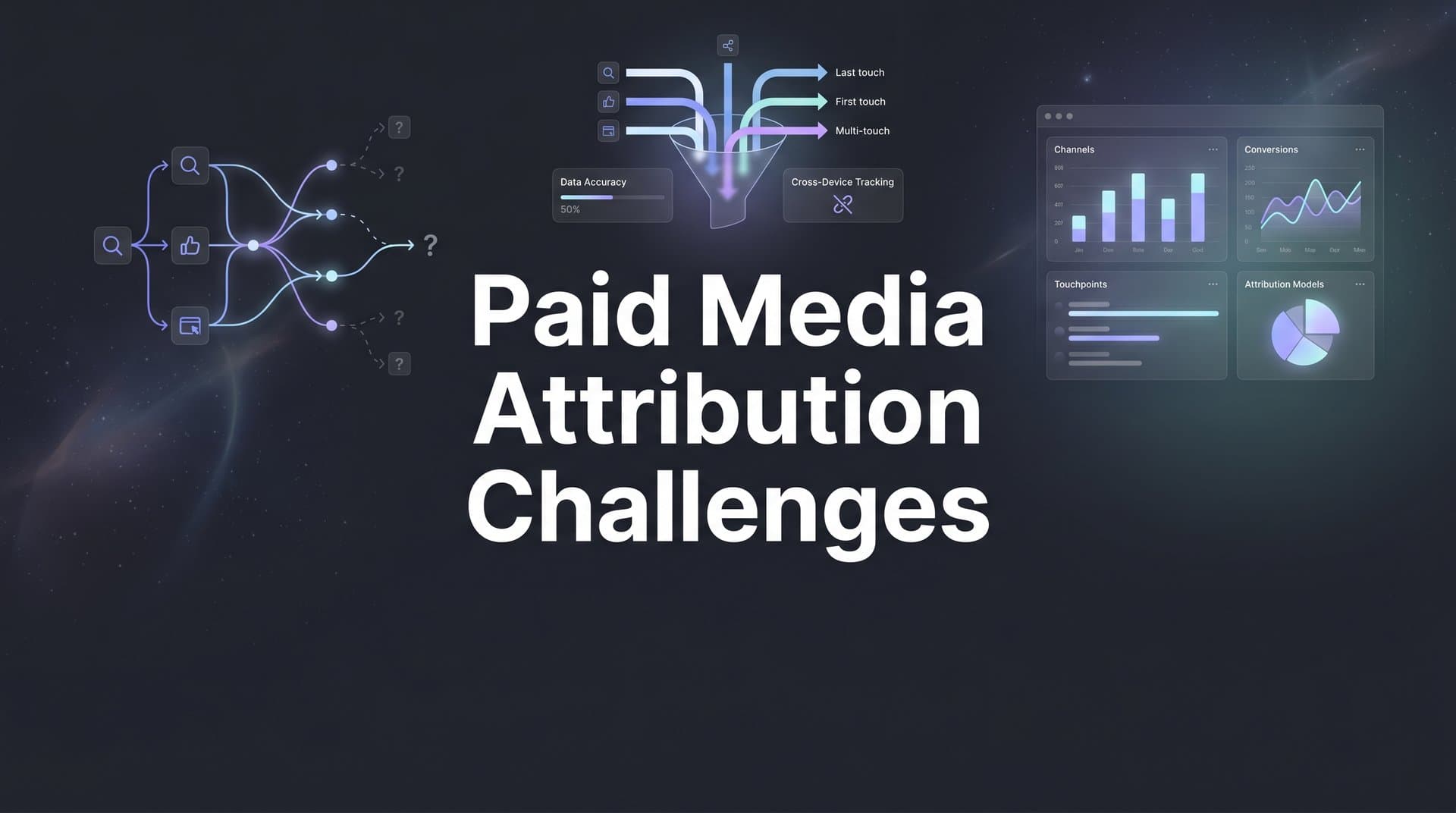
Last-click attribution, which gives 100% of the credit to the final touchpoint before conversion, is still surprisingly common. It is simple to implement and easy to understand, which is why it persists. But it systematically undervalues the channels that create awareness and consideration early in the journey. If you are running top-of-funnel campaigns on TikTok or LinkedIn to introduce your brand to new audiences, last-click attribution will make those campaigns look like they are not working, even if they are essential to filling your pipeline. Understanding the difference between single source and multi-touch attribution is critical for choosing the right approach.
First-click attribution has the opposite problem: it overvalues the initial touchpoint and ignores everything that happened afterward. Neither model gives you a realistic view of how your channels are actually working together.
More sophisticated models attempt to distribute credit across the full journey. Linear attribution splits credit equally across all touchpoints. Time-decay attribution gives more credit to touchpoints closer to the conversion. Position-based models weight the first and last touch more heavily while distributing the remainder across middle touches. Data-driven attribution uses machine learning to assign credit based on observed patterns in your actual conversion data. For a comprehensive overview of these options, review the various types of attribution models in digital marketing.
Choosing the right model is genuinely context-dependent. For short sales cycles with simple journeys, a simpler model may be sufficient. For complex B2B sales with long evaluation periods and multiple decision-makers, a more nuanced approach is necessary. There is no universally correct answer, which is part of what makes this challenging.
But here is the deeper issue: the model choice only matters if you have clean, unified data to feed into it. Most teams do not. Their ad platform data lives in separate silos. Their website analytics uses different tracking than their CRM. Touchpoints from different devices are not connected. Without a unified data foundation that stitches together every interaction from first ad click to final conversion, even the most sophisticated attribution model will produce unreliable outputs.
Building that unified foundation, connecting your ad platforms, website tracking, and CRM into a single source of truth, is the prerequisite for any meaningful multi-touch attribution work.
Offline Conversions and Long Sales Cycles: The Hidden Attribution Blind Spot
Not every conversion happens with a click on a "Buy Now" button. For many businesses, especially in B2B, the actual conversion is a signed contract, a phone call that turns into a deal, or an in-person meeting that closes weeks after the first digital touchpoint. These offline conversions are one of the most underappreciated paid media attribution challenges, and they create a significant blind spot in most marketing measurement systems.
When a prospect clicks your Google ad, downloads a whitepaper, attends a webinar, and then gets on a sales call three weeks later before signing a contract, your digital tracking may only see the first few steps. The revenue event, the one that actually matters, happens entirely outside your tracking infrastructure. Without a deliberate effort to connect that closed deal back to the originating campaign, the revenue goes unattributed and the campaign that generated it looks like it produced no return. Effective attribution for lead generation requires bridging this gap between digital touchpoints and offline outcomes.
Long B2B sales cycles create a related problem with lookback windows. Standard attribution windows on most platforms are 7 to 30 days. If your average sales cycle is 60 or 90 days, the attribution window expires long before the deal closes. The ad platform never receives the conversion signal, so it has no way to optimize toward the types of prospects who eventually become customers.
The solution requires integrating your CRM with your ad platform data. When a deal closes in your CRM, that event needs to be connected back to the original campaign touchpoints and sent back to the ad platforms as a conversion signal. This closes the loop between marketing activity and actual revenue outcomes, giving both your team and the platform algorithms the information they need to make smarter decisions. Teams evaluating solutions for this should explore the best B2B marketing attribution SaaS options available today.
This kind of CRM integration is not trivial to set up, but it is essential for any business where the sales process extends beyond a simple online transaction. Without it, you are making budget decisions based on lead volume rather than revenue, which often leads to optimizing for the wrong outcomes entirely.
Feeding Better Data Back to Ad Platform Algorithms
There is a dimension of attribution that most marketers overlook entirely. Attribution is not just about understanding your own performance. It is about feeding better information to the algorithms that are running your campaigns. This distinction matters enormously for how you think about solving paid media attribution challenges.
Ad platform algorithms like Meta's Advantage+ and Google's Smart Bidding are powerful tools, but they are only as good as the conversion data they receive. When these systems have complete, accurate, and timely conversion signals, they can identify the audience segments, placements, and creative combinations that are most likely to drive results. When they receive incomplete or delayed signals, their optimization degrades. Investing in revenue attribution tracking tools ensures these algorithms receive the high-quality data they need to perform at their best.
This is why the concept of conversion syncing has become so important. Instead of treating attribution as a passive reporting exercise where you look at data after the fact, conversion syncing turns it into an active performance lever. You collect enriched conversion data, including offline events, CRM milestones, and downstream revenue signals, and you send that data back to the ad platforms through their conversion APIs.
The result is a positive feedback loop. Better data leads to better algorithm optimization. Better optimization leads to more efficient spend and higher-quality conversions. More high-quality conversions generate more accurate data, which feeds back into the algorithm again. Over time, this compounding effect can meaningfully improve campaign performance without increasing budget. For a broader look at how to address these issues systematically, explore proven strategies for solving attribution data discrepancies.
This approach also addresses one of the most frustrating aspects of signal loss from privacy changes. Even if browser-based tracking has declined, server-side conversion syncing can recover a significant portion of those lost signals by sending conversion data directly through the API. The platforms get more complete information, and your campaigns benefit from better targeting and bidding as a result.
Treating attribution as a performance optimization tool rather than just a measurement tool is one of the most important mindset shifts a marketing team can make.
Building an Attribution System That Actually Works
So what does a functional attribution system actually look like in practice? The good news is that the framework is not as complicated as the individual challenges might suggest. It comes down to three interconnected layers: accurate data collection, unified measurement, and active optimization through conversion syncing.
Start with server-side tracking: This is your data foundation. Client-side pixels and cookies are no longer sufficient on their own given the privacy changes that have reshaped the tracking landscape. Server-side tracking ensures you are capturing conversion events accurately and completely, regardless of browser restrictions or ad blockers. Without this foundation, everything built on top of it will be compromised.
Layer on multi-touch attribution: Once you have reliable data flowing in, you need a measurement framework that gives you a unified view across all your channels. This means applying consistent attribution rules across Meta, Google, TikTok, LinkedIn, and any other channels you are running, rather than relying on each platform's self-reported numbers. The specific model you choose matters less than the consistency and completeness of the data feeding into it.
Close the loop with CRM integration and conversion syncing: Connect your CRM so that offline conversions, closed deals, and downstream revenue events are tied back to their originating campaigns. Then sync those enriched conversion events back to your ad platforms so their algorithms can optimize on real business outcomes rather than proxy metrics.
When evaluating attribution tools, look for a few key capabilities. Cross-platform unification is non-negotiable: the tool needs to pull data from all your ad platforms into a single view. Real-time data matters because delayed reporting means delayed decisions. CRM connectivity is essential for businesses with any offline conversion activity. And the ability to feed data back to ad platforms through their APIs is what separates modern attribution tools from legacy reporting solutions. For a comprehensive comparison, check out the top marketing attribution software options for 2026.
Cometly is built specifically to address these interconnected challenges. It captures every touchpoint from ad click to CRM event, giving its AI a complete view of the customer journey across every channel. Rather than forcing marketers to interpret raw data on their own, Cometly surfaces AI-powered recommendations that identify which ads and campaigns are actually driving revenue, and where to scale with confidence. Its server-side tracking recovers conversion signals that would otherwise be lost to privacy restrictions, and its Conversion Sync feature sends enriched, conversion-ready events back to Meta, Google, and other platforms to improve their targeting and bidding algorithms. For teams running paid media across multiple channels, it brings everything into one place so that budget decisions are based on accurate, unified data rather than conflicting platform reports.
Moving Forward with Clearer Attribution
Paid media attribution challenges are not going away. If anything, they will intensify as privacy regulations continue to evolve, customer journeys grow more complex, and the gap between platform-reported data and business reality widens. The marketers who invest in solving attribution now will have a compounding advantage: better data today leads to better optimization tomorrow, and that gap between them and their competitors grows over time.
The core insight from everything covered in this article is that attribution is not a reporting problem. It is a performance problem. When your attribution is broken, your algorithms are flying blind, your budget decisions are based on fiction, and your campaigns are optimizing toward the wrong outcomes. When your attribution works, every part of your paid media operation improves.
The path forward is clear: invest in server-side tracking to recover lost signals, build a unified multi-touch attribution layer to see the full customer journey, integrate your CRM to connect offline revenue to digital campaigns, and sync enriched conversion data back to your ad platforms to fuel better algorithmic performance.
Ready to stop guessing and start scaling with confidence? Get your free demo and see how Cometly can unify your attribution data, surface AI-driven insights, and feed better signals to your ad platforms so every dollar you spend works harder.