You're running ads on Meta, Google, TikTok, and LinkedIn. Your dashboard shows thousands of clicks, hundreds of conversions, and what looks like solid performance across every platform. But when you check your CRM, the numbers don't add up. Revenue is lower than expected, and each ad platform is claiming credit for the same sales. You're left wondering: which campaigns are actually driving revenue, and which ones are just burning budget?
This is the reality for most performance marketers today. You're making budget decisions with incomplete data, relying on platform-reported metrics that don't reflect what's really happening in your business. The result? Wasted spend, missed opportunities, and constant uncertainty about where to invest your marketing dollars.
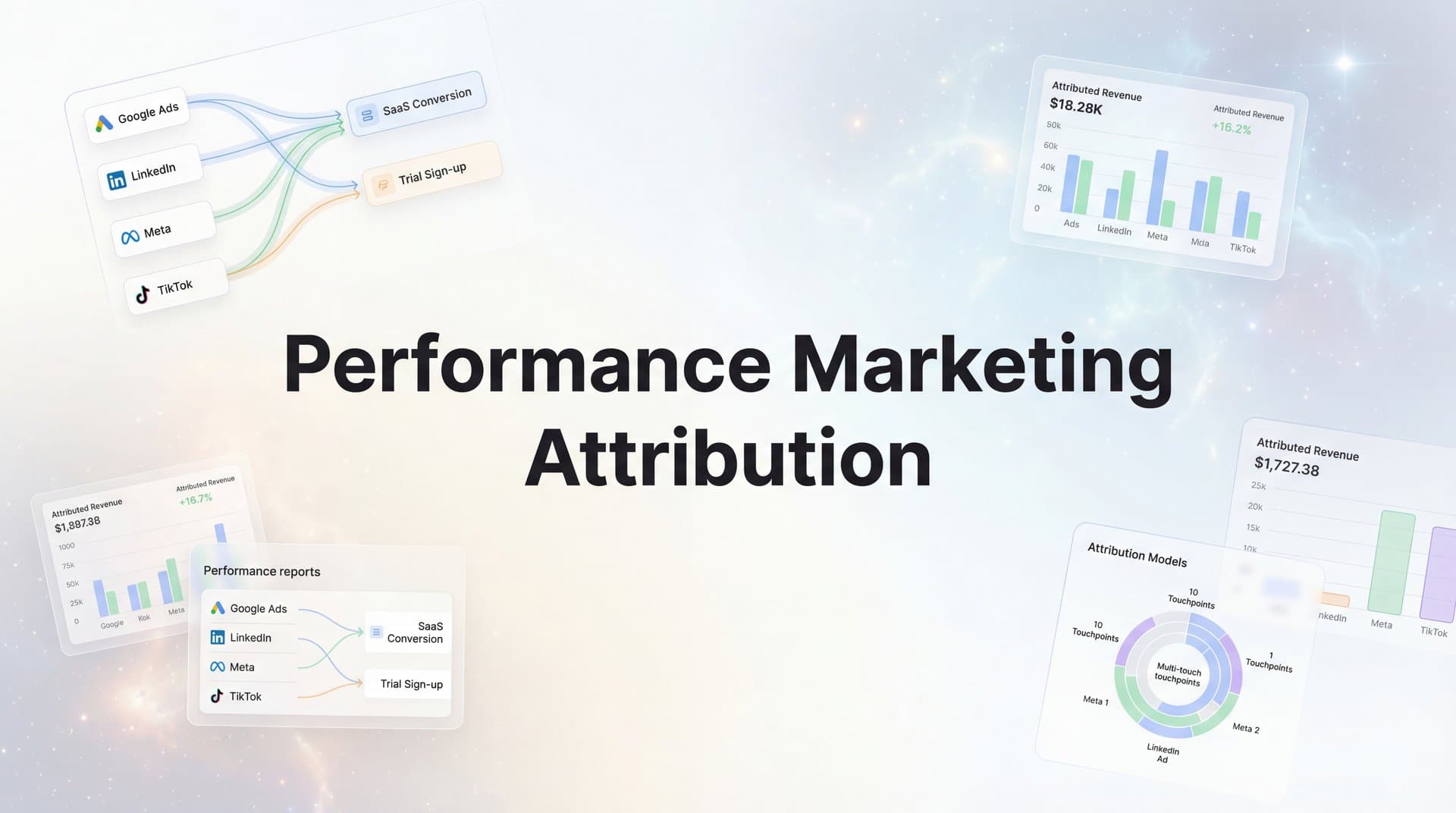
Performance marketing attribution solves this problem. It connects every ad click, every website visit, and every customer touchpoint to actual revenue outcomes. Instead of guessing which campaigns work, you see exactly which ads drive leads, which channels close deals, and where your next dollar should go. This guide shows you how to build an attribution system that transforms marketing from a cost center into a predictable revenue driver.
The Multi-Platform Attribution Problem
Here's what's broken about the way most marketers track performance today. You run a campaign on Meta. A prospect clicks your ad, visits your site, and later converts. Meta's pixel fires and claims a conversion. Sounds straightforward, right?
But that same prospect also clicked a Google ad three days earlier. And they saw your LinkedIn sponsored post last week. When they finally converted, Google's tracking claimed credit. So did LinkedIn's Insight Tag. Now you have three platforms all reporting the same conversion as their own success.
This isn't a technical glitch. It's how platform-level tracking works. Each ad platform operates in its own silo, using its own tracking pixel to measure conversions independently. They're not lying about the data—they just can't see the full picture. From Meta's perspective, that click led to a conversion. From Google's view, their click did the same thing. Both statements are technically true, but neither tells you which touchpoint actually drove the decision.
The problem compounds when you look at your actual business results. Your CRM shows 50 new customers this month. But when you add up the conversions reported by Meta, Google, TikTok, and LinkedIn, you're looking at 180 conversions. The math doesn't work. You're making budget decisions based on inflated numbers that don't reflect reality. This is the core digital marketing attribution problem that plagues most advertising teams.
Privacy changes have made this worse. iOS 14.5 gave users the power to opt out of tracking, and most did. Browser-based pixels now miss a significant portion of conversions because they can't track users across apps and websites. Cookie restrictions continue to tighten, creating more blind spots in your data. The tracking methods that worked three years ago now capture maybe 60-70% of actual conversions—and you don't know which 30-40% you're missing.
The real cost isn't just inaccurate reporting. It's the decisions you make based on that data. You might cut a Google campaign that looks underperforming in the dashboard but actually drives high-value customers who take longer to convert. Or you might scale a Meta campaign that reports great numbers but generates leads that never close. Without accurate attribution connecting ad spend to revenue, you're optimizing for the wrong metrics.
Connecting Ad Clicks to Actual Revenue
Performance marketing attribution works by tracking the entire customer journey from first touchpoint to closed deal. Instead of relying on what each ad platform reports, you capture every interaction in a unified system that connects ad clicks to CRM outcomes and actual revenue.
Think of it like this. A prospect sees your LinkedIn ad on Monday. They don't click, but they remember your brand. On Wednesday, they search for your solution on Google and click your ad. They browse your site but don't convert. On Friday, they click a Meta retargeting ad and finally submit a lead form. Two weeks later, after multiple sales touchpoints, they become a customer worth $5,000 in revenue.
Traditional platform tracking would show this as three separate conversions—one each for LinkedIn (view-through), Google (click-through), and Meta (click-through). But there was only one actual customer. Performance marketing attribution captures all three touchpoints and maps them to that single $5,000 deal. Now you can see the real role each channel played in driving revenue.
This requires first-party data collection. Instead of relying solely on browser pixels that users can block, you capture events server-side—directly from your website and CRM to your attribution platform. When someone fills out a form, makes a purchase, or takes any valuable action, that event is recorded with all the marketing context: which ads they clicked, which emails they opened, which pages they visited.
Server-side tracking captures what browser-based pixels miss. When iOS users opt out of tracking, their actions still get recorded in your first-party system. When cookie restrictions block traditional pixels, your server-side events keep flowing. You're no longer dependent on browser technology that users can disable. You're tracking actions on your own properties with your own data. Understanding attribution marketing tracking fundamentals is essential for implementing this correctly.
The key is connecting this data to your CRM. When that lead becomes an opportunity and eventually closes as a customer, your attribution system links that revenue back to the original marketing touchpoints. You see that the LinkedIn impression started the journey, Google drove the initial research, and Meta closed the loop. Each channel gets appropriate credit based on its actual role in driving that $5,000 in revenue.
This is where most marketing analytics tools stop. They show you which channels drive form fills or trial signups. But performance marketing attribution goes deeper. It tracks leads through your sales pipeline and attributes revenue to the campaigns that generated those customers. Effective marketing attribution platforms revenue tracking connects every dollar of ad spend to actual business outcomes.
The customer journey matters because people don't convert on the first touchpoint. Especially in B2B or high-consideration purchases, buyers interact with your brand multiple times before making a decision. They might see an ad, visit your site, read reviews, watch a demo video, and talk to sales before converting. Each of those touchpoints plays a role. Single-click attribution models that give 100% credit to one touchpoint miss the complexity of how people actually buy.
Modern attribution platforms use sophisticated identity resolution to connect these touchpoints. When someone clicks your ad, visits your site from organic search, and later converts via email, the system recognizes these as the same person and builds a unified customer journey. This creates a complete picture of how marketing drives revenue across every channel and touchpoint.
Choosing the Right Attribution Model
Attribution models are the rules that determine how credit gets distributed across touchpoints in a customer journey. Different models serve different purposes, and understanding when to use each one helps you analyze performance accurately. Exploring the various types of marketing attribution models helps you select the right approach for your business.
Last-click attribution gives 100% credit to the final touchpoint before conversion. If someone clicks a Meta ad and immediately converts, that Meta campaign gets full credit. This model is simple and makes sense for short sales cycles where the last interaction truly drives the decision. It's useful when you want to identify which channels close deals, but it ignores everything that happened earlier in the journey.
First-click attribution does the opposite—it gives 100% credit to the touchpoint that started the customer journey. If someone first discovered you through a Google ad, that campaign gets full credit even if they converted weeks later through a different channel. This model helps you understand which channels drive awareness and bring new prospects into your funnel. It's valuable for top-of-funnel analysis but misses the nurturing that happens afterward.
These single-touch models work well for specific questions. Want to know which channels introduce you to new customers? Use first-click. Want to identify your best closing channels? Use last-click. But neither model captures the full story of how marketing drives revenue across multiple touchpoints.
Linear attribution distributes credit equally across all touchpoints in the customer journey. If someone interacts with five different campaigns before converting, each one gets 20% credit. This model acknowledges that multiple channels contribute to conversions, but it assumes every touchpoint has equal impact—which usually isn't true. The ad that introduced someone to your brand probably played a different role than the retargeting ad that closed the deal. Some teams prefer linear model marketing attribution software for its simplicity and fairness across channels.
Time-decay attribution gives more credit to touchpoints closer to conversion. The logic is that recent interactions have more influence on the decision to buy. If someone saw your ad a month ago and then clicked another ad yesterday before converting, the recent ad gets more credit. This model works well when you believe proximity to conversion indicates importance, but it can undervalue the awareness-building that happens early in long sales cycles.
Position-based attribution, sometimes called U-shaped, typically assigns 40% credit to the first touchpoint, 40% to the last touchpoint, and distributes the remaining 20% among middle interactions. This model recognizes that both discovery and closing moments are crucial while acknowledging that nurturing touchpoints matter too. It's a balanced approach that works well for mid-length sales cycles with multiple touchpoints.
Data-driven attribution is where modern performance marketing attribution gets powerful. Instead of using predetermined rules about how credit should be distributed, data-driven models analyze your actual conversion data to determine which touchpoints statistically drive results. The algorithm looks at thousands of customer journeys, identifies patterns, and assigns credit based on what actually correlates with conversions in your business. Understanding what is predetermined in marketing attribution models helps you appreciate why data-driven approaches offer more accuracy.
This approach adapts to your specific customer behavior. If your data shows that LinkedIn impressions early in the journey strongly predict eventual conversions, those impressions get more credit. If retargeting ads consistently appear in converting journeys but rarely in non-converting ones, they receive higher attribution. The model learns from your real outcomes rather than assuming how customers should behave.
Which model should you use? The answer is: it depends on what you're trying to learn. Many marketers use multiple models simultaneously. Last-click helps you optimize for immediate conversions. First-click shows you which channels drive awareness. Data-driven attribution gives you the most accurate overall picture of how channels work together to drive revenue.
The key is understanding that no single model is objectively "correct." Attribution models are analytical lenses. Each one reveals different insights about your marketing performance. The best approach is to choose models that align with your business goals and use them consistently to make informed decisions about budget allocation.
Essential Components of Your Attribution System
Building accurate performance marketing attribution requires connecting several data sources into a unified tracking system. The goal is to capture every marketing touchpoint and link it to business outcomes in your CRM.
Start with unified tracking across all ad platforms. Your attribution system needs to capture clicks and impressions from Meta, Google, TikTok, LinkedIn, and any other channel where you run campaigns. This means integrating with each platform's API to pull in campaign data, ad spend, and engagement metrics. When someone clicks your ad, that interaction gets recorded with full context: which campaign, which ad creative, which audience, and exactly when it happened.
Website tracking is the next critical piece. You need to know what happens after someone clicks your ad. Which pages did they visit? How long did they stay? Did they download content, watch videos, or interact with your pricing page? This requires tracking pixels on your site that fire events to your attribution platform. But here's where it gets important: you need both browser-based and server-side tracking.
Server-side event tracking captures conversions that browser pixels miss. When someone fills out a form on your site, that event gets sent directly from your server to your attribution platform—not through a browser pixel that can be blocked. This ensures you capture conversions even from users who have opted out of tracking or are using ad blockers. Server-side tracking is especially crucial for iOS users and anyone browsing in privacy-focused modes.
CRM integration completes the picture. Your attribution system needs to connect marketing touchpoints to sales outcomes. When a lead enters your CRM, moves through your pipeline, and eventually closes as a customer, that revenue gets attributed back to the marketing campaigns that generated that lead. This connection between marketing data and CRM data is what transforms attribution from "which ads get clicks" to "which ads drive revenue." When comparing marketing attribution software features, CRM integration capabilities should be a top priority.
The technical implementation typically works like this: your attribution platform acts as a central hub that receives data from all sources. Ad platforms send campaign performance data. Your website sends user behavior and conversion events. Your CRM sends lead and revenue data. The attribution system uses identity resolution to connect these data points—recognizing that the person who clicked your Meta ad, visited your pricing page, and submitted a lead form is the same individual who became a customer in your CRM.
But tracking is only half the equation. Modern attribution systems also send data back to your ad platforms. This is called conversion sync or conversion API integration. When your attribution system knows that a lead became a customer, it sends that conversion event back to Meta, Google, and other platforms. This enriched data improves their machine learning algorithms.
Here's why this matters. Ad platforms optimize based on the conversion data they receive. If you're only sending basic form submissions, the algorithm learns to find people who fill out forms—not necessarily people who become customers. When you send back enriched conversion data that includes lead quality, pipeline stage, and actual revenue, the algorithm learns to find people who become valuable customers. Your targeting improves, your cost per acquisition drops, and your ROAS increases.
This creates a feedback loop. Better attribution data helps you make smarter budget decisions. Sending that data back to ad platforms improves their optimization. Better optimization drives more efficient conversions. More conversion data improves your attribution accuracy. The system gets smarter over time as more data flows through it.
Turning Attribution Data Into Revenue Growth
Accurate attribution data is valuable only when you use it to make better decisions. The goal isn't perfect measurement—it's actionable insights that help you scale the campaigns that drive revenue and cut the ones that don't.
Start by identifying which campaigns actually generate valuable customers. Look beyond surface metrics like clicks, impressions, or even conversions. Focus on revenue attribution. Which campaigns drive customers who close deals? Which ones generate leads that stall in your pipeline? You might discover that a Google campaign with a high cost per lead actually delivers customers worth 3x more than leads from a cheaper Meta campaign. That insight changes how you allocate budget.
Compare channel performance using the same attribution model. If you're using data-driven attribution, apply it consistently across all channels. This creates an apples-to-apples comparison. You can see that LinkedIn drives 15% of conversions but 25% of revenue—meaning LinkedIn customers are more valuable. Or that TikTok generates high-volume leads but low conversion-to-customer rates. Mastering cross channel attribution marketing ROI analysis helps you make these comparisons effectively.
Analyze creative performance at the revenue level. Attribution data shows which ad creatives, headlines, and offers drive not just clicks but actual customers. You might find that your "educational" content ads drive higher-quality leads than your "discount" offer ads, even though the discount ads get more immediate conversions. This helps you develop creative strategies that optimize for long-term revenue rather than short-term metrics.
Use attribution insights to reallocate budget dynamically. Instead of setting monthly budgets and hoping for the best, shift spend toward campaigns that demonstrate clear revenue impact. If your data shows that Google Search drives consistent high-value customers while Display ads generate volume but low conversion rates, move budget from Display to Search. Make these adjustments based on actual performance data rather than assumptions about how channels should work.
Improve ad platform optimization by feeding back better conversion data. When you send enriched conversion events to Meta or Google—events that include lead quality scores, pipeline stage, or actual revenue—their algorithms learn to find better prospects. This isn't just about tracking; it's about actively improving campaign performance by giving ad platforms the data they need to optimize effectively.
Look for patterns in high-value customer journeys. Attribution data reveals how your best customers discover and engage with your brand. Maybe they typically interact with three touchpoints before converting. Maybe they always visit your pricing page and then your case studies before submitting a lead form. These patterns help you design campaigns that guide prospects through the journey your best customers take.
Test attribution-informed hypotheses. If your data suggests that LinkedIn drives awareness but Meta closes deals, try a coordinated strategy: use LinkedIn for cold prospecting and Meta for retargeting. If time-decay attribution shows that recent touchpoints matter most, increase your retargeting budget. Make strategic changes based on what your attribution data reveals about customer behavior.
Share attribution insights across your team. When sales understands which marketing campaigns drive the best leads, they can prioritize follow-up accordingly. When leadership sees clear connections between ad spend and revenue, they're more likely to approve budget increases for high-performing channels. A comprehensive marketing attribution report creates alignment around what's actually working.
Your Attribution Implementation Roadmap
Building effective performance marketing attribution doesn't require a complete overhaul of your marketing stack overnight. Start with quick wins that improve your data accuracy immediately, then build toward more sophisticated tracking over time.
First, audit your current tracking setup. Check whether your conversion pixels are firing correctly across all platforms. Verify that your CRM is capturing lead source data accurately. Identify gaps where conversions happen but don't get tracked—these are your biggest blind spots. This audit shows you where you're losing data and which fixes will have the biggest impact. Understanding how to evaluate marketing performance metrics helps you identify what's working and what needs improvement.
Implement server-side tracking for your most important conversion events. Start with form submissions, demo requests, or purchases—whatever defines a conversion in your business. Server-side tracking ensures these critical events get captured even when browser-based pixels fail. This single change can improve your conversion tracking accuracy by 20-30% or more, especially for iOS users.
Connect your ad platforms to a unified attribution system. Instead of logging into five different dashboards to see campaign performance, bring all that data into one place where you can compare channels directly. This centralized view makes it immediately obvious which campaigns drive results and which ones underperform. The best software for tracking marketing attribution provides this unified view across all your channels.
Integrate your CRM with your attribution platform. This connection lets you track leads through your sales pipeline and attribute revenue to the campaigns that generated those customers. Start simple—just connect closed deals to their original marketing source. You can add more sophisticated pipeline tracking later.
Choose an attribution model and use it consistently. Start with last-click if you want simplicity, or position-based if you want to acknowledge multiple touchpoints. The specific model matters less than using it consistently to make decisions. You can always add more models later for deeper analysis.
Set up conversion sync to send enriched data back to your ad platforms. This improves their optimization algorithms and helps them find better prospects. Start with Meta's Conversions API and Google's Enhanced Conversions—these are the highest-impact integrations for most marketers.
Build a culture of data-driven decision making. Share attribution insights in team meetings. Make budget decisions based on revenue attribution rather than platform-reported metrics. When everyone on your team understands how attribution works and trusts the data, your entire marketing strategy becomes more effective.
Making Attribution Your Competitive Advantage
Performance marketing attribution isn't just a measurement tool—it's the foundation of scalable, predictable revenue growth. When you know exactly which campaigns drive customers and which ones waste budget, you stop guessing and start making confident decisions about where to invest your marketing dollars.
The marketers who win in 2026 and beyond are the ones who can prove ROI, optimize based on real data, and scale campaigns that actually drive business outcomes. Attribution transforms marketing from a cost center that leadership questions into a revenue driver that leadership funds. You're no longer defending your budget—you're showing exactly how marketing dollars turn into customer revenue.
This shift requires accurate tracking, unified data, and the right tools to connect ad spend to business outcomes. But the payoff is massive. You eliminate wasted spend on underperforming campaigns. You scale the channels that drive your best customers. You improve ad platform optimization by feeding back better data. And you build a marketing engine that generates predictable, measurable revenue.
Ready to elevate your marketing game with precision and confidence? Discover how Cometly's AI-driven recommendations can transform your ad strategy—Get your free demo today and start capturing every touchpoint to maximize your conversions.