You've been staring at your marketing dashboard for twenty minutes, trying to figure out which campaign actually deserves credit for that $50,000 deal that just closed. Was it the LinkedIn ad that introduced your prospect to your brand three months ago? The webinar they attended six weeks later? Or the retargeting email that finally got them to book a demo? The truth is—it was probably all of them.
Traditional attribution models force you into an uncomfortable choice: give all the credit to the first touchpoint that sparked awareness, or hand it entirely to the last interaction before conversion. Both approaches feel wrong because they ignore half the story. The LinkedIn ad that caught their attention matters. So does the email that sealed the deal. And pretending otherwise means you'll keep making budget decisions based on incomplete information.
Position based attribution offers a more balanced approach. Instead of picking sides, it acknowledges that both bookend moments—the introduction and the close—play outsized roles in the customer journey, while still recognizing the nurturing that happens in between. For marketers managing complex, multi-channel campaigns where prospects take weeks or months to convert, this model provides a framework that actually reflects how buying decisions happen in the real world.
The Bookend Approach to Marketing Credit
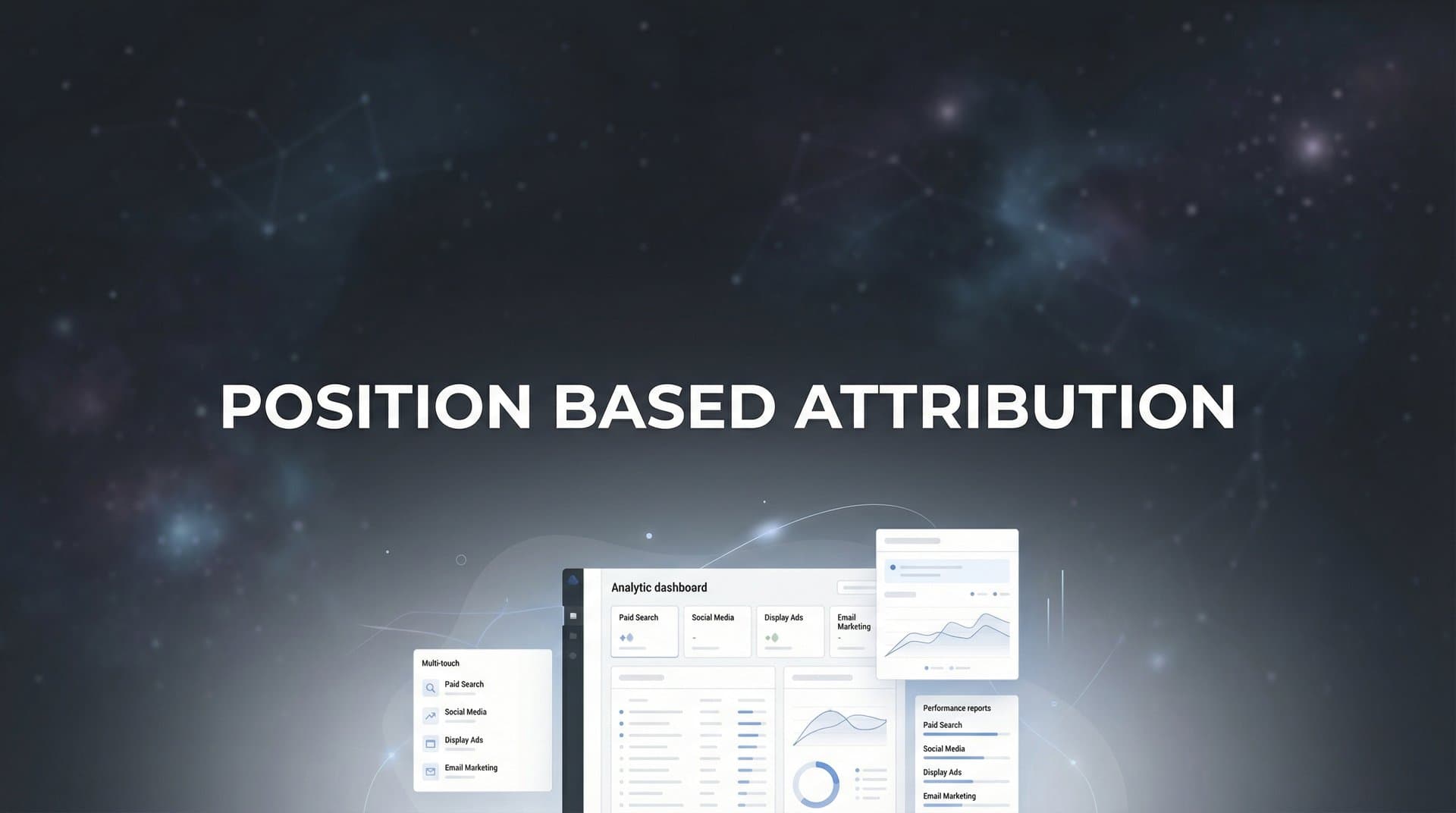
Position based attribution, also called U-shaped attribution, assigns 40% of conversion credit to the first touchpoint, 40% to the last touchpoint, and distributes the remaining 20% equally among all the interactions that happened in between. If you visualize this on a graph, the credit distribution forms a U-shape—heavy weight on both ends, lighter in the middle.
This model recognizes a fundamental truth about customer journeys: the moment someone discovers your brand and the moment they decide to convert are qualitatively different from the touchpoints in between. That first interaction—whether it's a Facebook ad, a podcast mention, or an organic search result—represents the awareness threshold. It's the channel that introduced a stranger to your solution and convinced them you're worth exploring further.
The last touchpoint, meanwhile, represents the conversion trigger. It's the interaction that moved someone from "interested" to "ready to buy." Maybe it's a retargeting ad that appeared at the perfect moment, or an email with a limited-time offer, or a demo request form after reading a case study. Whatever it is, it deserves recognition for closing the gap between consideration and action.
Here's what position based attribution solves: single-touch models force you to choose between awareness and conversion. First-touch attribution gives 100% credit to the channel that introduced the prospect, which means your conversion-focused campaigns look worthless. Last-touch attribution does the opposite—it makes your awareness campaigns appear ineffective because they rarely get credit for the final click.
Both approaches create distorted incentives. Under first-touch, you'd pour money into top-of-funnel campaigns while starving your retargeting and email nurture programs. Under last-touch, you'd optimize entirely for bottom-funnel conversions while neglecting the awareness channels that fill your pipeline in the first place.
Position based attribution acknowledges that discovery and decision moments both matter significantly, while the middle touchpoints—blog visits, email opens, social media interactions—play a supporting role in keeping prospects engaged. It's not perfect, but it's a massive improvement over pretending that only the first or last interaction counts.
The 40-20-40 split isn't arbitrary. It reflects a practical reality: if you're running a business with a considered purchase cycle, the channels that introduce prospects and the channels that convert them typically require different strategies, different creative, and different budget allocations. Position based attribution gives you a framework for measuring both without forcing you to pick a favorite.
When Position Based Attribution Makes Strategic Sense
Position based attribution isn't the right fit for every business, but it shines in specific scenarios where customer journeys involve multiple touchpoints spread over time. If your prospects typically interact with your brand 5-10 times before converting, and those interactions happen across different channels over weeks or months, position based gives you a more complete picture than single-touch models ever could.
B2B companies with longer sales cycles are ideal candidates. Think SaaS platforms, enterprise software, consulting services, or any business where prospects need to research, compare options, get internal buy-in, and schedule demos before making a decision. In these environments, the LinkedIn ad that introduced your brand and the demo request form that captured the lead both played critical roles—position based attribution reflects that reality.
Agencies managing multiple client campaigns across various channels also benefit. When you're running Facebook ads, Google Search campaigns, email nurture sequences, and retargeting simultaneously, position based attribution helps you understand which channels are effective at different stages. You can see which platforms excel at generating awareness versus which ones close deals, and adjust your attribution tracking for multiple campaigns accordingly.
High-consideration purchases in the consumer space work well with this model too. If you're selling products or services where customers spend time researching—home services, financial products, luxury goods, education programs—position based attribution captures the discovery moment and the conversion moment without ignoring the research phase in between.
But here's where position based attribution starts to break down: very short sales cycles. If your customers typically convert within a single session or after just one or two interactions, the model becomes overcomplicated. A first-time visitor who clicks a Google ad, lands on your product page, and immediately purchases doesn't need a multi-touch attribution model. Last-touch or even a simple conversion tracking setup would give you the same insights with less complexity.
Single-channel businesses also don't need position based attribution. If you're running exclusively on Google Ads or only doing email marketing, there's no multi-channel journey to attribute. The model is designed to answer questions about how different channels work together—if you're only using one channel, simpler attribution methods will serve you better.
Another warning sign: if you can't track the middle touchpoints reliably, position based attribution will give you misleading results. The model assumes you're capturing blog visits, email opens, social media clicks, and other mid-journey interactions. If you have tracking gaps, you'll end up distributing that middle 20% across incomplete data, which defeats the purpose of using a more sophisticated multi-touch attribution model in the first place.
Breaking Down the Credit Math
Let's walk through exactly how position based attribution assigns credit using a real-world example. Imagine a prospect's journey looks like this:
Touchpoint 1: Clicks a Facebook ad promoting your free guide → Downloads the guide
Touchpoint 2: Reads a blog post about solving their specific problem → Subscribes to your email list
Touchpoint 3: Opens a nurture email with a case study → Clicks through to read it
Touchpoint 4: Clicks a retargeting ad on Google → Fills out a demo request form worth $5,000 in potential revenue
Under position based attribution, here's how the $5,000 gets distributed:
Facebook ad (first touch): $2,000 (40% credit)
Blog post (middle touch): $500 (10% credit)
Email case study (middle touch): $500 (10% credit)
Google retargeting ad (last touch): $2,000 (40% credit)
The Facebook ad gets significant credit because it introduced the prospect to your brand and convinced them to engage for the first time. The Google retargeting ad gets equal credit because it appeared at the conversion moment and triggered the demo request. The two middle touchpoints—the blog post and the email—split the remaining 20% equally because they both played a role in keeping the prospect engaged during the consideration phase.
Now let's say the journey had five middle touchpoints instead of two. The math would look like this: 40% to first touch, 40% to last touch, and the remaining 20% divided by five middle touchpoints—giving each middle interaction 4% credit. The more touchpoints in the middle, the more diluted each individual middle interaction becomes, but the bookends always maintain their 40% weight.
Some attribution platforms let you customize these percentages based on your business model. You might use a 35-30-35 split if you want to give slightly more credit to the middle journey, or a 45-10-45 split if you believe the bookends are even more important than the standard model suggests. The key is consistency—once you choose a weighting scheme, stick with it long enough to gather meaningful data before adjusting.
Here's what makes this valuable: when you aggregate this data across hundreds or thousands of customer journeys, patterns emerge. You might discover that Facebook consistently appears as the first touch for high-value conversions, which suggests it's effective at reaching the right audience. Or you might find that email case studies appear frequently in the middle of successful journeys, which tells you that content is playing a crucial nurturing role even though it's not closing deals directly.
The credit distribution also helps with budget allocation. If your Google retargeting ads are accumulating significant last-touch credit but your Facebook awareness campaigns are generating most of the first touches, you know you need both channels working together. Cutting budget from either one would damage your overall performance, even if one channel looks more efficient in isolation.
Position Based vs. Other Multi-Touch Models
Position based attribution isn't the only multi-touch model available, and understanding how it compares to alternatives helps you choose the right approach for your business. Each model makes different assumptions about which touchpoints matter most, and those assumptions lead to different strategic insights.
Linear attribution takes the opposite approach from position based—it gives equal credit to every touchpoint in the customer journey. If someone interacted with your brand six times before converting, each touchpoint gets 16.67% credit. The philosophy here is democratic: every interaction contributed equally to the eventual conversion, so why favor some over others?
Linear attribution works well when you genuinely believe all touchpoints play equivalent roles, or when you want to avoid making assumptions about which interactions matter most. But it also means you're treating a quick blog visit the same as the demo that closed the deal, which often doesn't reflect reality. Position based attribution, by contrast, acknowledges that not all touchpoints are created equal—the moments of discovery and decision deserve more weight.
Time-decay attribution assigns more credit to recent touchpoints and less to older ones. The logic is that interactions closer to the conversion are more influential than interactions that happened weeks or months earlier. A touchpoint from yesterday gets more credit than one from last month, which gets more credit than one from three months ago.
This model makes sense if you believe recency matters more than position. Maybe your retargeting campaigns are what actually drive conversions, and the initial awareness touchpoint was just the beginning of a long journey where the early interactions became less relevant over time. But time-decay can undervalue the awareness channels that started the relationship, which is where position based attribution maintains balance by giving equal weight to first and last touches regardless of timing.
Data-driven attribution uses machine learning algorithms to analyze your actual conversion data and determine which touchpoints statistically correlate with higher conversion rates. Instead of using a fixed formula like 40-20-40, the algorithm assigns credit based on patterns it discovers in your data. A touchpoint that frequently appears in successful journeys gets more credit than one that rarely does.
Data-driven attribution is theoretically the most accurate model because it's based on your specific business rather than generic assumptions. But it requires significant data volume to work properly—Google recommends at least 15,000 clicks and 600 conversions within 30 days for their data-driven model to be reliable. It's also harder to explain to stakeholders because the credit distribution changes dynamically based on algorithmic calculations rather than a simple, consistent formula. Understanding the best attribution model for optimizing ad campaigns depends heavily on your specific business context and data availability.
Position based attribution sits in a sweet spot: it's more sophisticated than single-touch models, more predictable than data-driven attribution, and more realistic than linear attribution. You can explain the 40-20-40 logic to your team in two minutes, and the model will give you consistent, comparable results over time. For many marketers, especially those just moving beyond last-touch attribution, position based offers the right balance of sophistication and simplicity.
Implementing Position Based Attribution Effectively
Getting position based attribution right requires more than just flipping a switch in your analytics platform. The model only works if you're capturing the complete customer journey—every touchpoint from first interaction to final conversion. Miss a touchpoint, and you're distributing credit across incomplete data, which leads to bad decisions.
Start with unified tracking across all your marketing channels. That means implementing proper UTM parameters on every campaign link, setting up conversion tracking pixels on your website, integrating your CRM with your ad platforms, and ensuring your email marketing tool feeds data into your attribution system. If a prospect clicks a Facebook ad, reads three blog posts, opens two emails, and then converts via a Google search, you need to capture all six of those interactions and connect them to the same customer.
Cross-device attribution tracking is where many implementations fall apart. Your prospect might click a Facebook ad on their phone during their morning commute, research your product on their laptop at work, and finally convert on their tablet at home. If your tracking system treats those as three separate anonymous users, your attribution data becomes meaningless. You need a way to identify that all three devices belong to the same person—usually through authenticated user tracking, email-based identification, or probabilistic device matching.
Server-side tracking has become increasingly important as browser-based tracking gets less reliable. Third-party cookies are disappearing, ad blockers are common, and privacy regulations are tightening. Server-side tracking captures conversion events directly from your server rather than relying on browser pixels, which means you get more complete data even when client-side tracking fails. This is especially critical for the middle touchpoints in position based attribution—if you're missing 30% of your blog visits and email clicks due to tracking limitations, that 20% middle credit gets distributed across incomplete information.
Before you trust your position based attribution data, validate that you're capturing the full journey. Pull a sample of recent conversions and manually trace their paths through your systems. Did the attribution report show all the touchpoints you know happened? Are there gaps where interactions should appear but don't? Common blind spots include: direct traffic that's actually driven by offline marketing, email opens that don't fire tracking pixels, social media interactions that happen in-app rather than clicking through to your website, and phone calls that convert without any digital touchpoint.
Another implementation pitfall: treating every touchpoint type equally in your tracking setup. A five-second blog visit where someone immediately bounced probably shouldn't count the same as a 20-minute session where they read three articles and watched a product demo. Consider setting engagement thresholds—maybe a blog visit only counts as a touchpoint if the person spent at least 30 seconds on the page, or an email only counts if they clicked through rather than just opening it. These quality filters ensure you're distributing attribution credit to meaningful interactions rather than accidental clicks.
Integration between your analytics platform and your advertising platforms is crucial for closing the loop. You need to feed attributed conversion data back to Facebook, Google, and other ad platforms so their algorithms can optimize toward the conversions that actually matter. If you're only sending last-touch conversion data to your ad platforms while using position based attribution internally, you're creating a disconnect between how you measure success and how your campaigns optimize. Many marketers encounter attribution discrepancies in their data when their internal reporting doesn't align with platform-reported metrics.
Turning Attribution Insights Into Budget Decisions
Position based attribution data is only valuable if you actually use it to make better marketing decisions. The model gives you a more complete picture of channel performance, but that picture only matters if it changes how you allocate budget, optimize campaigns, and plan your marketing strategy.
Start by identifying undervalued channels—the ones that look mediocre under last-touch attribution but actually play important roles when you account for first-touch credit. You might discover that your podcast sponsorships or content marketing efforts are generating significant first-touch interactions that eventually convert, even though they rarely get credit as the last click. That insight should shift budget toward those awareness channels rather than cutting them because they don't show up in last-touch reports.
The same logic applies to conversion-focused channels that might look less impressive when you factor in first-touch credit. Your retargeting campaigns probably perform well under last-touch attribution because they're designed to capture people who are already familiar with your brand. Position based attribution still gives them credit, but it also reveals that those retargeting conversions often started with a different channel introducing the prospect months earlier. That doesn't mean retargeting is less valuable—it means you need both the awareness channels and the conversion channels working together.
Use position based data to optimize campaign creative and messaging for different journey stages. Channels that frequently appear as first touches should focus on awareness messaging—introducing your solution, explaining the problem you solve, building brand recognition. Channels that consistently show up as last touches should emphasize conversion messaging—limited-time offers, product demos, customer testimonials, clear calls to action. The middle touchpoints are where you nurture and educate, providing value without pushing for immediate conversion.
Build a feedback loop where you regularly review attributed revenue by channel and adjust spending accordingly. Maybe you discover that LinkedIn generates high-value first touches but requires a long nurturing period before conversion, while Google Search captures people who are already ready to buy. That insight might lead you to increase LinkedIn budget for awareness while maintaining Google budget for conversion capture, rather than treating them as competing channels where one needs to "win." Implementing channel attribution for revenue tracking helps you understand these dynamics across your entire marketing mix.
Track how attribution patterns change over time as you adjust your marketing mix. If you cut budget from a channel that was generating significant first-touch credit, you should see downstream effects on your conversion volume weeks or months later as that awareness pipeline dries up. Position based attribution helps you understand these delayed effects rather than making reactive decisions based on immediate last-touch results.
One practical approach: set different efficiency targets for channels based on their role in the journey. A channel that primarily generates first touches might have a higher acceptable cost per acquisition because you're valuing its awareness contribution. A channel that mostly captures last touches might need to meet a stricter efficiency threshold because it's benefiting from awareness work done elsewhere. Position based attribution gives you the data to set these differentiated targets rather than applying the same CPA goal across all channels regardless of their strategic role.
Moving Beyond Static Models to AI-Driven Insights
Position based attribution offers a practical middle ground for marketers who recognize that both discovery and conversion moments deserve significant credit. The 40-20-40 framework acknowledges reality: the channel that introduced a prospect to your brand and the channel that closed the deal both played crucial roles, while the touchpoints in between kept the relationship alive during the consideration phase.
This model works best when you've built the infrastructure to capture complete customer journeys—unified tracking across channels, reliable cross-device identification, and integration between your analytics systems and ad platforms. Without that foundation, you're just distributing credit across incomplete data, which doesn't lead to better decisions.
The real value comes from using position based insights to make smarter budget allocation choices. When you understand which channels excel at generating awareness versus driving conversions, you can optimize each one for its natural role rather than forcing every channel to compete on the same last-touch metrics. You start building a marketing system where different channels work together strategically instead of cannibalizing each other's credit.
But here's the truth: even position based attribution is still a static model. It applies the same 40-20-40 formula to every customer journey regardless of context—whether someone converted in three days or three months, whether they interacted with two touchpoints or twenty, whether they're a $500 customer or a $50,000 enterprise deal. The model is better than single-touch attribution, but it's still making broad assumptions about what matters.
The future of attribution is moving toward AI-powered analytics that can identify patterns in your specific data rather than applying generic formulas. Imagine a system that recognizes when certain touchpoint sequences are more likely to convert, when specific channels play outsized roles for particular customer segments, or when the timing between interactions matters more than the interactions themselves. That level of insight requires moving beyond static models to dynamic, data-driven approaches that learn from your actual results.
Ready to elevate your marketing game with precision and confidence? Discover how Cometly's AI-driven recommendations can transform your ad strategy—Get your free demo today and start capturing every touchpoint to maximize your conversions.