

You just approved a $5,000 budget increase for a Facebook campaign that looked like it was crushing it. The dashboard showed strong click-through rates, decent cost per click, and what appeared to be solid conversion numbers. You felt confident—this was a winner worth scaling.
Three days later, the full picture emerged. That campaign wasn't driving quality leads at all. Most conversions were low-intent form fills that never turned into sales calls. By the time you realized what was happening, you'd burned through thousands of dollars on a campaign that was actually underperforming your baseline.
This scenario plays out constantly across marketing teams because most attribution tools operate with significant data lag. You're making today's decisions based on yesterday's data—or worse, last week's incomplete picture. Real time attribution reporting eliminates this blind spot entirely, giving you immediate visibility into what's actually driving conversions the moment it happens.
This isn't just about having fresher numbers to look at. It's about fundamentally changing how you make marketing decisions—shifting from reactive adjustments to proactive optimization while momentum still matters.
The Mechanics Behind Instant Attribution Data
Real time attribution reporting operates on a completely different technical foundation than traditional analytics. Most marketing tools you're familiar with use batch processing—they collect data throughout the day, then process and update reports on a schedule. Maybe that's every few hours, maybe it's overnight. Either way, there's an inherent delay between when something happens and when you can see it.
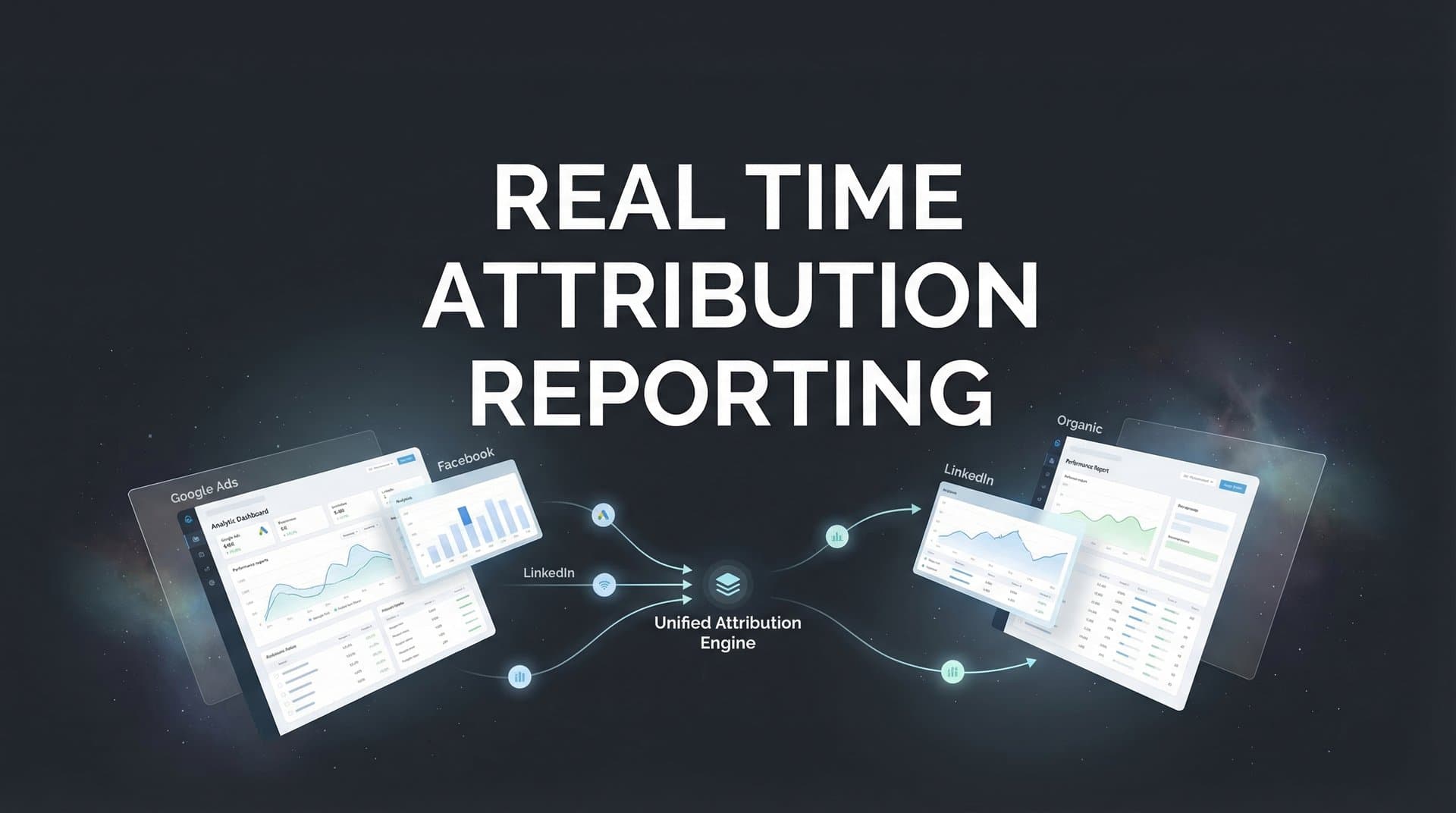
True real time attribution works through continuous data streaming. Instead of waiting for scheduled updates, data flows instantly from every touchpoint to your attribution platform the moment an event occurs. When someone clicks an ad, fills out a form, or completes a purchase, that information becomes available in your dashboard within seconds, not hours.
The technical components that enable this instant data capture include server-side tracking, webhook integrations, and direct platform connections. Server-side tracking is particularly crucial because it bypasses browser limitations entirely. When tracking happens on your server rather than in a visitor's browser, you're not subject to ad blockers, cookie restrictions, or the iOS privacy changes that have gutted traditional client-side tracking accuracy.
Think of it like the difference between getting text message notifications versus checking your email once a day. With batch processing, you're checking email—you only know what happened when you decide to look. With real time attribution, you're getting instant notifications as events occur.
Direct API connections to ad platforms like Meta, Google, TikTok, and LinkedIn mean conversion data flows both ways. You're not just pulling data from these platforms to analyze—you're also sending enriched conversion information back to them. This bidirectional data flow is what enables ad platform algorithms to optimize effectively, learning from actual conversion outcomes in real time rather than waiting for delayed signals.
Webhook-based CRM integrations complete the picture by connecting your attribution data to sales outcomes. When a lead converts to a customer in your CRM, that revenue data instantly flows back to your attribution platform. You can see which specific ads and touchpoints drove actual revenue, not just form fills or sign-ups.
Traditional attribution tools have delays because they rely on scheduled data pulls, third-party tracking pixels that batch data, or manual imports that require human intervention. Modern solutions overcome these limitations by establishing direct, persistent connections to every data source in your marketing stack. The result is a continuous stream of attribution data that updates as fast as events happen.
Why Delayed Data Costs You More Than You Think
The financial impact of data lag compounds quickly. Consider a scenario where you're spending $10,000 per day across multiple campaigns. If your attribution reporting has a 24-hour delay, you're making decisions about tomorrow's budget based on yesterday's performance. That's not just inconvenient—it's expensive.
Let's say a campaign starts underperforming at 9 AM on Monday. With delayed reporting, you might not see the full picture until Tuesday morning. That's 24 hours of continued spend on a campaign that's actively losing money. At scale, those hours translate to thousands in wasted budget that could have been reallocated to better-performing campaigns.
The compounding effect gets worse when you consider the opportunity cost. While you're unknowingly funding underperformers, your winning campaigns are operating at their current budget level instead of being scaled up. You're simultaneously overspending on losers and underspending on winners—the exact opposite of what effective marketing budget allocation requires.
Attribution windows and timing create another layer of problems with delayed data. Multi-touch attribution models need to connect touchpoints across the customer journey—first click, middle interactions, and final conversion. When there's lag in your reporting, you're missing the real-time connection between these touchpoints. A conversion that happens today might not get properly attributed to the ad click from three days ago until your system catches up and processes the full journey.
This timing mismatch distorts your understanding of what's actually working. You might see strong performance from one channel in isolation, not realizing it's only effective when combined with touchpoints from another channel. By the time you piece together the full journey through delayed reporting, the campaign dynamics have already shifted.
Perhaps the most costly impact of delayed data is the feedback loop problem with ad platform algorithms. Meta, Google, and other platforms optimize campaigns based on conversion signals you send them. When those signals are delayed by hours or days, their algorithms are learning from stale data. They're making optimization decisions about today's auctions based on yesterday's conversion patterns.
This creates a fundamental mismatch between what the algorithm thinks is working and what's actually driving results right now. Your campaigns optimize slower, target less effectively, and ultimately deliver weaker performance than they would with fresh conversion data flowing back immediately.
What Real Time Reporting Actually Shows You
Real time attribution reporting gives you live visibility into which specific ads, campaigns, and channels are generating leads and revenue at this exact moment. You're not looking at aggregated data from yesterday or last week—you're seeing what's happening right now.
This means you can open your dashboard at 2 PM on a Tuesday and see exactly which Facebook ad creative drove three conversions in the last hour, which Google search campaign just generated a high-value lead, and which LinkedIn touchpoint assisted in a deal that closed this morning. The granularity is immediate and actionable.
Cross-platform performance comparison becomes dramatically more useful when you're working with current data. Instead of waiting for each platform's native analytics to update on different schedules, then manually comparing numbers that represent different time periods, you see unified performance across all channels updated simultaneously.
You can instantly answer questions like: Is my Meta spend outperforming Google today? Which channel is driving the lowest cost per acquisition right now? Are my retargeting campaigns converting better this week than last week? These aren't questions you can answer accurately with delayed reporting because the data you're comparing represents different snapshots in time.
Customer journey tracking becomes exponentially more powerful when you can watch journeys unfold in real time rather than reconstructing them after the fact. You see the first touchpoint when it happens, middle interactions as they occur, and the final conversion the moment someone takes action.
This live journey visibility reveals patterns you'd miss in delayed reporting. You might notice that conversions happening on Tuesday afternoons typically have a different touchpoint sequence than conversions happening on Thursday mornings. Or that high-value customers tend to engage with specific content combinations before converting. These insights only emerge when you can observe the journey as it happens rather than analyzing it days later.
Real time reporting also shows you the immediate impact of changes you make. Launch a new ad creative at 10 AM and you can see how it's performing by noon. Adjust your targeting parameters and watch conversion rates shift within hours, not days. This tight feedback loop between action and outcome makes optimization faster and more precise.
Turning Instant Data Into Immediate Action
The strategic value of real time attribution reporting lies in the decisions it enables you to make today rather than next week. Budget reallocation becomes a same-day activity instead of a weekly planning exercise. When you see a campaign underperforming in the morning, you can shift that budget to better performers by afternoon.
This agility compounds over time. A marketing team that can reallocate budget daily based on current performance will consistently outperform a team making the same decisions weekly based on delayed data. The difference isn't just speed—it's the cumulative effect of hundreds of small optimizations made while they still matter.
Identifying and pausing underperforming ads before they drain your budget is perhaps the most immediate financial benefit. With real time campaign performance monitoring, you can spot a poorly performing ad within hours of launch rather than days. If an ad creative is generating clicks but no conversions, you know by lunch instead of discovering it at the end of the week.
This early detection prevents the slow bleed of wasted spend that happens when underperformers run unchecked. Even a few hours of delay can mean hundreds or thousands in unnecessary spend, depending on your budget scale. Real time attribution lets you act on performance signals the moment they emerge.
Scaling winning campaigns with confidence becomes possible when you can see momentum building in real time. There's a critical window when a campaign starts performing well—it's generating strong results, ad platform algorithms are learning effectively, and audience response is positive. This is when you want to scale budget aggressively.
With delayed reporting, you often miss this window entirely. By the time you identify a winner and decide to scale it, momentum may have already shifted. Market conditions change, audience saturation increases, or competitors adjust their strategies. Real time attribution lets you catch winners while they're hot and scale them immediately.
The decision-making process itself becomes more dynamic. Instead of weekly marketing reviews where you analyze last week's performance and plan next week's changes, you're making continuous micro-adjustments based on what's happening right now. Your marketing operations shift from periodic optimization to constant refinement.
This doesn't mean you're constantly making reactive changes without strategy. It means your strategic decisions are informed by current data rather than historical analysis. You still plan campaigns, set budgets, and establish KPIs—but you adjust them based on real time performance rather than waiting for delayed reports to tell you what already happened.
Setting Up Your Stack for Real Time Attribution
Building a real time attribution infrastructure requires connecting your entire marketing stack into a unified data flow. The essential integrations include your ad platforms, CRM, website tracking, and any other systems where customer interactions occur. Each connection needs to be bidirectional—data flows both into your attribution platform and back out to the original systems.
Ad platform integrations form the foundation. You need direct API connections to Meta, Google, TikTok, LinkedIn, and any other channels where you run campaigns. These connections serve two purposes: pulling campaign performance data into your attribution system, and sending enriched conversion data back to each platform to improve their optimization algorithms.
The conversion data you send back is particularly important. When someone converts on your website, your attribution platform can send that conversion event back to the ad platform with additional context—lead quality scores, revenue value, customer lifetime value predictions, or any other enrichment data your CRM provides. This enriched data helps ad platforms optimize more effectively than they could with basic conversion pixels alone.
CRM integration connects attribution data to actual business outcomes. When a lead becomes a customer, when a deal closes, when revenue is recognized—these events flow back into your attribution system. This completes the picture by showing you which marketing touchpoints drove not just leads, but actual revenue.
Server-side tracking deserves special attention because it's become essential for accurate attribution in the current privacy landscape. Client-side tracking—JavaScript pixels that run in visitors' browsers—faces significant limitations. Ad blockers remove them, browser privacy features restrict them, and iOS changes have severely limited their effectiveness.
Server-side tracking bypasses these limitations entirely. Tracking happens on your server, not in the visitor's browser. When someone clicks an ad and lands on your site, your server captures that interaction directly. When they convert, your server sends that event to your attribution platform and back to ad platforms. There's no reliance on browser cookies or client-side scripts that can be blocked or restricted.
The technical setup for server-side tracking typically involves implementing a tracking script that runs on your server, configuring webhooks to send conversion events in real time, and establishing secure API connections to receive and send data. Many modern attribution reporting platforms handle much of this complexity through managed integrations, but understanding the underlying architecture helps you troubleshoot issues and optimize performance.
Feeding enriched conversion data back to ad platforms creates a powerful optimization loop. When Meta or Google receives not just a conversion signal but additional context about that conversion—lead quality, revenue value, customer segment—their algorithms can optimize toward the outcomes that actually matter to your business, not just volume.
This is particularly valuable for B2B marketing where not all leads are equal. A form fill might look like a conversion to an ad platform, but your CRM knows whether it's a qualified prospect or a low-intent inquiry. By sending that qualification data back to the ad platform, you help it learn to target more qualified leads rather than just more leads.
Making Real Time Attribution Work for Your Team
Real time attribution reporting isn't just about faster data—it's about making better decisions while they still matter. The competitive advantage comes from acting on today's insights rather than yesterday's guesses. While your competitors are waiting for weekly reports to update, you're optimizing campaigns based on what's happening right now.
This shift requires a different operational mindset. Marketing becomes more dynamic, more responsive, and ultimately more effective. You're not locked into weekly budget allocations or monthly campaign plans that ignore current performance. You can adjust strategy based on real time signals while maintaining the strategic vision that guides your overall approach.
The financial impact compounds quickly. Every hour of delay in identifying underperformers costs you money. Every day of waiting to scale winners means missed opportunity. Real time attribution eliminates both problems by giving you the visibility to act immediately on performance signals.
Perhaps most importantly, real time attribution solves the feedback loop problem with ad platform algorithms. When conversion data flows back to platforms instantly rather than with hours or days of delay, their optimization improves dramatically. They learn faster, target more effectively, and deliver better results because they're working with fresh signals rather than stale data.
Ready to elevate your marketing game with precision and confidence? Discover how Cometly's AI-driven recommendations can transform your ad strategy—Get your free demo today and start capturing every touchpoint to maximize your conversions.



