You're staring at your ad dashboard on a Tuesday afternoon, finger hovering over the pause button. The campaign that looked promising yesterday now shows declining performance in your morning report. You make the call, redirect the budget, and move on. By Thursday, you discover the truth: that campaign was actually converting beautifully on Tuesday. You just couldn't see it until the data caught up.
This isn't a hypothetical scenario. It's the daily reality for marketers operating with delayed attribution data. You're making million-dollar decisions based on information that's already outdated by the time it reaches your screen. Meanwhile, your best-performing campaigns might be bleeding budget, your worst ones keep running, and opportunities to scale slip away before you even know they exist.
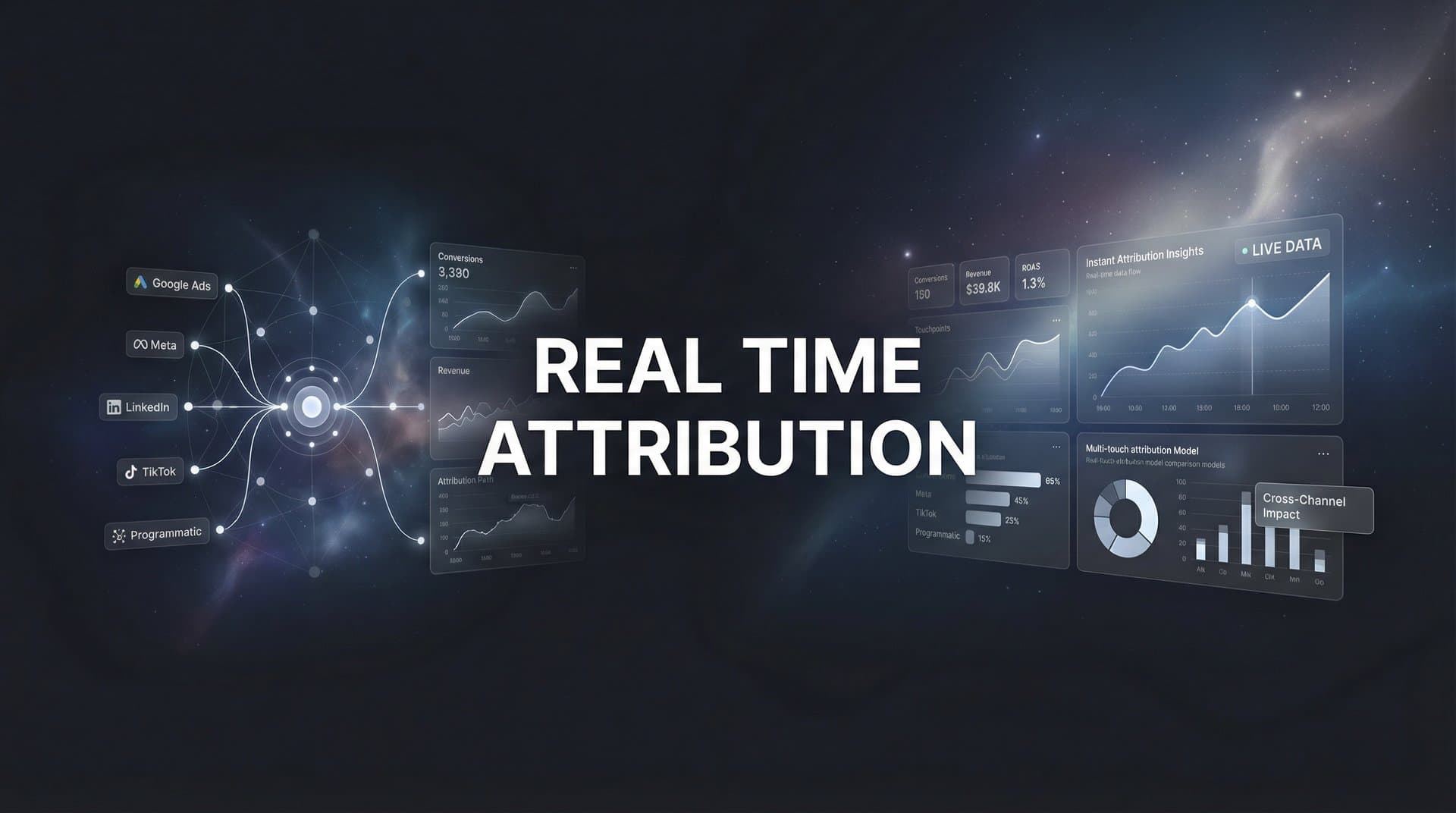
Real time attribution changes this equation fundamentally. Instead of reconstructing what happened yesterday or last week, you see which ads and channels are driving conversions as they happen. This isn't about drowning in more data—it's about having the right information at the exact moment you need it to make confident marketing decisions. When you can see performance instantly, you stop reacting to the past and start responding to the present.
The Speed Gap in Traditional Marketing Attribution
Traditional attribution operates on a delay. Your tracking pixels collect data, that information gets batched and processed, reports get generated, and eventually—maybe 24 hours later, maybe 48, sometimes longer—you see what actually happened. During that gap, everything changes.
Think about what happens in those missing hours. Ad auction dynamics shift. Audience behavior evolves. Competitors adjust their bids. Your campaign that was crushing it yesterday might be overspending today, but you won't know until tomorrow's report. That's not a minor inconvenience—it's a fundamental decision-making blind spot that costs real money.
The compounding cost of stale information reveals itself in multiple ways. You waste ad spend on campaigns that stopped performing hours ago. You miss scaling opportunities because you don't realize a campaign is converting until it's already exhausted its best audience segments. You misallocate budget across channels because your attribution model is showing you a customer journey that happened two days ago, not the one happening right now.
Batch processing became the norm for practical reasons. Early attribution systems couldn't handle the computational load of processing every touchpoint instantly. It was easier to collect data throughout the day and crunch the numbers overnight. Marketing teams adapted their workflows around this limitation, building reporting schedules and decision-making cadences that assumed data would always be delayed.
But the technical landscape has evolved dramatically. Server infrastructure can now process massive data streams in real time. Cloud computing makes continuous analysis economically viable. First-party tracking approaches capture data more reliably than old pixel-based methods. The technical barriers that made delayed attribution necessary have largely disappeared.
What hasn't changed quickly enough is the mindset. Many marketers still operate as if delayed data is inevitable, building their processes around weekly reports and batch updates. They've normalized the speed gap, accepting it as just how attribution works. Meanwhile, the marketers who've embraced real time marketing analytics are making decisions with information that's hours or days fresher—and that advantage compounds quickly.
How Real Time Attribution Actually Works
Real time attribution starts with a fundamentally different approach to data capture. Instead of relying on browser-based pixels that fire when a page loads and hope the data makes it back to your analytics platform, server-side tracking captures events directly from your server. When someone clicks your ad, visits your site, or completes a conversion, that information flows immediately into your attribution system without depending on browser cookies or client-side JavaScript.
This server-side foundation matters more than ever. Browser restrictions on third-party cookies, ad blockers, and privacy features like Intelligent Tracking Prevention have made traditional pixel-based tracking increasingly unreliable. You might think you're capturing complete data, but significant portions of your traffic never trigger those pixels. Implementing cookieless attribution tracking bypasses these limitations, giving you more accurate data that arrives instantly.
The continuous processing piece is what transforms captured data into actionable attribution. Traditional systems batch their analysis—they wait until they have a complete dataset for a time period, then process everything together. Real time systems process each event as it arrives. When a conversion happens, the system immediately traces back through all the touchpoints that led to it, updating attribution across every channel and campaign involved.
Connecting the dots across platforms is where real time attribution shows its power. A customer's journey rarely happens in one place. They might click a Facebook ad, visit your site, leave, see a Google retargeting ad, return through organic search, and finally convert after receiving an email. Each of those touchpoints lives in a different platform with its own data structure and reporting timeline.
Real time attribution systems unify these disparate touchpoints instantly. They're not waiting for Facebook's daily export, Google's batch report, and your email platform's overnight sync. Instead, they're capturing each interaction as it happens and immediately connecting it to the customer's evolving journey. This gives you a living view of how your channels work together, not a historical reconstruction.
First-party data plays a crucial role in making this instant unification possible. When you're collecting data directly from your own systems rather than relying on third-party cookies or platform-specific identifiers, you can match users across touchpoints more reliably. Your CRM knows this is the same person who clicked your ad yesterday, visited your site this morning, and just converted. That first-party identity graph enables accurate, immediate attribution even as third-party tracking becomes less viable.
The privacy-first aspect isn't just about compliance—it's about data quality. First-party tracking with proper user consent gives you more complete, more accurate information than trying to piece together fragmented third-party data. When your attribution system owns the entire data pipeline from initial touchpoint to final conversion, it can process and attribute everything in real time without waiting for external platforms to share their data.
Five Ways Instant Attribution Data Changes Your Marketing
Same-day budget reallocation becomes not just possible but practical when you have real time attribution. Instead of waiting until Monday to review last week's performance and adjust budgets for the week ahead, you can see by lunchtime which campaigns are converting and which aren't. That Facebook campaign that's driving qualified leads this morning? Scale it before the day ends. The Google campaign that stopped converting after yesterday's creative change? Pause it now instead of burning budget through the weekend.
This isn't about making impulsive decisions based on small sample sizes. It's about responding to clear signals as they emerge. When you see a campaign has driven 15 conversions by noon with a cost per acquisition well below your target, you don't need to wait three more days to confirm it's working. Effective real time marketing budget allocation lets you confidently increase spend while the campaign still has momentum.
Identifying winning creative and messaging before campaigns exhaust their budgets changes how you test and iterate. With delayed attribution, you might run three ad variations for a week, analyze the results, and scale the winner—only to find that the audience has already seen these ads multiple times and response rates have declined. Real time attribution lets you spot the winning variation within hours or days, giving you time to scale it while it's still fresh and expand your testing to new concepts.
The creative optimization cycle compresses dramatically. You can test a new headline in the morning, see it's outperforming by afternoon, and have budget shifted to it before the workday ends. Your competitors running on weekly reporting cycles are still analyzing last week's tests while you're already scaling this week's winners.
Catching tracking issues and data discrepancies immediately instead of discovering them in weekly reports saves countless hours of troubleshooting and prevents bad decisions based on incomplete data. When your attribution system shows conversions dropping to zero suddenly, you know within minutes rather than days. Understanding how to fix attribution discrepancies becomes critical when you can investigate immediately—did a tracking script break? Is there a technical issue on the checkout page? Did an integration stop working?
Without real time visibility, these issues can persist for days before anyone notices. You might make budget decisions based on what looks like poor campaign performance when the real problem is that conversions aren't being tracked. By the time you discover the issue, you've paused good campaigns and missed opportunities. Real time attribution turns tracking problems from silent killers into immediate alerts you can fix before they cause damage.
Feeding fresher conversion signals back to ad platform algorithms for better optimization is one of the most powerful but least obvious benefits of real time attribution. Facebook, Google, and other ad platforms use machine learning to optimize your campaigns, but they need conversion data to train their algorithms. The faster they receive accurate conversion information, the faster they can optimize toward the outcomes you actually care about.
When you're using delayed attribution, the platforms might not know a conversion happened until a day or two after the click. Their algorithms are optimizing based on yesterday's learnings, not today's. Real time attribution with conversion sync capabilities sends that data back to the platforms immediately. The algorithm learns faster, optimizes more accurately, and improves campaign performance without you manually adjusting anything.
Building confidence in scaling decisions with current, not historical, performance data transforms how aggressively you can grow winning campaigns. The biggest scaling mistakes happen when you increase budget based on past performance just as a campaign starts declining. With delayed data, you can't tell the difference between "this campaign has been working great" and "this campaign is working great right now."
Real time attribution gives you the confidence to scale decisively when performance is strong and pull back immediately when it weakens. You're not guessing whether yesterday's success will continue today. You're seeing today's results and making today's decisions. That confidence translates directly into better capital allocation and faster growth.
Real Time vs. Delayed Attribution: A Practical Comparison
Let's walk through what happens with a product launch campaign under both scenarios. You're launching a new feature and running aggressive paid campaigns across multiple channels with a $50,000 weekly budget. The launch happens Monday morning.
With delayed attribution, you run campaigns Monday. Tuesday morning, you review Monday's data and see decent initial performance. Wednesday morning, you analyze Tuesday's numbers and notice Facebook is outperforming Google. Thursday morning, you realize Monday's Facebook performance was actually exceptional but has since declined, while Google improved Tuesday but you didn't know it yet. By Friday, you're making budget adjustments based on Wednesday's data while Thursday's reality has already shifted again.
With real time attribution, Monday's launch data flows in continuously. By Monday afternoon, you see Facebook campaigns driving strong conversion rates. You increase Facebook budget by 30% before the day ends. Tuesday morning, you notice Google campaigns are underperforming with a specific audience segment. You adjust targeting by lunch. Tuesday afternoon, data shows the Google adjustment is working. You scale it immediately. Wednesday, you catch a tracking issue with one campaign within an hour and fix it before it affects results.
The difference isn't subtle. In the delayed scenario, you spent two days running campaigns at suboptimal budget allocation, missed the peak performance window for Facebook, and didn't optimize Google until half the week was gone. In the real time scenario, you captured the Facebook opportunity immediately, fixed Google's targeting in real time, and prevented a tracking issue from corrupting your data. Same budget, dramatically different outcomes.
Scenarios where timing matters most reveal the true value of real time attribution. Flash sales demand immediate visibility because performance can shift hour by hour as inventory levels change and audience saturation increases. Competitive moments—like responding to a competitor's campaign or capitalizing on trending topics—require fast decisions based on current data, not yesterday's reports. High-spend campaigns where daily budgets exceed five figures make every hour of delayed data costly.
Product launches, seasonal campaigns, and time-sensitive promotions all share the same characteristic: the window of opportunity is narrow, and delayed information means missed opportunities. When you're spending aggressively for a short period, you can't afford to discover on Wednesday that Monday's strategy wasn't optimal. Leveraging real time ad performance monitoring tools ensures you capture every opportunity as it emerges.
Understanding the tradeoffs helps you decide when true real time matters versus when near-real-time is sufficient. For always-on brand campaigns with stable performance, checking attribution every few hours might be perfectly adequate. For testing new channels with modest budgets, daily updates could work fine. But for high-stakes campaigns where performance changes rapidly and budget efficiency directly impacts profitability, the difference between real time and delayed attribution is the difference between capitalizing on opportunities and learning about them after they've passed.
Building Your Real Time Attribution Stack
The foundation of real time attribution starts with your tracking infrastructure. You need server-side tracking that captures every meaningful touchpoint without depending on browser cookies or client-side scripts. This means implementing real time data tracking that runs on your server, not in your visitor's browser, ensuring data flows reliably even when ad blockers are active or browser privacy features restrict traditional pixels.
Your tracking infrastructure should capture ad clicks, website visits, form submissions, and conversions at the server level. It should handle both anonymous visitors and identified users, connecting their pre-conversion activity with post-conversion data. Most importantly, it needs to process and transmit this data immediately, not batch it for later processing.
The data integration layer connects your tracking infrastructure with every platform in your marketing stack. This includes your ad platforms (Facebook, Google, LinkedIn, TikTok), your website analytics, your CRM, and any other systems that hold pieces of the customer journey. Real time attribution requires real time data flow between these systems.
Look for integration capabilities that support instant data sync, not scheduled exports. If your attribution platform can only import data from Facebook once per day, it's not truly real time. The integration layer should continuously pull data from each platform and push enriched conversion data back to them, creating a feedback loop that improves both your visibility and the platforms' optimization algorithms.
Visualization and action tools turn real time data into real time decisions. You need dashboards that update continuously, showing current performance across all channels and campaigns. You need alerting systems that notify you when significant changes occur—conversion rates drop, costs spike, or tracking breaks. A robust real time analytics platform provides the ability to drill down from high-level metrics to individual customer journeys instantly.
When evaluating attribution platforms for real time capabilities, ask specific questions about their data processing architecture. How quickly does data flow from initial capture to appearing in your dashboard? Do they batch process periodically or continuously update? Can they handle the data volume your campaigns generate without introducing delays? What's their actual data latency—seconds, minutes, or hours?
Ask about their integration depth with your specific ad platforms and tools. Can they capture server-side conversion data and send it back to ad platforms in real time? Do they support the attribution models you need? Can they track cross-device journeys accurately? How do they handle data discrepancies between platforms?
Integration priorities should start with connecting your highest-spend channels. If you're running significant Facebook and Google campaigns, those platforms need to be fully integrated with real time data flow in both directions. Your website tracking needs to be bulletproof—every conversion must be captured and attributed correctly. Your CRM integration ensures that sales data flows back into your attribution model, connecting marketing touchpoints with revenue outcomes.
Don't try to integrate everything at once. Start with your core marketing channels, validate the data accuracy, then expand to secondary channels. Each integration should be tested thoroughly to ensure data flows correctly in real time before you start making decisions based on it.
Putting Real Time Attribution Into Practice
Start with your highest-spend campaigns where delayed data costs the most. If you're spending $10,000 per day on Facebook campaigns, even a few hours of delayed attribution can result in significant wasted spend or missed opportunities. These campaigns should be your first priority for real time visibility because the return on investment from better, faster decisions is highest.
Begin by implementing real time tracking and attribution for these top campaigns while keeping your existing reporting as a validation layer. Run them in parallel initially, comparing real time insights with your delayed reports to build confidence in the new data. Once you've validated accuracy, start making small optimization decisions based on real time data—budget adjustments, bid changes, creative rotations—and measure the impact.
Establish response protocols before you have real time data flowing. Decide in advance what triggers action, who has authority to act, and how quickly responses should happen. Without clear protocols, real time data creates confusion rather than clarity. Your team needs to know: at what point does a performance change warrant a budget adjustment? Who can pause underperforming campaigns immediately versus who needs approval? What constitutes an urgent alert versus normal performance variation?
Create decision frameworks that define your response thresholds. For example: if a campaign's cost per acquisition exceeds target by 30% for three consecutive hours, reduce budget by 50%. If conversion rate drops below a specific threshold, trigger an immediate investigation for tracking issues. If a new campaign drives 10 qualified conversions within the first four hours at below-target CPA, increase budget by 25%. Following best practices for real time marketing optimization turns real time data into systematic action.
Build your team's muscle memory with real time decision-making gradually. Start with low-risk optimizations—small budget shifts, minor targeting adjustments—to develop comfort with acting on current data rather than waiting for comprehensive reports. As confidence grows, increase the scope and speed of decisions. The goal is making real time optimization feel natural rather than reactive.
Measuring success means tracking whether real time attribution actually improves your outcomes. Monitor your overall cost per acquisition, return on ad spend, and budget efficiency before and after implementing real time attribution. Track how quickly you identify and scale winning campaigns. Measure how much budget you save by catching underperforming campaigns faster. Document how many tracking issues you catch immediately versus how many would have gone unnoticed for days.
Pay attention to leading indicators of improvement: faster time from campaign launch to optimization, reduced wasted spend on underperforming campaigns, increased confidence in scaling decisions, and better alignment between your attribution data and actual business results. Tracking the right marketing attribution metrics often reveals improvement before bottom-line numbers show dramatic changes.
The real measure of success is whether your marketing decisions improve. Are you scaling winners faster? Cutting losers sooner? Allocating budget more efficiently? Catching problems immediately? If real time attribution enables better decisions that drive better outcomes, it's working. If it just gives you more data to look at without changing how you operate, you're not leveraging it effectively.
The Competitive Advantage of Instant Visibility
Real time attribution isn't about having more data—it's about having the right data at the right moment to make confident decisions. In a landscape where ad costs continue rising and tracking becomes more complex, the marketers who can see and act on performance instantly have a significant advantage over those still operating on delayed reports.
This advantage compounds quickly. Every hour you spend making decisions based on current data while competitors work from yesterday's reports creates a small edge. Over weeks and months, those small edges accumulate into substantial differences in campaign efficiency, budget allocation, and overall marketing ROI. The faster you can identify what's working and scale it, the more value you extract from every marketing dollar.
As marketing becomes increasingly automated and AI-driven, real time attribution becomes even more critical. AI-powered optimization requires fresh data to make smart decisions. When you feed machine learning algorithms with real time conversion data, they learn faster and optimize more effectively. The platforms themselves—Facebook, Google, and others—perform better when they receive immediate conversion signals rather than delayed batch updates.
Real time visibility becomes the foundation for AI-powered marketing optimization. Your attribution platform can identify patterns and opportunities faster than any human analyst. It can automatically adjust budgets based on current performance, alert you to anomalies immediately, and provide optimization recommendations grounded in what's happening right now. But all of that depends on having real time data flowing through your system.
The future of marketing belongs to teams that can see clearly, decide quickly, and act confidently. Real time attribution provides that clarity. It closes the gap between marketing activity and marketing intelligence, giving you the visibility you need to optimize aggressively without guessing. When you know what's working right now, you can scale it. When you see what's not working immediately, you can fix it or cut it. That's the advantage.
Ready to elevate your marketing game with precision and confidence? Discover how Cometly's AI-driven recommendations can transform your ad strategy—Get your free demo today and start capturing every touchpoint to maximize your conversions.