You're reviewing yesterday's campaign performance when you notice something troubling: one of your highest-budget ad sets has been hemorrhaging money for the past 18 hours. The conversion rate tanked yesterday morning, but you're only seeing it now. By the time you pause it, thousands of dollars have already been spent on ads that stopped working almost a day ago.
This scenario plays out constantly in marketing departments everywhere. Decisions get made on stale data. Opportunities slip away while reports process. Winning campaigns don't get scaled fast enough, and losing ones keep running because nobody knows they're failing.
Real-time data tracking changes this equation entirely. Instead of looking backward at what happened yesterday, you see what's happening right now—as clicks turn into conversions, as campaigns surge or stumble, as customer journeys unfold across every touchpoint. This isn't just about faster reporting. It's about transforming how you make decisions, allocate budgets, and optimize performance.
In this guide, we'll break down everything you need to know about real-time data tracking: what it actually is beyond the marketing buzzwords, why the speed advantage matters more than you might think, how the technology works behind the scenes, and how to implement it in a way that drives real results. Whether you're running a six-figure monthly ad budget or just starting to scale, understanding real-time tracking is essential for staying competitive in modern digital marketing.
Beyond Delayed Reports: Understanding Real-Time Data Tracking
Real-time data tracking is the continuous capture and processing of marketing events as they occur, with latency measured in seconds rather than hours or days. When someone clicks your ad, visits your website, fills out a form, or completes a purchase, that information flows into your analytics system immediately—not in tomorrow's batch report.
Think of it like the difference between getting a bank statement at the end of the month versus checking your account balance on your phone. One tells you what happened. The other tells you what's happening.
Most traditional analytics platforms still operate on batch processing. They collect data throughout the day, process it in scheduled intervals (usually overnight), and deliver reports the next morning. This approach made sense when computing power was expensive and data volumes were manageable. But in today's fast-paced advertising environment, waiting 24-48 hours to understand campaign performance creates a massive blind spot.
Real-time systems work fundamentally differently. They use event streaming architecture to process data as it arrives, updating dashboards and triggering alerts within seconds of an event occurring. The infrastructure involves four key components working in concert:
Event Capture: Tracking mechanisms (pixels, server-side integrations, APIs) detect and record actions as they happen across your website, ad platforms, and CRM systems.
Data Processing: Stream processing engines analyze incoming data instantly, matching events to users, attributing conversions to sources, and calculating metrics on the fly.
Data Storage: Information gets written to databases optimized for both real-time queries and historical analysis, maintaining accuracy without sacrificing speed. Many organizations leverage an attribution data warehouse to centralize this information for comprehensive analysis.
Visualization: Dashboards refresh continuously, showing current performance without requiring manual updates or page refreshes.
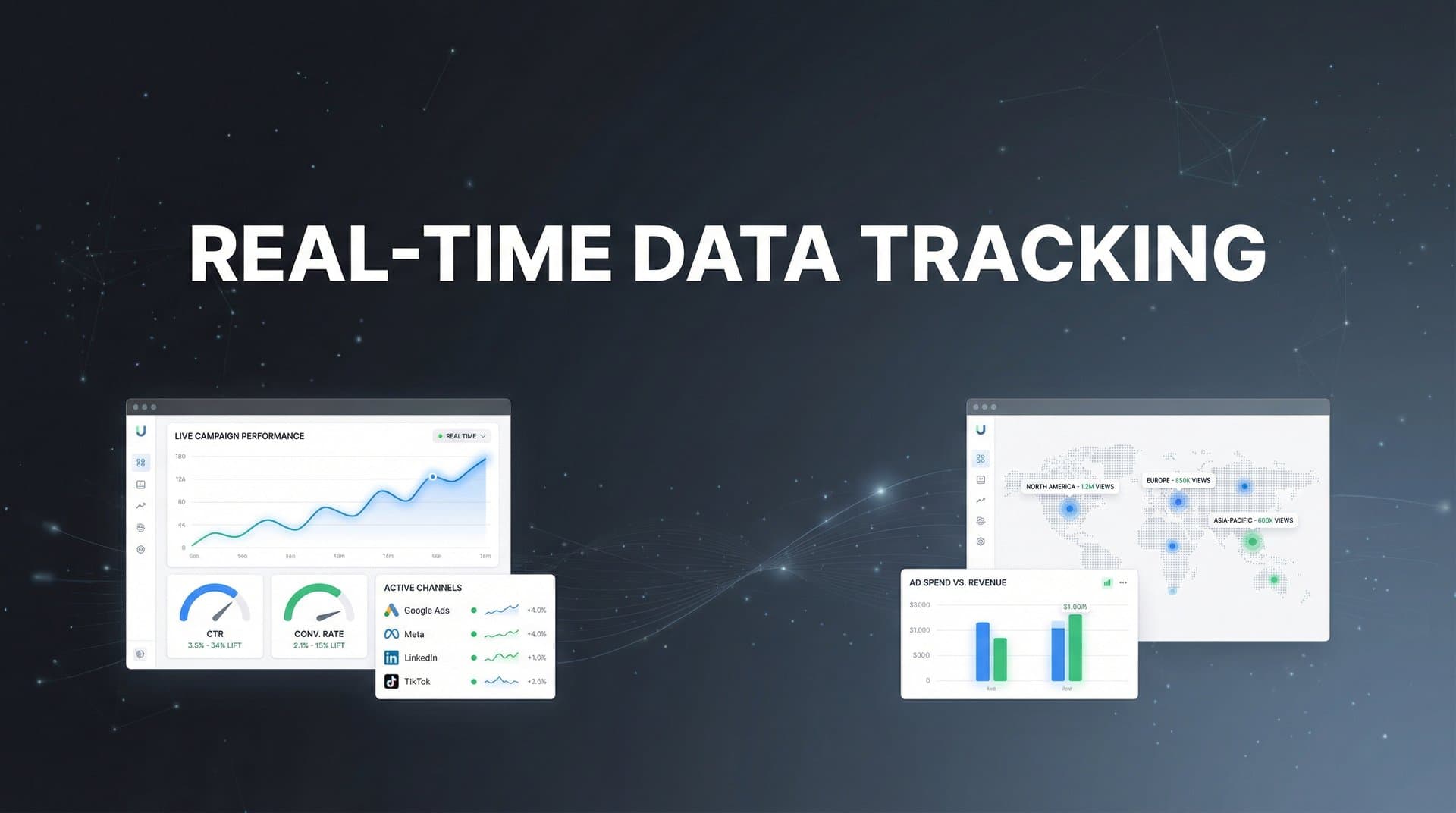
The technical complexity happens behind the scenes. What you see is simple: a dashboard that reflects reality as it unfolds, not as it was yesterday. When a conversion happens, you see it. When a campaign starts underperforming, you know immediately. When traffic surges from an unexpected source, the data is already there.
This isn't about obsessively watching dashboards all day. It's about having the infrastructure in place so that when you need to make a decision—whether that's at 9 AM or 9 PM—the data you're looking at actually reflects current reality.
Why Speed Matters: The Business Case for Instant Insights
Let's say you're running a product launch campaign with a $10,000 daily budget split across multiple ad sets. One of your top-performing ad sets suddenly stops converting around noon. With traditional next-day reporting, you won't discover this until tomorrow morning. That's potentially $5,000 spent on ads that stopped working 18 hours ago.
Real-time visibility changes the math entirely. You see the conversion rate drop within minutes. You investigate, discover the landing page has a technical issue, fix it, and get the campaign back on track—all within an hour. The difference isn't just $5,000 in saved budget. It's maintaining momentum during a critical launch window when every hour matters.
This scenario illustrates why speed isn't just convenient—it's financially material. Marketing campaigns exist in dynamic environments where performance can shift rapidly due to factors ranging from technical issues to audience saturation to competitive changes. The faster you can identify and respond to these shifts, the more efficiently your budget works.
The competitive advantage extends beyond damage control. When you identify a winning ad or audience segment in real time, you can scale it immediately while it's still hot. Your competitors running on delayed data will spot the same opportunity tomorrow—after the initial surge has already passed and costs have increased due to competition. Understanding how ad tracking tools can help you scale ads is essential for capitalizing on these moments.
Consider the customer journey implications. Modern buyers rarely convert on their first interaction. They might click an ad on mobile during their commute, research on desktop during lunch, and finally purchase on tablet that evening. Real-time tracking lets you see this journey as it unfolds, understanding which touchpoints are actually moving people toward conversion.
Without real-time visibility, you're essentially flying blind for significant portions of the day. You make budget decisions based on yesterday's performance, hoping conditions haven't changed. You optimize campaigns based on aggregated data that might be hiding important patterns. You miss the window to capitalize on unexpected successes because you don't know they're happening.
The psychological impact matters too. When you can see performance in real time, you make decisions with confidence rather than anxiety. You're not wondering whether your campaigns are working—you know. You're not guessing whether that budget increase was smart—you're watching the results unfold. This confidence translates into better decision-making and more aggressive scaling when conditions are right.
For agencies managing multiple client accounts, real-time data becomes even more critical. You can monitor dozens of campaigns simultaneously, receiving instant alerts when any account needs attention. Instead of spending hours each morning reviewing overnight reports, you focus on strategy and optimization because the monitoring happens automatically.
The business case is straightforward: real-time data tracking reduces wasted spend, enables faster scaling of what works, provides competitive timing advantages, and transforms marketing from reactive firefighting into proactive optimization. In an environment where margins matter and every percentage point of efficiency compounds over time, these advantages add up quickly.
The Technical Foundation: How Real-Time Tracking Actually Works
Understanding the technical foundation of real-time tracking helps you evaluate solutions and troubleshoot issues when they arise. At its core, real-time tracking relies on event streaming architecture—a system designed to handle continuous flows of data rather than periodic batches.
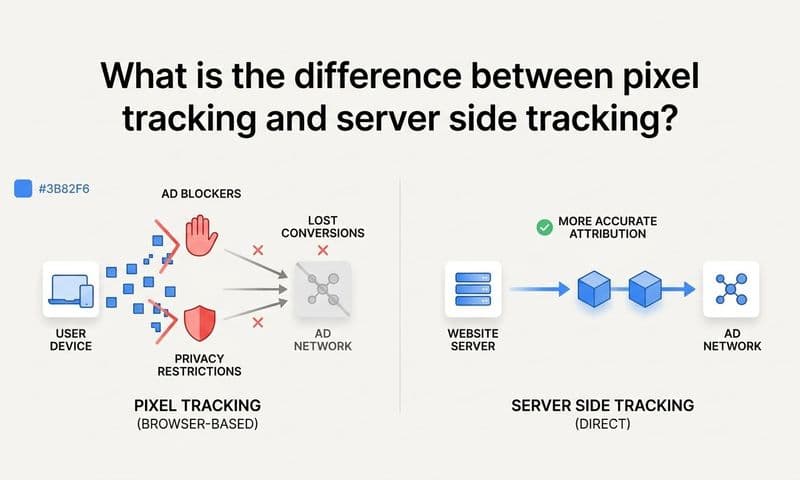
The first critical distinction is between client-side and server-side tracking. Client-side tracking relies on code running in the user's browser (like traditional pixels and tags). When someone visits your website, their browser executes JavaScript that sends data to your analytics platform. This approach works, but it has significant limitations.
Browser-based tracking can be blocked by ad blockers, privacy settings, or slow internet connections. iOS privacy changes have made it increasingly unreliable, with tracking prevention features actively interfering with data collection. When users leave your site quickly or close their browser, events might not fire at all. These issues create data gaps that make attribution less accurate.
Server-side tracking takes a different approach. Instead of relying on the user's browser to send data, your web server communicates directly with analytics platforms via APIs. When someone completes an action on your site, your server sends that information immediately—regardless of browser settings, ad blockers, or privacy features. For a deeper comparison, explore the differences between Google Analytics vs server side tracking.
This architecture provides several advantages for real-time tracking. Data flows more reliably because it doesn't depend on client-side code execution. You can capture events that happen entirely on your backend, like CRM updates or payment processing, without requiring browser interactions. And you maintain more control over data quality and consistency.
The event streaming process works like this: When an action occurs (ad click, page view, form submission, purchase), an event gets created with relevant metadata—user identifier, timestamp, event type, associated values. This event enters a stream processing pipeline that can handle millions of events per second, analyzing and routing them in real time.
Stream processors match events to user profiles, applying attribution logic to determine which marketing touchpoints contributed to conversions. They calculate metrics on the fly, updating aggregated statistics without waiting for batch processing windows. They trigger alerts when specific conditions are met, like sudden performance drops or unusual traffic patterns.
Data accuracy in real-time systems requires careful attention to several challenges. iOS privacy changes, particularly App Tracking Transparency, have significantly impacted pixel-based tracking accuracy. Users can now opt out of cross-app tracking, creating blind spots in the customer journey.
Modern real-time tracking platforms address this through multiple strategies. Server-side tracking bypasses many browser-level restrictions. First-party cookies set by your own domain are more reliable than third-party tracking cookies. Understanding first-party data tracking is crucial for maintaining accuracy in this privacy-focused landscape.
Cookie limitations present another challenge. Third-party cookies are being phased out across major browsers, making it harder to track users across different websites. Real-time tracking systems compensate by focusing on first-party data collection and using server-side integrations with platforms like Meta and Google to maintain attribution accuracy.
The technical infrastructure also needs to handle data consistency. When the same conversion gets reported through multiple channels (your website, the ad platform's pixel, and your CRM), the system must deduplicate and reconcile these signals to provide accurate counts. Real-time deduplication is more complex than batch processing but essential for reliable metrics.
Latency management is another technical consideration. True real-time processing means data appears in your dashboard within seconds of the event occurring. This requires optimized database queries, efficient caching strategies, and infrastructure designed for low-latency operations rather than just high throughput.
The result is a technical foundation that can capture events reliably, process them instantly, maintain accuracy despite privacy restrictions, and deliver insights fast enough to support real-time decision-making. The complexity lives in the infrastructure layer, while the user experience remains simple and responsive.
From Clicks to Revenue: Tracking the Complete Customer Journey
Real-time data tracking becomes exponentially more valuable when it captures the complete customer journey rather than isolated events. Modern buyers interact with brands across multiple channels and devices before converting. Understanding this full path—as it happens—transforms how you optimize and scale campaigns.
Multi-touch attribution in a real-time context means connecting every interaction a customer has with your marketing, from initial ad click through website visits, email engagement, retargeting impressions, and finally to conversion. Traditional attribution models apply these connections after the fact, in batch processing. Real-time attribution builds the journey map as events occur. For a comprehensive overview, review our attribution marketing tracking complete guide.
Picture this scenario: A potential customer clicks your Facebook ad at 10 AM, browses your website but doesn't convert. At 2 PM, they see a retargeting ad on Instagram and click through again. At 4 PM, they receive your automated email sequence and click the link. At 6 PM, they search your brand name on Google, click the ad, and finally purchase. Real-time tracking captures all six touchpoints as they happen, immediately attributing the conversion across the entire journey.
This visibility matters because different attribution models weight these touchpoints differently. First-touch attribution gives all credit to that initial Facebook ad. Last-touch attributes everything to the Google search. Linear attribution spreads credit equally. Real-time systems let you compare these models instantly, understanding which channels are driving initial awareness versus which are closing deals. Exploring multi-touch attribution models for data helps you choose the right approach for your business.
The technical challenge is connecting these touchpoints across platforms. Meta tracks what happens in their ecosystem. Google tracks theirs. Your website analytics tracks visitor behavior. Your CRM tracks sales interactions. Each system has its own user identifiers and tracking mechanisms. Real-time tracking platforms must unify these disparate data sources into a single, coherent view.
This unification happens through sophisticated identity resolution. When someone clicks an ad, the tracking system captures their click ID from the ad platform. When they land on your website, server-side tracking matches that click ID to their session. When they fill out a form, their email address connects to their user profile. When they purchase, that transaction links back to all previous touchpoints.
The real-time aspect is crucial because this identity resolution happens continuously as events occur, not in overnight batch processing. You can see customer journeys forming in real time, understanding which paths lead to conversion and which result in drop-off.
Capturing every touchpoint across platforms requires deep integrations with each ad network, analytics tool, and CRM system you use. Modern attribution platforms maintain connections with Meta, Google, TikTok, LinkedIn, and dozens of other channels, pulling data through APIs and webhooks to ensure nothing gets missed.
But real-time tracking isn't just about collecting data—it's also about sending enriched information back to ad platforms. This feedback loop is where things get really powerful. When you track conversions accurately on your end, you can send that data back to Meta's Conversions API or Google's Enhanced Conversions, providing these platforms with better signals for their optimization algorithms.
Ad platforms use machine learning to target audiences and optimize delivery. The quality of their optimization depends entirely on the quality of conversion data they receive. Browser-based pixels miss conversions due to tracking prevention. They can't always attribute conversions to the correct ad. They don't capture offline conversions or multi-session journeys.
Server-side conversion tracking solves these issues by sending accurate, complete conversion data directly to ad platforms. When someone converts after a multi-day journey involving multiple touchpoints, the platform receives the full context—not just the last click. This enriched data helps algorithms understand which audiences and creative approaches actually drive results, improving targeting and delivery over time.
The complete customer journey view also reveals optimization opportunities you'd otherwise miss. You might discover that customers who engage with both Facebook and Google ads before converting have a 3x higher lifetime value than single-touch conversions. Or that mobile traffic converts poorly but drives valuable remarketing audiences. These insights only emerge when you can see the full journey in real time.
Implementing Real-Time Tracking: A Practical Framework
Setting up real-time tracking effectively requires more than just installing a pixel. You need a structured approach that ensures data flows reliably from every relevant source, gets processed accurately, and surfaces in formats that support decision-making.
Start with your essential integrations. At minimum, you need connections to your ad platforms (Meta, Google, TikTok, LinkedIn, or wherever you advertise), your website tracking infrastructure, your CRM system, and your analytics dashboard. Each integration serves a specific purpose in building the complete real-time picture.
Ad platform integrations pull campaign performance data—impressions, clicks, spend—and send conversion data back through Conversions APIs. Website tracking captures visitor behavior, page views, and on-site conversions. CRM integrations connect sales data, showing which leads convert to customers and their lifetime value. The analytics dashboard brings everything together into unified reporting.
The implementation sequence matters. Begin with website tracking because it forms the foundation for everything else. Deploy server-side tracking that can reliably capture events regardless of browser restrictions. Ensure you're setting first-party cookies properly and capturing user identifiers that can be matched across sessions. Our guide on attribution tracking setup walks through this process in detail.
Next, connect your ad platforms with both data pulling (to see campaign performance) and data pushing (to send conversion events back). This bidirectional integration is critical for real-time attribution and for improving ad platform optimization. Configure conversion events carefully, ensuring they match your actual business goals rather than vanity metrics.
CRM integration comes third because it depends on having accurate tracking already in place. Connect your CRM to match leads and customers back to their original marketing touchpoints. This closes the loop between marketing activity and actual revenue, enabling real revenue attribution rather than just lead tracking.
Common implementation challenges typically fall into three categories: data silos, inconsistent naming conventions, and platform limitations.
Data silos occur when different tools capture information in isolation without connecting to each other. Your ad platforms know about clicks and impressions. Your website analytics knows about visitor behavior. Your CRM knows about sales. But if these systems don't communicate, you can't build complete customer journeys. The solution is choosing an attribution platform that integrates deeply with all your tools, acting as the central hub that unifies data streams.
Inconsistent naming conventions create chaos in real-time reporting. If your Facebook campaigns use one naming structure, Google uses another, and your internal tracking uses a third, you can't easily compare performance or aggregate data. Establish clear naming conventions before launching campaigns, and enforce them consistently across all platforms. Include campaign type, audience, creative variant, and any other dimensions you need for analysis.
Platform limitations are real constraints you need to work around. Some ad platforms have API rate limits that restrict how frequently you can pull data. Others have delays in their own reporting that affect real-time accuracy. Understanding these limitations helps you set realistic expectations and choose workarounds when necessary. Learning how to fix attribution discrepancies in data becomes essential when these issues arise.
When evaluating real-time tracking solutions, focus on three core criteria: accuracy, integration depth, and actionable outputs.
Accuracy means the platform reliably captures events and attributes them correctly despite privacy restrictions and technical challenges. Look for server-side tracking capabilities, robust identity resolution, and transparent methodology for handling attribution.
Integration depth refers to how comprehensively the platform connects with your existing tools. Surface-level integrations might pull basic metrics but miss crucial details. Deep integrations capture everything you need and support bidirectional data flow for conversion feedback. Review the attribution tracking tools available to find the right fit for your stack.
Actionable outputs mean the platform doesn't just show you data—it helps you understand what to do with it. Real-time alerts for performance changes, clear visualization of customer journeys, and AI-powered recommendations transform raw data into decisions.
Implementation isn't a one-time project. Plan for ongoing optimization as you learn what metrics matter most, which reports your team actually uses, and where data quality issues emerge. The goal is building infrastructure that becomes more valuable over time as you refine your tracking and attribution models.
Turning Real-Time Data Into Real-Time Decisions
Having real-time data is only valuable if you actually use it to make better decisions faster. The challenge is building workflows that leverage instant insights without creating chaos or constant fire-drills.
Start with clear decision frameworks that define when and how you'll act on real-time data. Not every fluctuation requires immediate action. Set thresholds that trigger investigation: conversion rate drops below X%, cost per acquisition exceeds Y, daily spend reaches Z without hitting conversion targets. These guardrails prevent both overreaction to normal variance and underreaction to genuine problems.
Budget reallocation becomes dramatically more effective with real-time visibility. Instead of waiting until tomorrow to shift budget from underperforming campaigns to winners, you can make these moves throughout the day as performance becomes clear. This doesn't mean constantly tweaking budgets every hour. It means having the flexibility to act when you identify significant opportunities or issues.
The practical workflow looks like this: Monitor your dashboard for alerts or unusual patterns. When something catches your attention, investigate the underlying data to understand whether it's a real trend or temporary noise. If it's real and significant, make the appropriate adjustment—pause underperforming ads, increase budgets on winners, adjust targeting, or test new creative. Then monitor the impact of your change in real time to confirm it worked as expected.
AI plays an increasingly important role in analyzing real-time data streams because humans can't effectively monitor dozens of campaigns and hundreds of metrics simultaneously. Machine learning algorithms can identify patterns, anomalies, and opportunities across your entire marketing operation, surfacing recommendations that would take hours of manual analysis to discover.
Modern attribution platforms with AI capabilities can automatically detect when specific ads, audiences, or channels are performing above or below expectations. They can identify which combinations of touchpoints lead to highest-value customers. They can predict when campaigns are likely to hit saturation and suggest when to refresh creative or expand targeting. Understanding data analytics in digital marketing helps you leverage these capabilities effectively.
The key is using AI to augment human decision-making rather than replace it. AI excels at processing large volumes of data and identifying patterns. Humans excel at strategic thinking, creative problem-solving, and understanding business context that isn't captured in data. The combination is more powerful than either alone.
Building effective workflows requires balancing responsiveness with stability. Some best practices that help maintain this balance:
Establish Review Cadences: Check real-time dashboards at specific times (morning, midday, end of day) rather than constantly monitoring. This creates structure while maintaining responsiveness.
Define Clear Ownership: Make sure someone is responsible for monitoring and acting on real-time data. Without clear ownership, alerts get ignored and opportunities get missed.
Document Decision Logic: When you make changes based on real-time data, note what you changed and why. This builds institutional knowledge and helps refine your decision frameworks over time.
Test and Learn: Use real-time data to run more experiments faster. Launch tests, monitor results in real time, and iterate quickly based on what you learn.
Set Automated Rules: For routine decisions that follow clear logic (pause ads below X conversion rate, increase budget when ROAS exceeds Y), set up automated rules that act without requiring manual intervention.
The goal is creating a system where real-time data informs decisions at the right moments without creating constant disruption. You're not chasing every fluctuation—you're maintaining strategic oversight while having the capability to act quickly when it matters.
Putting It All Together
The transformation from delayed reporting to real-time data tracking represents a fundamental shift in how modern marketers operate. Instead of making decisions based on yesterday's performance and hoping conditions haven't changed, you see what's happening right now and respond accordingly.
This isn't about obsessively monitoring dashboards or making constant micro-adjustments. It's about building infrastructure that gives you confidence in your decisions. When you increase budget on a campaign, you can watch the impact unfold in real time rather than waiting until tomorrow to discover whether it was the right call. When performance shifts, you know immediately rather than discovering it after thousands of dollars have been spent.
The competitive landscape has evolved to the point where real-time visibility is no longer a luxury—it's table stakes for scaling campaigns effectively. Your competitors who are still operating on delayed data are making decisions with incomplete information while you're acting on current reality. That timing advantage compounds over weeks and months of optimization.
The technical foundation—server-side tracking, event streaming, unified attribution across platforms—might seem complex, but the user experience is straightforward. You see accurate data reflecting what's actually happening. You understand which marketing touchpoints are driving results. You receive actionable recommendations about where to focus your efforts.
Implementation requires thoughtful planning and the right technology partner. You need deep integrations with all your marketing platforms, reliable tracking that works despite privacy restrictions, and analytics that transform raw data into clear insights. But once that foundation is in place, the operational benefits are immediate and ongoing.
Every day you operate without real-time tracking is a day you're making decisions with one hand tied behind your back. You're discovering problems after they've already cost you money. You're scaling winners after the initial opportunity has passed. You're optimizing based on aggregated data that hides important patterns.
The good news is that modern attribution platforms have made real-time tracking accessible to marketing teams of all sizes. You don't need to build custom infrastructure or hire data engineers. You need the right platform that connects your marketing stack, captures every touchpoint accurately, and delivers insights you can actually use to make better decisions faster.
Ready to elevate your marketing game with precision and confidence? Discover how Cometly's AI-driven recommendations can transform your ad strategy—Get your free demo today and start capturing every touchpoint to maximize your conversions.