

You're staring at your ad dashboard on a Thursday afternoon, watching your cost per acquisition climb. The campaign that looked promising on Monday now seems to be bleeding budget. So you make the call: pause it, cut your losses, move on.
Three days later, your CRM data finally syncs. Turns out that campaign was actually converting. The leads just took 48 hours to move through your funnel. By the time you saw the revenue attribution, you'd already killed your best performer.
This scenario plays out constantly in digital marketing because most attribution systems weren't built for the speed of modern advertising. They process data in batches, creating delays that turn every budget decision into an educated guess. You're flying blind during the hours and days that matter most, when campaigns are live and money is being spent.
Real time marketing attribution reporting closes this gap. Instead of waiting for yesterday's data to tell you what went wrong, you see results as they happen. You can optimize campaigns while they're still running, shift budgets toward what's working, and catch problems before they drain your entire monthly spend. It transforms marketing from a reactive discipline into a proactive one, where decisions are based on what's happening right now, not what happened last week.
The Fundamental Shift from Batch to Real Time Attribution
Traditional attribution systems operate like overnight delivery. They collect data throughout the day, process it in batches during off-peak hours, and deliver insights the next morning. For some marketing activities, this works fine. For paid advertising that burns through thousands of dollars per day, it's painfully inadequate.
The difference isn't just about speed. It's about the entire philosophy of how marketing data gets processed and used.
Batch processing systems were designed for a different era of digital marketing. They assume you have time to review reports, discuss findings in weekly meetings, and implement changes in the next campaign iteration. They treat attribution as a historical exercise, something you analyze after the fact to inform future decisions.
Real time attribution systems process touchpoints as they occur. When someone clicks your ad, visits your landing page, and submits a form, that entire sequence gets captured and attributed within seconds, not hours or days. The system doesn't wait for a scheduled batch job. It continuously ingests data, matches it to user journeys, and updates attribution models on the fly.
This fundamental architectural difference changes how marketing teams operate. Instead of conducting post-mortems on campaigns that already ran, you're making live adjustments based on current performance. You can see which ads are driving conversions this hour, which landing pages are underperforming right now, and which audience segments are responding today.
The shift also demands different infrastructure. Real time systems require server-side tracking that captures data directly from your servers rather than relying solely on browser-based pixels that can be blocked or delayed. They need direct API connections to ad platforms, CRMs, and analytics tools to maintain continuous data synchronization. And they require processing pipelines capable of handling high-velocity data streams without creating bottlenecks.
But the payoff is substantial. When you can see real time attribution reporting data, you stop making decisions based on assumptions about what might be working. You know what's working, right now, with the data to prove it.
Building Blocks: What Powers Real Time Attribution
Real time marketing attribution reporting doesn't happen by accident. It requires specific technical components working together to capture, process, and attribute customer touchpoints as they occur.
The foundation is first-party data collection through server-side tracking. Unlike browser-based tracking that depends on cookies and pixels that can be blocked, server-side tracking sends data directly from your servers to your attribution platform. When someone submits a form on your website, that conversion event gets transmitted server-to-server, bypassing browser limitations entirely.
This approach captures more complete data. Ad blockers can't interfere with server-side tracking. iOS privacy restrictions that limit pixel-based tracking don't affect it. You get a more accurate picture of your customer journey because you're not losing touchpoints to technical limitations.
The second critical component is cross-platform identity resolution. Your customers don't experience your marketing in neat, isolated channels. They might see your Instagram ad on their phone during lunch, research your product on their laptop that evening, and convert on their tablet the next day.
Real time attribution systems need to recognize that these touchpoints belong to the same person, even across different devices and sessions. This requires sophisticated identity matching that goes beyond simple cookie tracking. It combines deterministic matching (when users log in or provide email addresses) with probabilistic matching (analyzing behavioral patterns and device fingerprints) to build unified user profiles.
Without this capability, your attribution data fragments into disconnected touchpoints that don't tell the full story. With it, you can see complete customer journeys that span multiple devices, channels, and time periods.
The third essential element is live data pipelines that maintain continuous synchronization across your marketing stack. Your attribution system needs to pull conversion data from your CRM in real time, sync with ad platforms to capture click and impression data, and integrate with your analytics tools to correlate website behavior with advertising touchpoints.
These pipelines can't rely on nightly batch jobs or manual exports. They need to operate continuously, processing new data as it arrives and updating attribution models without delay. This requires robust API integrations, efficient data processing, and infrastructure that can scale with your marketing activity.
When these components work together, you get a system that captures every touchpoint, connects them to individual users, and attributes conversions in real time. That's what makes the difference between knowing what worked last week and knowing what's working right now. Understanding the real time marketing analytics benefits helps teams justify the investment in this infrastructure.
Insights That Only Emerge in Real Time
The value of real time marketing attribution reporting isn't just faster access to the same data. It's entirely new categories of insights that only become visible when you can see patterns as they develop.
Consider intraday performance patterns. Traditional batch reporting might tell you that Wednesdays perform well overall. Real time attribution reveals that conversions spike between 2 PM and 4 PM on Wednesdays, plateau during evening hours, and drop off after 9 PM. This granular timing data enables smarter ad scheduling. Instead of running ads uniformly throughout the day, you can concentrate budget during peak conversion windows and reduce spend during low-performance hours.
These patterns often vary by channel, audience, and campaign type. Your B2B campaigns might convert best during business hours, while your consumer campaigns peak in the evening. Real time data surfaces these nuances immediately, allowing you to optimize scheduling for each campaign rather than applying blanket rules across your entire account.
Real time attribution also provides early warning signals for campaign fatigue and audience saturation. When you see conversion rates declining hour by hour while impression frequency climbs, you're watching creative burnout happen in real time. You can refresh your ads before performance completely tanks, rather than discovering the problem days later when you've already wasted significant budget.
The same applies to audience saturation. If your cost per acquisition steadily increases while your audience reach plateaus, you're exhausting your target market. Real time data lets you expand to new audiences or adjust targeting parameters before your campaign becomes unprofitable.
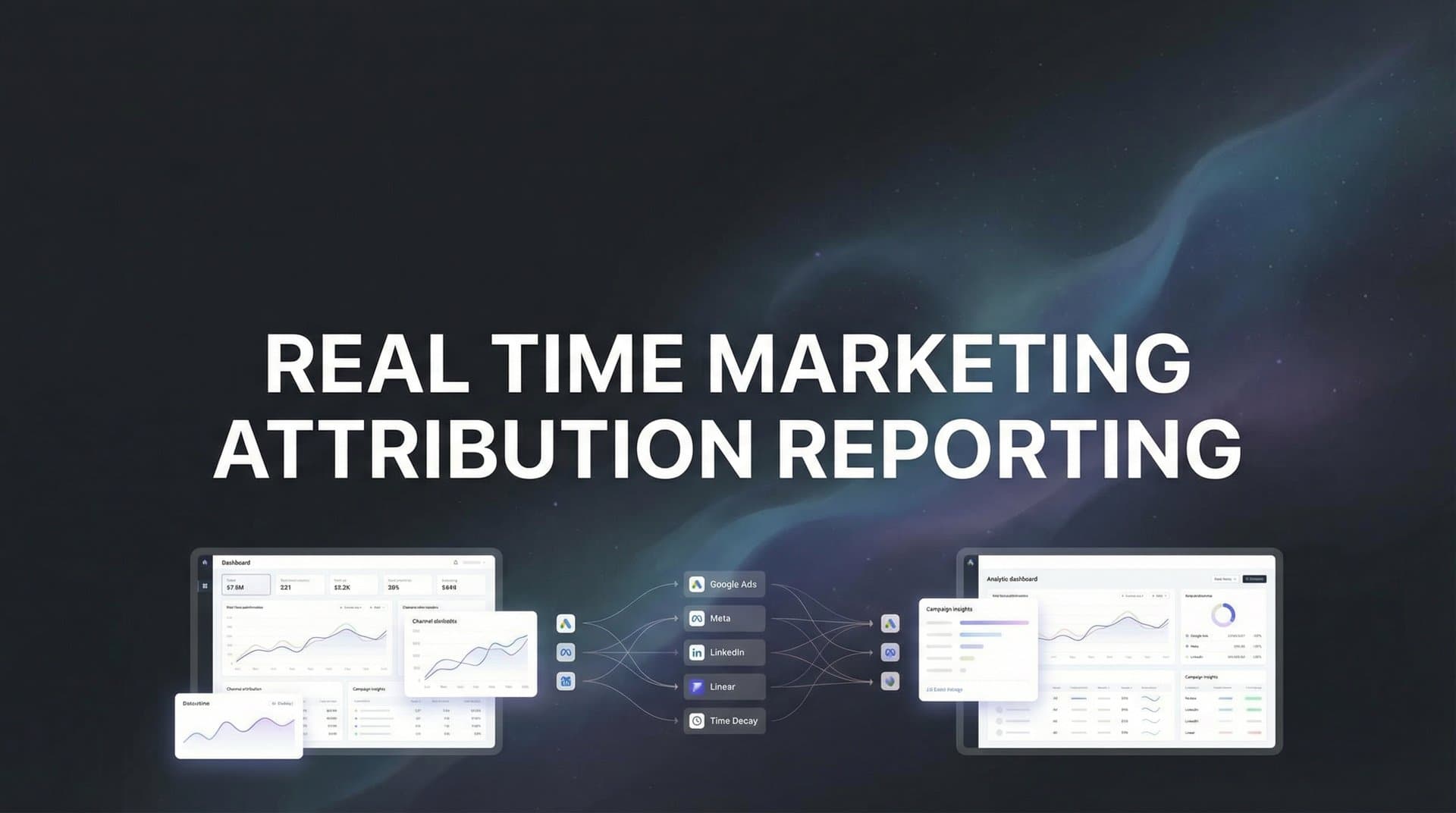
Perhaps most valuable is the ability to compare attribution models in real time. Multi-touch attribution offers different perspectives on how credit should be distributed across touchpoints. Linear attribution spreads credit evenly, time-decay gives more weight to recent touchpoints, position-based emphasizes first and last interactions, and data-driven models use algorithms to assign credit based on statistical analysis.
With real time reporting, you can see how these different models evaluate the same customer journeys as they happen. If last-click attribution credits a retargeting ad while multi-touch reveals that the conversion actually started with an organic social interaction days earlier, you gain crucial context about what's really driving results. This prevents you from over-investing in bottom-funnel tactics while neglecting the top-funnel activities that initiate customer journeys. A well-designed real time marketing analytics dashboard makes comparing these models intuitive.
Connecting Your Marketing Stack for Live Attribution
Implementing real time marketing attribution reporting requires integrating multiple systems into a unified data pipeline. Each connection serves a specific purpose in building complete, accurate attribution.
Start with your ad platforms. Direct API integrations with Meta, Google Ads, TikTok, LinkedIn, and other channels allow your attribution system to pull click, impression, and cost data in real time. These aren't simple data exports. They're live connections that continuously sync advertising activity with conversion outcomes.
When someone clicks your Facebook ad, that click gets recorded in your attribution system within seconds. When they convert on your website, the system immediately connects that conversion back to the original ad click, updating your attribution models and campaign performance metrics without delay.
This real time sync enables immediate optimization. You can see which specific ads, ad sets, and campaigns are driving conversions right now, not which ones performed well yesterday. If an ad that looked promising this morning starts underperforming this afternoon, you catch it early enough to make adjustments before burning through your daily budget.
Next, integrate your CRM. Marketing attribution isn't just about tracking website conversions. For many businesses, the real value comes from understanding which marketing touchpoints lead to closed deals, not just form submissions or trial signups.
Your attribution system needs to pull CRM events in real time. When a lead becomes an opportunity, when an opportunity closes, when revenue gets recognized, these events should feed back into your attribution models immediately. This creates a complete picture of marketing's impact on revenue, not just top-of-funnel metrics. Effective channel attribution in digital marketing revenue tracking depends on this CRM integration.
Without this connection, you're optimizing for the wrong outcomes. You might scale campaigns that generate lots of leads but few customers, while underfunding campaigns that drive smaller lead volumes but higher conversion rates and larger deal sizes.
The third critical integration is conversion sync, also known as Conversions API. This involves sending enriched conversion data back to your ad platforms to improve their optimization algorithms. When you capture a conversion on your website or in your CRM, you don't just record it in your attribution system. You also send it back to Meta, Google, and other platforms with additional context they can use to optimize targeting.
This might include customer lifetime value, purchase amount, product categories, or custom events that matter to your business. Ad platforms use this data to train their algorithms, finding more users who are likely to convert in similar ways. The result is better targeting, lower cost per acquisition, and improved return on ad spend.
Conversion sync also helps overcome tracking limitations. When browser-based pixels miss conversions due to ad blockers or privacy restrictions, server-side conversion sync ensures ad platforms still receive the data they need to optimize campaigns effectively.
Balancing Speed with Statistical Confidence
Real time data creates a new challenge: knowing when you have enough information to make confident decisions. Traditional reporting gave you time to accumulate data before acting. Real time reporting demands faster decisions, but not reckless ones.
The key is understanding statistical significance in the context of your business. If you run high-volume campaigns with thousands of clicks per day, you can reach statistical confidence quickly. A few hours of data might be enough to identify clear performance differences between ad variations.
For lower-volume campaigns, you need more patience. Making decisions based on 10 conversions split across 5 ads tells you almost nothing reliable. You're essentially making random choices and calling them data-driven.
Smart marketers set minimum thresholds before acting on real time data. You might decide that you need at least 50 conversions per ad variation before declaring a winner, or that cost per acquisition needs to deviate by at least 30% from your target before you make budget adjustments. These guardrails prevent you from chasing noise while still allowing you to respond to genuine performance signals.
Multi-touch attribution becomes especially important in real time environments. Last-click attribution is fast and simple, but it systematically undervalues top-funnel and mid-funnel touchpoints. If you optimize purely on last-click data, you'll keep investing in retargeting and branded search while starving the awareness campaigns that feed your funnel.
Real time multi-touch attribution shows you the full customer journey as it develops. You can see which initial touchpoints start customer journeys that eventually convert, even if the conversion happens days later through a different channel. This prevents you from making short-sighted optimization decisions that improve immediate metrics while damaging long-term performance. Understanding attribution challenges in marketing analytics helps teams avoid common pitfalls when interpreting this data.
The final piece is dashboard design. Real time data can quickly become overwhelming if you try to monitor everything at once. Effective dashboards surface actionable insights rather than drowning teams in raw metrics.
Focus on the metrics that actually drive decisions. If you're running paid advertising, you probably care most about cost per acquisition, return on ad spend, conversion rate, and attribution by channel. Build dashboards that highlight these metrics prominently and show trends over relevant time periods.
Include alerts for significant changes. If your cost per acquisition suddenly spikes by 50%, you want to know immediately, not when you happen to check your dashboard. If a campaign that was converting well suddenly stops generating results, automated alerts ensure you catch it before it becomes expensive. Exploring real time marketing dashboard tools can help you find the right solution for your team.
Scaling What Works While It's Working
The ultimate value of real time marketing attribution reporting is the ability to scale successful campaigns while they're still performing, not after the opportunity has passed.
When you identify high-performing ads and audiences in real time, you can shift budget immediately. If a new ad creative is driving conversions at half your target cost per acquisition, you don't wait until next week's budget review to capitalize on it. You increase its budget today, while the performance is still strong.
This responsive budget allocation compounds over time. Traditional batch reporting means you might run underperforming campaigns for days before you notice and react. Real time attribution lets you catch problems within hours and redirect that budget toward better opportunities. Implementing real time marketing budget allocation strategies maximizes this advantage.
The same principle applies to creative testing. Instead of running A/B tests for predetermined periods regardless of results, you can declare winners as soon as you reach statistical confidence. If Creative A clearly outperforms Creative B after 100 conversions, you don't need to wait another week to gather more data. You can shift budget to the winner and start testing the next variation.
This creates faster feedback loops that accelerate optimization. You can test more creative variations, landing pages, and messaging approaches in the same time period because you're not artificially extending tests beyond the point where they provide useful information.
Real time attribution also improves alignment between marketing and sales teams. When both teams look at the same live revenue attribution data, conversations shift from finger-pointing about lead quality to collaborative problem-solving about conversion optimization.
Sales can see which marketing sources are driving the best leads right now, allowing them to prioritize follow-up accordingly. Marketing can see which campaigns are generating leads that actually close, enabling them to optimize for revenue rather than just volume. This shared visibility creates accountability and cooperation that's difficult to achieve when teams work from different data sources with different update schedules. Effective attribution reporting for marketing teams bridges this gap between departments.
Moving from Reactive to Proactive Marketing
Real time marketing attribution reporting represents more than a technical upgrade. It's a fundamental shift in how marketing teams operate, moving from reactive analysis to proactive optimization.
The traditional approach treats attribution as a retrospective exercise. You run campaigns, wait for data to accumulate, analyze what happened, and apply those learnings to future efforts. This works, but it means you're always optimizing based on past performance in environments that may have already changed.
Real time attribution flips this model. You see performance as it develops, identify opportunities and problems while they're happening, and make adjustments that affect current results, not just future campaigns. This transforms marketing from a discipline of educated guesses into one of continuous, data-driven refinement.
The core capabilities that make this possible are clear: capturing every touchpoint through server-side tracking that bypasses browser limitations, understanding true revenue drivers through multi-touch attribution that credits the full customer journey, and feeding better data back to ad platforms through conversion sync that improves their optimization algorithms.
When these elements work together, you gain visibility and control that simply isn't possible with traditional batch reporting. You know which campaigns are driving results right now. You can scale what's working while it's working. You catch problems before they become expensive. And you make decisions based on current data rather than outdated assumptions.
The competitive advantage is significant. While competitors wait for weekly reports to tell them what went wrong, you're already optimizing based on what's happening today. While they conduct post-mortems on missed opportunities, you're capturing opportunities in real time.
Ready to elevate your marketing game with precision and confidence? Discover how Cometly's AI-driven recommendations can transform your ad strategy. Get your free demo today and start capturing every touchpoint to maximize your conversions.


