By the time your weekly performance report hits your inbox, your ad budget has already been working hard for seven days based on assumptions. By the time a monthly review gets scheduled, you have spent thirty days optimizing toward data that may have been misleading from the start. This is the reality most marketing teams live with, and it is costing them more than they realize.
Real time marketing insights flip this dynamic entirely. Instead of waiting for data to be collected, processed, and packaged into a report, you see what is happening as it happens. Campaigns that stop converting get caught early. Winning ads get scaled before the opportunity window closes. Budget decisions happen in hours, not weeks.
This guide is for marketing teams running paid campaigns across multiple platforms who want to understand what real time insights actually are, how they differ from the reporting setups most teams rely on, and how to build a data infrastructure that supports faster, smarter decisions. If you have ever felt like you were flying blind between reports, this is where that changes.
Beyond Batch Reports: What Real Time Marketing Insights Actually Mean
Real time marketing insights are continuously updated data about campaign performance, customer behavior, and attribution that is available as events happen, not hours or days after the fact. When someone clicks your ad, completes a purchase, or abandons a checkout, that event is captured and reflected in your analytics immediately rather than being queued for a nightly data sync.
It is worth clarifying the distinction between "real time" and "near real time," because the difference matters for decision-making quality. True real time data means events are tracked and surfaced with minimal latency, typically within seconds or minutes. Near real time usually means data is refreshed on a scheduled basis, perhaps every hour or every few hours. For most campaign optimization decisions, near real time is workable. But the closer your data is to the moment of action, the less room there is for wasted spend to accumulate.
Data latency is the gap between when something happens and when you can see it in your analytics. In traditional batch reporting, that gap can stretch to days or weeks. A weekly dashboard might aggregate seven days of performance data into a single view, which means a campaign that started underperforming on Tuesday might not surface as a problem until Friday's report. By then, significant budget has already been allocated toward a losing strategy. Understanding the full scope of real time marketing analytics benefits helps illustrate why closing this gap matters so much.
This is where the contrast with traditional reporting becomes stark. Monthly reviews and weekly dashboards have their place for strategic planning, but they are fundamentally backward-looking tools. They tell you what happened. Real time insights tell you what is happening, which is the only timeframe where you can actually intervene.
The gap between data collection and action is where wasted ad spend lives. Every hour that passes between a campaign underperforming and a marketer knowing about it is an hour of budget working against you. Real time insights close that gap, turning what used to be a reactive process into a proactive one. That shift in timing is not just a workflow improvement. It is a structural advantage that compounds over the life of a campaign.
The Data That Drives Instant Decisions
Not all data is equally useful in real time. The types of data that matter most for live campaign decisions fall into a few distinct categories, and understanding each one helps you build a monitoring setup that actually supports faster action.
Ad performance metrics: Cost per acquisition, return on ad spend, click-through rate, and cost per click are the core signals that tell you whether a campaign is working. When these update in real time, you can spot a CPA that is climbing out of range before it blows your budget, or catch a ROAS spike that signals a creative worth scaling immediately. If you need a deeper understanding of this metric, our guide on what is ROAS in marketing breaks it down thoroughly.
Conversion events: Real time conversion tracking goes beyond knowing that a sale happened. It captures which ad, which audience, which channel, and which touchpoint preceded that conversion. This granularity is what separates useful data from noise.
Customer journey touchpoints: Most customers interact with your brand multiple times before converting. Tracking these touchpoints in real time, from a first ad impression to a retargeting click to a final purchase, gives you a live view of how the customer journey actually unfolds rather than a theoretical model of how it should.
Cross-platform attribution signals: When you are running campaigns across Meta, Google, TikTok, and other channels simultaneously, you need a way to connect performance data across all of them. Real time cross-platform attribution signals let you see which channels are contributing to conversions and how they interact with each other.
Here is where server-side tracking becomes critical. Browser-based tracking, which relies on cookies and client-side scripts, has become increasingly unreliable. iOS privacy changes introduced with App Tracking Transparency, combined with the ongoing deprecation of third-party cookies, have created significant gaps in what browser-based tools can capture. Understanding the digital marketing strategy that tracks users across the web helps put these challenges in context. Server-side tracking bypasses these limitations by sending data directly from your server to your analytics platform, resulting in more complete and more accurate event data.
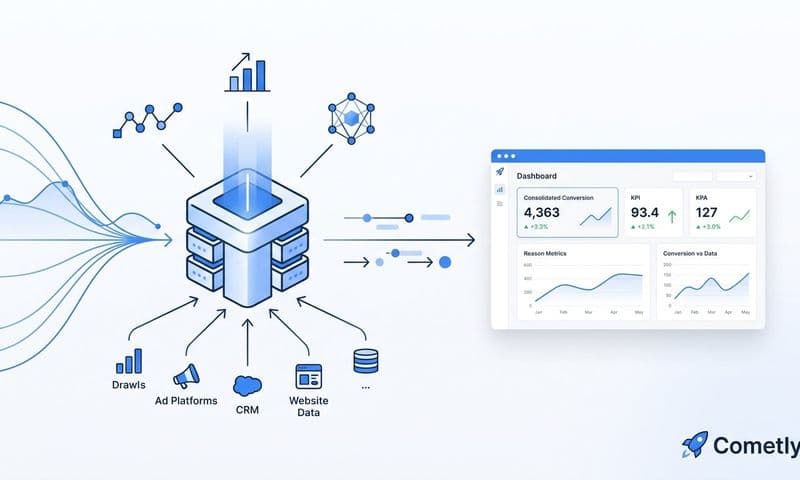
The real power of real time insights comes from connecting these data sources into a unified stream. Ad platform dashboards like Meta Ads Manager or Google Ads only show you their own slice of the picture. Your CRM holds customer data that these platforms cannot see. Your website analytics capture behavior that neither platform fully understands. When you connect all three into a single, continuously updated data layer, you get a complete picture of performance that no isolated dashboard can provide.
This unified view is what makes real time insights actionable rather than just fast. Speed without context is just noise. Speed with complete, cross-platform context is a competitive advantage.
Why Delayed Data Costs You More Than You Think
Stale data does not just slow you down. It actively misleads you. When your reporting cycle runs behind your spending cycle, you are making budget decisions based on a version of reality that no longer exists, and the financial consequences add up quickly.
The most common cost of delayed data is continued spending on underperforming campaigns. If a campaign stops converting on Monday but you do not see that in a report until Thursday, you have spent three days of budget on ads that were not working. Multiply that across multiple campaigns and multiple platforms, and the cumulative waste becomes significant over a quarter. This is precisely why marketing data accuracy matters for ROI at every level of your organization.
The second cost is missed scaling opportunities. When a creative or audience suddenly starts outperforming, the window to capitalize on that performance is often short. Algorithms shift, audiences saturate, and competitive dynamics change. If you discover a winning ad three days after it peaked, you have already missed the best opportunity to scale it efficiently.
The third cost is attribution distortion. When data arrives late and in batches, it is harder to connect specific ads to specific outcomes accurately. This leads to flawed conclusions about which channels are driving revenue, which in turn shapes future budget allocations in the wrong direction. Many teams end up over-investing in channels that look good in last-click attribution while underfunding the channels that actually initiated the customer journey. Exploring where most marketing conversions drop off can help you identify exactly where these blind spots occur.
To make this concrete, picture a marketer running campaigns across Meta, Google, and TikTok simultaneously. On Tuesday, the TikTok campaigns stop converting, perhaps due to creative fatigue or an audience shift. But the budget keeps running automatically. By Friday, when the weekly report surfaces the problem, three days of TikTok spend has produced minimal return. Meanwhile, the Google campaigns that were quietly outperforming never received additional budget because there was no signal to act on in time.
Real time insights change this scenario entirely. The TikTok performance drop surfaces within hours. Budget gets reallocated to Google while the TikTok creative gets refreshed. The loss is contained, and the winning channel gets more fuel while it is still performing.
This same principle applies to creative testing. Real time performance data compresses the feedback loop on creative iteration. Instead of waiting a week to determine whether a new ad concept is working, you can read signals within 24 to 48 hours and make confident decisions about what to continue, what to kill, and what to test next. Faster creative cycles mean more learning per dollar spent, which compounds into better performance over time.
Turning Raw Data Into Actionable Intelligence
There is an important distinction that often gets lost in conversations about real time data: having fast data is not the same as having useful insights. Raw numbers flowing in real time are a starting point, not a destination. The leap from data to insight requires context, attribution modeling, and pattern recognition layered on top of the numbers themselves.
Consider what a raw real time data stream actually looks like. You might see that your CPA increased by fifteen percent in the last four hours. That is a data point. But is it a problem? It depends on whether that increase is concentrated in one campaign or spread across all of them, whether it correlates with a creative change you made this morning, whether it reflects a seasonal shift in competition, or whether it is simply normal variance within an acceptable range. Without that context, the number alone does not tell you what to do.
This is where AI-powered marketing analytics becomes genuinely valuable rather than just a marketing buzzword. AI can process continuous data streams at a scale and speed that manual analysis cannot match. It can identify patterns across hundreds of campaigns simultaneously, flag anomalies that a human analyst might not notice until much later, and surface specific recommendations: which ads to scale, which to pause, where to shift budget, and which audiences are showing early signs of fatigue.
The key is that these recommendations are grounded in real time data rather than periodic snapshots. When an AI system is continuously monitoring performance and comparing it against historical patterns, it can catch meaningful signals much earlier than a weekly review process would allow.
Multi-touch attribution is the other critical layer that separates raw real time data from genuine intelligence. Most ad platforms default to last-click attribution, which credits the final touchpoint before a conversion and ignores everything that came before it. This creates a systematically distorted view of which channels are actually driving revenue. Our in-depth guide on multi-touch attribution in marketing explains how these models work and why they matter.
Multi-touch attribution models distribute credit across all the touchpoints in a customer journey, giving you a more accurate picture of how your channels work together. When this attribution layer is applied to real time data, you can see in live time how a customer who clicked a TikTok ad three days ago, engaged with a retargeting ad on Meta yesterday, and converted through a Google search today actually moved through your funnel. That visibility changes how you allocate budget across channels, because you are optimizing toward actual revenue drivers rather than whichever platform happens to be closest to the conversion event.
Building Your Real Time Insights Stack
Understanding what real time insights are is one thing. Building the infrastructure to actually deliver them is another. A functional real time marketing insights stack has four core components, and each one plays a distinct role in ensuring the data you are acting on is accurate, complete, and timely.
Server-side tracking: This is the foundation. Without reliable data capture, everything downstream is compromised. Server-side tracking ensures that conversion events are recorded accurately, even in environments where browser-based tracking is blocked or limited by privacy settings. It also reduces data loss from ad blockers and script failures, which are more common than most marketers realize.
Cross-platform data integration: Your campaigns run across multiple platforms, and your customer data lives in your CRM. A real time insights stack needs to pull all of this together into a single, unified view. This means connecting your ad platforms, your website analytics, and your CRM into a continuous data stream rather than treating each as a separate silo. Building unified dashboards for marketing and sales attribution is a critical step in achieving this integration.
Attribution modeling: As discussed above, the attribution layer is what transforms touchpoint data into revenue intelligence. Your stack needs to support multiple attribution models so you can compare how different frameworks interpret the same customer journeys and make informed decisions about which model best reflects your actual conversion dynamics. Understanding the types of marketing attribution models available will help you choose the right approach for your business.
Conversion syncing: This is the component that many marketers overlook, and it may be the one with the highest leverage. Feeding enriched, real time conversion data back to platforms like Meta and Google improves their machine learning models. These platforms rely on conversion signals to optimize ad delivery. When they receive more accurate, more complete, and more timely data, their algorithms can find better audiences and deliver ads more efficiently. The result is lower acquisition costs and better targeting over time, driven by the quality of the data you send back.
When evaluating whether your current analytics setup delivers true real time insights, consider these questions:
1. How quickly do conversion events appear in your analytics after they occur? If the answer is hours or days, you are working with delayed data.
2. Can you see performance across all your ad platforms in a single view, or do you have to manually reconcile data from separate dashboards?
3. Does your attribution model account for all touchpoints in the customer journey, or does it default to last-click?
4. Are you sending conversion data back to your ad platforms, and if so, how complete and accurate is that data?
5. Do you have any AI-powered layer that surfaces patterns and recommendations, or are you relying entirely on manual analysis?
If the answers to these questions reveal gaps, you are likely spending more than you need to on campaigns that could be performing better with better data infrastructure underneath them.
Putting Real Time Insights to Work Across Your Campaigns
The practical applications of real time marketing insights fall into a few high-impact use cases that marketers across industries consistently find valuable once they have the right data infrastructure in place.
Daily budget optimization: With real time performance data, budget allocation becomes a daily activity rather than a weekly one. When you can see which campaigns are hitting target ROAS and which are not, you can shift spend toward winners and pull back from underperformers every morning rather than waiting for a report to tell you what already happened. Over a month, this kind of daily responsiveness can significantly improve overall campaign efficiency. Choosing the right real time marketing performance monitoring tools is essential to making this workflow practical.
Rapid creative iteration: Real time performance data compresses the creative testing cycle. When you can read meaningful signals on a new ad concept within 24 to 48 hours, you can run more tests per month, learn faster, and build a stronger creative library based on actual performance rather than gut instinct. Teams that use live data to guide creative decisions typically develop a more refined understanding of what resonates with their audiences over time.
Cross-channel attribution comparison: Real time multi-touch attribution lets you compare how different channels contribute to conversions on an ongoing basis rather than during a quarterly review. This live visibility helps you find the best-performing channel mix and adjust your budget allocation as performance dynamics shift.
For agencies, real time insights also create a meaningful client relationship advantage. When you can show clients a live view of campaign performance rather than a backward-looking summary, you build trust through transparency. Clients who can see what is happening in real time are more confident in the decisions you are making, and they are more likely to approve budget adjustments quickly because the data supporting those decisions is right in front of them.
The deeper benefit is the feedback loop that real time insights create. Better data leads to better ad platform optimization. Better ad platform optimization leads to better results. Better results generate more conversion events, which feed even richer data back into your attribution models and back to the platforms themselves. Over time, this loop compounds. The gap between teams with real time insights infrastructure and those without it tends to widen as this compounding effect takes hold.
The Bottom Line on Real Time Marketing Insights
Real time marketing insights are not a dashboard upgrade or a reporting preference. They represent a fundamental shift in how marketing decisions get made. The speed at which you can act on data directly determines how efficiently you spend, and in competitive advertising environments, that efficiency gap between fast-moving teams and slow-moving ones translates directly into performance outcomes.
The core takeaway is straightforward: every hour between a campaign event and your awareness of it is an hour where budget decisions are being made without complete information. Closing that gap with real time data, accurate attribution, and AI-powered analysis is one of the highest-leverage investments a marketing team can make.
The teams that win in paid advertising are not necessarily the ones with the biggest budgets. They are the ones who can read what is working fastest, act on it most decisively, and feed better data back into their systems to improve performance over time. Real time insights are what make that possible.
If your current analytics setup is still delivering weekly dashboards and monthly summaries while your campaigns run continuously, it is worth asking what that delay is costing you. The answer is almost always more than it appears.
Cometly is built specifically to solve this problem. It connects your ad platforms, CRM, and website into a single real time data stream, applies multi-touch attribution across every touchpoint, and uses AI to surface the recommendations that help you scale what is working and cut what is not. From server-side tracking to conversion syncing back to Meta and Google, Cometly gives marketing teams and agencies the infrastructure to act on data in the moment rather than after the fact. Get your free demo today and start building the real time insights foundation your campaigns deserve.