Your data warehouse holds the truth about which marketing channels actually drive revenue. It knows which leads closed, how much they spent, and which touchpoints influenced their decision. Meanwhile, your ad platforms are flying blind—optimizing campaigns based on incomplete signals, burning budget on audiences that look engaged but never convert.
This disconnect isn't just frustrating. It's expensive.
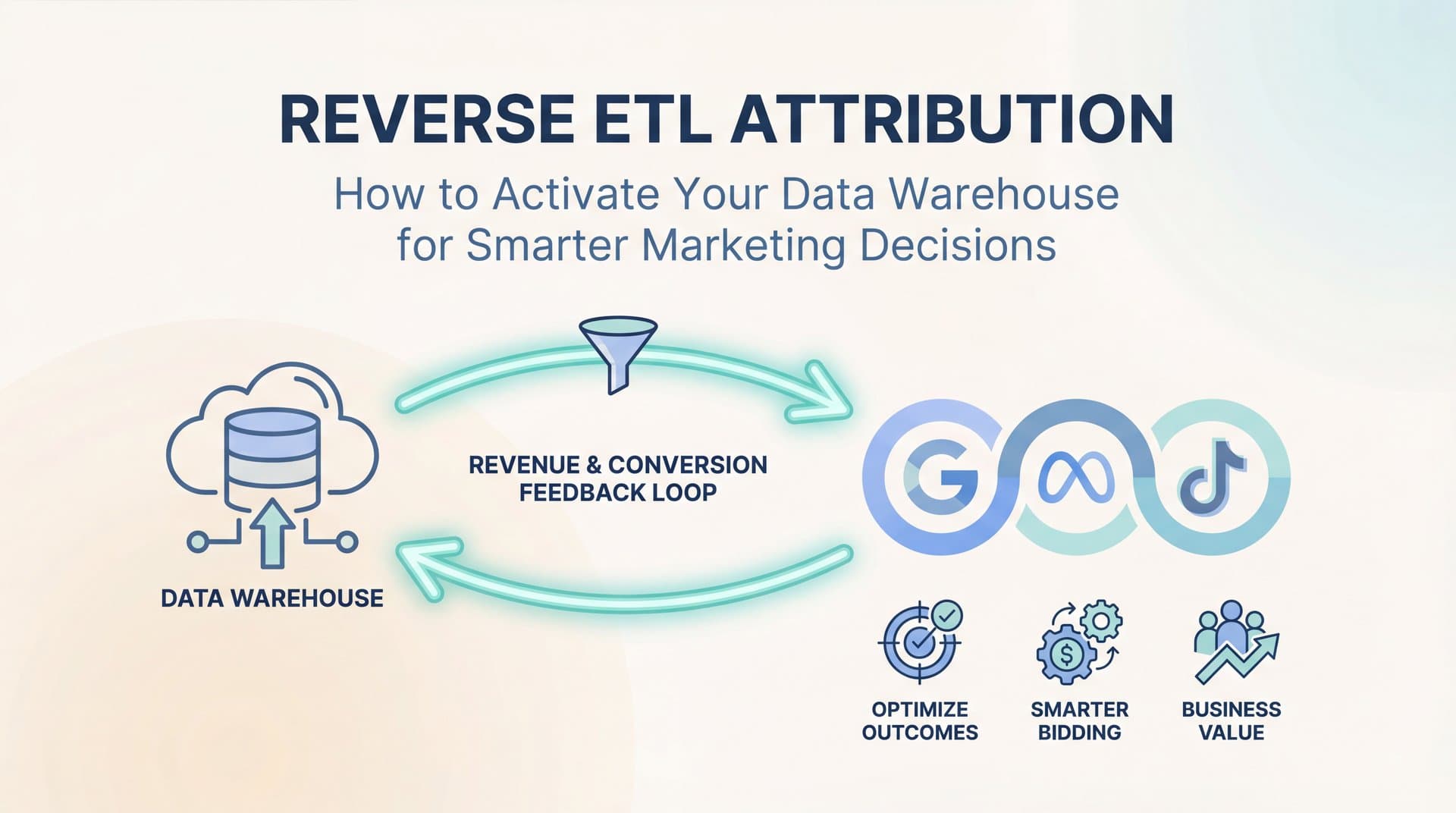
Reverse ETL attribution solves this problem by creating a feedback loop between your warehouse and your ad platforms. Instead of letting valuable conversion data sit idle in storage, you sync it back to Meta, Google, TikTok, and other channels where their algorithms can actually use it. The result? Smarter automated bidding, better lookalike audiences, and campaigns that optimize for revenue instead of vanity metrics.
By the end of this guide, you'll understand exactly how reverse ETL attribution works, why it's become essential for serious marketers, and how to implement it without building a complex data engineering project from scratch.
The Data Disconnect That's Costing You Conversions
Traditional ETL (Extract, Transform, Load) moves data in one direction: from your operational systems into your data warehouse. Your website tracking feeds in. Your CRM pushes updates. Your ad platforms send click data. Everything flows inward, creating a centralized repository where you can analyze the complete customer journey.
But here's the problem: all that valuable insight stays trapped in your warehouse.
Reverse ETL flips this model. It takes the enriched, transformed data sitting in your warehouse and pushes it back out to the operational tools where your team actually works—your ad platforms, CRM, email systems, and marketing automation tools. Instead of analysis living in a dashboard that only your data team sees, it becomes actionable intelligence that powers your campaigns in real time.
The attribution gap hits hardest in paid advertising. When someone clicks your Facebook ad, Meta records that click. But Meta has no idea what happens next. Did that person become a customer? Did they spend $50 or $5,000? Did they churn after one month or stay for years?
Without this feedback, ad platforms optimize for what they can measure: clicks, landing page views, form submissions. These proxy metrics correlate with business outcomes, but they're not the same thing. You end up with campaigns that excel at generating engagement while your actual revenue flatlines.
The consequences compound over time. Meta's algorithm learns to find more people who look like your clickers, not your customers. Google's automated bidding strategies chase conversions that never turn into revenue. TikTok's interest targeting zeroes in on audiences that engage with content but never pull out their wallets.
This isn't a hypothetical problem. Companies with longer sales cycles or offline conversions face it daily. B2B businesses that close deals weeks after the initial ad click. E-commerce brands where the real value comes from repeat purchases, not first orders. Service businesses where the conversion happens over the phone or in person.
In all these scenarios, your warehouse knows the truth. It connects the dots between that initial click, the sales conversation, the closed deal, and the lifetime value. But your ad platforms are still optimizing based on that first form fill, completely blind to everything that happened afterward.
How Reverse ETL Attribution Actually Works
Reverse ETL attribution starts with your data warehouse as the source of truth. This is where all your customer journey data converges—website interactions, ad clicks, CRM events, purchase history, and support tickets. The warehouse becomes your central nervous system, collecting signals from every touchpoint.
The transformation layer is where attribution logic lives. This is the step that most marketers underestimate. Raw warehouse data isn't ready to send back to ad platforms. You need to map which touchpoints deserve credit for conversions, apply your attribution model (first-touch, last-touch, multi-touch, or time-decay), and calculate the revenue value associated with each conversion event.
Think of it like this: your warehouse knows Customer A clicked a Facebook ad on Monday, visited from Google on Wednesday, and purchased on Friday after getting a promotional email. The transformation layer decides how to distribute credit across those touchpoints and packages that information into conversion events that ad platforms can understand.
The sync layer handles the technical challenge of pushing this data back to each platform using their specific APIs. Meta uses the Conversions API (CAPI). Google has Enhanced Conversions. TikTok has Events API. Each requires slightly different data formats, authentication methods, and event structures.
This is where reverse ETL gets complex if you're building it yourself. You're not just moving data—you're translating it into the language each platform expects, handling rate limits, managing authentication tokens, and ensuring data arrives with proper timestamps and deduplication keys.
Identity resolution is the technical foundation that makes all of this possible. When someone clicks your ad, they're anonymous. When they fill out a form, you capture an email. When they become a customer, your CRM assigns them an ID. Reverse ETL attribution requires connecting these identities across the entire journey through robust customer attribution tracking capabilities.
Server-side tracking has become essential for accurate identity resolution. Browser-based tracking faces increasing restrictions from iOS privacy features, cookie blockers, and browser policies. Server-side approaches capture data at the infrastructure level, bypassing many of these limitations.
When implemented correctly, server-side tracking captures the initial ad click parameters (campaign, ad set, creative) and stores them server-side. When that same user converts days or weeks later, the server can match their identity back to that original click and send a complete conversion event back to the ad platform—even if browser cookies were cleared or blocked.
The real power emerges when you start syncing offline conversions. Someone calls your sales team after clicking an ad. Your CRM logs the call, tracks the opportunity, and records the closed deal. Reverse ETL attribution connects that offline event back to the original ad interaction and sends a conversion signal to Meta or Google weeks after the initial click.
Now the ad platform's algorithm gets feedback about what actually drives business results, not just what drives form fills. This feedback loop transforms how machine learning optimization works in your campaigns.
Why Ad Platform Algorithms Need Better Attribution Data
Ad platform algorithms are prediction machines. They analyze patterns in your conversion data to identify which audiences, placements, and creative variations are most likely to drive results. Then they automatically adjust bidding and targeting to show your ads to more people who match those successful patterns.
But these algorithms are only as smart as the data you feed them.
When Meta's algorithm sees that certain demographics converted after clicking your ad, it builds lookalike audiences based on those converters. When Google's automated bidding notices which search queries led to conversions, it adjusts bids to prioritize similar queries. When TikTok's interest targeting identifies which content categories drove action, it expands reach to users with similar interests.
The garbage-in-garbage-out problem hits hard when your conversion signals are incomplete. If you're only tracking form submissions as conversions, platforms optimize for people who fill out forms—not people who actually become customers. If you're tracking all purchases equally, platforms can't distinguish between a $50 impulse buy and a $5,000 enterprise deal.
This creates a vicious cycle. Platforms show your ads to audiences that look like your form-fillers. You get more form fills, but conversion rates from lead to customer stay flat. Your cost per lead looks great in the ads dashboard while your actual cost per customer climbs steadily higher.
Enriched attribution data breaks this cycle by giving algorithms signals that actually correlate with business value. Instead of "User A converted," you send "User A became a customer worth $2,400 in annual recurring revenue." Instead of "User B clicked and purchased," you send "User B made an initial $80 purchase, then returned three times in the next 60 days for a total customer value of $340."
With this enriched data, Meta's algorithm learns to find audiences that don't just engage—they buy repeatedly and stick around. Google's Smart Bidding strategies optimize for actual revenue, not just conversion volume. TikTok's automated targeting identifies which interest combinations drive high-value customers, not just viral engagement.
The ROAS improvements can be dramatic. When platforms optimize for proxy metrics, you might see a 2x return on ad spend based on initial purchases. When they optimize for actual customer value including repeat purchases and lifetime value, that same budget can deliver 4x or 5x returns by finding fundamentally better audiences. Understanding cross channel attribution for marketing ROI becomes essential for measuring these improvements accurately.
The competitive advantage compounds over time. Every conversion event you send back to ad platforms makes their algorithms slightly smarter about your specific business. Competitors who only send basic conversion signals are training their algorithms on incomplete data. Your campaigns get more efficient while theirs plateau.
Building Your Reverse ETL Attribution Stack
The core infrastructure requires four key components working together: a data warehouse, an attribution platform, identity resolution capabilities, and sync infrastructure to connect everything back to your ad platforms.
Your data warehouse serves as the foundation. This could be Snowflake, BigQuery, Redshift, or any modern cloud data warehouse. The warehouse needs to collect data from all your marketing touchpoints, your CRM, your product analytics, and your revenue systems. Without this centralized data collection, you can't build accurate attribution models.
The attribution platform sits on top of your warehouse and handles the complex logic of connecting touchpoints to conversions. This is where you define your attribution rules, apply your chosen model, and calculate which interactions deserve credit. Purpose-built attribution platforms handle this natively, while DIY approaches require custom SQL queries and transformation scripts. For teams evaluating options, comparing marketing attribution software features can help identify the right fit.
Identity resolution capabilities determine how accurately you can match anonymous website visitors to known customers across different devices and sessions. This typically involves matching on email addresses, phone numbers, or device identifiers. The more data points you can match on, the more complete your attribution picture becomes.
Sync infrastructure handles the technical challenge of pushing conversion events back to each ad platform using their specific APIs. This includes managing authentication, handling rate limits, formatting data correctly for each platform, and ensuring events arrive with proper deduplication to avoid double-counting conversions.
DIY approaches using tools like Census or Hightouch give you flexibility but require significant technical investment. You'll need data engineers to build and maintain transformation pipelines, write custom SQL for attribution logic, and handle the ongoing maintenance as ad platform APIs change. The upside is complete control over every aspect of your data flow.
Purpose-built attribution platforms like Cometly handle the entire stack as an integrated solution. They capture tracking data, store it in their infrastructure, apply attribution models, resolve identities, and sync conversion events back to ad platforms—all without requiring you to manage a data warehouse or write transformation code.
Data freshness requirements vary by business model. E-commerce companies with short sales cycles might need conversion events synced within hours. B2B businesses with month-long sales processes can tolerate daily sync schedules. The key is ensuring conversion signals reach ad platforms while they're still relevant for optimization.
Sync frequency impacts both cost and effectiveness. More frequent syncs mean higher API usage and infrastructure costs, but they give ad platform algorithms fresher signals to work with. Less frequent syncs reduce costs but create a lag between conversions happening and algorithms learning from them.
Offline conversions present unique challenges. Phone calls, in-person sales, and deals closed through sales teams don't generate automatic digital signals. Your reverse ETL stack needs to capture these events from your CRM and connect them back to the original marketing touchpoint—sometimes weeks or months after the initial interaction. Implementing marketing attribution for phone calls requires specialized tracking approaches.
The technical complexity of offline conversion tracking is why many marketers never implement it. But it's also where the biggest gains often hide. If half your revenue comes through sales calls but you're only tracking online conversions, your ad platforms are optimizing on half the picture.
Putting Reverse ETL Attribution Into Action
Start with an audit of your current tracking infrastructure. Document every place where conversion data gets captured: your website analytics, CRM, payment processor, customer support system, and any other tools that record customer interactions. Map out which data points each system captures and identify gaps where important conversions aren't being tracked at all.
Connect your data sources to a central location where you can build attribution logic. If you're using a data warehouse approach, this means setting up data pipelines from each source system. If you're using a purpose-built attribution platform, this means installing tracking pixels, connecting API integrations, and configuring your CRM sync.
Map your attribution logic based on your business model. E-commerce companies might use last-click attribution for simplicity. B2B businesses with complex buying journeys often need multi-touch attribution models that credit multiple touchpoints. Service businesses might weight phone calls more heavily than form fills because calls convert at higher rates.
Test your sync accuracy before going live with campaign optimization. Send a small number of test conversion events back to your ad platforms and verify they appear correctly in each platform's reporting. Check that revenue values match, timestamps are accurate, and deduplication is working to prevent double-counting conversions.
Common pitfalls can derail your implementation if you're not watching for them. Duplicate conversions happen when multiple systems send the same event or when deduplication keys aren't configured correctly. This inflates your conversion counts and makes your campaigns look more successful than they actually are.
Mismatched timestamps create attribution errors. If your warehouse records a conversion at 2pm but syncs it to ad platforms with a 10am timestamp, the platform might attribute it to the wrong campaign or ad set. Timestamps need to reflect when the conversion actually happened, not when your sync job ran. Learning how to fix attribution discrepancies in data helps prevent these issues from skewing your optimization.
Identity resolution failures are the most frustrating pitfall because they're invisible. When you can't match a conversion back to the original ad click, that conversion becomes "organic" in platform reporting. Your paid campaigns look less effective than they actually are, and algorithms don't receive the signal they need to optimize.
Measure success by comparing platform-reported conversions against actual revenue. Before implementing reverse ETL attribution, your ad platforms might report 100 conversions while your CRM shows 70 actual customers. After implementation, those numbers should converge as platforms receive more complete conversion signals.
Track ROAS improvements over time, but give algorithms time to learn. When you start sending enriched conversion data, ad platforms need a few weeks to incorporate these new signals into their optimization models. Don't expect overnight transformations—look for steady improvements in efficiency over 30-60 days.
Monitor the quality of conversions, not just the quantity. If reverse ETL attribution is working correctly, you should see campaigns delivering customers with higher lifetime value, better retention rates, and stronger engagement—even if the initial conversion volume stays flat or decreases slightly.
Closing the Loop Between Data and Decisions
Reverse ETL attribution transforms your data warehouse from a passive storage system into an active optimization engine. Instead of valuable conversion insights sitting idle in SQL tables, they flow back to the platforms where they can actually improve campaign performance. Your ad spend becomes more efficient because algorithms finally have the signals they need to find genuinely valuable audiences.
The marketers who implement this approach gain a significant competitive advantage. While competitors optimize for proxy metrics and incomplete signals, you're training ad platform algorithms on actual business outcomes. Over time, this gap compounds—your campaigns get smarter while theirs plateau.
The technical complexity can feel overwhelming, especially if you're starting from scratch. Building a DIY reverse ETL stack requires data engineering resources, ongoing maintenance, and deep expertise in both attribution modeling and ad platform APIs. Many marketing teams simply don't have the bandwidth to build and maintain this infrastructure themselves.
Cometly handles reverse ETL attribution natively as part of its core platform. It captures every touchpoint across your marketing channels, connects those interactions to actual revenue in your CRM, and automatically syncs enriched conversion data back to Meta, Google, TikTok, and other ad platforms. The entire attribution loop closes without requiring you to manage data pipelines or write transformation code.
Server-side tracking ensures you capture accurate data even as browser restrictions tighten. Identity resolution connects anonymous visitors to known customers across devices and sessions. Multi-touch marketing attribution gives credit to the touchpoints that actually influence buying decisions. And conversion sync pushes this enriched data back to ad platforms where their algorithms can use it to find more high-value customers.
Ready to elevate your marketing game with precision and confidence? Discover how Cometly's AI-driven recommendations can transform your ad strategy—Get your free demo today and start capturing every touchpoint to maximize your conversions.