You're staring at your Salesforce dashboard, looking at a healthy pipeline of opportunities worth hundreds of thousands of dollars. Your team is celebrating the lead volume. But there's a nagging question you can't answer: which specific campaigns, ads, or marketing touchpoints actually created this pipeline?
Salesforce tells you a lead came from "Paid Social" or "Google Ads," but that's where the trail goes cold. You're running dozens of campaigns across Meta, Google, LinkedIn, and other platforms—each with multiple ad sets and creative variations. Your CFO wants to know which marketing investments are driving revenue, and you're stuck piecing together incomplete data from multiple sources that don't quite align.
This is the attribution gap that marketers face every day. Salesforce is incredibly powerful for managing customer relationships and tracking deals through your pipeline, but its native capabilities weren't designed to answer the granular attribution questions that modern multi-channel marketing demands. You need to know not just that paid social worked, but which specific ad creative, audience segment, and campaign structure drove your highest-value customers.
The Fundamental Gap in Salesforce's Attribution Capabilities
Salesforce excels at what it was built for: managing relationships, tracking opportunities, and moving deals through your sales process. But when it comes to marketing attribution—connecting specific marketing touchpoints to revenue outcomes—there's a significant blind spot.
The core issue is visibility. Salesforce tracks from the moment a lead enters your CRM, but the customer journey typically starts much earlier. Someone might click your Meta ad on Monday, visit your site from a Google search on Wednesday, click a retargeting ad on Thursday, and finally fill out a form on Friday. Salesforce only sees that Friday form submission. Everything that happened before that moment? It's invisible unless you've manually captured and associated it.
Even when you do capture some attribution data through UTM parameters or hidden form fields, Salesforce categorizes it broadly. Your lead source might say "Paid Social," but you're left guessing which of your 47 active Meta campaigns actually generated that lead. Was it the carousel ad targeting enterprise decision-makers, or the video ad aimed at mid-market companies? That granularity simply doesn't exist in standard Salesforce lead and opportunity records.
Campaign influence reports require you to manually associate leads with campaigns as "campaign members." This sounds straightforward until you're managing campaigns across five different ad platforms, each with their own naming conventions and structures. Maintaining consistent campaign member associations becomes a full-time job, and gaps in the data are inevitable. When someone converts after multiple touchpoints, you need to create campaign members for each interaction—a process that's nearly impossible to maintain accurately at scale.
The disconnect between your ad platform data and your CRM data creates a frustrating reality: your Meta Ads Manager shows one set of conversion numbers, Google Ads shows another, and Salesforce shows something completely different. You're stuck in endless meetings trying to reconcile these numbers instead of making confident decisions about where to invest your budget. Understanding common attribution challenges in marketing analytics can help you identify where your tracking breaks down.
What Salesforce Does Offer (And Where It Falls Short)
To be fair, Salesforce does provide attribution features—they're just not designed for the level of detail modern marketers need. Understanding what exists and its limitations helps you make better decisions about your attribution strategy.
Campaign Influence Models: Salesforce's standard Campaign Influence feature allows you to attribute revenue across multiple campaigns that touched an opportunity. You can choose between different attribution models: first touch (crediting the first campaign), last touch (crediting the final campaign before conversion), or even split (distributing credit equally). The Customizable Campaign Influence feature lets you create your own models with custom weighting.
This works well in theory. In practice, it requires every meaningful marketing touchpoint to be captured as a campaign in Salesforce, with the lead properly associated as a campaign member. Miss one touchpoint, and your attribution data is incomplete. For a lead that clicked three different ads, visited from organic search, and attended a webinar before converting, you need five separate campaign member records—each created manually or through automated workflows that often break.
Einstein Attribution: For organizations with higher-tier Salesforce editions, Einstein Attribution uses machine learning to analyze your campaign data and distribute credit across touchpoints. It's Salesforce's most sophisticated native attribution tool, providing algorithmic multi-touch attribution within your CRM ecosystem.
The challenge? Einstein Attribution still relies on the same underlying data—those campaign member associations. If your campaign tracking isn't comprehensive and consistent, Einstein is analyzing incomplete information. It also operates entirely within the Salesforce environment, meaning it can't directly access the granular data sitting in your ad platforms. It doesn't know that Campaign A had 12 different ad sets with varying performance, or that specific creative variations drove different quality leads. Learning what a marketing attribution model entails helps clarify why native CRM tools often fall short.
The Manual Dependency Problem: All of Salesforce's native attribution features depend heavily on manual processes or complex automation. You need UTM parameters on every link, hidden form fields to capture those parameters, workflows to create campaigns and campaign members, and consistent naming conventions across your entire team. One person forgetting to add UTM parameters to their LinkedIn campaign creates a permanent gap in your attribution data.
Server-side tracking doesn't exist in native Salesforce. You're relying on browser-based tracking through forms and landing pages, which means you're vulnerable to every limitation of cookie-based attribution. Ad platform integrations are limited to basic lead imports—you're not pulling in the detailed campaign structure, ad-level performance data, or real-time optimization metrics that would give you actionable insights.
The Customer Journey That Salesforce Never Sees
Think about your own buying behavior. When you're researching a significant business purchase, do you see one ad and immediately fill out a form? Of course not. You click an ad, browse the website, leave, see a retargeting ad a few days later, search for reviews, visit from your phone, come back on your laptop, compare competitors, and eventually convert.
This is the modern customer journey—multi-session, multi-device, spanning days or weeks. Salesforce only sees the endpoint: the form submission or the moment someone becomes a lead. Everything before that moment is invisible unless you've built extensive tracking infrastructure. A robust multi-touch marketing attribution platform captures these interactions that your CRM misses.
The problem has gotten dramatically worse with privacy changes. iOS 14.5 and subsequent updates fundamentally broke browser-based attribution. When users opt out of tracking—and most do—your UTM parameters might not persist across sessions. That carefully tagged Meta ad click? It might not be connected to the form submission that happens three days later on a different device.
Cookie deprecation across browsers compounds this issue. Third-party cookies are disappearing, and even first-party cookies face limitations. The browser-based tracking that marketers relied on for years is becoming increasingly unreliable. You're making million-dollar budget decisions based on attribution data that's missing 30-40% of the actual customer journey.
Without server-side tracking—where events are recorded directly from your server to analytics platforms, bypassing browser limitations entirely—you're flying blind. The data feeding into Salesforce is already incomplete before it even arrives. You can't attribute revenue to marketing touchpoints you never captured in the first place.
Connecting the Dots Between Ad Spend and Salesforce Revenue
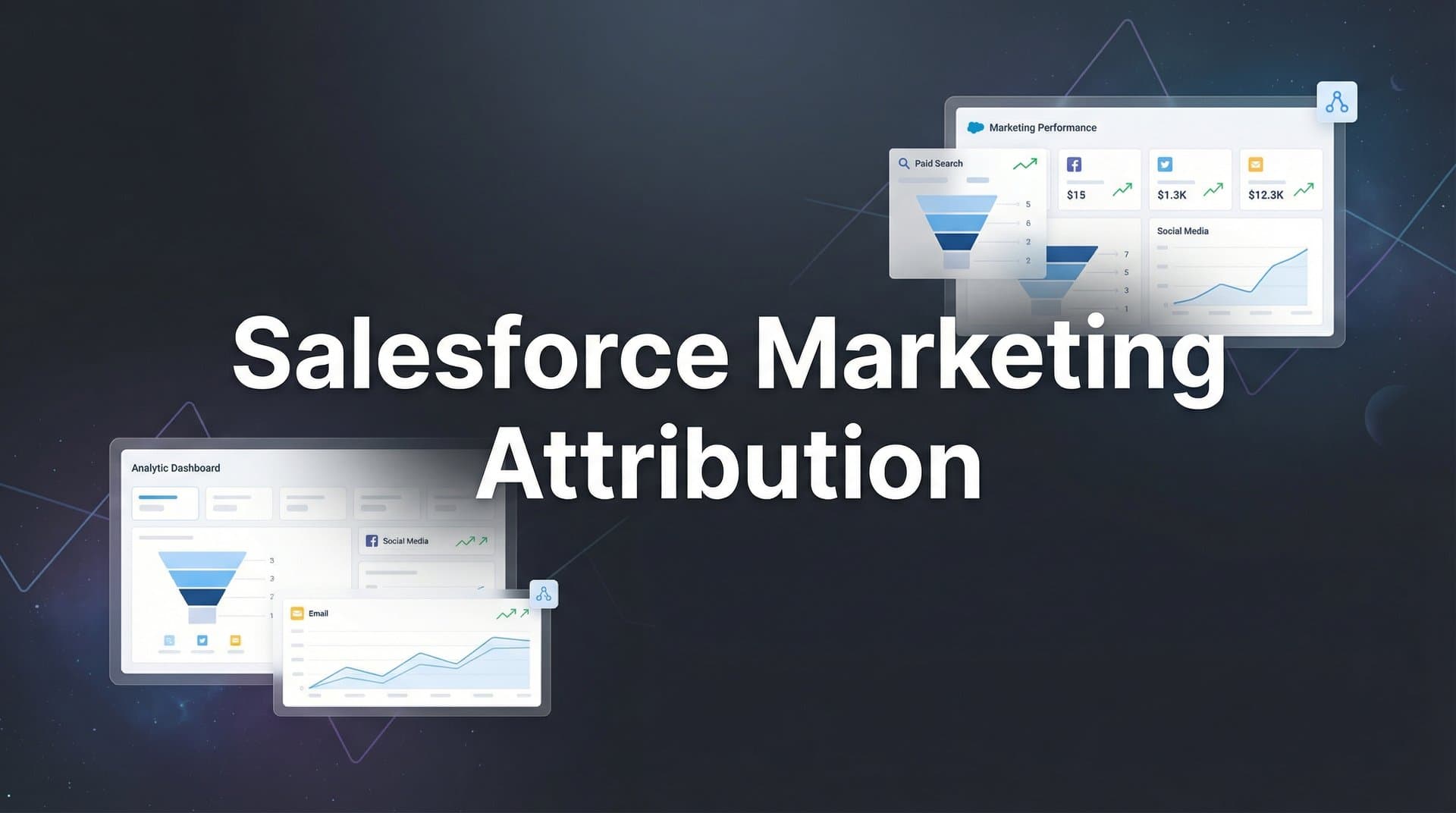
Here's what complete attribution actually looks like: you open your dashboard and see that Meta Campaign "Enterprise - Problem Aware - Carousel" generated 47 leads last month, 12 became opportunities, and 3 closed for $127,000 in revenue. You can see the exact ad creative, the audience targeting, and the cost per acquisition. You know this campaign is profitable, so you increase its budget with confidence.
That's the ideal state—direct visibility from ad-level performance to closed revenue. But getting there requires bridging the gap between your ad platforms and your CRM in ways Salesforce wasn't designed to handle. Implementing channel attribution for revenue tracking creates this critical connection between marketing spend and pipeline outcomes.
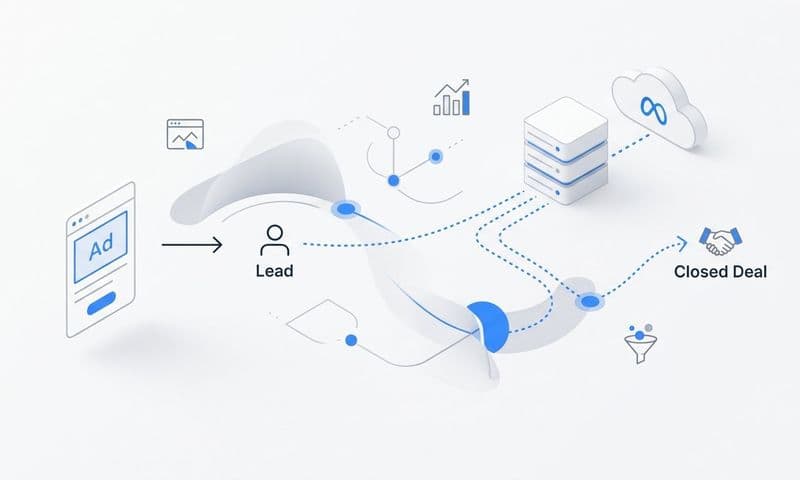
Dedicated attribution platforms solve this by tracking the complete customer journey from first touch to closed deal. They capture every ad click, website visit, and engagement across all your marketing channels. When someone eventually converts and enters Salesforce, that entire journey history connects to their CRM record. You finally see which specific Meta ad, Google keyword, or LinkedIn campaign generated each opportunity.
The technical approach matters here. Server-side tracking captures attribution data reliably, regardless of browser settings or cookie limitations. Direct integrations with ad platforms pull in granular campaign structure data—not just campaign names, but ad sets, individual ads, creative variations, and audience segments. Integration with Salesforce ensures this enriched attribution data flows into your CRM, connecting marketing touchpoints to pipeline and revenue.
But the value goes beyond reporting. When you send accurate conversion data back to your ad platforms, their optimization algorithms get smarter. Meta's algorithm learns which specific audiences and creative variations drive not just leads, but qualified opportunities that close. Google's Smart Bidding optimizes for actual revenue outcomes, not just form submissions. This feedback loop transforms your ad performance over time.
Consider the difference in decision-making. Without complete attribution, you might see that "Paid Social" generated 200 leads and decide to increase your Meta budget. With complete attribution, you see that three specific campaigns drove 90% of your qualified pipeline, while the other campaigns generated junk leads that never converted. You reallocate budget to the winners and pause the losers—a decision that's impossible without ad-level attribution connected to revenue data. Exploring cross-channel attribution and marketing ROI reveals how this unified view transforms budget allocation.
Finding the Right Attribution Solution for Your Salesforce Environment
Not every organization needs the same level of attribution sophistication. The right approach depends on your marketing complexity, sales cycle, and resources. Start by asking yourself a few key questions.
How many marketing channels are you actively running? If you're only running Google Ads with a handful of campaigns, Salesforce's native attribution might suffice. But if you're managing campaigns across Meta, Google, LinkedIn, programmatic display, and other platforms—each with multiple campaigns and ad variations—you need more granular tracking than Salesforce provides. Reviewing the best marketing attribution tools for B2B SaaS companies can help you evaluate options suited to complex tech stacks.
How complex is your sales cycle? For simple, short sales cycles where leads convert quickly, basic lead source tracking might be enough. But for B2B companies with 3-6 month sales cycles and multiple touchpoints before conversion, you need multi-touch attribution that captures the entire journey. A lead might interact with your marketing 15 times before becoming an opportunity—you need to see all 15 touchpoints, not just the first and last. Our B2B marketing attribution guide covers the fundamentals for longer sales cycles.
What Salesforce edition are you using? Einstein Attribution is only available in higher-tier editions. If you're on a standard edition, your native attribution options are limited to basic campaign influence. This might inform your decision about whether to invest in upgrading Salesforce or implementing a dedicated attribution platform.
Do you have resources for manual campaign management? Salesforce's native attribution requires ongoing maintenance—creating campaigns, managing campaign members, ensuring consistent UTM tagging. If you have a marketing operations person who can dedicate significant time to this, native features might work. Most teams don't have this luxury.
Native Salesforce attribution makes sense when you have simpler funnels, fewer channels, and strong internal processes for campaign management. It's a reasonable starting point for teams just beginning to think seriously about attribution. You can implement campaign influence, establish consistent tagging practices, and get directional insights about which channels are working.
A dedicated attribution platform becomes essential when you're running sophisticated multi-channel campaigns, need ad-level granularity for optimization decisions, operate in privacy-restricted environments where browser tracking is unreliable, or want to feed conversion data back to ad platforms to improve their algorithms. The investment pays for itself quickly when you can confidently shift budget from underperforming campaigns to proven winners. Comparing marketing attribution software versus traditional analytics clarifies when specialized tools outperform standard reporting.
Building Your Complete Attribution Picture
Salesforce remains the backbone of your customer relationship management and pipeline tracking—that's not changing. But accurate marketing attribution requires more than Salesforce alone can provide. The gap between what your ad platforms report and what shows up in your CRM isn't just a data reconciliation problem—it's preventing you from making confident decisions about where to invest your marketing budget.
The marketers who win in this environment are those who connect every dot from first ad impression to closed revenue. They see which specific campaigns, ad sets, and creative variations drive not just leads, but qualified pipeline and actual revenue. They optimize based on complete data, not guesswork. And they feed better conversion data back to their ad platforms, creating a virtuous cycle of improving performance.
This isn't about replacing Salesforce—it's about enhancing it with the attribution capabilities modern marketing demands. When you capture every touchpoint and connect it to revenue outcomes, you transform from reactive reporting to proactive optimization. You stop arguing about which platform's numbers are "right" and start making decisions based on a complete, accurate picture of your marketing performance.
Ready to elevate your marketing game with precision and confidence? Discover how Cometly's AI-driven recommendations can transform your ad strategy—Get your free demo today and start capturing every touchpoint to maximize your conversions.