Your marketing campaigns are working. Ad spend is increasing. New channels are launching. But your analytics setup that worked at $10K monthly spend is now buckling under $100K. Data lives in disconnected spreadsheets, attribution gaps are widening, and your team spends more time pulling reports than acting on insights.
This is the scalability wall that every growing marketing team hits.
The good news: building scalable marketing analytics is not about buying more tools or hiring more analysts. It is about creating a foundation that grows with your business, connecting the right data sources, and implementing systems that deliver insights automatically.
In this guide, you will learn how to transform fragmented marketing data into a unified analytics system that scales from startup to enterprise. Whether you are managing campaigns across two platforms or twenty, these six steps will help you build an analytics infrastructure that supports confident, data-driven decisions at any scale.
Step 1: Audit Your Current Analytics Infrastructure
Before you can build something better, you need to understand exactly what you are working with right now. Think of this as taking inventory before a major renovation. You cannot fix what you cannot see.
Start by mapping every data source currently feeding your marketing decisions. This means documenting every ad platform you are running campaigns on—Meta, Google Ads, LinkedIn, TikTok, Twitter, Pinterest, whatever you are using. Then add your website analytics tools, your CRM, email marketing platforms, landing page builders, and any third-party tools tracking customer behavior.
Most marketing teams discover they have more data sources than they realized. The problem is not too little data. It is too much data living in too many places, which is why understanding marketing analytics data gaps becomes essential for growth.
Next, identify the gaps. Where are customer touchpoints happening that you are not capturing? Maybe someone clicks a Meta ad, visits your site, leaves, comes back through Google search, signs up for your email list, clicks a link in that email, and then finally converts. How many of those touchpoints are you actually tracking? How many are you connecting together into a single customer journey?
These gaps widen as you scale. What seems like a minor tracking issue at low volume becomes a massive blind spot when you are spending six figures monthly.
Now document every manual process in your current workflow. Which reports require someone to log into multiple platforms, export CSVs, and combine data in spreadsheets? Which metrics need to be calculated manually because your tools do not talk to each other? How long does it take to answer a simple question like "What is our actual cost per acquisition across all channels?"
These manual processes are time bombs. They work when you have one person managing two channels. They break completely when you have a team managing ten channels with multiple campaigns each.
Assess your current reporting lag time. How old is the data you are making decisions on? If you are looking at yesterday's performance to make today's budget decisions, you are already behind. Real-time data becomes critical as spend increases because small inefficiencies compound quickly at scale.
Finally, create a simple scalability score for your existing setup. Rate each component on whether it can handle 10x your current volume without breaking. Your website tracking might scale fine, but your manual reporting process definitely will not.
This audit is not about feeling bad about your current setup. It is about creating a clear baseline so you can measure improvement and prioritize where to focus your efforts first.
Step 2: Define Your Core Metrics and Attribution Model
Here is where most teams go wrong: they track everything and understand nothing. Scalable analytics starts with ruthless clarity about what actually matters.
Establish your primary KPIs based on business revenue goals, not vanity metrics. Impressions and clicks are interesting, but they do not pay the bills. Focus on metrics that connect directly to revenue: cost per acquisition, customer lifetime value, return on ad spend, conversion rate, and revenue attributed to marketing.
The key word is "primary." You can track dozens of metrics, but only three to five should drive major decisions. Everything else is supporting context.
Now comes the critical decision: choosing your attribution model. This determines how you assign credit for conversions across multiple touchpoints. First-touch attribution gives all credit to the initial interaction. Last-touch gives it all to the final click before conversion. Multi-touch distributes credit across the entire journey. Understanding these common attribution challenges in marketing analytics helps you make the right choice for your business.
There is no universally correct answer, but there is a correct answer for your business. If you have a short sales cycle where people see one ad and buy, last-touch might work fine. If you have a complex B2B journey with multiple touchpoints over weeks or months, multi-touch attribution reflects reality much better.
Most growing teams find that their attribution model needs to evolve as their marketing sophistication increases. You might start with last-touch because it is simple, then move to multi-touch as you add more channels and realize you are under-crediting top-of-funnel efforts.
Set up standardized naming conventions right now, before they become a mess. Create clear rules for how campaigns, ad sets, and ads are named across all platforms. Include key information like channel, campaign type, audience, and offer in a consistent format.
Poor naming conventions seem like a small issue until you are trying to analyze performance across hundreds of campaigns and cannot tell which is which. Standardization is not exciting, but it is essential for scale.
Create a metrics hierarchy from tactical to strategic. Daily tactical metrics might include cost per click and click-through rate. Weekly strategic metrics focus on cost per lead and conversion rate. Monthly executive metrics look at customer acquisition cost and return on ad spend. Different stakeholders need different views of the same data.
Verify success by getting all stakeholders to agree on definitions. When the CEO asks about customer acquisition cost, the marketing manager should calculate it exactly the same way the finance team does. Misaligned definitions create confusion and erode trust in your analytics.
This step feels bureaucratic, but it is the foundation everything else builds on. Clear metrics and attribution models turn raw data into actionable insights.
Step 3: Connect Your Data Sources to a Central Hub
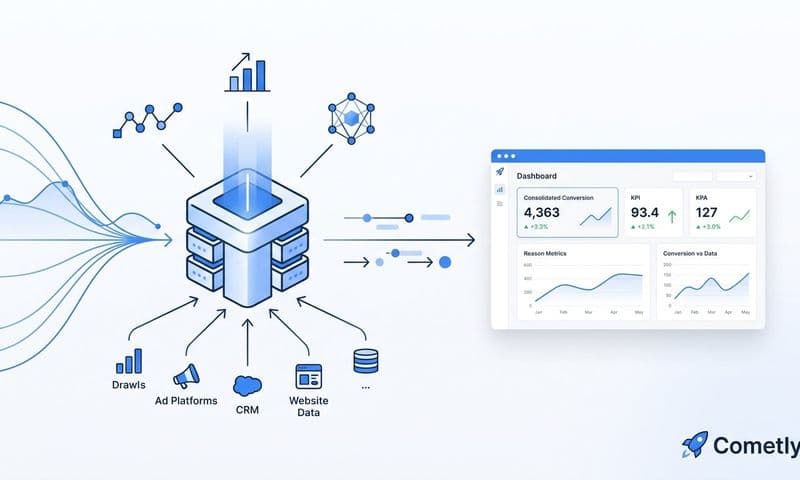
This is where scalable analytics shifts from theory to infrastructure. You need a single source of truth where all your marketing data lives together, talks to each other, and updates in real time.
Start by integrating your ad platforms into a central tracking system. Meta, Google Ads, LinkedIn, TikTok, Twitter, Pinterest—every platform where you spend money needs to feed into the same place. This is not about replacing these platforms. It is about creating a unified view above them.
The traditional approach is exporting data from each platform and combining it manually. This breaks immediately at scale. You need direct API integrations that pull data automatically and update continuously. A robust marketing data analytics platform handles these integrations seamlessly.
Next, connect your CRM data. This is the crucial link that ties marketing touchpoints to actual revenue outcomes. Someone clicking your ad is interesting. Someone clicking your ad, becoming a lead, and closing as a $50,000 customer is what actually matters.
Without CRM integration, you are optimizing for leads without knowing which leads convert to revenue. This works okay at small scale where most leads are similar quality. It fails completely at larger scale where lead quality varies dramatically across channels and campaigns.
Implement server-side tracking to capture data that browser-based tracking misses. iOS privacy changes, ad blockers, and cookie restrictions have made browser-only tracking increasingly unreliable. Server-side tracking captures events directly from your server, bypassing these limitations.
Think of it like this: browser-based tracking is asking customers to tell you what they did. Server-side tracking is watching what actually happened on your server. The second method is far more accurate, especially as privacy restrictions tighten.
Set up real-time data syncing rather than batch imports. Batch imports mean you are always looking at old data. Real-time syncing means you see what is happening now and can respond immediately. When a campaign suddenly starts burning budget without conversions, you want to know in minutes, not tomorrow morning.
Test your data accuracy by comparing source reports to your centralized data. Pull a report from Google Ads directly and compare it to what your central hub shows for Google Ads. The numbers should match. Discrepancies indicate integration issues that need fixing before you trust the data for decisions.
We cover this in more depth in our guide to ad platform data accuracy issues.
This step requires technical implementation, but the payoff is enormous. Instead of logging into six platforms to understand performance, you have one dashboard showing everything. Instead of wondering if your data is accurate, you have verified integrations you can trust.
Platforms like Cometly are built specifically for this challenge, connecting ad platforms, CRM, and website tracking into a unified system with server-side tracking and real-time syncing built in.
Step 4: Implement Cross-Channel Journey Tracking
Here is the reality of modern customer journeys: nobody sees one ad and buys anymore. They see your Meta ad on mobile, visit your site on desktop later, get retargeted on Google, click an email, and finally convert. If you are only tracking individual touchpoints without connecting them, you are missing the story.
Configure your tracking to follow users across devices and sessions. This means implementing cross-device tracking that recognizes when the person who clicked your ad on their phone is the same person who converted on their laptop three days later.
Without cross-device tracking, these look like two different people. Your attribution breaks, your conversion rates look worse than reality, and you under-invest in top-of-funnel campaigns that are actually working. Learning how to leverage analytics for marketing strategy helps you avoid these costly mistakes.
Map the full customer journey from first ad click to closed deal. This requires connecting your ad platform data, website analytics, email engagement, and CRM outcomes into a single timeline. When someone converts, you should be able to see every touchpoint that led to that moment.
This visibility transforms how you optimize campaigns. Instead of guessing which channels work together, you see exactly how awareness campaigns on Meta feed consideration on Google, which drives conversions through email follow-up.
Set up event tracking for key conversion points beyond just purchases. Track newsletter signups, demo requests, free trial starts, feature usage, and other meaningful actions. These micro-conversions help you understand what is working even before someone becomes a paying customer.
For B2B companies especially, the gap between first touch and revenue can be weeks or months. Event tracking fills that gap with meaningful signals about campaign performance.
Create customer journey segments based on behavior patterns. Group customers by how they found you, how many touchpoints they needed, how long their journey took, and which channels they engaged with. These segments reveal patterns you can use to optimize future campaigns.
You might discover that customers who engage with both Meta ads and Google search convert at three times the rate of single-channel customers. That insight changes how you allocate budget across channels.
Validate your tracking by testing sample customer paths end-to-end. Create test conversions and verify that every touchpoint appears correctly in your analytics. Click a test ad, visit your site, fill out a form, and confirm that the full journey shows up accurately in your reporting.
Cross-channel journey tracking is complex to implement but essential for accurate attribution at scale. It is the difference between knowing which ads got clicked and knowing which marketing efforts actually drive revenue.
Step 5: Build Automated Reporting and Alert Systems
If your team is still manually pulling reports every morning, you are wasting the most valuable resource you have: analyst time. Automated reporting is not a luxury. It is a requirement for scalable analytics.
Create dashboards that update automatically without manual data pulls. Your morning performance review should be opening a dashboard that already has fresh data, not logging into five platforms to export CSVs. The right data visualization tools for marketing analytics make this process seamless and intuitive.
Set up performance alerts for anomalies that need immediate attention. Configure alerts for spend spikes where a campaign suddenly burns through budget faster than normal. Set alerts for conversion drops where your cost per acquisition jumps above acceptable thresholds. Create ROAS alerts that notify you when return on ad spend falls below your target.
These alerts catch problems in hours instead of days. A campaign with broken tracking or targeting issues can waste thousands of dollars before anyone notices if you are only checking reports once daily. Automated alerts mean you know about issues as they happen.
Configure scheduled reports for different stakeholders with different needs. Your media buyers need daily tactical reports showing campaign performance and budget pacing. Your marketing director needs weekly strategic reports showing channel performance and trend analysis. Your executive team needs monthly reports connecting marketing spend to revenue outcomes.
Same data, different views, all automated. Nobody should be manually creating these reports every week.
Establish data quality monitors to catch tracking issues early. Set up checks that alert you when conversion tracking stops working, when data from a platform stops flowing, or when numbers look suspicious. Addressing marketing analytics data accuracy issues proactively prevents decisions made on bad data.
The goal is reducing manual reporting time by at least 80 percent. If your team currently spends ten hours weekly on reporting, automation should cut that to two hours. Those eight saved hours go toward strategic analysis, testing new campaigns, and optimizing performance.
Automated reporting is not about replacing human analysis. It is about freeing humans from repetitive data collection so they can focus on interpretation and action. The insights matter, not the spreadsheet gymnastics.
Step 6: Feed Better Data Back to Ad Platforms
Here is something most marketers miss: your analytics system should not just collect data. It should improve your advertising performance by sending better data back to the platforms where you spend money.
Set up conversion syncing to send enriched data back to Meta, Google, and other ad platforms. These platforms use conversion data to optimize their algorithms, improving targeting and bidding over time. The better data you send them, the better they perform.
The problem with standard tracking is that it only captures basic conversion events. Someone converted, yes or no. But what if you could tell Meta which conversions came from high-value customers versus low-value ones? What if you could feed Google Ads data about which leads actually closed as sales? Understanding marketing analytics for Google Ads specifically helps you maximize this optimization loop.
That is what conversion syncing does. It sends enriched conversion events that include revenue data, customer lifetime value, and other business outcomes that happened after the initial conversion.
Configure offline conversion tracking for leads that convert via sales calls or in-person interactions. Many B2B companies and high-ticket services close deals through phone calls or meetings, not online checkouts. Without offline conversion tracking, your ad platforms never learn which leads actually generated revenue.
This creates a dangerous optimization gap. The platforms optimize for form fills because that is all they can see, even though only a fraction of those form fills become customers. Offline conversion tracking closes this gap by feeding back which leads converted to sales.
Use server-side events to improve ad platform optimization algorithms. Server-side tracking captures more accurate conversion data than browser-based tracking, especially given iOS privacy restrictions. Sending this higher-quality data back to ad platforms helps their algorithms make better decisions about who to target and how much to bid.
Test the impact by comparing campaign performance before and after implementing conversion syncing. Many marketing teams see immediate improvements in cost per acquisition and return on ad spend once ad platforms start receiving better conversion data. The algorithms can finally optimize for what actually matters.
Create a feedback loop where better data drives better ad performance, which generates more conversions, which provides more data to improve performance further. This compounding effect is how sophisticated marketing teams scale efficiently while maintaining or improving performance metrics.
Platforms like Cometly include conversion syncing as a core feature, automatically sending enriched conversion data back to ad platforms to improve targeting and optimization without manual setup.
Putting It All Together
Building scalable marketing analytics is not a one-time project but an ongoing system that evolves with your business. By auditing your current setup, defining clear metrics, centralizing your data, tracking cross-channel journeys, automating reports, and feeding better data back to ad platforms, you create an analytics foundation that supports growth rather than limiting it.
Here is your quick implementation checklist:
Complete infrastructure audit and identify gaps. Map every data source, document manual processes, and assess where your current setup will break as volume increases.
Align team on core metrics and attribution model. Get stakeholders to agree on what success looks like and how you will measure it across the entire customer journey.
Connect all data sources to a central platform. Integrate ad platforms, CRM, and website tracking into a unified system with real-time syncing.
Implement server-side and cross-channel tracking. Capture accurate data across devices and sessions to understand the full customer journey.
Set up automated dashboards and alerts. Eliminate manual reporting and catch performance issues immediately instead of days later.
Configure conversion syncing for ad platforms. Send enriched conversion data back to improve targeting and optimization algorithms.
Start with step one today. Even a simple audit of your current data sources will reveal opportunities to improve accuracy and reduce manual work. The marketing teams that scale successfully are the ones that invest in their analytics infrastructure before they hit the wall.
The difference between struggling at scale and thriving at scale often comes down to data infrastructure. Disconnected tools and manual processes create friction that slows everything down. Unified analytics systems create clarity that speeds everything up.
Your campaigns will continue growing. Your channels will keep expanding. Your team will get larger. The question is whether your analytics infrastructure will support that growth or become the bottleneck that limits it.
Ready to elevate your marketing game with precision and confidence? Discover how Cometly's AI-driven recommendations can transform your ad strategy. Get your free demo today and start capturing every touchpoint to maximize your conversions.