Most marketers focus on the last click before a conversion and call it a day. But that approach ignores every touchpoint that helped warm up the buyer along the way. The blog post that caught their attention, the retargeting ad that kept your brand top of mind, the email that nudged them back to your site.
These are assisted conversions, and they represent the hidden engine behind your revenue.
When you fail to track assisted conversions accurately, you end up cutting the very campaigns that are feeding your pipeline. You over-invest in bottom-of-funnel channels that get credit for closing deals they did not start, and you starve the top-of-funnel efforts that actually drive demand. The result is a slow decline in performance that feels impossible to diagnose.
Sound familiar? You pull the budget from a social campaign because it shows low direct conversions. A month later, lead volume drops and you cannot figure out why. The truth is that social ad was doing the heavy lifting at the awareness stage. Last-click attribution just never gave it the recognition it deserved.
This guide walks you through a clear, repeatable process to track assisted conversions accurately across every channel and platform you use. By the end, you will know how to define your conversion events, set up proper multi-touch tracking, choose the right attribution model, validate your data, and use your findings to make smarter budget decisions.
Whether you run ads on Meta, Google, TikTok, or all three at once, these steps will help you see the full customer journey and give credit where it is truly earned. Let's get into it.
Step 1: Define Your Conversion Events and Touchpoint Map
Before you can track assisted conversions accurately, you need to be crystal clear on what a conversion actually means for your business. This sounds obvious, but most teams skip this step and end up with incomplete data from the start.
Start by listing every meaningful conversion event your business cares about. For most marketing teams, this includes a mix of the following:
Primary conversions: Purchases, closed deals, subscription sign-ups. These are the revenue-generating events that everyone tracks.
Micro-conversions: Demo requests, free trial sign-ups, lead form submissions, content downloads, and email opt-ins. These signal intent and often appear earlier in the journey as assisted touchpoints.
Engagement milestones: Pricing page visits, video completions, return visits, and chat interactions. These are softer signals but they matter in longer sales cycles.
Once you have your conversion events listed, assign a priority or value to each one. A closed deal is worth more than a content download, but that download may have been the first step toward the deal. Understanding the relative weight of each event helps you interpret assisted conversion data in context.
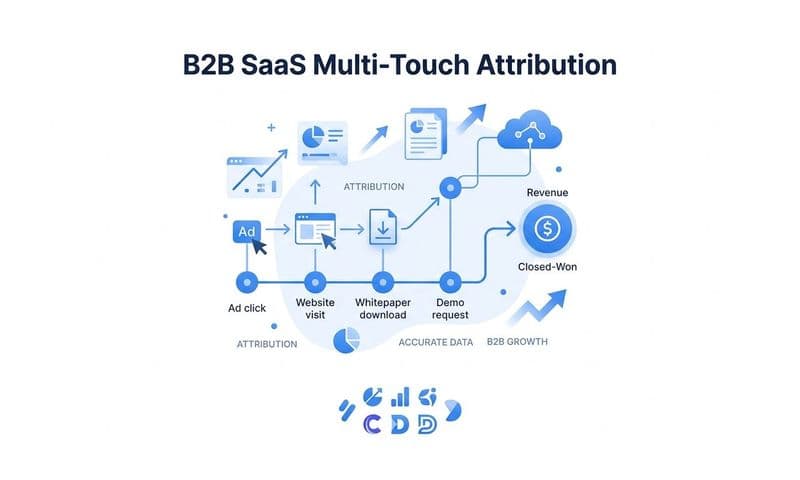
Next, map out every touchpoint a prospect can encounter on their way to converting. Think across all your active channels: paid search, paid social, organic search, email campaigns, direct traffic, referral links, and any offline interactions like events or sales calls. Draw this out as a simple flow if it helps. The goal is to see the full landscape before you start configuring tracking.
One critical detail here is your lookback window. How long does it typically take for a prospect to go from first touch to conversion in your business? A SaaS product with a short trial period might see journeys of seven to fourteen days. An enterprise software sale might span several months. Your attribution platform needs a lookback window that matches your actual sales cycle, or you will miss early touchpoints entirely.
The most common pitfall at this stage is defining conversions too narrowly. If you only track the final purchase, you lose visibility into the micro-conversions that reveal which channels are warming up your audience. Capture those intermediate events and you will have a much richer picture of where assists are happening throughout the funnel. Understanding where most marketing conversions drop off can help you identify which micro-conversions matter most.
Document everything in a simple spreadsheet or shared document. Your conversion event list, their priority levels, all active channels, and your estimated journey length. This becomes your reference point for every configuration decision in the steps that follow.
Step 2: Implement Server-Side Tracking Across All Channels
Here is where a lot of assisted conversion tracking falls apart before it even begins. If you are relying entirely on browser-based pixels and client-side JavaScript to capture your conversion data, you are already working with incomplete information.
Browser-based tracking has become increasingly unreliable for a few compounding reasons. Ad blockers prevent pixels from firing. Safari's Intelligent Tracking Prevention limits cookie lifespans to as little as one day. iOS privacy changes have made it harder to track users across apps and websites. The result is that a meaningful portion of your conversion events simply never get recorded when you rely solely on client-side tracking. Understanding the difference between server-side tracking vs pixel tracking is essential before you configure anything.
Server-side tracking solves this by sending event data directly from your server to your analytics and ad platforms, bypassing the browser entirely. Because the data never touches the user's browser environment, it is not subject to the same blocking and restriction mechanisms. The event fires reliably, regardless of what browser settings or privacy tools the user has in place.
Here is how to set it up in practical terms:
1. Identify your conversion events from Step 1 and determine which ones need server-side instrumentation. Start with your highest-priority events: purchases, lead form submissions, and trial sign-ups.
2. Set up a server-side tagging container or use your attribution platform's server-side infrastructure. This container receives events from your website or app and routes them to the appropriate destinations.
3. Connect your ad platforms to your server-side setup. Meta's Conversions API (CAPI), Google's Enhanced Conversions, and TikTok's Events API all support server-side data ingestion. Configure each one so your conversion events flow directly from your server to each platform.
4. Use deduplication logic to prevent double-counting. When you run both a browser pixel and server-side tracking simultaneously (which is recommended during transition), you need event IDs or transaction IDs to tell the platforms which events are duplicates.
Cometly's server-side tracking is built specifically for this challenge. It captures touchpoints that client-side pixels miss, including events from Safari users and privacy-focused browsers, giving you a complete data foundation for assisted conversion analysis. Rather than patching together multiple tools, you get a unified tracking layer that feeds accurate data to your attribution platform and back to your ad platforms simultaneously.
The success indicator for this step is straightforward: you should see consistent event firing across browser types, including Safari and Firefox. If your event volume increases after implementing server-side tracking, that is a sign you were previously missing data. That recovered data is exactly what you need to accurately credit assisted touchpoints.
Step 3: Connect Your CRM and Revenue Data to Your Attribution Platform
Tracking clicks and page views is only half the picture. To truly understand which channels assist conversions, you need to close the loop between your marketing data and your actual revenue outcomes.
This is where your CRM becomes essential. When a lead comes in, your CRM records it. When that lead eventually becomes a paying customer, your CRM records that too. But without a connection between your CRM and your attribution platform, those downstream revenue events remain invisible to your marketing analysis. You end up making budget decisions based on top-of-funnel activity without knowing which of those activities actually produced revenue. This is especially critical when you are tracking conversions for lead generation where the sales cycle extends well beyond the initial click.
Start by ensuring every lead record in your CRM carries the right identifiers. UTM parameters, click IDs from ad platforms (like Google's GCLID or Meta's FBCLID), and session identifiers should all be captured at the moment of form submission and stored on the lead record. This is the data thread that connects a marketing touchpoint to a downstream conversion months later.
Here is what the connection process typically looks like:
For HubSpot users: Use hidden form fields to capture UTM parameters automatically. Set up your HubSpot integration with your attribution platform to sync lead status updates and deal stage changes as they happen.
For Salesforce users: Map UTM and click ID fields to custom lead and opportunity objects. Configure your attribution platform's Salesforce connector to pull closed-won opportunity data and match it back to the originating touchpoints.
The most common pitfall here is broken data handoffs. A lead enters your CRM without UTM parameters because the form was not configured to capture them. Or the CRM integration syncs contacts but not opportunities. Or deal stage updates happen but the timestamps are off. Any one of these gaps creates holes in your journey data that make assisted conversion analysis unreliable. Following UTM parameter tracking best practices from the start prevents many of these issues.
Cometly connects your ad platforms, website, and CRM into a single customer journey view in real time. When a lead moves through your pipeline and eventually converts to revenue, that event is tied back to every marketing touchpoint that influenced it, including the assists that happened weeks or months earlier. This is what transforms your attribution data from a click-counting exercise into a genuine revenue intelligence tool.
Once this connection is live, you will be able to answer questions like: which campaigns generate leads that actually close? Which channels assist the most high-value deals? That is the level of insight that changes how you allocate budget.
Step 4: Choose the Right Multi-Touch Attribution Model
Now that your tracking infrastructure is in place and your data is flowing, you need to decide how credit gets distributed across the touchpoints in each customer journey. This is your attribution model, and choosing the right one is central to tracking assisted conversions accurately.
Here is a quick breakdown of the main models you will encounter:
Last-touch attribution: All credit goes to the final touchpoint before conversion. Simple, but systematically undervalues every channel that assisted along the way. This is the default in most ad platforms and the reason so many top-of-funnel campaigns get cut unfairly.
First-touch attribution: All credit goes to the first touchpoint. Better for understanding demand generation, but ignores everything that happened in the middle and at the bottom of the funnel.
Linear attribution: Credit is distributed equally across every touchpoint in the journey. Easy to understand and more balanced than single-touch models, though it treats a quick awareness impression the same as a high-intent product page visit.
Time-decay attribution: More credit goes to touchpoints that happened closer to the conversion. This works well for short sales cycles where recency genuinely indicates higher intent.
Position-based (U-shaped) attribution: The first and last touchpoints each receive a larger share of credit, with the remaining credit split among middle touchpoints. This model acknowledges both the channel that introduced the prospect and the one that closed them, while still crediting assists in between.
Data-driven attribution: Uses machine learning to assign credit based on the actual patterns in your conversion data. This is the most accurate model when you have sufficient data volume, because it reflects the real influence each touchpoint has in your specific customer journeys.
For most multi-channel marketers, position-based or data-driven attribution will give you the most actionable view of assisted conversions. Last-click is almost never the right choice if you want to understand the full funnel. The challenge of tracking conversions across multiple touchpoints is precisely why multi-touch models exist.
The natural question becomes: how do you know which model fits your business? Start by comparing models side by side. When you switch from last-click to linear or position-based, watch how credit shifts. Channels that looked weak under last-click often reveal significant assist value under multi-touch models. That shift tells you where your true leverage points are.
Cometly lets you toggle between attribution models to compare how each one distributes credit across your channels. You can see how your campaigns perform under different models simultaneously, so you can identify which one best reflects your actual customer journey and make budget decisions from a place of confidence rather than guesswork.
Step 5: Validate Your Assisted Conversion Data for Accuracy
Setting up tracking is one thing. Trusting it is another. Before you start making budget decisions based on assisted conversion data, you need to validate that the data is actually accurate.
Start with a cross-reference between your attribution platform and your native ad platform reports. Pull conversion totals from Google Ads, Meta Ads Manager, and any other platforms you use, then compare them to what your attribution platform is reporting for the same date range. Some variance is normal because of different attribution windows and counting methods. But large discrepancies signal a problem worth investigating. If you are seeing major gaps, this guide on why your conversion tracking numbers are wrong can help you diagnose the root cause.
Next, check for these common data quality issues:
Duplicate conversions: If both your browser pixel and server-side tracking are firing without proper deduplication, you may be counting the same conversion twice. Check your event logs for duplicate event IDs on the same transaction.
Missing touchpoints: Look for journeys that show only one or two touchpoints when you would expect more. This often indicates a tracking gap on a specific page, a campaign that is not passing click IDs properly, or a channel that is not connected to your attribution platform.
Broken UTM parameters: UTM parameters get stripped by redirects, broken by URL encoding issues, or simply never added to certain campaigns. Audit a sample of your recent traffic sources to confirm UTMs are arriving intact.
Incorrect timestamps: Events recorded with the wrong timestamp will be assigned to the wrong attribution window, misrepresenting which touchpoints were actually part of each journey.
The most reliable validation method is a manual journey audit. Select ten to twenty recent conversions from your CRM and trace each one backward through your attribution platform. Does the platform show the touchpoints you would expect for each customer? Are the timestamps in the right order? Does the first touch match the original acquisition source recorded in your CRM? This exercise will reveal gaps that automated checks miss.
Set a recurring reminder to run this audit at least once per quarter. Tracking setups degrade over time. New landing pages launch without tracking codes. Campaign URL structures change and break UTM parameters. Integrations update and start behaving differently. Regular validation is what keeps your assisted conversion data trustworthy over the long term.
Your success indicator here is alignment: your attributed revenue in your analytics platform should closely match the actual revenue recorded in your CRM or payment processor. When those numbers are in the same ballpark, you can move forward with confidence.
Step 6: Analyze Assist Patterns and Reallocate Budget With Confidence
You have clean data, a solid attribution model, and validated results. Now comes the part that actually changes your marketing performance: using your assisted conversion insights to make smarter budget decisions.
Start by pulling your assisted conversion report and looking for patterns across channels. You are specifically looking for two things: channels that frequently appear early or in the middle of the journey, and channels that rarely receive last-click credit despite showing up repeatedly as assists.
Display advertising and paid social often fall into this category. These channels are excellent at introducing your brand to new prospects and keeping it top of mind during a consideration period. But because they rarely get the last click before conversion, they look underperforming in last-click reports. Your assisted conversion data tells a different story. Knowing how to properly go about tracking paid social conversions is what separates marketers who understand their full funnel from those who do not.
Here is how to read the data practically:
High-assist, low-direct-conversion channels: These are at risk of being cut in the next budget review. But if they consistently appear in the journeys of your highest-value customers, cutting them will shrink your pipeline even if the impact is not immediately visible. Protect these channels and look for ways to optimize them rather than eliminate them.
High-assist, high-direct-conversion channels: These are your workhorses. They contribute at multiple stages and deserve significant investment. Scale them carefully and watch how total conversion volume responds.
Low-assist, low-direct-conversion channels: These are genuine candidates for budget reallocation. If a channel is not helping at any stage of the journey, it is not contributing to your revenue.
Once you have identified where to shift budget, use your conversion data to feed better signals back to your ad platforms. This is where conversion sync becomes a powerful lever. When you send enriched, multi-touch conversion data back to Meta, Google, and TikTok via their respective conversion APIs, those platforms can optimize their algorithms toward the full customer journey rather than just the last click. The result is improved targeting, better audience matching, and higher overall campaign efficiency. Avoiding wasted ad budget on untracked conversions starts with feeding these platforms the complete picture.
Cometly's AI recommendations take this a step further. By analyzing your complete conversion data across every channel, including channels that primarily assist rather than close, the AI surfaces which ads and campaigns are generating the most total value. You get specific, actionable recommendations for where to scale and where to pull back, grounded in the complete picture of your customer journey rather than a narrow slice of it.
This is the compounding benefit of tracking assisted conversions accurately. Each optimization cycle improves your data, which improves your ad platform algorithms, which improves your results, which gives you better data to optimize from next time.
Your Assisted Conversion Tracking Checklist
Tracking assisted conversions accurately is not a one-time setup. It is an ongoing practice that requires clean data, the right attribution model, and regular validation. Use this checklist to confirm you have everything in place:
1. All conversion events and touchpoints are defined and mapped, including micro-conversions and your estimated customer journey length.
2. Server-side tracking is live and capturing data across all channels, including events from Safari and privacy-focused browsers.
3. Your CRM is connected and passing revenue data back to your attribution platform, with UTM parameters and click IDs stored on every lead record.
4. You are using a multi-touch attribution model, not just last-click, and you have compared models side by side to find the one that best reflects your actual customer journey.
5. You have validated your data against native platform reports and CRM records, and you have a recurring audit schedule to maintain accuracy over time.
6. You are actively using assisted conversion insights to inform budget decisions and feeding enriched conversion data back to your ad platforms.
When every touchpoint is captured and credited properly, you stop guessing and start scaling the campaigns that actually drive revenue. The channels that were being overlooked become visible. The budget decisions that used to feel like gut calls become grounded in real data.
Cometly brings all of this together in one platform, connecting your ads, website, and CRM so you can see the complete customer journey and make data-driven decisions with confidence. Ready to stop leaving assisted conversions invisible? Get your free demo today and start capturing every touchpoint to maximize your conversions.