You're staring at five browser tabs. Google Ads says your campaign drove 200 conversions. Meta claims 180. TikTok insists it delivered 150. Your CRM shows 120 closed deals. And somehow, when you add up what each platform claims, you've apparently generated 630 conversions from 120 actual customers.
Sound familiar?
This isn't just frustrating—it's expensive. Every day you spend reconciling conflicting reports is a day you're not optimizing campaigns. Every budget decision based on incomplete data is a gamble. And every time you choose one platform's truth over another's, you're flying blind.
Welcome to the fragmented analytics nightmare that's costing marketers millions in wasted spend and missed opportunities.
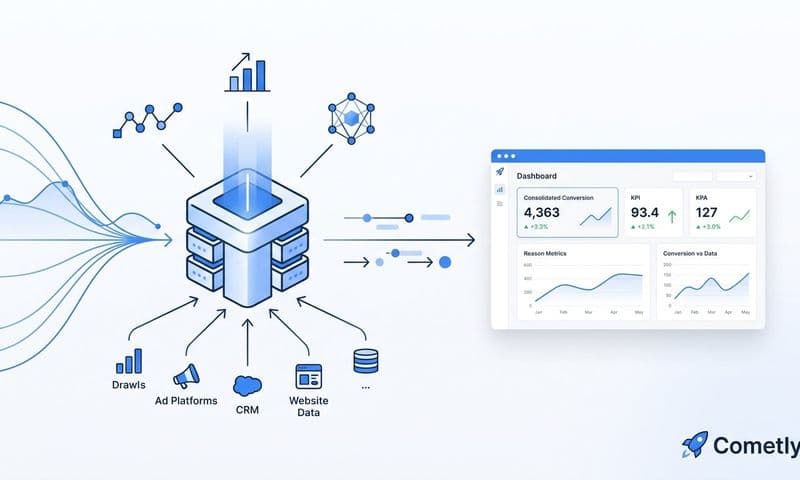
Unified marketing analytics solves this by connecting every piece of your marketing data—ad platforms, CRM, website tracking, conversion events—into a single, coherent view. Instead of jumping between dashboards trying to piece together what's actually working, you see the complete customer journey from first click to closed deal. You understand which channels truly drive revenue, not just which ones claim credit loudest.
As marketing channels multiply and customer journeys grow more complex, unified analytics has shifted from nice-to-have to essential. Privacy changes have made browser-based tracking unreliable. Ad platforms increasingly depend on accurate conversion data to optimize effectively. And marketing teams need faster, more confident decisions to stay competitive.
This guide breaks down everything you need to know about unified marketing analytics—what it is, how it works, and how to implement it to transform scattered data into clear, actionable insights that drive real business results.
Why Fragmented Data Is Costing You More Than You Think
The cost of siloed analytics isn't just the hours your team spends in spreadsheets. It's the compounding effect of decisions made on incomplete information.
When your ad data lives in Google Ads, your social performance sits in Meta Business Manager, your CRM tracks deals separately, and your website analytics exist in yet another platform, you're not just missing the big picture. You're making critical budget decisions based on fragments of truth.
The Wasted Spend Problem: Without unified visibility, you're likely over-investing in channels that look good in isolation but don't actually drive revenue. A channel might show excellent click-through rates and low cost-per-click, but if those clicks never convert to customers, you're burning budget. Fragmented data hides this reality until it's too late.
The Attribution War: Here's where it gets messy. Every platform uses its own attribution model, and most default to last-click. When a customer sees your Facebook ad, clicks a Google search ad, then converts via direct traffic, all three platforms claim the conversion. Multiply this across dozens of campaigns and thousands of customers, and your attribution reports become fiction. Understanding these common attribution challenges in marketing analytics is the first step toward solving them.
This isn't just an accounting problem. When you believe Facebook drove 200 conversions but it actually contributed to 80, you'll over-allocate budget there and starve channels that are genuinely performing. The opportunity cost is massive.
The Algorithm Impact: There's a hidden cost that most marketers miss entirely. Ad platforms like Meta and Google use conversion data to optimize their algorithms—to learn which audiences to target, which creative to show, and when to bid aggressively. When your conversion tracking is fragmented or inaccurate, you're feeding these algorithms incomplete information.
The result? Your campaigns optimize toward the wrong signals. You might be optimizing for clicks that never convert, or missing high-value customer segments entirely because the platform's AI doesn't see the full picture. This compounds over time as the algorithm drifts further from reality.
The Decision Delay Tax: When every marketing question requires pulling data from multiple sources, reconciling conflicts, and building custom reports, you slow down dramatically. By the time you've figured out what worked last month, market conditions have shifted. Your competitors with unified analytics are already three optimization cycles ahead.
The real cost of fragmented data isn't just the money you waste. It's the revenue you never capture because you're too slow to identify what's working and scale it with confidence.
The Core Components of a Unified Analytics System
Building unified marketing analytics isn't about adding another dashboard. It's about creating infrastructure that captures, connects, and makes sense of data across your entire marketing ecosystem.
Think of it like building a nervous system for your marketing operations. Every touchpoint—ad clicks, website visits, form submissions, CRM updates—needs to connect to a central intelligence that understands how they relate to each other and to revenue.
Cross-Platform Data Integration: The foundation is connecting your ad platforms, CRM, website analytics, and conversion events in real time. This means more than just importing data—it requires active integrations that capture events as they happen and maintain context about where each interaction came from.
Your unified system needs direct connections to platforms like Meta, Google Ads, TikTok, and LinkedIn to pull campaign data, ad spend, and platform-reported conversions. Simultaneously, it must integrate with your CRM (HubSpot, Salesforce, or similar) to understand which leads actually closed and their revenue value. Website tracking captures the in-between moments—the pages visited, content consumed, and actions taken before conversion. A multi-channel marketing analytics dashboard brings all these data sources together in one unified view.
The key is maintaining identity resolution across these touchpoints. When someone clicks your Facebook ad, visits your site three times, fills out a form, and eventually becomes a customer, your system needs to recognize this is one person's journey, not five disconnected events.
Multi-Touch Attribution Models: Once you're capturing the complete journey, you need attribution logic that assigns credit appropriately across touchpoints. Unlike platform-specific attribution that only sees its own contribution, multi-touch models evaluate the entire path.
A robust unified analytics system lets you compare different attribution models—first-touch, last-touch, linear, time-decay, position-based, and data-driven—within the same view. This flexibility matters because different questions require different lenses. Understanding which channels initiate customer relationships is different from understanding which close deals. Exploring marketing attribution analytics helps you select the right approach for your business.
The goal isn't finding the "perfect" attribution model. It's having the flexibility to analyze your data from multiple angles and make informed decisions based on complete information rather than a single platform's perspective.
Server-Side Tracking Infrastructure: Browser-based tracking is increasingly unreliable. iOS privacy changes, browser cookie restrictions, and ad blockers mean you're missing significant portions of your customer journey when you rely solely on pixel-based tracking.
Server-side tracking solves this by capturing conversion events directly from your server to ad platforms and your analytics system. When someone converts on your site, your server sends that event data directly—no browser pixel required. This dramatically improves data accuracy and completeness.
Beyond accuracy, server-side tracking enables you to send enriched conversion data. Instead of just "someone converted," you can include customer lifetime value, product purchased, subscription tier, or other business context that helps ad platforms optimize more effectively.
Real-Time Data Synchronization: Unified analytics only works if your data stays current. Batch imports that update once daily leave you making decisions on stale information. The benefits of real-time marketing analytics include faster optimization cycles and more responsive campaign management. Real-time synchronization means when a conversion happens, it flows immediately to your analytics system and back to relevant ad platforms.
This creates a feedback loop where ad platforms receive accurate conversion data quickly, allowing their algorithms to optimize faster and more effectively. The faster this loop operates, the better your campaigns perform.
From Raw Data to Revenue Insights: How Unified Analytics Works
Understanding the mechanics of unified analytics helps you evaluate solutions and implement them effectively. The magic isn't in collecting data—it's in how that data gets connected, analyzed, and transformed into decisions.
Let's walk through the complete data flow from touchpoint to insight.
Capture and Identity Resolution: The process starts when someone interacts with your marketing. They might click a Facebook ad, which triggers your tracking to capture that touchpoint along with campaign details, ad creative, and audience targeting. Your system assigns this person a unique identifier.
When that same person visits your website, your tracking recognizes them (through cookies, server-side identification, or other methods) and connects this visit to the previous ad click. As they browse, every page view and interaction gets logged as part of their journey.
If they return days later via a Google search ad, the system recognizes this is the same person and adds this touchpoint to their journey. When they finally convert by filling out a form or making a purchase, that conversion gets attributed back across all the touchpoints that led to it.
The critical piece is identity resolution—the ability to recognize the same person across devices, sessions, and channels. Without this, you're just collecting disconnected events, not understanding journeys.
Attribution Calculation and Model Comparison: Once the system has captured a complete journey, attribution models assign credit to each touchpoint. This is where unified analytics shows its power—you can analyze the same conversion across multiple attribution models simultaneously.
First-touch attribution might credit the Facebook ad that started the journey. Last-touch gives credit to the Google search ad that preceded conversion. Linear attribution splits credit equally across all touchpoints. Time-decay weights recent interactions more heavily. Data-driven attribution uses machine learning to assign credit based on which touchpoints statistically correlate with conversion.
By comparing these models side-by-side, you develop nuanced understanding. Maybe Facebook excels at initiating customer relationships but rarely closes deals. Google search captures high-intent users ready to convert. Email nurtures consideration over time. Each channel plays a role, and multi-model attribution reveals what that role actually is.
This insight transforms budget allocation. Instead of asking "which channel is best," you ask "which channels work together to drive conversions, and how should I invest in each stage of the journey?"
Conversion Data Enrichment and Sync: Here's where unified analytics creates a competitive advantage beyond reporting. Once your system knows which ad led to which conversion and what that customer is worth, it can feed this enriched data back to ad platforms.
Through conversion APIs, your unified system sends detailed conversion events to Meta, Google, TikTok, and other platforms. Instead of just "conversion happened," you're sending "high-value customer converted, $5,000 lifetime value, purchased enterprise tier." This enriched data dramatically improves ad platform optimization.
Meta's algorithm learns to target users similar to your high-value converters, not just anyone who converts. Google's Smart Bidding adjusts bids based on predicted customer value, not just conversion likelihood. Your campaigns get smarter because they're learning from complete, accurate data rather than fragmented signals. This is how data analytics in marketing transforms from passive reporting to active performance improvement.
This feedback loop is continuous. As more conversions flow through your unified system, ad platforms receive progressively better training data, improving performance over time. It's compound interest for your marketing effectiveness.
Revenue Attribution and ROI Analysis: The final step connects marketing activity to actual business outcomes. By integrating CRM data, your unified analytics system knows which leads closed, their deal size, and how long the sales cycle took.
This transforms analysis from "this campaign generated 50 leads" to "this campaign generated $150,000 in closed revenue with a 3.2x ROAS." You can calculate true customer acquisition cost, lifetime value by channel, and payback periods that account for the complete customer journey. The right marketing analytics software with revenue tracking makes this level of analysis accessible without complex manual calculations.
For B2B marketers with long sales cycles, this is game-changing. You can finally connect top-of-funnel activity to bottom-line revenue, even when months separate initial touchpoint from closed deal.
Practical Applications for Marketing Teams and Agencies
Theory is interesting. Results are what matter. Here's how unified marketing analytics translates into tangible improvements for teams and agencies managing real campaigns.
Budget Allocation Based on Revenue Impact: The most immediate application is shifting spend from channels that look good to channels that actually drive revenue. With unified analytics, you're no longer guessing or relying on platform-reported metrics that inflate their own importance.
You might discover that LinkedIn generates fewer leads than Facebook, but those leads convert at 3x the rate and have 2x higher customer lifetime value. Unified analytics reveals this by connecting ad spend to closed revenue, not just form fills. Armed with this insight, you confidently shift budget to LinkedIn despite its higher cost-per-lead.
Or you might find that your awareness campaigns on TikTok don't directly drive conversions, but customers who saw those ads convert at significantly higher rates when they later encounter your search or remarketing campaigns. Multi-touch attribution reveals TikTok's role in the journey, preventing you from cutting a channel that's actually contributing to revenue.
These decisions compound. Every dollar moved from low-performing to high-performing channels increases overall ROAS. Over months, this optimization creates substantial competitive advantage.
Campaign Optimization with Confidence: When you know which specific ads, audiences, and campaigns drive actual revenue, you can scale with confidence rather than hope. Unified analytics shows you which creative resonates with high-value customers, which audience segments convert best, and which campaign structures deliver the strongest ROI.
Instead of optimizing for clicks or even conversions, you optimize for revenue. This shifts everything. You might discover that your highest-converting ad actually attracts low-value customers, while a different creative drives fewer conversions but much higher customer lifetime value. Without unified analytics, you'd scale the wrong ad. Learning how to leverage analytics for marketing strategy ensures you're making decisions based on business outcomes, not vanity metrics.
This precision extends to audience testing, landing page optimization, and offer development. Every test gets evaluated against real business outcomes, not proxy metrics. Your learning accelerates because you're measuring what actually matters.
Agency Reporting That Builds Trust: For agencies, unified analytics solves the reporting nightmare. Instead of compiling data from five platforms into a deck that still leaves clients confused about what's actually working, you deliver a single source of truth.
Clients see their complete marketing performance in one view—how much they spent across all channels, how many leads and customers each channel generated, and the actual revenue impact. When attribution conflicts arise, you have the data to explain why Meta's dashboard shows different numbers than your unified view. Understanding marketing analytics and reporting best practices helps agencies communicate insights more effectively.
This transparency builds trust. Clients understand that you're optimizing for their business outcomes, not just making platforms happy with their own metrics. When you recommend shifting budget or testing new channels, you're backing it up with complete, unified data rather than platform-specific reporting that might be self-serving.
The efficiency gains are substantial too. Instead of spending hours each week pulling reports from multiple platforms and reconciling discrepancies, your team accesses real-time unified dashboards. That time gets redirected to strategy and optimization—the work that actually improves client results.
Faster Decision Cycles: Perhaps the most underrated benefit is speed. When you can answer "what's working?" in minutes instead of days, you operate at a different tempo than competitors still stuck in manual reporting.
You spot winning campaigns early and scale them while they're hot. You identify underperformers quickly and cut them before wasting significant budget. You test more frequently because each test's results are immediately clear. This velocity compounds into a massive advantage over time.
Building Your Unified Analytics Stack: Key Considerations
Implementing unified marketing analytics isn't plug-and-play. The right approach depends on your tech stack, team capabilities, and business priorities. Here's how to think through the key decisions.
Essential Integrations to Prioritize: Start with the connections that will deliver the most immediate value. For most teams, this means your primary ad platforms (likely Meta and Google Ads), your CRM, and your website tracking.
These three create the core data flow: ad platforms show where you're spending and what you're buying, website tracking captures the middle of the journey, and CRM data reveals which marketing efforts actually drive revenue. Get these three connected first, and you'll already have dramatically better visibility than fragmented analytics.
Secondary integrations—platforms like TikTok, LinkedIn, email marketing tools, and analytics platforms—can be added progressively. Don't let perfect be the enemy of good. It's better to have three platforms unified and working well than eight platforms loosely connected with data quality issues.
Evaluating Attribution Accuracy: Not all unified analytics solutions are created equal. The key differentiator is how accurately they capture and attribute conversions across the complete customer journey. When choosing a marketing analytics platform, prioritize solutions with robust tracking capabilities over flashy features.
Look for solutions with robust server-side tracking capabilities. Browser-based tracking alone will miss significant portions of your traffic due to iOS privacy changes and cookie restrictions. Server-side tracking ensures you're capturing conversions accurately regardless of browser limitations.
Evaluate how the solution handles identity resolution across devices and sessions. Can it recognize when the same person clicks an ad on mobile, researches on desktop, and converts on tablet? Solutions that can't maintain identity across these touchpoints will fragment your data just like disconnected platforms.
Ask about attribution model flexibility. You want the ability to compare multiple attribution models, not get locked into a single approach. Different business models and sales cycles require different attribution lenses. Make sure the solution supports the models relevant to your business.
Implementation Priorities and Sequencing: The most successful unified analytics implementations follow a phased approach. Trying to connect everything simultaneously creates complexity that delays time-to-value.
Phase one should focus on data capture and validation. Ensure your tracking is accurately capturing conversions across your primary platforms. Verify that attribution numbers make sense when compared to platform-reported data. This foundation is critical—if your data capture is flawed, everything built on top will be unreliable.
Phase two adds attribution analysis and reporting. Once you trust your data, start using multi-touch attribution models to understand channel performance. Build dashboards that answer your most important questions: which channels drive revenue, what's your true ROAS by channel, where should you allocate budget?
Phase three implements the feedback loop—sending enriched conversion data back to ad platforms to improve their optimization. This is where unified analytics shifts from better reporting to better performance. Your campaigns start learning from complete, accurate data, and results improve accordingly.
Team Alignment and Training: Technology alone doesn't create unified analytics. Your team needs to shift from platform-specific thinking to journey-based analysis. This requires training on how to interpret multi-touch attribution, how to make decisions based on unified data, and how to communicate insights to stakeholders.
Set clear expectations about how attribution will be measured and which metrics matter most. When you shift from last-click to multi-touch attribution, channel performance will look different. Prepare your team for this shift and ensure everyone understands why the new approach is more accurate. Understanding marketing attribution software vs traditional analytics helps teams appreciate the value of this transition.
Create processes around your unified analytics. Who reviews the data daily? What triggers budget reallocation decisions? How often do you analyze attribution model comparisons? Structure ensures your unified analytics becomes a decision-making engine, not just another dashboard that occasionally gets checked.
Your Path to Data-Driven Marketing
The transformation from fragmented analytics to unified visibility isn't just about better reporting. It's about fundamentally changing how you make marketing decisions.
With unified marketing analytics, you shift from reactive reporting—explaining what happened last month—to proactive optimization. You identify winning campaigns while they're still running and scale them immediately. You spot underperformers early and reallocate budget before waste compounds. You test with confidence because you're measuring real business outcomes, not proxy metrics.
The competitive advantage is substantial. While competitors still debate which platform's numbers to trust, you're already three optimization cycles ahead. While they're manually reconciling reports, you're testing new audiences and creative. While they're guessing at attribution, you're making data-driven decisions backed by complete customer journey visibility.
Key Indicators Your Unified Analytics Is Working: You'll know you've successfully implemented unified analytics when decision speed increases dramatically. Questions that used to take days to answer—what's our ROAS by channel, which campaigns drive the highest-value customers, where should we allocate next month's budget—now take minutes.
Attribution clarity improves. Instead of conflicting reports where every platform claims credit, you have a single source of truth that explains each channel's role in the customer journey. Budget allocation becomes strategic rather than political. Decisions get made based on data, not which platform advocate argues most persuasively.
Most importantly, results improve. When you feed ad platforms better conversion data, their algorithms optimize more effectively. When you allocate budget based on revenue impact rather than vanity metrics, ROAS increases. When you identify winning campaigns faster, you capture more value before market conditions shift.
The marketers and agencies winning in today's complex, multi-channel environment aren't the ones with the biggest budgets. They're the ones with the clearest visibility into what's actually working. Unified marketing analytics delivers that clarity.
Moving Forward with Confidence
The shift from platform-specific dashboards to unified marketing analytics represents more than a technology upgrade. It's a fundamental change in how you understand and optimize your marketing performance.
Instead of accepting that every platform tells a different story, you create a single source of truth that connects every touchpoint to revenue. Instead of making budget decisions based on incomplete information, you allocate spend with confidence backed by complete customer journey data. Instead of wondering which channels really drive results, you know—and you can prove it.
The complexity of modern marketing isn't going away. Customer journeys will continue spanning more channels and touchpoints. Privacy changes will keep making traditional tracking less reliable. Ad platforms will increasingly depend on accurate conversion data to optimize effectively. The question isn't whether you need unified marketing analytics—it's how quickly you can implement it to stay competitive.
Cometly delivers unified marketing analytics by connecting your ad platforms, CRM, and website data into a single source of truth. With AI-powered insights, server-side tracking, and real-time attribution across every touchpoint, you'll finally see which marketing efforts actually drive revenue—and scale them with confidence.
Ready to elevate your marketing game with precision and confidence? Discover how Cometly's AI-driven recommendations can transform your ad strategy—Get your free demo today and start capturing every touchpoint to maximize your conversions.