Picture this: your team has spent hours building out a meticulous UTM tagging system. Every campaign link is labeled, every ad set has a parameter, and your spreadsheet of naming conventions is color-coded to perfection. Then you open your analytics dashboard and find a story full of gaps. Channels that you know are driving interest show zero conversions. Direct traffic is mysteriously inflated. And the numbers in your analytics tool simply do not match what your ad platforms are reporting.
Sound familiar? You are not alone. UTM parameters have been a cornerstone of digital marketing tracking for well over a decade, and for good reason. They are simple, free, and compatible with virtually every analytics platform on the market. But the digital landscape these parameters were designed for looks very different from the one marketers operate in today.
The reality is that UTM tracking limitations are not minor inconveniences you can paper over with better naming conventions. They are structural gaps baked into how UTMs work, and those gaps have grown significantly wider as privacy regulations tighten, browsers restrict cookies, and customers move fluidly across devices before converting. Relying on UTMs as your primary source of attribution truth means making budget decisions based on an incomplete picture, and that has real consequences for your campaigns and your bottom line.
This guide breaks down exactly where UTM tracking falls short, why privacy changes have accelerated those shortcomings, how those blind spots translate into misallocated ad spend, and what modern tracking approaches can do to fill the gaps. By the end, you will have a clear picture of what your current setup is missing and a practical path forward.
A Quick Refresher on How UTM Parameters Actually Work
Before diving into where UTMs break down, it helps to understand the mechanics behind them. UTM stands for Urchin Tracking Module, a name inherited from Urchin Software, which Google acquired in 2005 and eventually evolved into Google Analytics. The concept is straightforward: you append a series of query string parameters to a destination URL, and when someone clicks that link, the analytics platform reads those parameters and uses them to categorize the session.
There are five standard UTM parameters:
utm_source: Identifies where the traffic is coming from, such as Google, Facebook, or a newsletter.
utm_medium: Describes the marketing channel, such as cpc, email, or organic.
utm_campaign: Names the specific campaign driving the traffic.
utm_term: Captures the keyword that triggered an ad, primarily used for paid search.
utm_content: Differentiates between multiple links within the same campaign, useful for A/B testing ad creatives.
When a user clicks a tagged link, the analytics platform reads these parameters, stores them in a browser cookie, and attributes the session accordingly. If you want a deeper dive into the fundamentals, our guide on what UTM tracking is and how it helps marketing covers the basics thoroughly. If the user converts during that session, the conversion gets credited to whatever the UTM parameters said.
Most analytics platforms, including Google Analytics, default to last-click attribution. This means that if a user touches multiple campaigns before converting, the final click gets all the credit. The UTM parameters from that last click win, and every prior touchpoint disappears from the attribution record.
This design made a lot of sense in the early days of web analytics. Customer journeys were simpler, most browsing happened on desktop, and cookies were reliable. UTMs were built on three core assumptions: that users complete their journey in a single session, that cookies persist reliably across that session, and that every meaningful touchpoint involves clicking a tagged link. Each of those assumptions has eroded significantly in the years since.
The Biggest Blind Spots in UTM-Based Tracking
Understanding UTM tracking limitations starts with recognizing what these parameters simply cannot see. And the list is longer than most marketers realize.
Cross-device journeys fracture the story. Today's buyers rarely convert on the same device where they first encountered your brand. A user might see your ad on their phone during a commute, do more research on a work laptop later that day, and finally convert on a home desktop that evening. Because UTM parameters are tied to a single session and device, each of these touchpoints looks like a separate, unconnected visit. Your analytics platform has no way to stitch them together. The result is that your mobile campaigns appear to drive no conversions, your direct traffic looks inexplicably high, and the actual journey remains invisible.
UTMs only track what gets clicked. This is one of the most significant UTM parameter tracking limitations and one that often catches marketers off guard. If someone sees your ad but does not click it, that exposure generates no UTM data whatsoever. View-through conversions, where a user sees an ad and later converts through a different path, are completely invisible to UTM tracking. The same applies to dark social: when someone shares your content in a private Slack channel, a WhatsApp group, or a direct message, those links typically arrive in analytics as direct traffic, stripping out any attribution context.
Human error degrades data quality faster than you think. UTM parameters are only as reliable as the people creating them. Inconsistent capitalization means that "Facebook" and "facebook" appear as two separate sources. Typos in campaign names split your data across multiple rows. Teams that do not follow a shared naming convention create a reporting environment where the same campaign might appear under five different labels. Over time, these errors compound into a dataset that is genuinely difficult to trust. You might be looking at clean-looking reports that are actually built on fragmented, inconsistent underlying data.
Last-click defaults distort your understanding of the funnel. Because most analytics setups attribute conversions to the last UTM-tagged click, every other touchpoint in the journey is effectively erased from the credit record. A user who engaged with three different campaigns over two weeks before converting will show only the final interaction in your UTM-based reports. This systematically undervalues top-of-funnel and mid-funnel activity, which has real consequences for how you allocate budget across channels.
Taken together, these blind spots mean that even a well-implemented UTM strategy captures only a partial view of what is actually driving your results.
Why Privacy Changes Have Made UTMs Even Less Reliable
If UTM tracking limitations were already significant before the privacy era, recent developments have pushed them further. The tracking infrastructure that UTMs depend on has been systematically dismantled by browser makers, operating system vendors, and regulators over the past several years.
Safari's Intelligent Tracking Prevention (ITP) has been progressively restricting how long cookies can persist in the browser. Because UTM data is stored in cookies during a session, shortened cookie lifespans mean that multi-session journeys become even harder to track accurately. A user who clicks a tagged link today and returns to convert tomorrow may have their cookie expired by the time they come back, breaking the attribution chain entirely. These are the same dynamics explored in detail in our article on tracking pixel limitations and privacy updates.
Firefox's Enhanced Tracking Protection takes a similar approach, blocking many of the tracking mechanisms that client-side analytics relies on. And while Chrome has historically been more permissive, Google's ongoing Privacy Sandbox initiative signals that the era of unrestricted cookie-based tracking in Chrome is also winding down.
Apple's App Tracking Transparency framework, introduced with iOS 14.5 and tightened in subsequent updates, has had a particularly significant impact on mobile ad tracking. When users opt out of tracking, the data that flows back from ad clicks becomes far less granular. UTM-tagged links from mobile ads lose much of their context, and the connection between ad exposure and downstream conversion becomes harder to establish.
Beyond browser and OS-level restrictions, the growing adoption of ad blockers and VPNs further erodes the reliability of client-side UTM tracking. Ad blockers frequently strip tracking parameters from URLs before the page loads, meaning a user who clicks a carefully tagged link arrives on your site with no UTM data at all. Understanding first-party data tracking has become essential as these third-party signals continue to degrade. VPNs can obscure geographic and device signals that analytics platforms use to reconcile sessions.
The cumulative effect is that the percentage of customer journeys accurately captured by UTM tracking has declined meaningfully, and that trend is continuing. A tracking method that was already working with incomplete data is now working with even less.
How UTM Gaps Lead to Misallocated Ad Budgets
Incomplete data does not just mean imperfect reports. It means marketing teams make budget decisions based on a distorted picture of reality, and those decisions have compounding consequences.
Here is a scenario that plays out regularly in marketing teams that rely primarily on UTM-based reporting. A paid social campaign runs for several weeks, generating significant reach and engagement. Users see the ads, visit the site, and develop awareness of the brand. But because many of them do not convert immediately on that first click, the UTM data shows few direct conversions attributed to the social campaign. Later, when those same users are ready to buy, they search for the brand by name on Google, click a branded search result, and convert. Under UTM-based last-click reporting, Google branded search gets full credit for the conversion. The social campaign that created the intent in the first place receives nothing.
The natural response from a data-driven team looking at those numbers is to cut social spend and double down on branded search. But branded search is capturing demand that social created. Cutting social eventually reduces the pool of users who are searching for the brand, which then erodes the branded search performance that looked so strong in the reports. The feedback loop is self-defeating, and it starts with the UTM tracking limitation of last-click attribution. If you have ever wondered why your conversion tracking numbers are wrong, this dynamic is often the root cause.
Ad platform algorithms suffer too. Modern ad platforms like Meta and Google rely on conversion signals to optimize their bidding and audience targeting. When those conversion signals are incomplete because UTM-based client-side tracking misses a significant portion of actual conversions, the algorithms work with degraded data. Automated bidding strategies optimize toward a subset of real conversions, which means they are not finding the best audiences or the most efficient placements. The result is higher cost per acquisition and lower overall campaign performance.
Top-of-funnel investment gets systematically cut. Because UTMs default to last-click and cannot track view-through or dark social conversions, awareness-driving channels are chronically undervalued in UTM-based reports. Teams that trust those reports tend to over-invest in bottom-funnel channels that show direct UTM attribution while starving the upper funnel of the budget it needs to keep filling the pipeline. Accurate touchpoint attribution tracking is the only way to properly value these upper-funnel contributions. Over time, this creates a situation where bottom-funnel efficiency declines because there is not enough top-of-funnel activity generating the demand that bottom-funnel channels convert.
These are not edge cases. They are predictable outcomes of building attribution strategy on a tracking method with structural blind spots.
Moving Beyond UTMs: Server-Side Tracking and Multi-Touch Attribution
The good news is that the marketing technology ecosystem has developed more robust approaches to the problems that UTM tracking limitations create. Two in particular deserve attention: server-side tracking and multi-touch attribution.
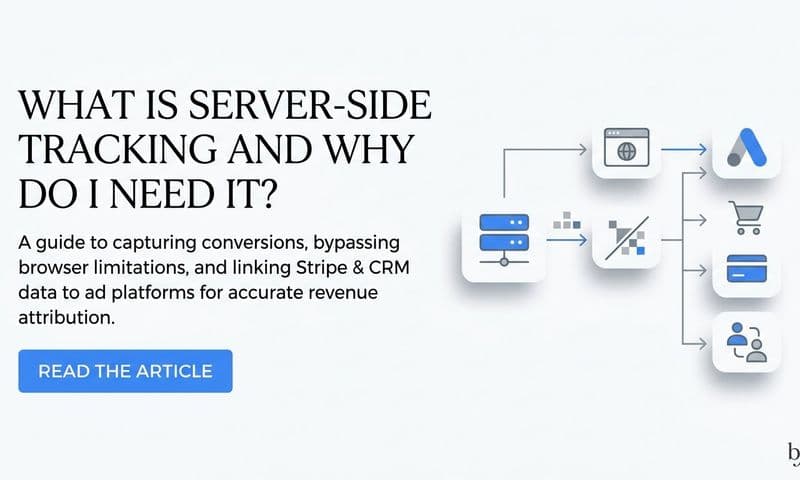
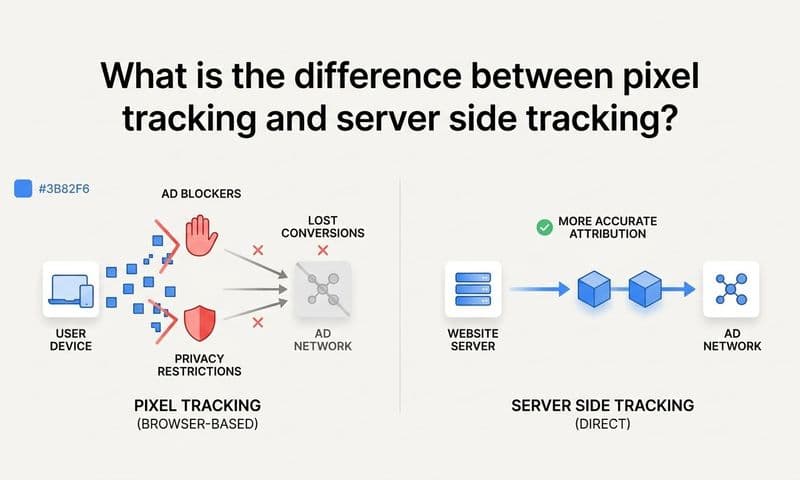
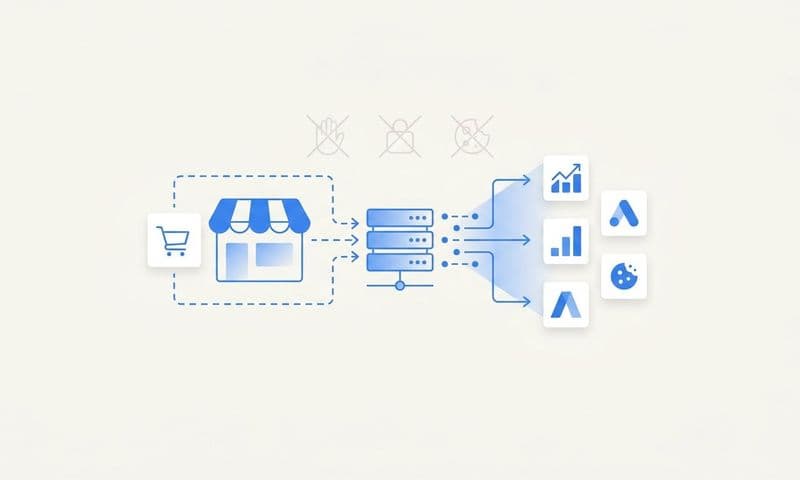
Server-side tracking shifts data collection away from the browser. Traditional UTM tracking relies entirely on client-side code running in the user's browser, which makes it vulnerable to ad blockers, cookie restrictions, and browser privacy features. As our guide on why server-side tracking is more accurate explains, processing data at the server level means it does not depend on the browser to pass information along. When a user takes an action on your site, that event is sent directly from your server to your analytics infrastructure, bypassing the client-side environment where so many tracking signals get lost. This makes server-side tracking significantly more resilient to the privacy changes that have undermined UTM reliability.
Multi-touch attribution distributes credit across the full journey. Rather than assigning all conversion credit to the last click, multi-touch attribution models assign proportional credit to every touchpoint a user encountered before converting. Depending on the model, that might mean equal credit distributed across all touches (linear attribution), more weight given to recent interactions (time-decay), extra emphasis on the first and last touches (position-based), or a data-driven model that uses machine learning to determine which touchpoints actually influenced the outcome. Any of these approaches gives a far more accurate picture of how your marketing mix is working together than UTM-based last-click reporting can provide.
Platforms like Cometly bring these capabilities together. Cometly combines server-side tracking with AI-powered multi-touch attribution to capture the full customer journey from the first ad click through to CRM events. Because it tracks at the server level, it captures conversions that client-side UTM tracking misses entirely. Because it uses multi-touch models, it distributes credit accurately across every touchpoint rather than collapsing the journey into a single last-click attribution. And critically, Cometly syncs enriched conversion data back to ad platforms like Meta and Google, feeding their algorithms better signals so their automated bidding and audience optimization actually work the way they are supposed to. Comparing UTM tracking versus attribution software makes it clear why dedicated platforms deliver a more complete picture of what is driving revenue.
This combination of server-side collection, multi-touch credit assignment, and conversion syncing represents the current standard for marketers who want attribution data they can actually act on.
Practical Steps to Strengthen Your Tracking Strategy Today
Acknowledging UTM tracking limitations does not mean abandoning UTMs entirely. It means building a more complete tracking architecture around them. Here is where to start.
Audit and standardize your UTM conventions. Before adding new tracking layers, clean up what you already have. Review your existing UTM parameters for inconsistencies in capitalization, naming conventions, and parameter usage. Build a centralized naming framework that every team member and every ad platform follows. Our article on UTM tracking best practices provides a detailed framework for getting this right. Use a UTM builder tool to enforce consistency rather than relying on manual entry. This will not solve the structural limitations of UTM tracking, but it will ensure that the data you do collect is clean and comparable over time.
Layer server-side tracking on top of your existing setup. Client-side UTM tracking and server-side tracking are not mutually exclusive. You can run both simultaneously, with server-side tracking capturing the events and conversions that client-side tracking misses. Start by implementing server-side conversion tracking for your highest-value conversion events, such as purchases, form submissions, or qualified leads. Our server-side tracking setup guide walks through the implementation process step by step. Then verify that those conversions are being sent back to your ad platforms accurately so their algorithms have complete signals to work with.
Evaluate your attribution model honestly. If your primary attribution view is still last-click UTM data, run a comparison against a multi-touch model. Look at how credit distribution shifts across your channels when you move from last-click to linear or position-based attribution. Pay particular attention to how your top-of-funnel and mid-funnel campaigns perform under each model. The difference is often significant enough to change how you think about budget allocation across your entire marketing mix.
Set up conversion syncing to feed ad platforms better data. Even if you cannot immediately overhaul your entire attribution setup, improving the quality of conversion data you send back to Meta, Google, and other ad platforms will improve their optimization performance. Enriched conversion events that include more customer data points help these platforms match conversions to the right users and refine their targeting accordingly. This is one of the highest-leverage improvements you can make to campaign performance without changing your creative or bidding strategy.
None of these steps requires abandoning UTMs. They require recognizing that UTMs are one input in a larger tracking ecosystem, not the whole picture.
The Bottom Line on UTM Tracking in 2026
UTM parameters are not going away. They still serve a legitimate purpose for basic campaign organization and source labeling, and they will continue to be part of how marketers tag and categorize their traffic. But treating UTM-based reporting as your primary source of attribution truth in 2026 means operating with a fundamentally incomplete dataset.
The UTM tracking limitations discussed in this guide are not theoretical. Cross-device fragmentation, view-through blind spots, privacy-driven cookie erosion, and last-click distortion are all actively affecting the accuracy of what you see in your analytics dashboard right now. And the budget decisions being made on top of that data carry real consequences for campaign performance and revenue growth.
The path forward is not to fix UTMs. It is to layer modern tracking methods on top of them. Server-side tracking, multi-touch attribution, and conversion syncing fill the gaps that UTMs leave open, giving you a complete and accurate picture of how your marketing is actually performing across every channel and every touchpoint in the customer journey.
Ready to stop making budget decisions based on incomplete data? Get your free demo of Cometly today and see how it captures every touchpoint, connects each one to real revenue, and feeds better conversion signals back to your ad platforms so you can scale your campaigns with genuine confidence.