Every click, scroll, and purchase tells a story—analytics is how you learn to read it. If you've ever stared at a dashboard full of numbers and wondered what it all means, you're not alone. Modern marketers are drowning in data from Google Ads, Facebook campaigns, email platforms, CRM systems, and website tracking tools. The numbers keep piling up, but the clarity doesn't.
Here's the truth: having data isn't the same as having answers. Analytics is the bridge that transforms those raw numbers into insights you can actually use. It's what tells you which campaign brought in your best customers, why conversions dropped last Tuesday, and where to invest your next dollar for maximum return.
This guide will walk you through what analytics really means in modern marketing, the different types you'll encounter, and how to build a practical framework that turns data into decisions. Whether you're explaining analytics to your team or trying to make sense of your own marketing performance, you'll leave with a clear understanding of how to leverage analytics for better outcomes.
The Simple Definition Behind a Complex Concept
Analytics is the systematic analysis of data to discover patterns, draw conclusions, and support decision-making. That's the textbook definition, but let's break it down into something more useful.
Think of analytics as the process of asking questions of your data and getting meaningful answers back. When you look at your website traffic and ask "which source brings the most qualified leads?"—that's analytics. When you compare two ad campaigns to determine which messaging resonates better—that's analytics. When you track how customers move through your funnel to identify where they drop off—that's analytics.
The key distinction to understand: data and analytics are not the same thing. Data is the raw material—the numbers, events, and facts your systems collect. Analytics is what you do with that data to extract meaning.
Your Google Analytics dashboard shows 10,000 website visitors last month. That's data. When you analyze that traffic to discover that 60% came from organic search, spent an average of four minutes on your pricing page, and converted at twice the rate of paid traffic—now you're doing analytics. You've transformed raw numbers into actionable intelligence.
Why does this matter more than ever? Three major shifts have made analytics absolutely critical for modern marketers.
First, the marketing landscape has exploded in complexity. You're no longer running ads in one or two places. You're managing campaigns across Meta, Google, LinkedIn, TikTok, email, SMS, and more. Each platform generates its own data, and understanding how they work together requires sophisticated digital marketing analytics.
Second, privacy changes have made tracking harder. iOS updates limit what you can see about user behavior. Cookie deprecation means you can't follow users across the web as easily. Browser restrictions block third-party tracking. Analytics has evolved to address these challenges through methods like server-side tracking and first-party data collection.
Third, the stakes are higher. Marketing budgets are under scrutiny. Every dollar needs to justify its existence. Analytics is how you prove ROI, identify what's working, and make the case for continued investment. It's moved from "nice to have" to "business critical."
The marketers who master analytics don't just have more data—they have clarity. They know which channels drive revenue, which campaigns deliver the best customers, and where to allocate budget for maximum impact. That's the power of turning data into insights.
Four Types of Analytics Every Marketer Should Know
Analytics isn't one thing—it's a spectrum of approaches that answer different questions. Understanding these four types will help you know which tool to reach for when you need specific insights.
Descriptive Analytics: Understanding What Happened
This is where most marketers start, and it's the foundation of all analytics work. Descriptive analytics tells you what occurred in the past. Your monthly traffic report? Descriptive analytics. Your conversion rate dashboard? Descriptive analytics. Any time you're looking at historical data to understand what happened, you're using descriptive analytics.
Common examples include: How many visitors came to your site last week? What was your cost per acquisition across campaigns? Which blog posts got the most engagement? How many leads entered your funnel from each source?
Descriptive analytics is powerful because it establishes your baseline. You can't improve what you don't measure, and you can't measure without first describing what's happening. The limitation? It only tells you what occurred, not why it happened or what to do about it.
Diagnostic Analytics: Discovering Why It Happened
Once you know what happened, the natural next question is "why?" Diagnostic analytics digs into the causes behind your results. This is where analytics gets interesting—and more valuable.
Let's say your descriptive analytics shows conversion rates dropped 30% last month. Diagnostic analytics helps you investigate: Did traffic quality change? Did a specific campaign send unqualified visitors? Was there a technical issue on your checkout page? Did a competitor launch something that shifted market dynamics?
Attribution analysis is a prime example of diagnostic analytics. When you track the customer journey to understand which touchpoints influenced a conversion, you're diagnosing what drove that outcome. Multi-touch attribution models show you how different channels work together—revealing that while Google Ads gets the last click, LinkedIn and email played crucial roles earlier in the journey. Understanding what attribution means in marketing is essential for this type of analysis.
Funnel analysis is another diagnostic tool. By examining where users drop off in your conversion process, you can diagnose friction points. Maybe 40% of users abandon their cart at shipping costs—that's diagnostic insight you can act on.
Predictive Analytics: Forecasting What Might Happen
Predictive analytics uses historical data and statistical models to forecast future outcomes. This is where analytics starts feeling like a superpower—you're no longer just reacting to what happened, you're anticipating what's coming.
In marketing, predictive analytics helps you identify trends before they fully emerge. You might analyze seasonal patterns to forecast next quarter's traffic. You could model customer behavior to predict which leads are most likely to convert. Advanced systems can forecast campaign performance based on historical patterns.
Customer lifetime value (CLV) prediction is a practical application many marketers use. By analyzing past customer behavior—purchase frequency, average order value, retention rates—you can predict the long-term value of new customers. This helps you determine how much to spend acquiring them.
Lead scoring is another predictive approach. By analyzing which behaviors correlate with eventual conversion—time on site, pages viewed, content downloaded—you can predict which new leads deserve immediate attention from sales.
The key with predictive analytics: it's probability, not certainty. Models help you make better bets, but they're not crystal balls. The value comes from making more informed decisions about where to invest resources.
Prescriptive Analytics: Determining What Action to Take
This is the most sophisticated form of analytics, and it's becoming increasingly accessible through AI. Prescriptive analytics doesn't just tell you what happened or what might happen—it recommends what you should do about it.
Modern AI-powered platforms analyze your marketing data and suggest specific actions: "Increase budget on this campaign by 20%," "Shift spend from Channel A to Channel B," "This audience segment is underperforming—adjust your targeting." These aren't just observations—they're actionable recommendations backed by data analysis.
Budget optimization is a practical example. Rather than manually analyzing which campaigns deliver the best ROI and reallocating budget yourself, prescriptive analytics can recommend the optimal distribution across your channels. The system considers performance data, seasonal trends, and your business goals to prescribe the best allocation.
A/B testing with automated optimization takes this further. Instead of just running tests and analyzing results manually, prescriptive systems can automatically shift traffic to winning variations and recommend when to implement changes.
The evolution from descriptive to prescriptive analytics represents a fundamental shift: from "here's what the data shows" to "here's what you should do." As AI capabilities advance, prescriptive analytics is becoming the competitive advantage for marketers who want to move faster and smarter than their competition. Staying ahead requires understanding the future of marketing analytics and emerging trends.
Marketing Analytics in Action: From Clicks to Revenue
Let's bring analytics down from theory to practice. In marketing, analytics serves one primary purpose: connecting your activities to business outcomes. It's the difference between knowing you got 50,000 impressions and knowing that those impressions led to 12 qualified leads that converted to $48,000 in revenue.
Marketing analytics tracks the entire customer journey across every touchpoint. A potential customer might first see your brand through a LinkedIn ad, visit your website but not convert, receive a nurture email sequence, click through to read a blog post, see a retargeting ad on Facebook, and finally convert after a Google search for your brand name. Understanding customer journey analytics helps you map these complex paths.
Without analytics, you might credit that final Google search as the "winner." With proper analytics, you understand that LinkedIn started the relationship, email kept them engaged, and Facebook reminded them to return. Each touchpoint played a role, and your budget decisions should reflect that reality.
This is where attribution becomes critical. Attribution analytics connects ad spend to actual business outcomes by tracking which channels, campaigns, and touchpoints influenced conversions. Modern attribution goes beyond simple last-click models to show the full picture of how customers discover and engage with your brand.
Metrics That Actually Matter
One of the biggest challenges in marketing analytics is focusing on metrics that drive real business value rather than vanity metrics that look impressive but don't connect to outcomes.
Vanity metrics feel good but don't inform decisions. Total page views, social media followers, email list size—these numbers can grow while your business stagnates. They're not worthless, but they're incomplete without context.
Revenue-driving metrics connect your marketing activities to business outcomes. These include: cost per acquisition relative to customer lifetime value, conversion rate by traffic source, revenue attribution by channel, customer acquisition cost trends over time, and return on ad spend across campaigns. Mastering the right marketing analytics metrics separates effective marketers from those flying blind.
The key is connecting top-of-funnel metrics to bottom-of-funnel outcomes. You want to know not just how many people clicked your ad, but how many of those clickers became customers and how much revenue they generated. That's the analytics that justifies budgets and guides strategy.
The Attribution Connection
Here's where marketing analytics gets really powerful: understanding which channels and campaigns actually drive revenue, not just traffic or clicks.
Attribution analytics solves a fundamental problem. When you're spending across multiple channels—Meta ads, Google search, LinkedIn campaigns, email marketing—how do you know which investments are working? Each platform's native analytics will claim credit for conversions, but they can't see the full journey.
A comprehensive attribution system tracks users across all touchpoints, connects those interactions to conversions, and shows you which channels work together to drive results. This reveals insights like: your LinkedIn ads rarely get the last click, but they're essential for introducing high-value prospects to your brand. Your email sequences don't directly drive many conversions, but customers who engage with email convert at 3x the rate of those who don't.
This level of analytics transforms budget decisions. Instead of blindly following platform recommendations or gut feelings, you allocate spend based on actual contribution to revenue. You identify underperforming channels to cut, high-performing channels to scale, and synergies between channels that amplify results.
The most sophisticated attribution systems also feed data back to ad platforms. When you send enriched conversion data to Meta or Google—including details about which leads became customers and their value—those platforms can optimize their algorithms to find more people like your best customers. Your analytics becomes a feedback loop that improves campaign performance over time.
Common Analytics Challenges (And How to Overcome Them)
Even marketers who understand the value of analytics face real obstacles in implementation. Let's address the most common challenges and practical approaches to overcome them.
Data Silos: When Your Platforms Don't Talk to Each Other
You run ads on Meta. Your leads flow into HubSpot. Sales happen in Salesforce. Website behavior lives in Google Analytics. Each system has its own dashboard, its own metrics, and its own version of the truth. This is the data silo problem, and it's one of the biggest barriers to effective analytics.
When your data lives in disconnected systems, you can't see the full customer journey. You might know that a lead came from Facebook, but can you connect that to their eventual purchase value three months later? You can see website behavior, but can you tie it back to which ad campaign brought them there?
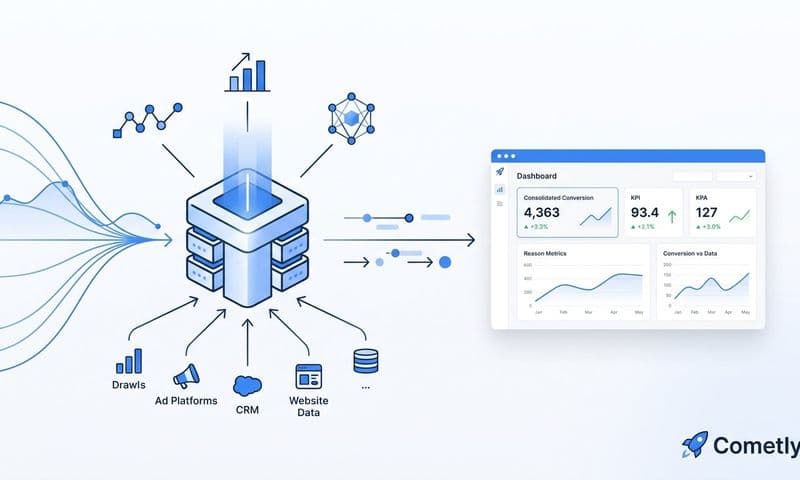
The solution requires integration. Modern attribution platforms connect your ad platforms, CRM, and website tracking to create a unified view of the customer journey. Instead of logging into five different dashboards to piece together what happened, you see the complete story in one place.
Start by identifying your critical data sources—the platforms that hold information about customer touchpoints and conversions. Then look for integration solutions that can connect them. Many modern analytics platforms offer native integrations with major marketing and sales tools, eliminating manual data export and import.
Tracking Gaps: iOS Privacy Changes and Cookie Deprecation
Related reading: our complete guide to cookie deprecation solutions.
Browser and platform privacy changes have created significant tracking challenges. iOS updates limit what apps can track. Browsers block third-party cookies. Users opt out of tracking. The result? Incomplete data that makes analytics harder.
These changes are real, but they're not insurmountable. The solution lies in first-party data collection and server-side tracking. Instead of relying on browser cookies that can be blocked, server-side tracking captures events directly from your server to your analytics platform. This approach is more reliable and privacy-compliant.
First-party data—information users voluntarily provide through forms, accounts, and interactions with your owned properties—becomes increasingly valuable. When someone fills out a lead form or creates an account, you have reliable, consented data about their journey. Building systems that capture and utilize first-party data effectively is key to maintaining analytics accuracy.
The shift also means moving from probabilistic tracking (guessing which device belongs to which user) to deterministic tracking (knowing because they logged in or provided information). This requires rethinking some analytics approaches, but it ultimately leads to more accurate, privacy-respecting measurement.
Analysis Paralysis: Focusing on Metrics That Actually Move the Needle
With so much data available, it's easy to get overwhelmed. You could spend all day analyzing metrics and still not know what action to take. This is analysis paralysis, and it's surprisingly common among data-rich marketers.
The antidote is ruthless prioritization. Start by identifying your North Star metric—the one number that best represents success for your business. For many companies, this is revenue or customer acquisition. Everything else should connect back to that core metric.
Then establish a small set of key performance indicators (KPIs) that directly influence your North Star. These might include: conversion rate, average order value, customer acquisition cost, and lifetime value. Track these consistently, and use them to guide decisions.
Resist the temptation to track everything just because you can. More metrics don't equal better insights—they equal more confusion. Focus on the few metrics that actually inform action, and check them regularly. You can always dig deeper into supporting data when you need to diagnose a specific issue.
Building Your Analytics Foundation: A Practical Framework
Understanding analytics concepts is one thing. Building a system that delivers consistent insights is another. Here's a practical framework for establishing analytics that actually improves your marketing.
Step 1: Define What Success Looks Like
Before you dive into dashboards and data, get crystal clear on what you're trying to achieve. What does success look like for your marketing efforts? This isn't about vanity metrics—it's about business outcomes.
Start with your business goals. Are you trying to grow revenue? Reduce customer acquisition cost? Increase customer lifetime value? Improve retention? Your analytics framework should align with these objectives. Understanding the core goals of marketing analytics helps you build this foundation correctly.
Then translate business goals into measurable KPIs. If your goal is revenue growth, your KPIs might include: monthly recurring revenue, conversion rate, average deal size, and sales cycle length. If your goal is efficiency, you might focus on: cost per acquisition, return on ad spend, and customer acquisition cost as a percentage of lifetime value.
Document these KPIs and share them with your team. Everyone should understand what you're measuring and why it matters. This alignment ensures your analytics efforts focus on questions that actually impact the business.
Step 2: Connect Your Data Sources
Once you know what to measure, you need systems that can actually measure it. This means connecting all the platforms that touch your customer journey.
At minimum, you'll want to integrate: your advertising platforms (Meta, Google, LinkedIn, etc.), your website tracking (analytics and behavior tracking), your CRM or lead management system, and your sales or transaction platform. The goal is creating a complete view from first touchpoint to final conversion.
Look for attribution and analytics platforms that offer native integrations with your existing tools. The easier the integration, the more likely you'll maintain it consistently. Server-side tracking implementations provide the most reliable data collection, especially given browser and privacy restrictions. Understanding how tracking pixels work is fundamental to setting up proper data collection.
Don't try to connect everything at once. Start with your most critical data sources—the platforms that handle the majority of your traffic and conversions. Get those working reliably, then expand to additional sources.
Step 3: Establish a Regular Review Cadence and Action Protocol
Analytics only creates value when insights lead to action. This requires establishing regular review rhythms and clear processes for acting on what you learn.
Set up a weekly review of your core KPIs. This doesn't need to be lengthy—15 minutes to check key metrics, identify any significant changes, and flag items for deeper investigation. The consistency matters more than the duration.
Schedule monthly deep dives where you analyze trends, compare performance across channels, and make strategic adjustments. This is when you ask bigger questions: Which campaigns should we scale? Where should we cut spend? What new opportunities do we see in the data?
Create an action protocol for your insights. When you discover something meaningful in your analytics, what happens next? Who needs to know? What decisions get made? How quickly can you implement changes? Without clear processes, insights stay in dashboards instead of improving outcomes.
Document your learnings. Keep a running record of what you've tested, what you've learned, and what actions you've taken. Over time, this becomes your institutional knowledge—preventing you from repeating mistakes and helping you build on successes.
Turning Insights Into Impact
The ultimate goal of analytics isn't better dashboards—it's better decisions. The marketers who win with analytics share a common mindset: they treat marketing as a continuous learning system rather than a set-it-and-forget-it operation.
This means embracing testing and optimization as core practices. When your analytics reveals that one audience segment converts better than another, you test new ways to reach more people like them. When attribution shows that certain channel combinations drive better results, you experiment with amplifying those synergies. Every insight becomes a hypothesis to test.
The challenge for many marketers isn't lack of data—it's the complexity of making sense of it all. Modern attribution platforms have evolved to simplify this process. Instead of manually connecting data sources, building custom reports, and trying to calculate attribution models, comprehensive platforms handle the technical complexity so you can focus on strategy and action. Choosing the right marketing analytics tools makes this transformation possible.
These systems track every touchpoint automatically, apply sophisticated attribution models to show true channel contribution, and provide AI-powered recommendations for optimization. The result is analytics that feels less like a research project and more like a strategic advisor.
The key is moving from reactive to proactive. Instead of waiting for monthly reports to tell you what happened last month, you're monitoring performance in real time and adjusting quickly. Instead of relying on platform-reported metrics that don't show the full picture, you're seeing accurate, cross-channel attribution that reveals true performance.
Start small but start now. Pick one area of your marketing to analyze deeply. Maybe it's understanding which campaigns actually drive qualified leads. Maybe it's figuring out why certain channels convert better than others. Maybe it's connecting your ad spend to actual revenue outcomes.
Focus on that one question, get the data infrastructure in place to answer it accurately, and act on what you learn. Then expand to the next question. This incremental approach builds analytics capabilities without overwhelming your team or requiring massive upfront investment.
Your Analytics Journey Starts Here
Analytics isn't about collecting more data—it's about asking better questions and making smarter decisions. The marketers who succeed don't have access to different data than you do. They've simply built systems that transform that data into actionable intelligence.
You now understand what analytics really means: the systematic process of turning raw data into insights that drive decisions. You know the four types of analytics and when to use each. You've seen how marketing analytics connects touchpoints to revenue through attribution. You understand the challenges you'll face and how to overcome them.
Most importantly, you have a practical framework for building analytics capabilities that actually improve your marketing outcomes. Start with clear goals, connect your critical data sources, and establish regular review rhythms that turn insights into action.
The difference between good marketers and great ones often comes down to analytics. Great marketers know which channels drive their best customers, which campaigns deliver real ROI, and where to invest the next dollar for maximum impact. That clarity comes from comprehensive, accurate analytics that show the complete customer journey.
Ready to elevate your marketing game with precision and confidence? Discover how Cometly's AI-driven recommendations can transform your ad strategy—Get your free demo today and start capturing every touchpoint to maximize your conversions.