

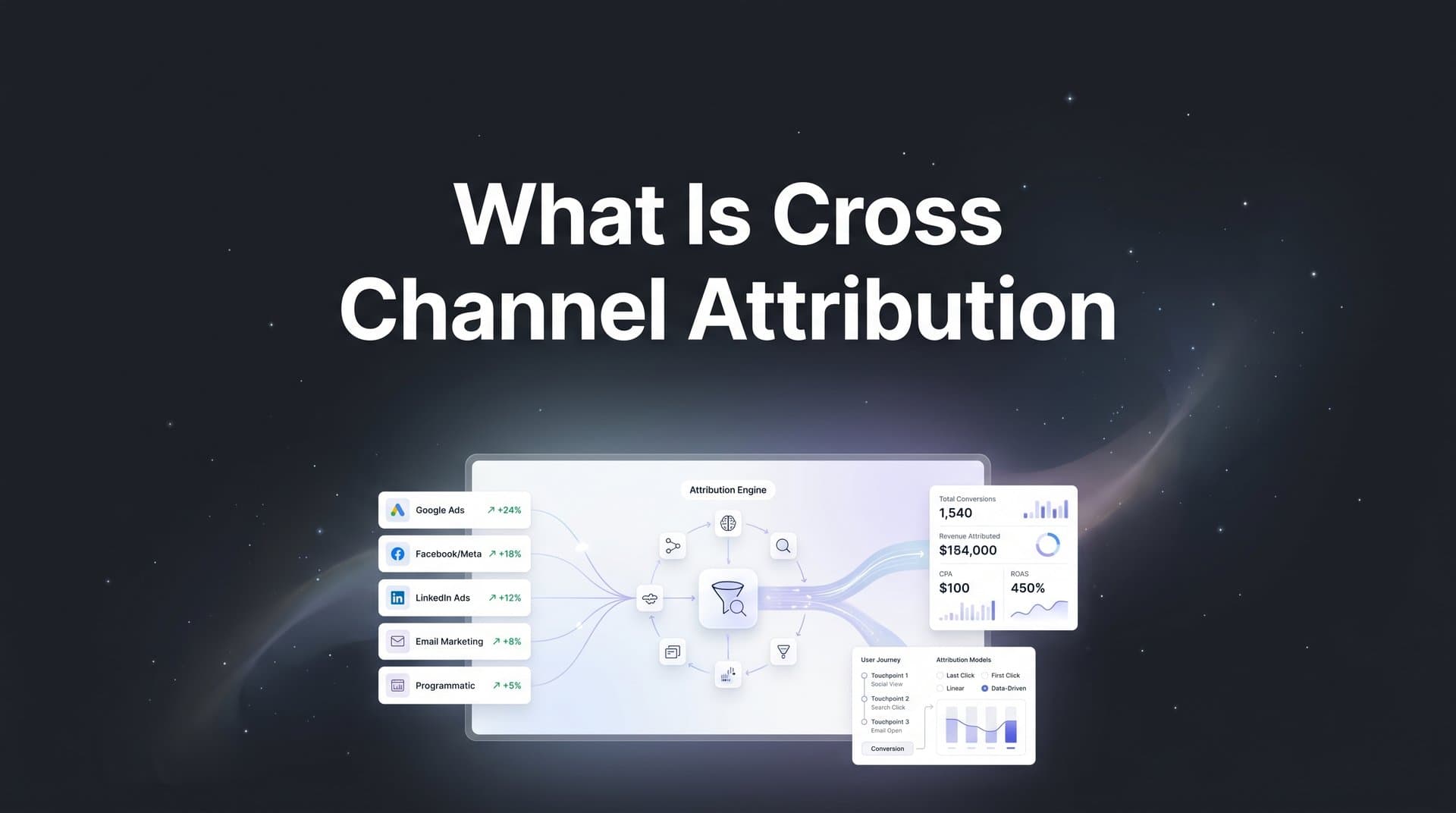
You open your analytics dashboard on Monday morning. Facebook says it drove 47 conversions this week. Google Ads claims 52. Your email platform reports 38. Add them up and you get 137 conversions—but your actual sales? Only 61.
This is not a tracking error. It is the reality of modern marketing where customers touch multiple channels before buying, and every platform takes full credit for the sale. Your Instagram ad introduced them to your brand. They Googled your product name three days later. They clicked an email offer. Then they converted through a retargeted Facebook ad. Who deserves the credit?
This is where cross channel attribution comes in. It is the practice of tracking and assigning credit to every marketing touchpoint across different platforms throughout the customer journey. Instead of letting each channel claim victory in isolation, cross channel attribution shows you the complete story: which channels work together to drive conversions, which ones initiate journeys, and which ones close deals.
In this guide, we will break down how cross channel attribution actually works, why single-platform reporting misleads your budget decisions, how to choose the right attribution model for your business, and how to build a system that turns scattered data into clear insights. By the end, you will understand how to stop guessing which channels matter and start making confident, data-driven decisions about where to invest your marketing budget.
The Foundation: How Cross Channel Attribution Actually Works
Cross channel attribution is the practice of tracking and assigning credit to multiple marketing touchpoints across different platforms throughout the customer journey. Instead of viewing each channel as an isolated event, it connects the dots between a customer's first awareness of your brand and their final purchase decision.
Here is how it works technically. When someone clicks your Facebook ad, a tracking pixel fires and logs that interaction. When they later search for your brand on Google and click your ad, UTM parameters capture that touchpoint. When they open your email and click through to your site, another tracking event records that engagement. Cross channel attribution tracking systems collect all these interactions, match them to the same user, and build a timeline of their journey.
The technical mechanics rely on several tracking methods working together. Browser-based tracking uses cookies to recognize returning visitors across sessions. UTM parameters tagged onto your URLs tell your analytics platform which campaign, source, and medium drove each visit. Tracking pixels embedded on your website capture user actions and send them back to ad platforms and analytics tools.
Server-side tracking has become increasingly important as browser-based methods face limitations. Instead of relying on cookies that users can block or browsers can restrict, server-side tracking sends event data directly from your server to analytics platforms and ad networks. This approach captures more complete data and is not affected by ad blockers or privacy settings that block client-side scripts.
The real power comes from connecting these technical pieces to your business systems. When your attribution platform integrates with your CRM, it can track which marketing touches led to qualified leads, which led to sales opportunities, and which ultimately drove revenue. This connection transforms marketing data from vanity metrics into business intelligence.
Think of it like assembling a puzzle. Single-channel reporting gives you individual pieces—each platform showing its own performance in isolation. Cross channel attribution assembles those pieces into a complete picture, revealing patterns you cannot see when looking at fragments.
The contrast with single-channel reporting is stark. When you log into Facebook Ads Manager, it shows you conversions attributed to Facebook based on Facebook's view of the world. Google Ads does the same from Google's perspective. Each platform uses its own attribution window, its own tracking methodology, and its own rules for claiming credit. The result is overlapping claims where multiple channels report the same conversion as theirs.
Cross channel attribution solves this by applying consistent methodology across all channels. It uses a unified tracking system to capture every touchpoint, a single source of truth for conversion data, and attribution rules applied equally to all channels. This consistency is what makes channel comparison meaningful and budget decisions reliable.
Why Single-Platform Reporting Leads You Astray
The double-counting problem is not just a technical quirk. It fundamentally distorts your understanding of what drives results. When Facebook, Google, and your email platform all claim full credit for the same conversion, your reported conversions can exceed your actual sales by 200% or more. This makes every channel look more effective than it actually is.
Picture this scenario. A customer sees your Instagram ad on Monday. They do not click but they remember your brand name. On Wednesday, they search for your product category on Google, see your ad, and click through to browse. They leave without buying. On Friday, they receive your email newsletter featuring a limited-time offer. They click the email, land on your site, and convert.
Instagram will claim that conversion using a view-through attribution window. Google will claim it because the customer clicked their ad within the last 30 days. Your email platform will claim it as an email-driven conversion. Each platform is technically correct based on its own tracking rules, but none of them tells you the whole story. Understanding tracking conversions across multiple channels is essential to solving this problem.
This gets worse when you try to calculate return on ad spend. If you add up the revenue each platform claims to have generated and divide by your total ad spend, you get inflated ROAS numbers that make every channel look profitable. You might see 4x ROAS on Facebook, 3.5x on Google, and 5x from email—but your actual blended ROAS across all channels is only 2.5x.
iOS privacy changes have made platform-reported data even less reliable. When Apple introduced App Tracking Transparency, the percentage of iOS users who opt into tracking dropped significantly. Facebook and other platforms lost visibility into a large portion of mobile user behavior. Their conversion tracking became incomplete, leading to underreported conversions in some cases and misattributed conversions in others.
Cookie deprecation is accelerating this trend. As browsers phase out third-party cookies and implement stricter privacy controls, browser-based tracking becomes less effective. Platforms that rely heavily on cookie-based attribution are losing the ability to track users across sites and sessions. This creates blind spots in their reporting.
The real cost shows up in your budget allocation. When you rely on siloed platform data, you end up over-investing in channels that look good in isolation but do not actually drive incremental conversions. You might pour budget into last-click channels that get credit for sales that would have happened anyway, while under-funding the awareness channels that actually introduced customers to your brand.
Many marketers discover they have been scaling the wrong channels. The retargeting campaign that shows a 10x ROAS is not creating new demand—it is converting people who were already interested. The prospecting campaign with a 2x ROAS might be doing the heavy lifting of building awareness, but it gets less credit and less budget because single-platform reporting does not show its full contribution.
Attribution Models Explained: Choosing Your Credit Distribution Method
Attribution models are the rules that determine how credit gets distributed across the touchpoints in a customer journey. Different models serve different analytical purposes, and choosing the right one depends on your sales cycle, buying behavior, and what questions you are trying to answer. For a deeper dive, explore our multi channel attribution models explained guide.
First-Touch Attribution: This model gives 100% of the credit to the first touchpoint that introduced the customer to your brand. If someone clicked your Facebook ad, then later searched on Google, then converted through an email, Facebook gets all the credit. First-touch attribution is useful for understanding which channels are best at generating awareness and bringing new prospects into your funnel. It helps you identify top-of-funnel performers.
The limitation is that it ignores everything that happened after that first interaction. It cannot tell you which channels are effective at nurturing prospects or closing deals. If you optimize solely for first-touch attribution, you might under-invest in the channels that move people from awareness to purchase.
Last-Touch Attribution: This is the opposite approach—100% of the credit goes to the final touchpoint before conversion. If the customer journey ended with a click from your email campaign, email gets all the credit regardless of what came before. Last-touch attribution is simple to implement and useful for identifying which channels are most effective at closing deals.
The problem is that it completely ignores the awareness and consideration phases. It over-credits bottom-of-funnel channels while giving no recognition to the channels that built interest and trust earlier in the journey. Many marketers using last-touch attribution end up over-investing in retargeting and branded search while under-funding the channels that create new demand.
Linear Attribution: This model distributes credit equally across all touchpoints. If there were five interactions in the customer journey, each one gets 20% of the credit. Linear attribution acknowledges that multiple channels contribute to conversions and ensures no single touchpoint gets disproportionate credit.
Linear attribution works well when you have relatively short sales cycles and want a balanced view of channel performance. The downside is that it treats all touchpoints as equally important, which is rarely true. The initial ad that created awareness probably had a different impact than the fifth retargeting impression.
Time-Decay Attribution: This model gives more credit to touchpoints that happened closer to the conversion. The most recent interaction gets the most credit, with earlier touchpoints receiving progressively less. Time-decay attribution reflects the reality that recent interactions often have more influence on the final purchase decision.
This model makes sense for businesses with longer sales cycles where recent engagement is a strong signal of purchase intent. It balances the extremes of first-touch and last-touch by acknowledging both early and late touchpoints while emphasizing recency.
Position-Based Attribution: Also called U-shaped attribution, this model gives 40% credit to the first touchpoint, 40% to the last touchpoint, and distributes the remaining 20% among the middle interactions. It recognizes that the first and last touches are typically most influential while still acknowledging the role of mid-funnel engagement.
Position-based attribution works well when both awareness and conversion are important to understand. It helps you identify which channels are best at introducing prospects and which are best at closing them, while not completely ignoring the nurturing that happens in between.
Data-Driven Attribution: Instead of using predetermined rules, data-driven attribution uses machine learning to analyze your actual conversion data and assign credit based on statistical impact. It compares converting paths to non-converting paths and identifies which touchpoints actually increased the probability of conversion.
Data-driven attribution can uncover patterns that rule-based models miss. It might reveal that a specific sequence of touchpoints is particularly effective, or that certain channels have more impact at certain stages of the journey. The limitation is that it requires significant conversion volume to generate reliable insights—if you only have a few dozen conversions per month, the algorithm does not have enough data to identify meaningful patterns.
Choosing the right model depends on what you are trying to optimize. If your goal is to maximize new customer acquisition, first-touch attribution helps you identify your best awareness channels. If you are focused on conversion efficiency, last-touch shows you which channels close deals. If you want a balanced view of the entire funnel, multi-touch models like linear, time-decay, or position-based provide more nuanced insights. Learn more about what attribution model is best for optimizing ad campaigns.
The best approach is often to use multiple models. Compare how different attribution models view your channel performance. If a channel performs well across all models, it is genuinely effective. If a channel only looks good under last-touch attribution, it might be getting credit for conversions it did not actually drive.
Building Your Cross Channel Attribution System
Setting up effective cross channel attribution requires three essential components working together: unified tracking across all marketing touchpoints, integration with your CRM to connect marketing touches to revenue outcomes, and a centralized analytics dashboard that applies consistent methodology across channels.
Unified Tracking Infrastructure: The foundation is a tracking system that captures every interaction across every channel using consistent methodology. This means implementing tracking pixels on your website, using UTM parameters consistently across all campaigns, and ensuring your analytics platform can recognize the same user across different sessions and devices.
Consistency is critical here. If you tag your Facebook campaigns with one naming convention and your Google campaigns with another, your analytics platform cannot compare them accurately. Establish a clear UTM tagging structure that identifies campaign, source, medium, content, and term in a standardized format. Document this structure and train everyone who creates campaigns to follow it.
Server-side tracking should be part of your infrastructure, especially as browser-based tracking becomes less reliable. Server-side tracking sends event data directly from your web server to analytics platforms and ad networks, bypassing browser restrictions and ad blockers. This approach captures more complete data and is not affected by cookie blocking or privacy settings that restrict client-side tracking. Implementing the right cross channel tracking solution is essential for accurate data.
CRM Integration: Connecting your attribution platform to your CRM transforms marketing data from activity metrics into business intelligence. When you can track which marketing touches led to qualified leads, which led to sales opportunities, and which ultimately drove closed revenue, you can optimize for business outcomes instead of vanity metrics.
This integration works by passing user identifiers and conversion events between systems. When someone fills out a lead form on your website, your attribution platform logs that conversion along with all the marketing touchpoints that preceded it. That lead data flows into your CRM where sales teams work the opportunity. When the deal closes, revenue data flows back to your attribution platform, completing the picture.
The power of this connection is that you can analyze attribution at every stage of the funnel. Which channels drive the most leads? Which drive the highest-quality leads that convert to opportunities? Which have the best lead-to-customer conversion rate? Which generate the highest average deal size? These insights are impossible to get when marketing and sales data live in separate systems.
Centralized Analytics Dashboard: You need a single source of truth where all your marketing data comes together under consistent attribution rules. This dashboard should pull data from all your ad platforms, your website analytics, your email platform, and your CRM. It should apply your chosen attribution model consistently across all channels so you can make meaningful comparisons.
The dashboard should show both high-level metrics and detailed journey analysis. At the summary level, you want to see total conversions, revenue, cost, and ROAS by channel using your attribution model. At the detailed level, you want to explore individual customer journeys, see which touchpoint sequences are most common, and identify patterns in how different channels work together. A robust cross channel attribution platform makes this possible.
Look for platforms that offer attribution model comparison. Being able to switch between first-touch, last-touch, and multi-touch views helps you understand channel performance from different angles. A channel that looks mediocre under last-touch attribution might be your best awareness driver under first-touch attribution.
Data Quality Checks: Your attribution system is only as good as the data feeding it. Build regular data quality checks into your process. Verify that tracking is firing correctly on all key pages. Check that UTM parameters are being captured accurately. Confirm that conversions are being recorded consistently across all platforms.
Watch for common data quality issues like duplicate conversions, missing touchpoints in customer journeys, or attribution windows that are too short to capture your typical sales cycle. If your average customer takes 14 days to convert but your attribution window is only 7 days, you are missing half the story.
Turning Attribution Data Into Smarter Budget Decisions
Attribution data becomes valuable when it changes how you allocate budget. The goal is not just to understand what happened, but to make better decisions about where to invest going forward. Here is how to translate attribution insights into action.
Identify Channel Roles: Different channels play different roles in the customer journey. Some channels excel at generating awareness and bringing new prospects into your funnel. Others are better at nurturing consideration. Still others are most effective at converting ready-to-buy prospects. Attribution data reveals these roles.
Look at first-touch attribution to identify your best awareness channels. These are the channels that introduce new customers to your brand. Then look at last-touch attribution to see which channels are best at closing deals. The channels that perform well on both metrics are your all-around performers. The channels that only show up in first-touch or only in last-touch have specialized roles.
This understanding should inform your budget allocation. Your awareness channels need enough budget to maintain a steady flow of new prospects. Your conversion channels need budget to capitalize on that awareness. Cutting budget from awareness channels to fund more retargeting might boost short-term conversions, but it starves your funnel and hurts long-term growth. Developing a solid cross channel attribution strategy helps you balance these priorities.
Optimize Channel Combinations: Cross channel attribution reveals which combinations of channels work particularly well together. You might discover that customers who see both a Facebook ad and a Google search ad convert at twice the rate of customers who only see one or the other. Or that email performs much better when customers have previously engaged with your content marketing.
Use these insights to create integrated campaigns that leverage channel synergies. Instead of running each channel in isolation, design campaigns where channels reinforce each other. Run awareness campaigns on social media and retarget engaged users with search ads. Follow up ad clicks with email sequences. Use content marketing to warm up prospects before hitting them with direct response ads.
Reallocate Based on True Performance: Attribution data often reveals that your budget allocation does not match actual performance. You might be over-investing in channels that look good in platform reports but do not actually drive incremental conversions. Or under-funding channels that play crucial roles in the customer journey but do not get credit under last-touch attribution.
Start by identifying your most efficient channels at each stage of the funnel. Which channels deliver qualified leads at the lowest cost? Which have the best lead-to-opportunity conversion rate? Which drive the highest revenue per dollar spent? Shift budget toward channels that excel on the metrics that matter most to your business. Understanding cross channel attribution marketing ROI is key to making these decisions.
Be strategic about how you make these shifts. Do not cut a channel entirely just because it does not perform well under one attribution model. Test reducing spend by 20-30% and monitor the impact on overall conversions. Some channels might have indirect effects that do not show up immediately in attribution data.
Feed Better Data to Ad Platforms: One of the most powerful applications of cross channel attribution is feeding accurate conversion data back to ad platforms. When you send conversion events to Facebook, Google, and other platforms through their conversion APIs, you give their optimization algorithms better information about what actually drives results.
This creates a virtuous cycle. Your attribution platform identifies which conversions came from which channels. It sends that conversion data back to the ad platforms through server-side integration. The platforms use that data to optimize their targeting and bidding algorithms. Over time, the platforms get better at finding and converting your ideal customers.
This approach is particularly important as browser-based tracking becomes less reliable. By sending conversion data server-side, you ensure ad platforms have complete visibility into conversions they drove, even when browser restrictions prevent them from tracking those conversions directly.
Common Attribution Pitfalls and How to Avoid Them
Over-Crediting Last-Touch Channels: The most common mistake is relying too heavily on last-touch attribution and over-investing in bottom-of-funnel channels as a result. Retargeting campaigns and branded search often dominate last-touch reports because they interact with customers who are already close to converting. But these channels are not creating new demand—they are harvesting demand created by other channels.
Avoid this trap by analyzing multiple attribution models. If a channel only performs well under last-touch attribution, question whether it is actually driving incremental conversions or just taking credit for sales that would have happened anyway. Balance your investment between demand creation and demand capture. Review multi channel attribution best practices to refine your approach.
Making Decisions on Incomplete Data: Attribution systems can only track what they can see. If your tracking is not implemented correctly across all touchpoints, or if your attribution window is too short to capture your typical sales cycle, you are making decisions based on incomplete information.
Before making major budget shifts based on attribution data, verify that your tracking is comprehensive. Check that all campaigns are properly tagged, that tracking pixels are firing on all key pages, and that your attribution window matches your actual customer journey length. Incomplete data leads to wrong conclusions.
Inconsistent Tracking Setup: When different channels use different tracking methodologies, you cannot compare them accurately. If you track Facebook conversions using a 7-day click window but Google conversions using a 30-day window, the data is not comparable. If some campaigns use UTM parameters and others do not, your attribution platform cannot connect the dots.
Establish consistent tracking standards across all channels. Use the same attribution windows, the same conversion definitions, and the same UTM tagging structure. Document these standards and audit your campaigns regularly to ensure compliance. Understanding cross channel attribution challenges helps you anticipate and solve these issues.
Ignoring Offline Touchpoints: Many customer journeys include offline interactions that never show up in digital attribution systems. A customer might see a billboard, hear about your brand from a friend, or visit a physical store before converting online. If you only track digital touchpoints, you are missing part of the story.
While you cannot track every offline interaction, you can account for them in your analysis. Use surveys to ask new customers how they first heard about your brand. Track branded search volume and direct traffic as proxies for offline awareness. Be humble about the limits of your attribution data and avoid over-optimizing based on incomplete information.
Attribution Window Mismatch: Your attribution window should match your actual sales cycle. If customers typically take 21 days to convert but your attribution window is only 7 days, you are missing two-thirds of the customer journey. This leads to under-crediting awareness channels and over-crediting late-stage touchpoints.
Analyze your actual time-to-conversion data to set appropriate attribution windows. For B2B businesses with longer sales cycles, you might need 30, 60, or even 90-day windows. For e-commerce with impulse purchases, a 7-day window might capture most journeys. Match your attribution window to your customer behavior.
Your Path to Data-Driven Marketing Decisions
Cross channel attribution transforms marketing from guesswork into a data-driven discipline. Instead of relying on each platform's biased view of performance, you get a complete picture of how channels work together to drive conversions. Instead of over-investing in channels that take credit for sales they did not drive, you can allocate budget based on true contribution to revenue.
The goal is not perfect attribution. Customer journeys are complex, and no system can capture every influence on a purchase decision. The goal is better decisions than competitors who are still flying blind with siloed platform data. Even imperfect attribution that shows you the general shape of customer journeys is vastly better than single-channel reporting that shows you distorted fragments.
Start by auditing your current attribution setup. Do you have unified tracking across all channels? Are your UTM parameters consistent? Does your attribution platform integrate with your CRM? Are you comparing channels using the same methodology? If the answer to any of these questions is no, you have gaps that are limiting your ability to make informed decisions.
Choose attribution models that align with your business goals. If you are focused on growth, use first-touch attribution to identify your best awareness channels. If you are optimizing for efficiency, use multi-touch models that show the full customer journey. If you have enough conversion volume, explore data-driven attribution to uncover patterns rule-based models might miss.
Most importantly, use attribution insights to take action. Shift budget toward channels that drive real results. Cut spending on channels that only look good because of attribution quirks. Feed accurate conversion data back to ad platforms to improve their optimization. Build integrated campaigns that leverage channel synergies instead of running each channel in isolation.
The marketers who master cross channel attribution will have a decisive advantage. They will know which channels create demand and which capture it. They will allocate budget based on contribution to revenue, not vanity metrics. They will optimize the entire customer journey, not just individual touchpoints. In a world where every competitor is running ads on the same platforms, superior attribution is the edge that drives better returns.
Ready to elevate your marketing game with precision and confidence? Discover how Cometly's AI-driven recommendations can transform your ad strategy—Get your free demo today and start capturing every touchpoint to maximize your conversions.