

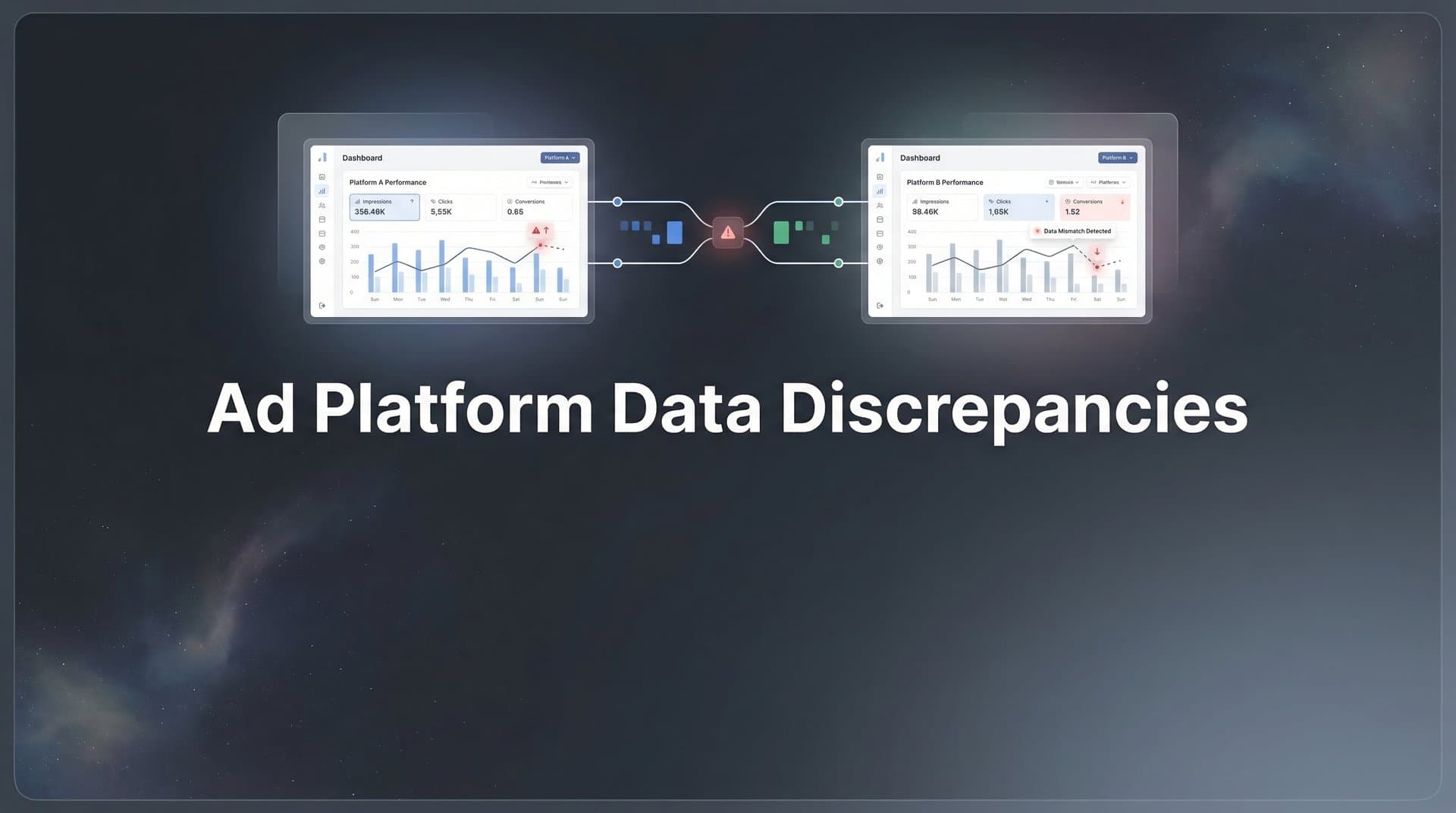
You refresh your Meta Ads Manager and see 47 conversions from yesterday's campaign. Feeling good, you switch tabs to Google Analytics—wait, it shows 52 conversions from the same period. Confused, you check your CRM to settle the dispute. It displays 31 actual sales.
Which number is real? Which platform should you trust when deciding where to invest your next $10,000 in ad spend?
Welcome to the frustrating world of ad platform data discrepancies—the gap between what different platforms report for the same marketing activity. This isn't a rare technical glitch or a sign that something's broken. It's the everyday reality for digital marketers managing campaigns across multiple channels. And if you're making budget decisions based on these conflicting numbers, you could be systematically wasting thousands of dollars on channels that look like winners but actually underperform.
This article will demystify why these mismatches happen, what they mean for your marketing decisions, and practical approaches to get closer to the truth. Because understanding the anatomy of data discrepancies isn't just about satisfying your curiosity—it's about making confident, data-driven decisions that actually grow your business.
The Anatomy of a Data Mismatch
Ad platform data discrepancies are the differences between what various platforms report for the same conversions, clicks, revenue, or other performance metrics. When Meta says your campaign drove 100 conversions and Google Analytics says it drove 85, that 15-conversion gap is a discrepancy.
The core problem? Each platform has its own tracking methodology, attribution window, and definition of what counts as a conversion. They're not measuring the same thing in the same way, even though they're theoretically tracking the same customer actions.
Think of it like three witnesses describing the same car accident. One focuses on what happened in the five seconds before impact. Another considers everything that occurred in the previous minute. The third only counts what they personally saw, ignoring anything blocked from view. They're all describing the same event, but their accounts differ based on their perspective and what they chose to measure.
Let's make this concrete with a simple customer journey. Sarah clicks your Meta ad on Monday morning while browsing Instagram on her phone. She doesn't buy anything. On Wednesday, she searches for your product on Google, clicks your search ad, and visits your site on her laptop—still no purchase. On Friday, she types your URL directly into her browser and completes a purchase.
Here's where it gets messy. Meta might claim credit for that conversion because Sarah's initial click happened within their 7-day attribution window. Google might also claim credit because her search ad click occurred within their 30-day window. Your analytics platform might attribute it to direct traffic because that was her last touchpoint before converting.
Same customer. Same sale. Three different platforms telling three different stories about who deserves credit. None of them are technically wrong—they're just measuring from different perspectives with different rules. Understanding the discrepancy between platform and analytics data is essential for making sense of these conflicting reports.
This isn't a problem you can simply fix by picking the "right" platform to trust. The discrepancies exist because of fundamental differences in how digital advertising measurement works across the ecosystem. Understanding these underlying causes is the first step toward building a measurement framework you can actually rely on.
Five Root Causes Behind the Numbers Gap
Attribution Window Differences: Perhaps the most significant cause of discrepancies is that platforms use different time windows to claim credit for conversions. Meta's default attribution window is 7-day click and 1-day view, meaning they'll count a conversion if it happens within seven days of someone clicking your ad, or within one day of someone simply viewing it. Google Ads, by contrast, defaults to a 30-day click attribution window with no view-through attribution.
What does this mean in practice? A customer who clicks your Meta ad on January 1st and converts on January 25th will show up in Google's conversion count but not Meta's. The same conversion gets counted differently—or not at all—depending on which platform you're looking at. Multiply this across hundreds of customer journeys, and you end up with substantially different conversion totals.
iOS Privacy Changes and Browser Tracking Prevention: Apple's App Tracking Transparency framework, introduced in iOS 14.5, fundamentally changed the tracking landscape. When users opt out of tracking—and many do—platforms lose visibility into significant portions of the customer journey. Safari's Intelligent Tracking Prevention and Firefox's Enhanced Tracking Protection actively block third-party cookies and limit first-party cookie lifespans.
The result? Your pixel-based tracking catches fewer conversions than actually occurred. If someone converts after their cookies expired or while using a browser with aggressive tracking prevention, that conversion might never get attributed to your ads. Different platforms handle these limitations differently, creating gaps in what they can see and report. Setting up first-party data tracking helps overcome many of these browser-based limitations.
Cross-Device Journeys and Matching Methods: Modern customers rarely complete their entire journey on a single device. They might discover your product on their phone during their morning commute, research it on their work laptop during lunch, and finally purchase on their home tablet in the evening.
Platforms use two approaches to connect these cross-device touchpoints: deterministic matching and probabilistic matching. Deterministic matching works when users are logged into the same account across devices—Google can definitively connect your phone and laptop activity if you're signed into your Google account on both. Probabilistic matching uses statistical inference based on signals like IP address, browser characteristics, and usage patterns to guess when different devices belong to the same person.
These different matching methodologies lead to different conclusions about the same customer journey. One platform might successfully connect all three devices and claim credit for the conversion. Another might only see the final tablet session and miss the earlier touchpoints entirely. A robust cross-platform attribution tracking system helps unify these fragmented journeys.
Click vs View-Through Attribution: Some platforms count conversions that happen after someone simply saw your ad, even if they never clicked it. Others only count conversions following actual clicks. This philosophical difference can create massive discrepancies, especially for display and video campaigns where view-through conversions can outnumber click-through conversions.
If you're running a brand awareness campaign with high impressions but moderate clicks, one platform might report substantial conversions from view-through attribution while another reports almost nothing because it only tracks clicks. Both numbers are "correct" based on their respective methodologies, but they tell very different stories about campaign performance.
Time Zone and Reporting Delays: This sounds minor but creates surprisingly large discrepancies. Different platforms close their daily reporting at different times and use different time zones. A conversion that happens at 11:30 PM Pacific might appear in one platform's report for Monday and another platform's report for Tuesday.
Additionally, some conversions take time to process. A sale might occur on Monday but not appear in your platform reports until Tuesday or Wednesday, depending on how quickly data flows from your website to your tracking systems. When you're comparing reports from different platforms on the same day, these timing differences compound into noticeable gaps.
The Real Cost of Flying Blind
Data discrepancies aren't just an annoying reporting headache—they directly impact your bottom line through systematic budget misallocation. When you make spending decisions based on inflated or deflated conversion numbers, you inevitably over-invest in channels that over-report their performance and under-invest in channels that under-report.
Picture this scenario: Your Meta campaigns show a $30 cost per acquisition, while your Google campaigns show $45. Based on these numbers, you shift more budget to Meta. But what if Meta's tracking is catching more view-through conversions that would have happened anyway, while Google is only counting direct-response clicks? You might be systematically defunding your best-performing channel because the data made it look worse.
Our explainer on what is cost per share covers the fundamentals in more depth.
This misallocation compounds over time. Every budget reallocation based on inaccurate data pushes you further from optimal performance. Companies often discover they've been over-investing in certain channels by 30-40% when they finally implement proper attribution tracking. Understanding ad platform reporting discrepancies is the first step toward preventing this costly mistake.
The second major cost comes from broken optimization feedback loops. Ad platforms use conversion data to train their machine learning algorithms. When you feed them incomplete or inaccurate conversion signals—which happens when browser-based tracking misses conversions—their algorithms optimize toward the wrong patterns.
Meta's algorithm might learn to target people who are easy to track rather than people who are likely to convert. Google's Smart Bidding might under-bid on valuable audience segments because it doesn't see the full conversion picture. Your platforms are working hard to optimize, but they're optimizing based on a distorted view of reality. The truth is that ad platform algorithms need better data to perform at their best.
Finally, there's the hidden cost of strategic decision paralysis. Marketing teams waste countless hours in meetings trying to reconcile conflicting reports. Should we trust the platform data or the analytics data? Why don't these numbers match? Which report should we show leadership?
This time spent reconciling numbers is time not spent improving campaigns, testing new creative, or exploring new channels. The opportunity cost of confusion is real—while you're debating which data source to trust, your competitors who've solved this problem are already three tests ahead of you.
Building Your Single Source of Truth
Server-Side Tracking as Your Foundation: The most significant step you can take is implementing server-side tracking to capture conversion events directly from your server rather than relying on browser-based pixels. When a conversion happens on your website, your server sends that event data directly to your tracking system, bypassing all the browser-level limitations that create blind spots.
Server-side tracking captures conversions that browser-based tracking misses—purchases from users with ad blockers, conversions after cookies expire, and actions taken by users who've opted out of app tracking. This creates a more complete dataset that isn't subject to the same limitations as pixel-based tracking.
The beauty of server-side tracking is that it gives you a consistent measurement baseline. While individual ad platforms might still show different numbers based on their attribution rules, you have an independent record of what actually happened that you can use to validate platform reports and make confident budget decisions. A dedicated attribution data platform can serve as this independent source of truth.
Connecting Your CRM to Your Attribution System: Your CRM contains the ultimate truth about what matters most—actual revenue from real customers. By connecting your CRM to your attribution system, you can match closed deals and revenue back to the specific ad touchpoints that influenced them.
This connection reveals performance that platform reporting often misses entirely. A lead might come through your website on Monday, get nurtured by your sales team for two weeks, and close as a $50,000 deal on Friday. Platform conversion tracking might only see the initial form submission, but CRM integration shows you the full revenue impact. Platforms focused on marketing attribution with revenue tracking make this connection seamless.
For B2B companies with longer sales cycles, this connection is essential. Platform-level conversion tracking tells you which ads drove form fills, but CRM integration tells you which ads drove revenue. These are often very different stories, and the revenue story is the one that actually matters for your business.
Multi-Touch Attribution Models: Moving beyond last-click attribution to understand the full customer journey across platforms is crucial for accurate performance measurement. Multi-touch attribution assigns credit to all the touchpoints that contributed to a conversion, not just the final click.
Different attribution models distribute credit differently. Linear attribution gives equal credit to all touchpoints. Time-decay attribution gives more credit to touchpoints closer to conversion. Position-based attribution emphasizes the first and last touchpoints. The specific model matters less than the principle: understanding that conversions rarely result from a single ad interaction.
When you implement multi-touch attribution, you often discover that channels you thought were underperforming actually play crucial roles early in the customer journey. That expensive display campaign might not drive many last-click conversions, but it could be essential for initial awareness that leads to conversions later. Multi-touch attribution reveals these hidden contributions.
The combination of server-side tracking, CRM integration, and multi-touch attribution creates a measurement framework that's more accurate, more complete, and more useful for decision-making than any single platform's reporting. This becomes your single source of truth—the data you trust when platform reports conflict.
Practical Steps to Minimize Discrepancies Today
Audit Your Attribution Windows Across All Platforms: Start by documenting the attribution window settings for every platform you use. Log into Meta Ads Manager, Google Ads, LinkedIn Campaign Manager, and any other platforms and record their current attribution window configurations. You'll likely find they're all different.
While you can't eliminate these differences entirely—platforms have different defaults for good reasons—you can align them where it makes sense. Consider standardizing on a 7-day click attribution window across platforms for more consistent comparison, or at least understanding how the differences affect your reporting so you can account for them in your analysis. Learning how to fix attribution discrepancies in data starts with this fundamental audit.
Implement UTM Parameter Standards: Consistent UTM parameters across all your campaigns create a reliable tracking foundation that works regardless of platform. Establish a clear naming convention for your UTM parameters and enforce it rigorously across your team.
Your UTM structure might look like this: utm_source for the platform (facebook, google, linkedin), utm_medium for the ad type (cpc, display, video), utm_campaign for the specific campaign name, and utm_content for the ad variation. When every campaign follows this standard, you can accurately track performance in your analytics platform even when individual ad platform tracking has gaps.
Document your UTM standards in a shared guide and use URL builders to ensure consistency. Many discrepancies stem from inconsistent or missing UTM parameters that make it impossible to properly attribute conversions in your analytics system.
Use Conversion Sync to Feed Better Data Back: Modern attribution platforms can send enriched, first-party conversion data back to your ad platforms through conversion sync or conversion API integrations. This feeds the platforms more accurate information about which ads actually drove conversions, improving their algorithm optimization.
When you implement conversion sync, you're sending conversion events captured by your server-side tracking back to Meta, Google, and other platforms. This gives their algorithms access to conversion data they might have missed through browser-based tracking, leading to better optimization and more accurate reporting. Understanding how to feed conversion data back to ad platforms is crucial for maximizing campaign performance.
The improvement can be substantial. Platforms report that advertisers using conversion APIs see 10-20% more conversions captured compared to pixel-only tracking, and their algorithms perform better because they're optimizing based on more complete data.
Establish a Regular Reconciliation Process: Set up a weekly or monthly process to compare platform-reported conversions against your CRM actuals. Create a simple spreadsheet that shows conversions reported by each platform alongside actual sales from your CRM for the same time period.
This reconciliation serves two purposes. First, it helps you understand the typical discrepancy range for each platform. You might discover that Meta consistently over-reports by about 15% while Google under-reports by 10%. Once you know these patterns, you can mentally adjust platform reports when making budget decisions.
Second, significant changes in discrepancy patterns can alert you to tracking problems. If Meta's over-reporting suddenly jumps from 15% to 40%, something probably broke in your tracking setup. Regular reconciliation helps you catch these issues quickly before they lead to poor decisions.
Moving Forward with Confidence
Let's be clear about something important: perfect data alignment across all platforms is a myth. Some level of discrepancy will always exist because platforms fundamentally measure different things from different perspectives with different methodologies. Expecting your numbers to match perfectly is like expecting three different people to tell identical stories about a complex event—it's never going to happen.
The goal isn't perfection. The goal is building a measurement framework you can trust for decision-making, even when individual platform reports conflict. When you have server-side tracking capturing complete conversion data, CRM integration showing actual revenue, and multi-touch attribution revealing full customer journeys, you have something far more valuable than perfectly matching reports—you have truth.
This matters more than most marketers realize. While your competitors are still arguing about which platform's numbers to trust, you're making confident budget decisions based on actual performance data. While they're flying blind, you're seeing clearly. That clarity translates directly into competitive advantage.
Marketers who solve the data discrepancy problem don't just save time on report reconciliation—they fundamentally improve their marketing effectiveness. They know which channels actually drive revenue, not just which channels claim credit. They feed their ad platforms better data, leading to better algorithmic optimization. They spot opportunities and problems faster because they're not drowning in conflicting reports.
The digital advertising landscape will only get more complex. Privacy regulations will continue tightening. Tracking limitations will expand. Cross-device journeys will become even more fragmented. In this environment, unified attribution platforms aren't a nice-to-have luxury—they're becoming essential infrastructure for serious marketers who want to scale with confidence.
The question isn't whether you'll eventually need to solve this problem. The question is whether you'll solve it now and gain an advantage, or solve it later after watching competitors pull ahead. Every day you make budget decisions based on incomplete or conflicting data is a day you're leaving performance on the table.
Ready to elevate your marketing game with precision and confidence? Discover how Cometly's AI-driven recommendations can transform your ad strategy—Get your free demo today and start capturing every touchpoint to maximize your conversions.



