Picture this: your marketing team has been scaling a campaign for six weeks. The dashboard looks incredible. ROAS is climbing, conversions are up, and the channel looks like a clear winner. You pour more budget in. Then the quarterly revenue review happens, and the numbers just do not add up. Sales did not grow the way the ad platform said they would. Leads did not convert. Revenue stayed flat.
The creative was solid. The audience targeting was reasonable. The offer was competitive. So what went wrong?
The culprit was the attribution model. Specifically, it was feeding your team bad data the entire time, and nobody caught it until the budget was already spent.
This is one of the most overlooked sources of wasted ad spend in modern digital marketing. Wrong attribution does not announce itself. It hides inside dashboards that look healthy while quietly redirecting budget toward channels that get credit without actually driving results. The ad platform reports a win. Your CRM tells a different story. And somewhere in that gap, significant money disappears.
This article walks through exactly why attribution models fail, what that failure costs in real budget terms, how to recognize the warning signs before they become expensive, and what a more accurate approach looks like in practice. If you rely on platform-native reporting to make budget decisions, this is worth reading carefully.
Why Attribution Models Break Down Before You Even Start
To understand why attribution goes wrong, you need to understand what different models actually do with the same conversion data. They do not all tell the same story, and the differences have real budget consequences.
Last-click attribution gives 100% of the credit to the final touchpoint before a conversion. If someone clicked a Google search ad right before purchasing, Google gets full credit, even if a Meta ad introduced them to your brand two weeks earlier and a retargeting ad brought them back three days ago.
First-click attribution does the opposite. The channel that first touched the customer gets all the credit, regardless of what moved them across the finish line. This tends to over-value awareness channels and under-value the bottom-funnel tactics that actually close deals.
Linear attribution splits credit evenly across every touchpoint. This sounds fair in theory, but it treats a brand awareness impression the same as a high-intent search click that directly preceded a purchase. In practice, that creates its own distortions. Understanding the nuances of types of attribution models in digital marketing is essential for avoiding these pitfalls.
Time-decay attribution gives more credit to touchpoints that happened closer to the conversion. This is more intuitive for some purchase journeys, but it systematically undervalues the channels that build awareness and intent at the top of the funnel.
Here is the core problem: each of these models produces a fundamentally different picture of channel performance from the exact same customer journey data. A team using last-click might cut their Meta budget because it rarely gets final-click credit. A team using first-click might over-invest in awareness campaigns that look like they start every journey. The model you choose shapes the budget decisions you make, often without anyone realizing the model itself is the variable.
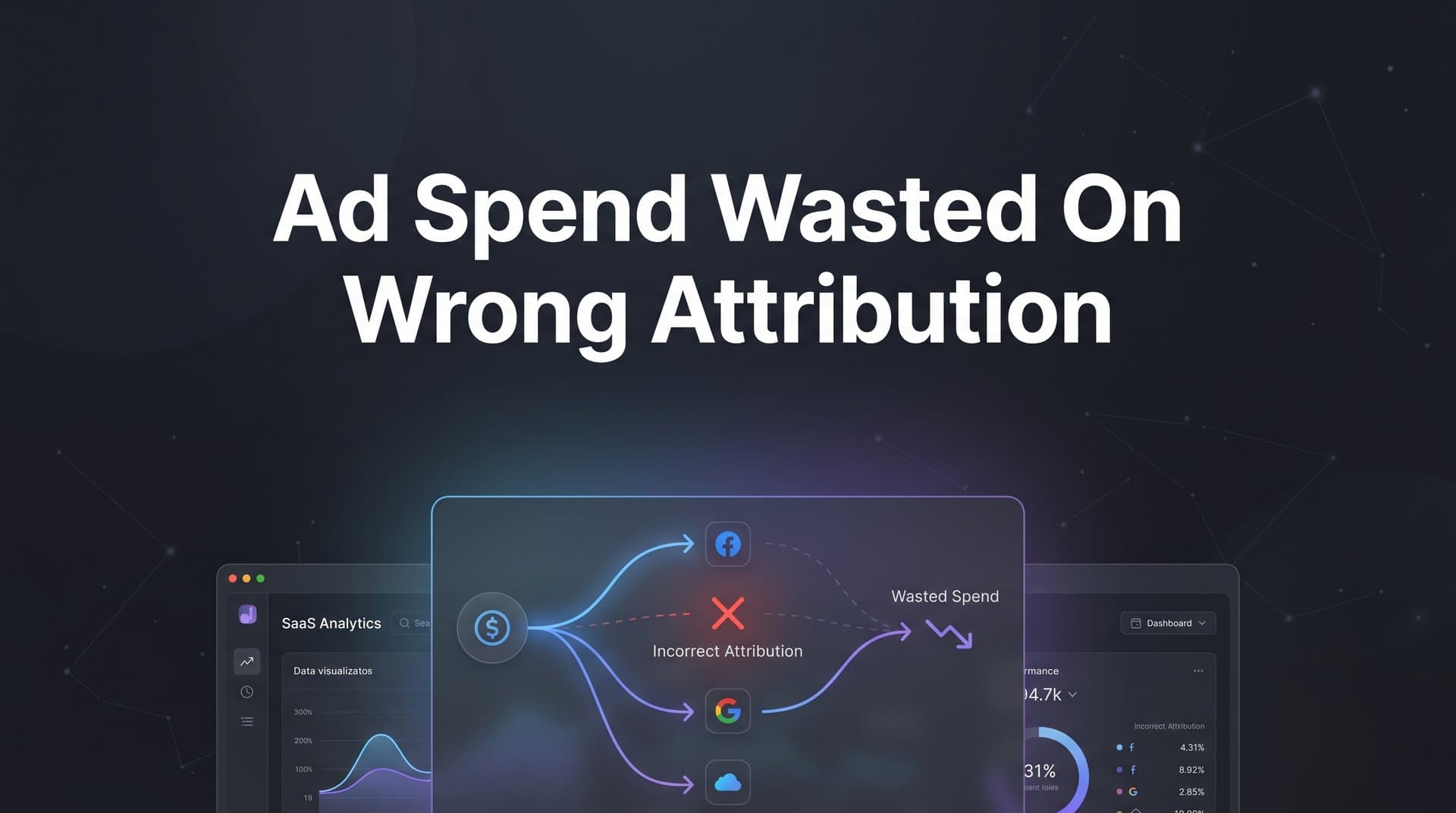
Then layer in platform-native attribution. Meta, Google, TikTok, and LinkedIn each use their own attribution windows in advertising and methodologies. When a user sees a Meta ad, then clicks a Google ad, then purchases, both platforms frequently claim full credit for that single conversion. You end up with reported conversions that exceed actual conversions by a wide margin. Your total reported ROAS across platforms can look excellent while your actual revenue growth tells a completely different story.
Privacy changes have made this significantly worse. Apple's App Tracking Transparency framework degraded the signal quality that Meta and other platforms rely on for mobile attribution. The gradual deprecation of third-party cookies has created similar gaps in browser-based tracking. Cross-device journeys, where someone sees an ad on mobile but converts on desktop, have always been difficult to track accurately, and these privacy shifts have made the problem larger. The default attribution models that most teams rely on were built for a more trackable internet. That internet no longer exists.
The Budget Drain You Cannot See on Your Dashboard
Wrong attribution does not just produce inaccurate reports. It triggers a chain reaction of budget decisions that compound over time.
It starts with misidentification. A channel appears to have strong ROAS because it consistently gets attribution credit, even if it is mostly capturing conversions that would have happened anyway through organic search or direct traffic. The team, trusting the data, increases budget allocation to that channel. Meanwhile, the channel that is actually generating new demand looks weaker in the dashboard, so its budget gets trimmed. This is how teams end up wasting ad spend on wrong channels without realizing it.
Over several weeks or months, you end up systematically over-investing in channels that look effective and under-investing in the ones that are actually driving revenue. The misallocation compounds because every budget cycle reinforces the previous decision.
There is a second layer that makes this worse. Ad platform algorithms are not passive recipients of your budget. They actively optimize based on the conversion signals you send them. When you feed Meta or Google inaccurate conversion data, those algorithms learn to find more users who match the profile of people who converted in your data. If your conversion data is inflated or misattributed, the algorithm optimizes toward the wrong audience profile. It gets better and better at finding people who trigger conversions in your reporting, rather than people who actually generate revenue for your business.
This is how misattribution makes performance worse over time, not just inaccurate. The algorithm is doing exactly what it is designed to do. It is just working from flawed inputs. Teams dealing with poor ad attribution data often see this compounding effect without understanding its root cause.
The distortion also flows into the metrics your team uses to make decisions. ROAS calculated from platform-reported conversions looks higher than actual ROAS. CPA looks lower than it actually is. When teams use these metrics to set bids, justify budgets, or evaluate creative, they are building their entire strategy on a foundation that does not reflect reality. Confident decisions made from inaccurate numbers are often more dangerous than uncertain decisions made from honest data, because confidence removes the caution that might otherwise prompt a second look.
Five Warning Signs Your Attribution Is Misleading You
The good news is that misattribution tends to leave visible signals if you know where to look. Here are five patterns worth investigating.
Platform conversions consistently exceed CRM or revenue data. This is the most direct signal. If your ad platforms are reporting 500 conversions in a period where your CRM shows 300 new customers, that gap is not a rounding error. It represents a meaningful discrepancy between what platforms claim and what actually happened. Understanding why attribution data doesn't match is the first step toward resolving these gaps. Pull this comparison regularly. A small gap may be explainable by timing differences. A large or growing gap points to a real attribution problem.
Multiple platforms claim credit for the same conversions. Add up the conversions reported across all your active ad platforms and compare that number to your actual transaction or lead count. If the sum of platform-reported conversions is significantly higher than your actual results, you are seeing double-counting in action. This is extremely common when running campaigns on Meta and Google simultaneously, as both platforms frequently attribute the same conversion to themselves.
Scaling a high-performing campaign produces diminishing returns or flat revenue. When you increase budget on a campaign that looks strong and revenue does not respond proportionally, that is a signal worth taking seriously. It often means the campaign was getting credit for conversions it did not actually cause, and scaling it simply spent more money without generating more real demand. The dashboard still looks fine. The bank account does not agree.
Your best-performing channels in the platform dashboard do not align with what your sales team or CRM data shows. Talk to your sales team. Ask where leads say they came from. Compare that to what your attribution model reports. Persistent misalignment between qualitative feedback and platform data is a meaningful warning sign. Developing strong wasted ad spend identification strategies can help you catch these discrepancies early.
Performance drops sharply after iOS updates or browser privacy changes. If a channel's reported conversions fell significantly after Apple's App Tracking Transparency changes without a corresponding drop in actual revenue, your previous numbers were likely inflated by tracking that is no longer possible. The channel may not have been performing as well as it appeared.
How Multi-Touch Attribution Closes the Gap
The fundamental problem with single-touch and platform-native attribution is that they only see part of the customer journey. Multi-touch attribution is built to see all of it.
Rather than giving full credit to one touchpoint or splitting it arbitrarily, multi-touch attribution tracks the complete sequence of interactions a customer has with your brand, from the first ad impression or click through every subsequent touchpoint, all the way to the CRM event or purchase. It then distributes credit across those touchpoints in proportion to their role in the journey. This gives you a much more accurate picture of which channels are actually contributing to revenue, not just which channels happen to appear last or first in a conversion path.
But accurate attribution starts with accurate data collection, and this is where server-side tracking becomes essential. Traditional client-side pixel tracking relies on JavaScript running in the user's browser. Browser privacy settings, ad blockers, iOS restrictions, and cookie limitations all interfere with that signal. Data gets lost before it is ever recorded.
Server-side tracking works differently. Instead of relying on the browser to fire a pixel, it sends conversion data directly from your server to the ad platform. This bypasses browser-based limitations entirely, capturing events that client-side pixels miss. The result is a more complete and accurate data set, which is the foundation that everything else depends on.
Once you have accurate, complete conversion data, the next step is feeding it back to the ad platforms in a way they can use. Meta's Conversions API and Google's enhanced conversions are designed for exactly this purpose. When you send enriched, server-side conversion data back to these platforms, their algorithms have better information to work with. Instead of optimizing toward users who match the profile of people who clicked, they can optimize toward users who match the profile of people who actually purchased or converted in your CRM. This is how teams reduce wasted ad spend with better data.
Platforms like Cometly are built around this approach. By connecting your ad platforms, website, and CRM into a single attribution system, Cometly captures every touchpoint across the customer journey and feeds enriched conversion data back to Meta, Google, and other platforms. The result is attribution that reflects what actually happened, not just what each platform wants to claim credit for.
A Practical Framework for Auditing Your Attribution Setup
Understanding the problem is one thing. Doing something about it requires a structured approach. Here is a practical framework for auditing your current attribution setup and identifying where the gaps are.
Step 1: Run a conversion reconciliation. Pull your platform-reported conversions for the last 30 to 90 days across every active ad channel. Then pull your actual conversion count from your CRM, payment processor, or sales system for the same period. Compare the two numbers. If platform-reported conversions are significantly higher than your actual business data, you have a measurable attribution gap. Quantifying this gap is the first step toward solving attribution data discrepancies.
Step 2: Map the overlap between platforms. If you are running campaigns on multiple platforms simultaneously, calculate the sum of all platform-reported conversions and compare it to your actual conversion count. The difference represents the degree of double-counting across platforms. This helps you understand which platforms are most likely over-claiming credit and by how much.
Step 3: Validate with incrementality testing. Platform-reported attribution tells you which channels got credit. Incrementality testing tells you which channels actually caused conversions. Geo-lift tests, where you run campaigns in some geographic markets but not others and compare results, are a standard method recommended by major ad platforms for measuring true incremental impact. Holdout experiments, where you withhold ads from a randomly selected audience segment and compare their conversion rate to the exposed group, serve a similar purpose. These tests are more work than reading a dashboard, but they provide the kind of ground truth that platform reporting cannot.
Step 4: Audit your tracking implementation. Check whether you are relying solely on client-side pixels. If so, evaluate what percentage of conversions may be going untracked due to browser limitations, ad blockers, or iOS restrictions. Investing in the right revenue attribution tracking tools is often the highest-leverage technical fix available for improving data quality.
Step 5: Build toward a unified data view. The goal is a single source of truth that connects your ad platform data, your website behavior data, and your CRM or revenue data into one coherent system. This is what makes it possible to see the full customer journey, compare attribution models against each other, and make budget decisions based on what actually drives revenue rather than what each platform claims it drove.
This kind of unified view is exactly what Cometly is designed to provide. By connecting every touchpoint from ad click to CRM event, it gives marketing teams the complete picture they need to allocate budget with confidence.
Reclaiming the Budget You Did Not Know You Were Losing
Wrong attribution is not a minor reporting inconvenience. It is an active budget leak that gets larger over time. Every dollar allocated based on inflated platform data is a dollar that could have gone to a channel that actually moves the needle. Every inaccurate conversion signal fed to an ad platform algorithm is a step toward worse targeting and higher effective CPAs. The compounding nature of these decisions means that teams who ignore attribution problems often find themselves in a progressively worse position without a clear explanation for why performance is declining.
The core fix requires three things working together. First, tracking every touchpoint accurately, which means moving beyond client-side pixels to server-side tracking that captures what browsers miss. Second, comparing attribution models and validating them against real business data rather than trusting any single platform's self-reported numbers. Third, feeding enriched, accurate conversion data back to ad platforms so their algorithms can optimize toward real buyers.
When these pieces are in place, something important shifts. Budget decisions become grounded in what is actually driving revenue. Channels that look weak in last-click attribution but play a critical role earlier in the journey get the investment they deserve. Channels that have been over-credited get scrutinized rather than automatically scaled. The entire marketing operation becomes more efficient because it is working from accurate information.
If you are not sure whether your current attribution setup is giving you an accurate picture, that uncertainty itself is worth acting on. The gap between what your platforms report and what your business actually generates is often larger than teams expect.
Cometly connects your ad platforms, CRM, and website data to show exactly which ads drive leads and revenue, with AI-powered analysis to surface what is actually working and recommendations to help you scale with confidence. Get your free demo today and start building the accurate, complete attribution picture your budget decisions deserve.