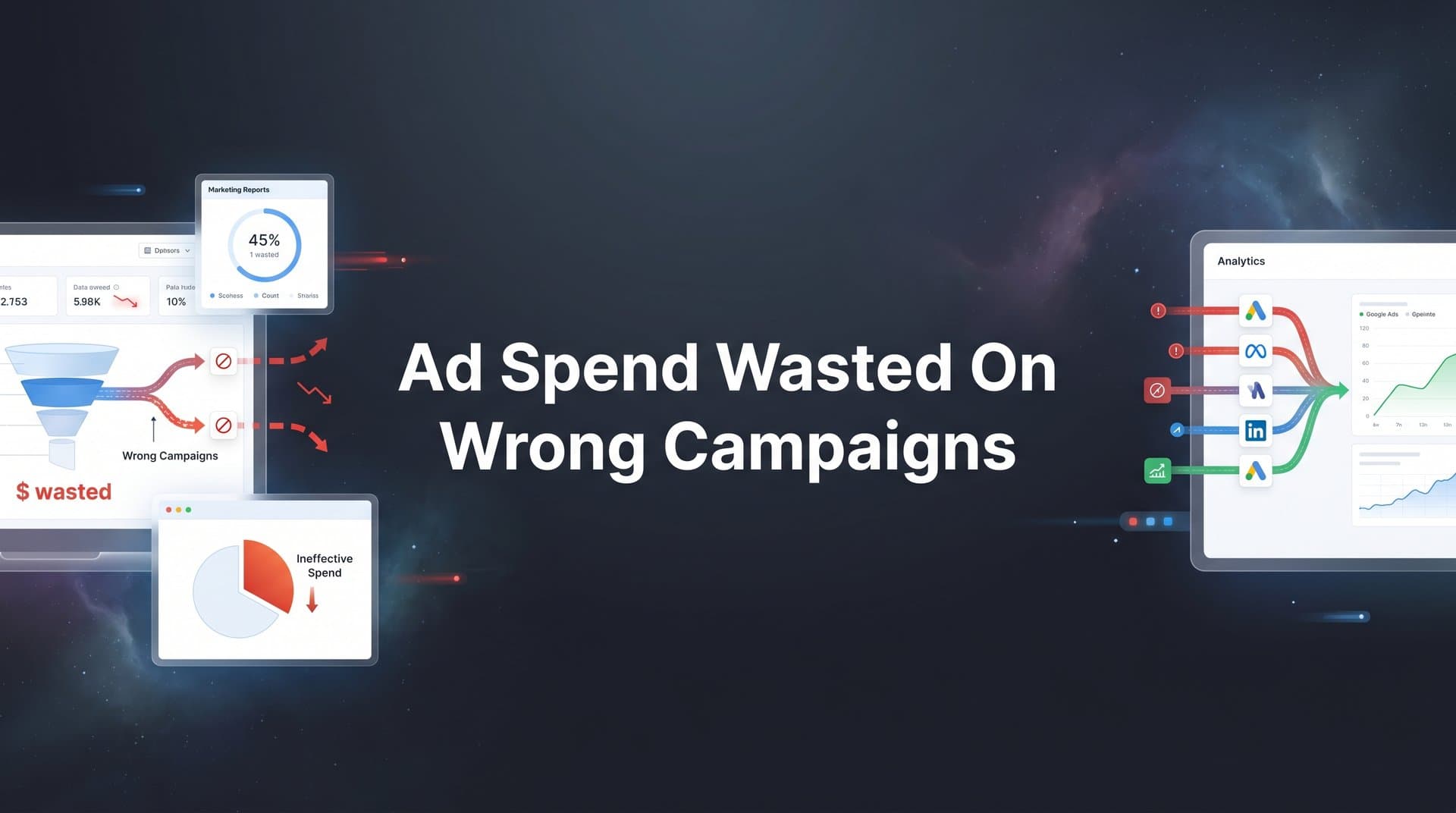
Picture this: your team wraps up the month, pulls up the ad performance dashboard, and the numbers look decent on the surface. Clicks are up. Impressions are strong. But when you cross-reference against actual revenue in your CRM, something feels off. A significant slice of your budget went to campaigns that generated plenty of activity but very little real business. The conversions the platforms reported? Many of them were duplicates, misattributed, or simply never connected to a closed deal.
This scenario plays out across marketing teams every single month. And the frustrating part is that it rarely feels like a data problem in the moment. It feels like a strategy problem, a creative problem, or maybe just a bad month. But the root cause is almost always the same: without accurate attribution, budget decisions are made in the dark.
Wasted ad spend is not just about overpaying for clicks that do not convert. It is about a deeper misalignment between where your money goes and where your revenue actually comes from. When your data is incomplete or misleading, your entire optimization process becomes unreliable. You scale the wrong campaigns, starve the right ones, and watch your cost per acquisition climb without understanding why.
This guide breaks down exactly why ad dollars get misallocated, the hidden mechanics that keep the problem alive, and the practical steps you can take to redirect your budget toward campaigns that actually drive results. Whether you are managing a modest budget or scaling aggressively across multiple platforms, understanding this problem is the first step to solving it.
The Real Cost of Flying Blind With Your Ad Budget
Before you can fix the problem, it helps to define it precisely. Wasted ad spend is money allocated to campaigns, audiences, or channels that do not meaningfully contribute to conversions or revenue. That sounds obvious, but the nuance matters. A campaign can generate thousands of clicks, strong engagement rates, and even platform-reported conversions while still being a net drain on your business if those conversions never translate into actual customers.
The problem compounds quickly. Ad platforms like Meta and Google rely on the conversion signals you send them to optimize their algorithms. When those signals are inaccurate or incomplete, the algorithm learns the wrong lessons. It starts targeting audiences that look like converters based on flawed data, which generates more flawed data, which further degrades performance. Over weeks and months, you can find yourself in a situation where your campaigns are highly optimized toward the wrong outcomes.
Think of it like training a sales team using the wrong success metrics. If you reward reps for the number of calls made rather than deals closed, you will get a team that is very busy but not very productive. The same logic applies to ad algorithms. Feed them bad signals, and they will get very good at doing the wrong thing.
There is also a significant opportunity cost to consider. Every dollar spent on a campaign that does not drive revenue is a dollar that could have gone to a campaign that does. When budgets are tight, this trade-off is obvious. But even when budgets are healthy, misallocation quietly erodes your overall return. Understanding how to optimize marketing spend is critical to avoiding this trap and ensuring every dollar works toward real business outcomes.
The marketers who recognize this dynamic early have a real competitive advantage. They stop chasing surface-level metrics and start building the data infrastructure that connects ad spend to actual business outcomes. That shift in perspective, from measuring activity to measuring impact, is where meaningful improvement begins.
Five Hidden Reasons Your Budget Keeps Going to the Wrong Campaigns
Most marketers know that tracking is imperfect. Fewer understand just how many distinct failure points exist between a customer's first ad interaction and a recorded conversion. Here are the most common reasons budget consistently flows toward the wrong campaigns.
Broken or incomplete tracking due to privacy changes: Apple's App Tracking Transparency framework, introduced with iOS 14.5, significantly reduced the ability of platforms like Meta to track user behavior across apps and websites. Combined with the ongoing deprecation of third-party cookies in browsers like Chrome, the result is that a meaningful portion of conversions simply go unrecorded by standard pixel-based tracking. When your pixel misses conversions, your data underreports performance across the board. But it does not underreport evenly. Campaigns targeting iOS users or privacy-conscious audiences may appear weaker than they actually are, causing you to cut spend on campaigns that are quietly driving real results.
Siloed platform reporting: Meta, Google, TikTok, and every other ad platform you run all have the same incentive: to show you the best possible version of their performance. Each platform uses its own attribution window and its own logic for claiming credit. The result is that the same conversion often gets counted by multiple platforms simultaneously. When you add up the conversions each platform reports, the total frequently exceeds the actual number of customers you acquired. Marketers who rely on platform-reported data in isolation routinely overestimate ROAS and make budget decisions based on inflated numbers. This is one reason why ad spend gets wasted on wrong channels so frequently.
Last-click attribution as the default: Many ad platforms and analytics tools default to last-click attribution, which gives 100% of the conversion credit to the final touchpoint before a purchase. This model systematically undervalues every campaign that happens earlier in the customer journey. Awareness campaigns, prospecting ads, and content-driven touchpoints that introduce your brand to new audiences get zero credit, even when they are the reason the customer entered your funnel in the first place. Over time, last-click attribution pushes marketers to over-invest in branded search and retargeting while cutting the campaigns that actually generate new demand.
Vanity metrics masquerading as performance: Click-through rates, impressions, and engagement metrics are easy to optimize for and easy to report. They look good in dashboards and feel like progress. But a campaign that drives high engagement without moving prospects through the funnel is not performing. It is just visible. When these metrics become the primary measure of success, budget naturally flows toward campaigns that produce them, regardless of their actual business impact.
Delayed or missing conversion data: When conversion events are not sent back to ad platforms in a timely and complete way, algorithms cannot optimize effectively. Delayed data means the platform is making targeting decisions based on stale signals. Missing data means it is working with an incomplete picture of what success looks like. Both scenarios lead to algorithmic drift, where campaigns gradually optimize toward proxies for conversion rather than actual revenue-generating behavior.
How Inaccurate Attribution Creates a Wasteful Feedback Loop
Understanding the individual failure points is important, but the bigger problem is how they interact. Inaccurate attribution does not just cause a one-time misread of performance. It creates a self-reinforcing cycle that gets harder to break the longer it runs.
Here is how the loop works. You run campaigns and collect conversion data. That data, even if incomplete or inaccurate, gets fed back to the ad platform's algorithm. The algorithm uses it to identify patterns: what audiences convert, what creative drives action, what placements perform. It then optimizes toward those patterns, allocating more budget and reach to what it believes is working. If the underlying data is flawed, the algorithm confidently scales in the wrong direction.
Conversion sync failures accelerate this problem. When the events you send back to Meta or Google are delayed, filtered, or missing key context like revenue value or customer quality, the algorithm is essentially working with a blurry image of your ideal customer. Mastering conversion tracking is essential to ensuring these signals reach the platforms accurately and completely.
Multi-touch customer journeys make this even more complex. In reality, most customers interact with multiple campaigns, channels, and touchpoints before converting. They might see a prospecting ad on Meta, click a Google search ad a week later, and then convert through a retargeting campaign. If your attribution only captures the last touchpoint, you see the retargeting campaign as the hero and the earlier campaigns as underperformers. You cut the prospecting budget. Fewer new customers enter the funnel. Retargeting performance declines because the audience pool shrinks. Now you have a performance problem that looks like a creative or bidding issue but is actually a data issue.
This is why fixing attribution is not just about getting more accurate reports. It is about breaking the feedback loop that systematically directs budget away from the campaigns that build your pipeline and toward the campaigns that simply close the deals those earlier campaigns made possible. Without a complete picture of the customer journey, you are essentially optimizing the last mile while neglecting the road that gets people there.
Diagnosing Where Your Ad Spend Is Leaking
If you suspect your budget is flowing toward the wrong campaigns, the most valuable thing you can do is run a structured audit before making any changes. Reactive budget cuts based on incomplete data often make the problem worse. A systematic diagnosis gives you a clear picture of where the leaks actually are.
Start by comparing platform-reported conversions against CRM-verified revenue. Pull the conversions each platform claims for a given period, then cross-reference those numbers against the deals or purchases actually recorded in your CRM. Look for the gap. Learning how to attribute revenue to specific campaigns is the foundation of this process and will reveal where your reported numbers diverge from reality.
Next, identify what you might call vanity campaigns. These are campaigns that generate strong engagement metrics, high click volumes, or even platform-attributed conversions, but show no corresponding pipeline activity or revenue when traced through your CRM. They look healthy in the ad platform dashboard but disappear when you follow the customer journey downstream. These campaigns are often the primary source of wasted spend because they are easy to justify on the surface and hard to cut without the right data.
Conversion funnel analytics can help you pinpoint exactly where the breakdown happens. Map out the stages of your funnel, from first ad interaction to lead to qualified opportunity to closed deal, and look at where volume drops off for each campaign. A campaign that drives strong top-of-funnel activity but zero progression past the first stage is a strong candidate for reallocation. Leveraging marketing campaign analytics at each stage helps you see these patterns clearly.
Pay particular attention to the time lag between ad interaction and conversion. Some campaigns influence decisions that take days or weeks to materialize. If your attribution window is too short, you will systematically undervalue these campaigns. Extending your lookback window and analyzing assisted conversions can reveal significant contributions that standard last-click reporting misses entirely.
The goal of this audit is not to find campaigns to cut. It is to understand the true relationship between your ad spend and your revenue, so that every subsequent budget decision is grounded in accurate data rather than platform-reported optimism.
Fixing the Problem: Building a Data-Accurate Ad Strategy
Once you understand where your data is breaking down, you can build a more reliable foundation for budget decisions. The fix is not a single tactic. It is a combination of infrastructure improvements and modeling changes that work together to give you an accurate picture of what is actually driving revenue.
Server-side tracking as your foundation: Browser-based pixels are increasingly unreliable. Ad blockers, browser privacy settings, and iOS restrictions all reduce the percentage of conversions that a standard pixel captures. Server-side tracking solves this by sending conversion data directly from your server to the ad platform, bypassing the browser entirely. This means conversions that would have been lost due to browser restrictions are now captured and reported accurately. The result is a more complete data set that gives ad platform algorithms better signals to optimize against.
Multi-touch attribution for a complete view: Replacing last-click attribution with a multi-touch model is one of the highest-leverage changes you can make. Choosing the right attribution model for optimizing ad campaigns is critical, as different models distribute conversion credit across touchpoints in different ways. This gives you a far more accurate picture of which campaigns contribute at each stage of the funnel. You can see which prospecting campaigns are generating the new demand that your bottom-funnel campaigns eventually close, and you can fund them accordingly. Budget decisions based on multi-touch data tend to be meaningfully more efficient than those based on single-touch models.
Feeding enriched conversion data back to platforms: This is where the compounding benefits really kick in. When you send enriched, verified conversion events back to Meta, Google, and other platforms, including revenue value, customer quality signals, and accurate match data, their algorithms can optimize toward your actual business outcomes rather than proxy metrics. This process, sometimes called conversion sync, transforms the feedback loop from a source of degradation into a source of improvement. Better signals in means better targeting out, which means higher-quality conversions, which means better signals in the next cycle.
Together, these three elements create an attribution infrastructure that supports confident, data-driven budget decisions. You stop guessing which campaigns are working and start knowing. Investing in the right marketing campaign attribution solution is what makes scaling possible without proportionally scaling waste.
Turning Wasted Spend Into Scalable Growth
There is a meaningful difference between reducing waste and building a system that continuously improves. The tactical fixes described above will stop the bleeding. But the real opportunity is in creating a compounding advantage where better data leads to better decisions, which leads to better results, which generates even better data.
AI-powered analytics play a significant role in making this compounding benefit practical. Rather than waiting for end-of-month reporting to identify underperforming campaigns, analytics for paid campaigns driven by AI can surface patterns in real time, flagging campaigns that are consuming budget without contributing to pipeline and recommending reallocation toward campaigns with stronger revenue signals. This shortens the feedback loop from weeks to hours, which means you are not burning budget on the wrong campaigns for an entire month before catching the problem.
Platforms like Cometly are built specifically for this kind of visibility. By connecting your ad platforms, CRM, and website into a unified attribution view, Cometly shows you exactly which campaigns, channels, and touchpoints are driving real revenue. The AI Ads Manager surfaces optimization recommendations based on actual performance data rather than platform-reported metrics. And with server-side tracking and conversion sync built in, the data flowing back to your ad platforms is richer and more accurate, which improves algorithmic targeting over time.
As your attribution improves, each dollar you spend becomes more efficient. You are no longer funding campaigns that look good on paper but deliver nothing downstream. You are concentrating budget on the campaigns that demonstrably move customers through your funnel and generate revenue. That efficiency compounds. As ad platform algorithms receive better signals, they get better at finding high-value prospects. You can also use a return on ad spend calculator to quantify these improvements and validate that your optimization efforts are translating into measurable gains.
Accurate attribution also changes how you think about scaling. Without it, scaling feels risky because you are not sure which part of your strategy is actually working. With it, scaling becomes a calculated decision based on clear evidence. You know which campaigns to increase, which to cut, and which to test further. That clarity is not just operationally useful. It is a genuine competitive advantage in markets where most advertisers are still flying blind.
Putting It All Together
Wasted ad spend is fundamentally a data problem. Strategy, creative, and bidding all matter, but none of them can compensate for attribution that is broken at the foundation. When your data is incomplete, your optimization process is unreliable, your platform algorithms learn the wrong lessons, and your budget consistently flows toward campaigns that generate activity rather than revenue.
The path forward requires three key shifts. First, move from siloed platform data to a unified attribution view that shows you the complete customer journey across every channel. Second, move from pixel-only tracking to server-side solutions that capture conversions even in a privacy-first environment. Third, move from guesswork and end-of-month reviews to AI-driven recommendations that surface insights in real time.
These are not incremental improvements. They are structural changes that transform how you understand and act on your marketing data. And the compounding benefit is significant: as your data improves, your decisions improve, your algorithms improve, and your return on every ad dollar improves alongside them.
You do not have to keep funding campaigns that are quietly draining your budget. With the right attribution infrastructure in place, you can see exactly what is working, scale it with confidence, and stop wasting spend on what is not. Ready to elevate your marketing game with precision and confidence? Discover how Cometly's AI-driven recommendations can transform your ad strategy. Get your free demo today and start capturing every touchpoint to maximize your conversions.