
Your retargeting campaigns are about to get a lot harder. The tracking methods you've relied on for years are disappearing, and if you're not prepared, you'll be flying blind while your competitors pull ahead.
Third-party cookies—the invisible trackers that followed users across the web and powered your attribution—are being phased out. Safari and Firefox already block them. Chrome, which controls over 60% of browser traffic, is actively dismantling them through Privacy Sandbox. This isn't a distant problem. It's happening now.
But here's what most marketers miss: cookie deprecation isn't the crisis everyone feared. It's actually an opportunity to build better, more accurate tracking systems that respect privacy while delivering clearer insights than cookies ever could. The marketers who adapt early will have a massive competitive advantage. Those who wait will scramble to catch up while their attribution crumbles.
This guide walks you through exactly what's changing, what you're losing, and how to build a modern tracking stack that works better than your old setup. You'll learn how to use server-side tracking, leverage first-party data, and maintain accurate attribution across every channel—all while staying ahead of privacy regulations.
The Cookie Collapse: Understanding What You're Actually Losing
Third-party cookies are dying because browsers and regulators decided users deserve control over their data. Apple's Safari introduced Intelligent Tracking Prevention in 2017. Firefox launched Enhanced Tracking Protection in 2019. Both browsers now block third-party cookies by default.
Google Chrome held out longer because of its massive market share and advertising business, but even Chrome is phasing out third-party cookies through Privacy Sandbox. The timeline has shifted multiple times, but the direction is clear: third-party cookies are finished.
Privacy regulations accelerated this shift. GDPR in Europe and CCPA in California established strict rules around data collection and user consent. Consumers expect transparency about how their data is used. Browsers responded by building privacy features directly into their platforms, making third-party tracking harder even before cookies fully disappear.
So what exactly are you losing? Third-party cookies enabled cross-site tracking, letting you follow a user from a blog article to a review site to your landing page. Without them, you can't track users across different domains using traditional pixel-based methods.
Your retargeting audiences will shrink dramatically. When someone visits your site but doesn't convert, you can't drop a cookie and follow them around the web with ads. The pools of users you can retarget become smaller and less precise. Understanding the full third-party cookie deprecation impact on your campaigns is essential for planning ahead.
View-through attribution gets murky. You lose visibility into users who saw your display ad but didn't click, then converted later. Without cross-site cookies, connecting that impression to the eventual conversion becomes nearly impossible with client-side tracking alone.
Attribution windows compress. Cookies had long lifespans, letting you attribute conversions weeks or months after the first touchpoint. As cookies disappear, your ability to track long consideration cycles weakens unless you adopt new methods.
The platforms themselves still have data about logged-in users within their ecosystems. Facebook knows what happens on Facebook. Google knows what happens across Google properties. But your ability to independently verify and attribute conversions across platforms diminishes when you rely only on browser-based tracking.
Building on First-Party Data: The Foundation That Actually Works
First-party data is information you collect directly from your customers with their consent. Unlike third-party cookies that track users across sites they don't control, first-party data comes from interactions users have directly with your business.
This includes website behavior tracked through first-party cookies—which are not being deprecated. When someone visits your site, you can still set cookies on your own domain to track their sessions, pages viewed, and actions taken. These first-party cookies survive browser restrictions because they serve legitimate functionality for your site.
It also includes CRM data: email addresses, phone numbers, purchase history, support interactions, and account information. This data is deterministic—you know exactly who the customer is because they told you directly.
Email engagement adds another layer: open rates, click-through rates, and conversion actions from email campaigns. Purchase data reveals what customers buy, how often, and at what price points. All of this first-party data is more accurate and privacy-compliant than anything third-party cookies ever provided.
Building a first-party data strategy starts with consent. You need clear opt-ins that explain what data you're collecting and how you'll use it. This isn't just legal compliance—it's building trust with customers who are increasingly aware of privacy issues.
Data enrichment comes next. When someone fills out a form with their email, you can connect that email to their previous website visits, ad clicks, and future purchases. You're building a unified profile of each customer that persists across sessions and devices. Implementing tracking conversions without cookies becomes much easier with this foundation.
The key is creating a single source of truth. Your website analytics, CRM, email platform, and ad accounts should all feed into a unified customer profile. When someone converts, you know every touchpoint they encountered because you've connected the data deterministically using identifiers like email or phone number.
Here's why first-party data is actually better than cookies: it's more accurate. Cookies could be deleted, blocked, or expire. First-party data persists. When you know someone's email address and purchase history, you don't lose that information when they clear their browser cache.
It's also more valuable to ad platforms. When you send conversion events with hashed email addresses or phone numbers, platforms like Meta and Google can match those conversions to user accounts with high confidence. This improves their optimization algorithms and helps them find more customers like your best converters.
First-party data gives you ownership. You're not dependent on third-party cookies that browsers can block or regulations can restrict. You control the data, the relationships, and the insights.
Server-Side Tracking: How Modern Attribution Actually Works
Server-side tracking fundamentally changes where and how conversion data is sent to ad platforms. Instead of relying on browser-based pixels that load on a user's device, server-side tracking sends events directly from your server to the ad platform's server.
Traditional pixel tracking works like this: A user visits your site, a JavaScript pixel fires in their browser, and that pixel sends data to Facebook, Google, or wherever. This method depends on the user's browser allowing that communication, cookies being enabled, and no ad blockers interfering. Many marketers have experienced cookie-based tracking problems that make this approach unreliable.
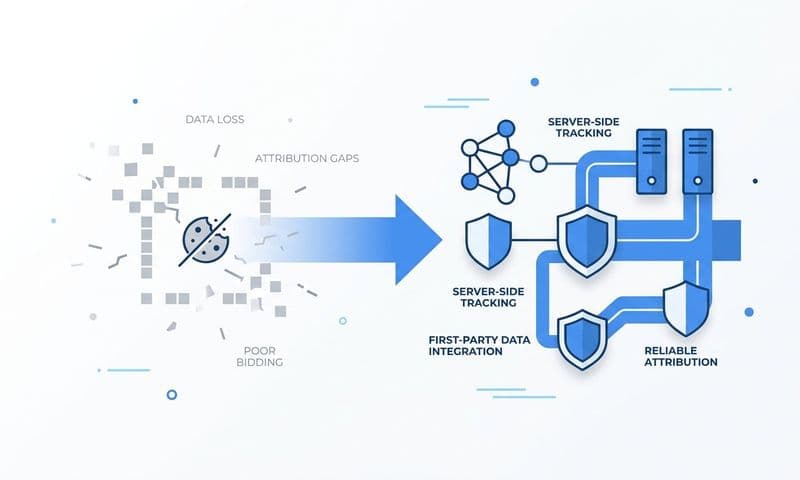
Server-side tracking bypasses all those limitations. When a user converts on your site, your server captures that event and sends it directly to the ad platform via API. The user's browser never needs to communicate with Facebook or Google. Ad blockers can't stop it. Browser privacy settings don't interfere.
This approach captures more complete data because it's not subject to client-side restrictions. You get better conversion visibility, more accurate attribution, and fewer lost signals from ad blockers or privacy features.
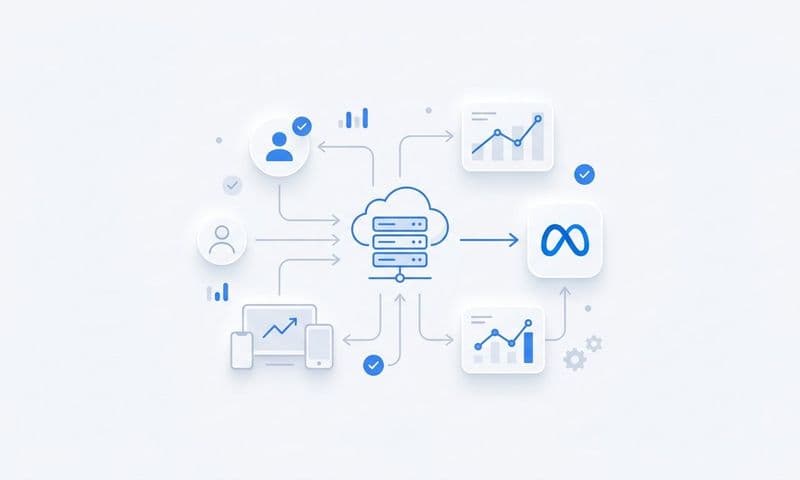
Implementation requires connecting your website, ad platforms, and CRM through server-side events. When someone makes a purchase, your server records the transaction and sends that conversion event to Meta, Google, and any other platforms you're using—all through direct server-to-server communication.
The technical setup involves creating server-side event tracking on your website backend, implementing APIs from each ad platform, and mapping your conversion events to the parameters each platform expects. You're essentially building a pipeline that flows conversion data from your server to theirs.
Server-side tracking also enables data enrichment before sending events. You can attach additional customer information—like lifetime value, customer segment, or purchase history—to each conversion event. This gives ad platforms richer signals to optimize against.
The combination of server-side tracking and first-party data creates a resilient attribution system. You're using deterministic identifiers (email, phone, user ID) sent through server-to-server connections that can't be blocked. This survives cookie deprecation completely.
Platform APIs: Feeding Better Data to Meta, Google, and Beyond
Every major ad platform has built APIs specifically designed to receive server-side conversion data. These APIs work alongside traditional pixels to give platforms more complete conversion signals, which improves their ability to optimize your campaigns.
Meta's Conversions API (CAPI) lets you send conversion events directly from your server to Facebook. Instead of relying solely on the Meta Pixel firing in a user's browser, you send purchase events, lead submissions, and other conversions through a direct server connection.
The power of CAPI is that it captures conversions the pixel misses. When someone has an ad blocker enabled or opts out of tracking in iOS, the pixel doesn't fire. But your server still knows the conversion happened, and CAPI sends that data to Meta anyway. This is why ad tracking without third-party cookies has become the new standard.
You send hashed customer information—email addresses, phone numbers—along with each conversion event. Meta matches these identifiers to user accounts and attributes the conversion to the correct ad. This deterministic matching is far more accurate than cookie-based probabilistic matching.
Google Enhanced Conversions works similarly for Google Ads. You send hashed first-party data (email, phone, address) with your conversion events. Google uses this information to improve conversion measurement and attribution, especially for users who don't allow third-party cookies.
Enhanced Conversions helps Google's algorithms understand which ads and keywords drive real business results. When you send back detailed conversion data with customer identifiers, Google can optimize your campaigns more effectively than it could with incomplete pixel data alone.
TikTok, Pinterest, Snapchat, and other platforms have their own versions of these APIs. The pattern is consistent: send conversion events from your server with hashed customer identifiers, and the platform matches them to user accounts for better attribution and optimization.
These APIs work best when combined with traditional pixels in a dual-tracking setup. The pixel captures browser-side events for users who allow tracking. The API captures everything else. Together, they give platforms the most complete view of your conversions.
When ad platforms receive better conversion data, their machine learning algorithms improve. They can identify patterns in who converts, optimize bidding toward high-value audiences, and find new customers who look like your best converters. Better data in means better performance out.
Multi-Touch Attribution Without Cookies: Connecting the Full Journey
Multi-touch attribution becomes more important in a cookieless world because you need to understand the full customer journey, not just the last click. Without cross-site cookies, connecting touchpoints requires deterministic matching using identifiers like email addresses, phone numbers, or user IDs.
Last-click attribution gives credit only to the final touchpoint before conversion. This undervalues top-of-funnel awareness campaigns and mid-funnel nurturing efforts. In a cookieless environment where you have less visibility into the full journey, relying on last-click becomes even more misleading.
Multi-touch attribution distributes credit across all touchpoints in the customer journey. Someone might discover you through a Facebook ad, research on Google, read your email campaign, and finally convert through a retargeting ad. Each of those touchpoints contributed to the conversion. Implementing cookieless attribution tracking ensures you capture this complete picture.
The challenge without cookies is connecting those touchpoints when they happen across different sites and platforms. The solution is first-party data. When someone clicks your Facebook ad and lands on your site, you capture their email when they sign up for your newsletter. Now you can track every subsequent interaction using that email as the identifier.
When they return from a Google search, you recognize them by email or user ID. When they open your email campaign and click through, you connect that touchpoint. When they finally convert, you have a complete record of every interaction because you've been matching events deterministically, not relying on cookies.
Different attribution models reveal different insights. First-touch attribution shows which channels are best at generating new leads. Linear attribution gives equal credit to all touchpoints. Time-decay attribution gives more credit to interactions closer to conversion. Position-based attribution emphasizes both first and last touch.
Comparing these models helps you understand true campaign performance. If a channel performs well in first-touch but poorly in last-click, it's a strong awareness driver but weak at closing. If it performs well in last-click but poorly in first-touch, it's effective at converting already-warm leads.
A unified attribution platform connects data from all your marketing channels—paid ads, organic search, email, social, direct traffic—and maps the complete customer journey. This gives you visibility into how channels work together, which combinations drive the best results, and where to invest your budget.
Without cookies, this level of attribution requires a system that captures first-party data, implements server-side tracking, and uses deterministic matching to connect touchpoints. It's more complex than cookie-based attribution, but it's also more accurate and privacy-compliant.
Your Cookieless Tracking Stack: What You Need and How to Implement It
Building a modern tracking stack that works without third-party cookies requires three essential components: server-side tracking, first-party data collection, and a unified attribution platform that connects everything.
Start with server-side tracking implementation. Set up event tracking on your website backend so your server captures conversions, page views, and key actions. Then implement server-side APIs for each ad platform you use—Meta CAPI, Google Enhanced Conversions, TikTok Events API, and others. Our cookieless tracking implementation guide walks through this process step by step.
Next, build your first-party data collection infrastructure. Create clear consent mechanisms that let users opt in to tracking. Implement lead capture forms that collect emails and phone numbers. Connect your CRM to your website so customer data flows into a unified profile.
The third component is a unified attribution platform that connects your website, ad platforms, and CRM. This platform should track the entire customer journey using deterministic identifiers, attribute conversions across multiple touchpoints, and feed enriched conversion data back to ad platforms.
Feeding better data back to ad platforms is crucial. When you send conversion events through server-side APIs with hashed customer identifiers and additional context (like customer lifetime value or purchase category), those platforms can optimize more effectively. Their algorithms learn what drives valuable conversions and adjust bidding accordingly.
Audit your current setup to identify gaps. Check whether your conversion tracking relies entirely on browser-based pixels. Evaluate how much first-party data you're collecting and whether it's unified across systems. Test whether your tracking survives ad blockers and browser privacy features.
Common gaps include: no server-side tracking implementation, disconnected data silos where your CRM doesn't talk to your ad platforms, reliance on third-party cookies for cross-domain tracking, and no multi-touch attribution to understand the full customer journey. If you're experiencing issues, review why cookie tracking not working anymore affects your specific setup.
Prioritize fixes based on impact. Implementing server-side tracking for your highest-spending ad platforms should come first. Building first-party data collection through lead magnets and email capture is next. Connecting systems through a unified attribution platform comes last but delivers the most comprehensive insights.
The marketers who build this infrastructure now will have a major advantage. While competitors scramble to adapt when cookies fully disappear, you'll already have accurate, privacy-compliant tracking that captures more data than cookie-based systems ever could.
The Cookieless Advantage: Why Early Adopters Win
Cookie deprecation isn't the end of effective ad tracking. It's a transition to more accurate, privacy-respecting methods that give you better insights and competitive advantages. The marketers who adopt server-side tracking and first-party data strategies now will dominate while others struggle to adapt.
Your new tracking stack will be more resilient. Server-side tracking bypasses ad blockers and browser restrictions. First-party data persists across sessions and devices. Deterministic matching using email and phone numbers is more accurate than cookie-based probabilistic matching ever was.
You'll feed better data to ad platforms, which improves their optimization algorithms. When Meta, Google, and other platforms receive complete conversion signals with enriched customer information, they can find more high-value customers and optimize bidding more effectively. Your campaigns perform better because the platforms have better data.
Privacy compliance becomes a competitive advantage. Users trust businesses that respect their data and provide transparency. When you build tracking systems on first-party data with clear consent, you're not just complying with regulations—you're building stronger customer relationships.
The time to act is now. Evaluate your current tracking capabilities. Identify what breaks when cookies disappear. Implement server-side tracking for your key platforms. Build first-party data collection into your marketing funnel. Connect everything through a unified attribution system that tracks the complete customer journey.
Ready to elevate your marketing game with precision and confidence? Discover how Cometly's AI-driven recommendations can transform your ad strategy—Get your free demo today and start capturing every touchpoint to maximize your conversions.