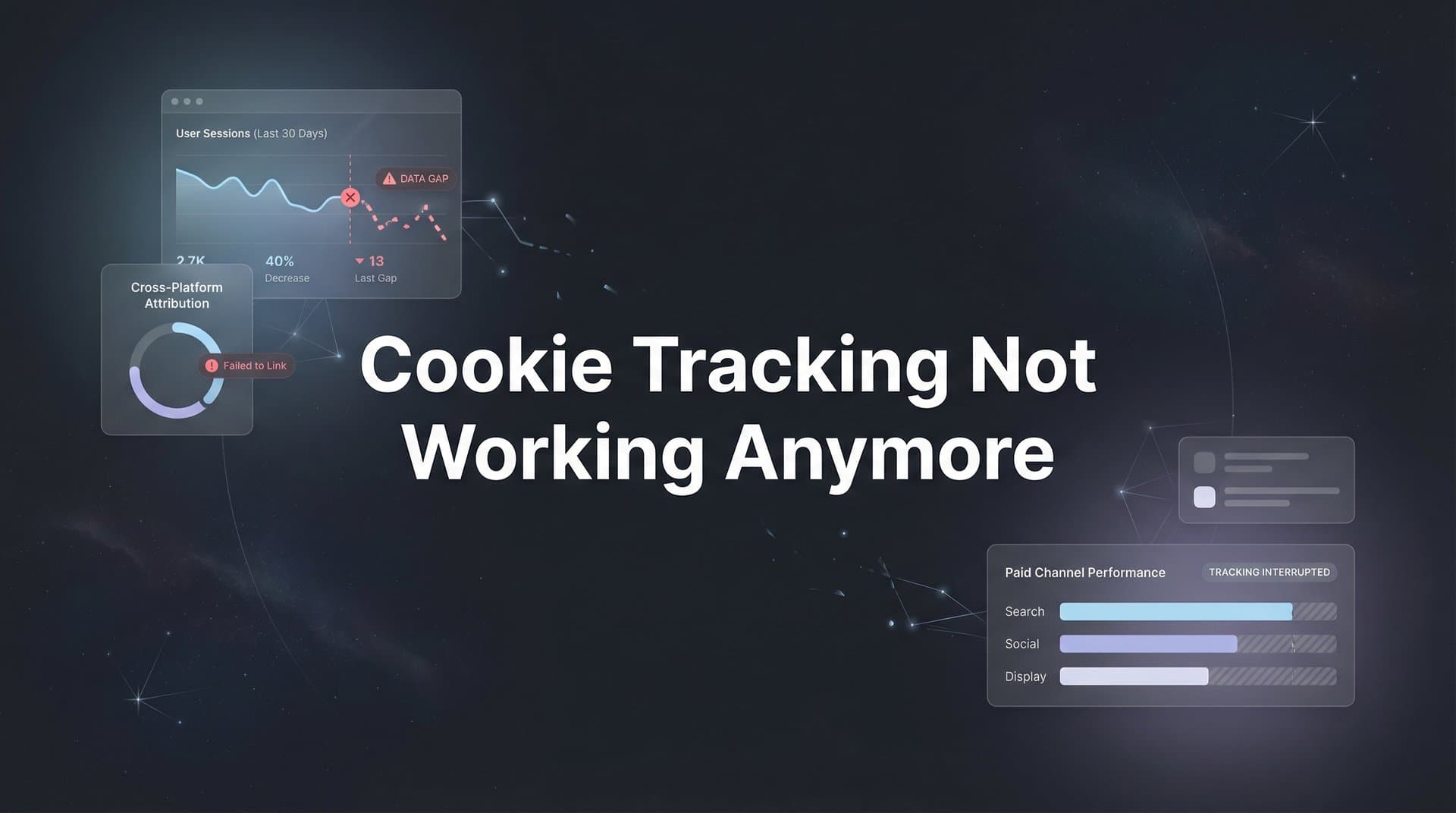
Your campaigns were crushing it last quarter. Strong ROAS, solid conversion rates, and your retargeting audiences were converting like clockwork. Then something shifted. Your Meta ads started reporting 30% fewer conversions than your CRM shows actually happened. Your Google Analytics dashboard looks like half your traffic vanished overnight. Retargeting pools that used to be thousands strong now barely hit the hundreds.
This isn't a technical glitch you can fix with a support ticket. This is the new reality of digital marketing measurement.
Cookie tracking—the invisible infrastructure that powered attribution, retargeting, and campaign optimization for over two decades—has fundamentally broken. Not "needs adjustment" broken. Not "wait for the next update" broken. Structurally, permanently changed. And if you're still running campaigns built on cookie-based tracking assumptions, you're optimizing with incomplete data and wondering why performance keeps declining despite doing everything "right."
The good news? The solution exists, and the marketers adopting it now are seeing dramatically better data accuracy and campaign performance than competitors still clinging to outdated tracking methods. Let's break down exactly what happened to cookie tracking, why it's destroying your attribution data, and what you need to implement to compete in this new environment.
The Perfect Storm: Three Forces That Killed Traditional Cookies
Cookie tracking didn't die from a single cause. It was killed by three simultaneous forces that converged between 2020 and 2025, each one cutting off a different piece of the tracking infrastructure marketers had relied on.
Browser Restrictions Rewrote the Rules
Apple fired the first major shot in 2017 with Safari's Intelligent Tracking Prevention (ITP). Initially, it seemed like a minor inconvenience. But by 2020, ITP had evolved into something far more aggressive: first-party cookies now expire after just 7 days maximum. Worse, cookies set via JavaScript from ad clicks—the exact mechanism most tracking pixels use—are limited to 24 hours.
Think about what that means for your attribution. A user clicks your Facebook ad on Monday, browses your site, leaves, comes back directly on Thursday to make a purchase. Your cookie expired on Tuesday. That conversion? Completely invisible to your ad tracking. As far as Facebook knows, that ad never drove a sale.
Firefox joined the fight in 2019, blocking third-party cookies by default. Then came the big one: Google Chrome, which commands over 60% of browser market share, began its phased third-party cookie deprecation. What started as a distant 2024 deadline became reality in 2025, and by early 2026, the cookie-based web you built campaigns around simply doesn't exist anymore. Understanding the full cookie deprecation impact on tracking is essential for adapting your strategy.
Privacy Regulations Made Consent Mandatory
While browsers were tightening technical restrictions, privacy laws were adding legal requirements. GDPR in Europe and CCPA in California didn't just suggest getting user consent—they made it legally mandatory before dropping tracking cookies.
Here's the problem: when you actually ask users if you can track them across the internet to serve targeted ads, a significant portion say no. Consent rates vary by region and implementation, but you're looking at anywhere from 30-60% of your European traffic actively declining tracking. Those users are completely invisible to your cookie-based analytics and retargeting systems.
You're not just losing data accuracy. You're losing the ability to measure and optimize for a substantial chunk of your actual audience.
iOS 14.5 Created a Mobile Attribution Black Hole
The third force hit in April 2021 when Apple released iOS 14.5 with App Tracking Transparency (ATT). For the first time, apps had to explicitly ask users for permission to track their activity across other apps and websites. Apple presented this choice with stark language designed to encourage declining.
The results were predictable. Industry reports consistently show that the majority of iOS users—often 70% or more—decline tracking when asked. Given that iOS users represent a disproportionately valuable demographic for many advertisers, this created massive attribution gaps overnight.
Meta famously estimated that iOS privacy changes would cost them $10 billion in lost ad revenue in 2022 alone. That wasn't money disappearing from their business—it was the value of conversions happening that could no longer be measured, attributed, or used to optimize campaigns. The challenges extend beyond mobile, creating significant cross-device user tracking challenges that affect your entire measurement strategy.
These three forces didn't just damage cookie tracking. They dismantled it completely, from three different angles simultaneously. And the impact on your marketing data is more severe than most marketers realize.
How Cookie Degradation Destroys Your Marketing Data
When cookies stop working, it's not just your analytics dashboard that suffers. The entire optimization engine that powers modern digital advertising breaks down. Let's walk through exactly how this plays out across your campaigns.
Attribution Gaps Turn Customer Journeys Into Fiction
Modern customer journeys are complex. Someone sees your Instagram ad on their phone Monday morning during their commute. They're intrigued but not ready to buy. Tuesday evening, they're on their laptop and search your brand name on Google. They land on your site, browse a few product pages, but still don't convert. Friday, they see a retargeting ad on Facebook, click through, and finally make a purchase.
In a cookie-based tracking world, you'd see that complete journey. Instagram gets credit for awareness, Google for consideration, Facebook for conversion. Your attribution model could intelligently distribute credit across those touchpoints.
Here's what actually happens now: The Instagram cookie expired after 24 hours because it was set from an ad click. The Google cookie lasted longer but was blocked by the user's browser privacy settings. The Facebook cookie existed but was a third-party cookie that Chrome blocked entirely. Your analytics platform sees a direct visit conversion with no marketing attribution whatsoever.
You just spent money on three different platforms to drive that sale, and your tracking system shows it as organic traffic. How do you optimize when your data is this fundamentally wrong? This is why understanding attribution tracking methods beyond cookies has become critical for modern marketers.
Your Retargeting Audiences Are Bleeding Users
Retargeting used to be the highest-ROI channel in most marketing stacks. Someone visited your pricing page but didn't convert? Add them to a retargeting audience and show them a discount offer. Simple, effective, and built entirely on cookies tracking that pricing page visit.
Now those audiences are shrinking dramatically. Users who decline tracking never get added. Users whose cookies expire before you can retarget them disappear from the pool. Users on browsers that block third-party cookies are invisible from the start.
What used to be an audience of 10,000 warm prospects is now 3,000. Your retargeting campaigns still run, but they're reaching a fraction of the actual qualified audience. Frequency increases because you're showing ads to the same small pool repeatedly. Costs rise because you're competing for a limited audience. Performance tanks because you're missing the majority of your actual prospects.
Ad Platform Algorithms Are Starving for Conversion Data
This is where cookie degradation hits hardest: the optimization loop that makes modern ad platforms work has been fundamentally broken.
Meta's machine learning doesn't just guess who might convert. It learns from actual conversion data. When someone clicks your ad and converts, Meta's algorithm notes every characteristic of that user—demographics, interests, behaviors, device type, time of day, everything. It then finds more users who match that profile and serves them your ads.
But here's the critical problem: Meta can only learn from conversions it can actually see and attribute. When cookie tracking breaks down, Meta might deliver 100 actual conversions but only receive conversion signals for 40 of them. The algorithm thinks it's optimizing toward users who convert, but it's actually optimizing toward the subset of users whose conversions happen to be trackable.
That's not a small technical issue. That's the difference between an algorithm that gets smarter with every conversion and one that's essentially guessing based on incomplete, biased data. Your CPAs climb because the platform can't efficiently find high-value prospects. Your ROAS drops because optimization is happening in the dark. When your tracking pixels aren't firing correctly, the downstream effects on campaign performance are severe.
The fundamental infrastructure of digital advertising assumed cookies would work. They don't anymore. And band-aid fixes won't solve a structural problem.
Server-Side Tracking: The Technical Foundation for Accurate Data
If cookie-based tracking is dead, what actually works? The answer that's emerged as the industry standard is server-side tracking—and it's not just a workaround. It's a fundamentally better approach to measurement that bypasses browser restrictions entirely.
How Server-Side Tracking Actually Works
Traditional tracking works like this: A user clicks your ad, lands on your website, and a JavaScript pixel fires in their browser. That pixel drops a cookie and sends conversion data directly from the user's browser to the ad platform. Every step of that process is now vulnerable to blocking, restrictions, or expiration.
Server-side tracking flips the model. When a user converts on your website, your server captures that conversion data. Instead of relying on browser pixels, your server sends that data directly to ad platforms via their APIs—Meta's Conversions API (CAPI), Google's Enhanced Conversions, TikTok Events API, and others.
The browser never touches the conversion data. There are no third-party cookies to block. No JavaScript pixels that privacy tools can disable. No 24-hour expiration timers. Your server has the conversion information, and it sends it directly to the platforms that need it. For a deeper comparison, explore how Google Analytics compares to server-side tracking in terms of data accuracy and reliability.
This isn't theoretical. It's how major e-commerce platforms, SaaS companies, and agencies are maintaining accurate attribution in 2026. The data flow is more direct, more reliable, and completely immune to browser-based tracking restrictions.
First-Party Data Advantage: Why Your Domain Matters
Server-side tracking also leverages first-party cookies—cookies set on your own domain rather than third-party advertising domains. Browsers treat these very differently.
When Facebook drops a cookie on your site from facebook.com, that's a third-party cookie. Browsers increasingly block these by default because they enable cross-site tracking. But when your own domain sets a cookie to remember user sessions, that's a first-party cookie. These are essential for basic website functionality, so browsers allow them to persist much longer.
A server-side tracking setup uses first-party cookies on your domain to maintain user sessions and track behavior. That data stays on your server, under your control, and gets sent to ad platforms only when conversions actually happen. You're building a first-party data asset while simultaneously improving attribution accuracy. Learning what first-party data tracking entails is the foundation for building this sustainable measurement infrastructure.
This approach also future-proofs your tracking infrastructure. As privacy regulations continue evolving, first-party data relationships become increasingly valuable. You're not dependent on third-party cookies that could disappear tomorrow—you're building direct data collection on your own property.
Implementation Considerations: Technical but Worth It
Server-side tracking requires more technical setup than dropping a pixel on your site. You need server infrastructure that can receive conversion events, match them to user sessions, and send them to ad platform APIs with the right parameters and authentication.
For many teams, this means working with platforms specifically built for server-side attribution, or implementing tag management solutions that support server-side containers. You'll need to configure API credentials for each ad platform, set up event matching parameters, and ensure your server can handle the data flow. A comprehensive cookieless tracking implementation guide can help you navigate the technical requirements.
But here's the reality: this technical lift is now table stakes for accurate marketing measurement. The alternative is continuing to run campaigns with 40-60% of your conversions invisible to your tracking systems. When you frame it that way, the implementation effort becomes an obvious investment.
And the payoff is immediate. Teams that implement server-side tracking consistently report dramatic improvements in reported conversion volumes—often seeing 30-50% more conversions show up in ad platform dashboards simply because they're now capturing data that was previously lost to cookie restrictions.
Feeding Ad Platform AI: Why Better Data Means Better Results
Server-side tracking isn't just about seeing more accurate numbers in your dashboard. It's about giving ad platform algorithms the fuel they need to actually optimize your campaigns effectively. The difference between incomplete cookie data and comprehensive server-side data directly impacts your cost per acquisition and campaign performance.
The Optimization Loop: How Algorithms Learn
Meta's machine learning, Google's Smart Bidding, TikTok's automated targeting—these aren't just buzzwords. They're sophisticated systems that get better at finding high-value prospects the more conversion data they receive.
The loop works like this: You run ads. Users convert. The platform receives conversion signals with detailed information about who converted and what they did before converting. The algorithm identifies patterns in that data—maybe users who engage with video content convert at higher rates, or mobile users in certain locations have higher lifetime value. The platform then adjusts targeting and bidding to show ads to more users who match those high-converting profiles.
But this loop completely breaks when conversion data is incomplete. If the platform only sees 50% of actual conversions due to cookie tracking limitations, it's learning from a biased, incomplete dataset. The patterns it identifies might be wrong. The users it thinks are high-value might just be the ones whose conversions happen to be trackable, not the ones who actually drive the most revenue.
Server-side tracking fixes this by ensuring the platform receives conversion signals for every actual conversion, regardless of browser restrictions or cookie limitations. The algorithm finally has complete data to learn from. And that completeness translates directly into better targeting and lower acquisition costs.
Conversion APIs and Event Matching: The Technical Details That Matter
When you send conversion data server-side, ad platforms need to match that conversion back to the original ad click or impression. This matching process is critical—without it, the platform knows a conversion happened but can't connect it to any specific campaign or user.
Meta's Conversions API uses event matching parameters: email addresses, phone numbers, IP addresses, user agent strings, and other identifiers that help match the server-side conversion event to the user who originally clicked the ad. The more parameters you send, the higher the match rate.
Google's Enhanced Conversions works similarly, using hashed customer data like email addresses to match conversions to Google ad clicks. TikTok, Pinterest, and other platforms have implemented their own versions of server-side conversion APIs with similar matching requirements. If you're advertising on TikTok, understanding the best tools for tracking TikTok ads will help you maximize match rates and attribution accuracy.
The quality of your event matching directly impacts optimization performance. High match rates mean the platform can confidently attribute conversions to specific campaigns and users, enabling accurate optimization. Low match rates leave the algorithm guessing, which degrades performance just as badly as missing conversion data entirely.
This is where enriched, first-party data becomes invaluable. When your conversion events include email addresses from user accounts, phone numbers from checkout forms, and other first-party identifiers, match rates soar. You're not just sending more conversion data—you're sending better, more matchable data.
Real Impact: From Data Quality to Campaign Performance
Better data quality creates a measurable performance advantage. When ad platforms receive complete, accurately matched conversion data, several things happen simultaneously.
First, they stop under-reporting conversions. Your dashboard finally reflects reality, which means you can make confident budget allocation decisions instead of guessing which campaigns actually drive results.
Second, automated bidding strategies become dramatically more effective. Smart Bidding in Google Ads or Campaign Budget Optimization in Meta rely on conversion data to adjust bids in real-time. Feed them incomplete data and they optimize toward the wrong outcomes. Feed them complete server-side data and they can efficiently find high-value conversion opportunities. Following best practices for tracking conversions accurately ensures your bidding algorithms have the data they need.
Third, lookalike audiences and similar targeting features improve. When the platform knows exactly who converts, it can build more accurate lookalike models. Your prospecting campaigns reach users who actually resemble your best customers, not just the subset whose conversions were trackable.
The compound effect of these improvements is substantial. Teams that migrate from cookie-based tracking to server-side implementations often see CPAs drop 20-40% within weeks, simply because the algorithms can finally optimize effectively. That's not from changing creative or targeting strategy—it's purely from feeding the optimization systems better data.
Building a Cookie-Proof Attribution Strategy
Server-side tracking solves the data collection problem, but accurate attribution requires more than just capturing conversions. You need infrastructure that connects every touchpoint across your marketing stack and provides clear visibility into what's actually driving revenue.
Capture Every Touchpoint: Connect Your Entire Marketing Stack
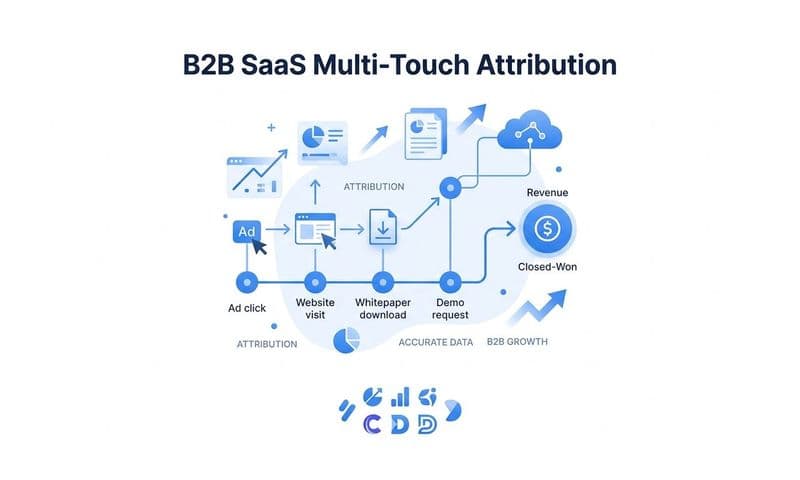
Modern customer journeys span multiple platforms and touchpoints. Someone might discover you through a podcast ad, research you on Google, engage with your content on LinkedIn, click a Facebook ad, and finally convert after receiving an email. Cookie-based tracking could never capture that complete journey because each platform operated in isolation.
A cookie-proof attribution strategy requires connecting all your data sources: ad platforms, CRM, email marketing, website analytics, and any other system that touches the customer journey. When these systems are integrated, you can track users across platforms and see the complete path to conversion. Implementing robust touchpoint tracking analytics ensures no interaction goes unmeasured.
This integration needs to happen at the server level, not through browser-based tracking. Your attribution platform should receive conversion events from your server, ad click data from platform APIs, CRM updates from your sales system, and website behavior from first-party tracking. All of this data gets unified around individual users, creating a complete view of their journey regardless of cookie limitations.
The technical term for this is a "unified data infrastructure," but the practical impact is simple: you finally see what's actually working. That podcast ad that seemed impossible to track? You can now see how many listeners eventually converted. That LinkedIn engagement that never showed up in your analytics? It's now visible as part of the consideration phase.
Multi-Touch Attribution Models: Move Beyond Last-Click
Once you're capturing complete customer journeys, you need attribution models that reflect how marketing actually works. Last-click attribution—giving all credit to the final touchpoint before conversion—made sense in a simple, cookie-based world. It makes no sense when you can see the full journey.
Multi-touch attribution distributes credit across all the touchpoints that contributed to a conversion. A user who saw your Instagram ad, clicked a Google search ad, and converted from an email gets credit distributed across all three channels based on their contribution.
Different models distribute credit differently. Linear attribution gives equal credit to every touchpoint. Time-decay gives more credit to recent touchpoints. Position-based gives more credit to the first and last touchpoints. Data-driven attribution uses machine learning to determine which touchpoints actually influence conversions based on historical patterns. Exploring cookieless attribution tracking approaches will help you select the right model for your business.
The key is having the flexibility to compare models and understand how credit distribution changes your channel performance view. Instagram might look mediocre under last-click attribution but incredibly valuable under first-click or data-driven models because it's driving awareness that leads to conversions days later.
This isn't academic. Understanding true channel contribution changes budget allocation decisions. Teams that implement multi-touch attribution often discover they've been under-investing in top-of-funnel channels that drive awareness and over-investing in bottom-funnel channels that simply capture demand that was already created.
Unified Data Infrastructure: Make Confident Scaling Decisions
The ultimate goal of a cookie-proof attribution strategy is confidence. Confidence that your data is accurate. Confidence that you understand which channels drive revenue. Confidence that when you scale a campaign, you're scaling something that actually works.
A unified data infrastructure provides that confidence by centralizing all your marketing data in one place where you can analyze it comprehensively. Instead of logging into five different platforms with five different conversion numbers, you have a single source of truth that reconciles data across all sources.
This centralization enables sophisticated analysis that's impossible with fragmented data. You can compare attribution models side-by-side. You can analyze customer lifetime value by acquisition channel. You can identify which campaigns drive the highest-quality leads that actually convert to sales. You can track how changes in one channel impact performance in others.
More importantly, you can make scaling decisions based on complete data. When your attribution shows that a particular Facebook campaign drives strong revenue with high confidence based on server-side tracking and complete journey data, you can scale that campaign aggressively. When cookie-based tracking would have shown incomplete data and left you uncertain, unified attribution provides clarity.
The competitive advantage here is significant. While competitors are still trying to optimize based on incomplete cookie data and guessing which channels actually work, teams with unified attribution infrastructure are making data-driven decisions with complete visibility. That difference compounds over time into dramatically better marketing efficiency and growth.
Moving Forward: The New Marketing Measurement Reality
Cookie tracking isn't coming back. Browser restrictions will continue tightening, not loosening. Privacy regulations are expanding globally, not retreating. Users are increasingly aware of tracking and increasingly likely to decline it when given the choice. The tracking infrastructure that powered digital marketing from 2000 to 2020 is permanently gone.
This isn't a crisis to panic about—it's a transition to adapt to. And the marketers adapting now are discovering that the new infrastructure is actually better than what it replaced.
Server-side tracking provides more accurate data than cookie-based pixels ever did. First-party data relationships are more valuable and sustainable than third-party tracking dependencies. Unified attribution platforms that connect every touchpoint deliver insights that fragmented cookie-based systems never could. And ad platform algorithms that receive complete, enriched conversion data optimize more effectively than those starved by cookie restrictions.
The shift required is real. You need technical infrastructure for server-side tracking. You need platforms that can unify data across your marketing stack. You need attribution models that reflect complete customer journeys, not just last-click conversions. But teams making these investments are seeing dramatic improvements in data accuracy, attribution confidence, and campaign performance.
The competitive landscape is splitting. On one side are marketers still running campaigns built on cookie-based assumptions, watching performance decline while wondering why tactics that used to work have stopped working. On the other side are teams that have adopted server-side tracking, unified attribution, and first-party data strategies—and they're seeing better results than ever because they're the only ones with accurate data.
The question isn't whether to adapt to the post-cookie reality. It's how quickly you can implement the infrastructure that makes accurate measurement possible again. Every week you delay is another week of incomplete data, inefficient optimization, and competitive disadvantage against teams that have already made the transition.
Ready to elevate your marketing game with precision and confidence? Discover how Cometly's AI-driven recommendations can transform your ad strategy—Get your free demo today and start capturing every touchpoint to maximize your conversions.