

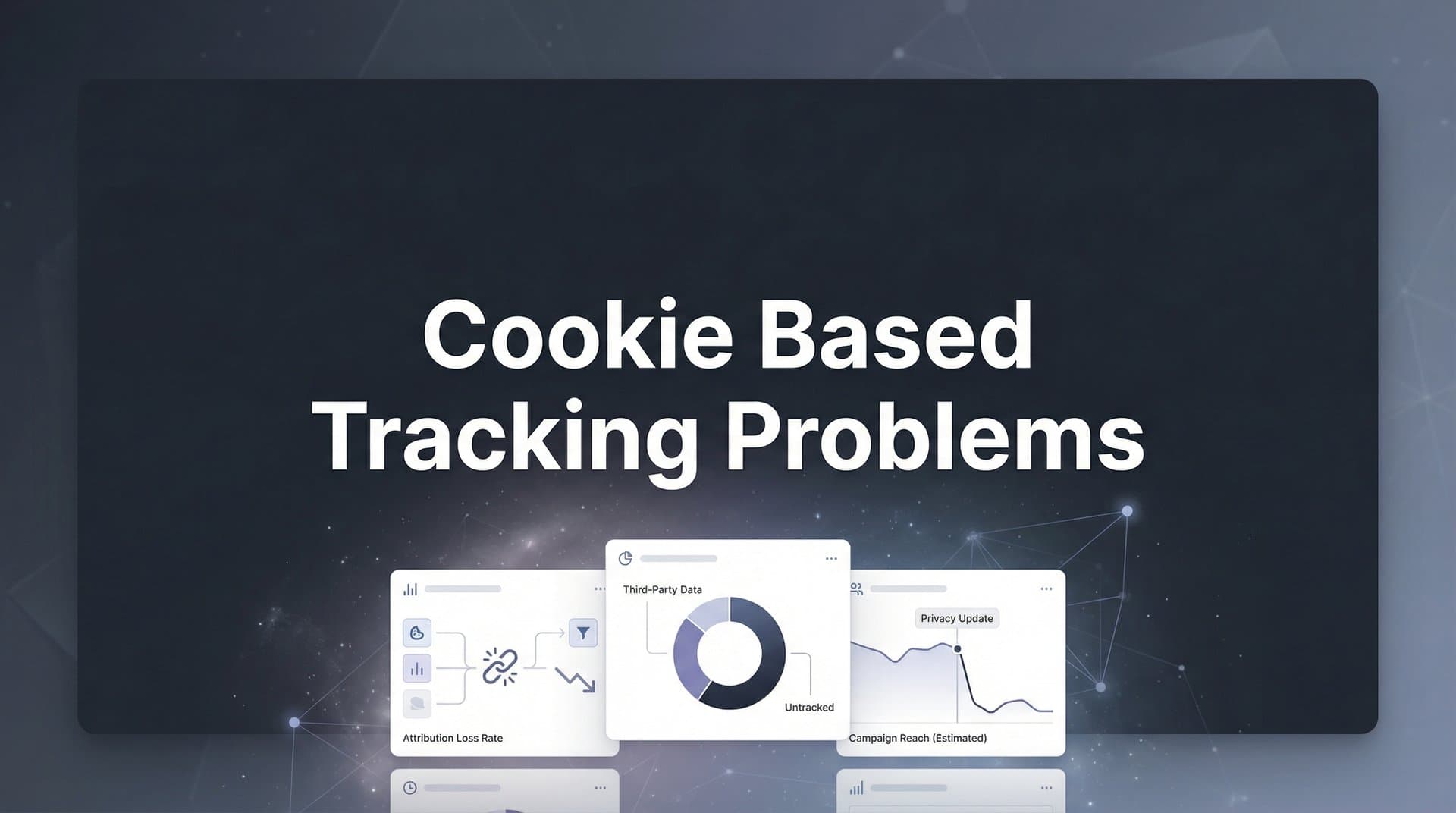
You're staring at three different dashboards, and they're telling three completely different stories about your marketing performance. Google Ads says you drove 47 conversions last week. Facebook claims 62. But when you check your CRM, only 31 new customers actually came through. Your boss wants to know which campaigns are working, and you're looking at numbers that don't add up.
This isn't a technical glitch you can fix by clearing your cache. It's the fundamental reality of cookie-based tracking in 2026. The measurement infrastructure that powered digital advertising for two decades is collapsing under the weight of privacy regulations, browser restrictions, and the multi-device behavior of modern consumers.
Cookies were never designed to track someone who sees your Instagram ad on their phone during lunch, researches your product on their work laptop that afternoon, and finally converts on their home tablet three days later. Yet that's exactly what marketers need to measure. The gap between what cookies can track and what businesses need to know has grown so wide that many marketing teams are essentially flying blind, making million-dollar budget decisions based on incomplete, conflicting data.
This guide breaks down exactly why cookie-based tracking is failing, what it's costing you in wasted ad spend, and how to build a measurement strategy that actually works in today's privacy-focused landscape.
The Rise and Fall of Cookie-Based Marketing Measurement
For nearly 25 years, cookies were the invisible infrastructure that made digital advertising measurable. When a visitor landed on your website, a small text file would be stored in their browser, creating a persistent identifier that could track their behavior across sessions and attribute conversions back to specific marketing touchpoints.
Third-party cookies, set by ad platforms and analytics tools, enabled remarketing campaigns and cross-site tracking. First-party cookies, set by your own domain, tracked user behavior on your website and helped measure conversion paths. Together, they created the attribution models that marketers relied on to understand which channels, campaigns, and keywords were driving results.
The system worked reasonably well when most browsing happened on desktop computers and privacy concerns were minimal. Marketers could track a visitor from initial ad click through multiple site visits to final conversion, building detailed pictures of customer journeys and optimizing accordingly.
Then everything changed. Safari introduced Intelligent Tracking Prevention (ITP) in 2017, aggressively limiting cookie lifespans and blocking third-party cookies entirely. Firefox followed with Enhanced Tracking Protection. The European Union implemented GDPR, requiring explicit consent for tracking. California passed CCPA. Apple launched App Tracking Transparency with iOS 14.5, requiring apps to ask permission before tracking users across other companies' apps and websites.
Each change chipped away at cookie-based measurement. By 2024, the majority of web traffic came from browsers or devices that significantly restricted cookie functionality. Chrome, which once seemed like the last holdout for third-party cookies, began its own privacy-focused transition. The cookie deprecation impact on tracking was becoming impossible to ignore.
The core problem runs deeper than just privacy regulations. Cookies were designed for a single-device, desktop-centric web. Modern consumers switch between phones, tablets, laptops, and sometimes smart TVs throughout their buying journey. A cookie set on your phone can't follow you to your laptop. Each device creates a separate identity, fragmenting what should be a unified customer journey into disconnected pieces that make accurate attribution impossible.
Seven Critical Failures Destroying Your Attribution Accuracy
Cross-Device Blindness: Your customer sees your Facebook ad on their iPhone during their morning commute. They're interested but not ready to buy. That evening, they sit down at their laptop, search for your product on Google, and make a purchase. Cookie-based tracking sees these as two completely different people. The Facebook cookie on their phone has no way to communicate with the Google cookie on their laptop. Your attribution report shows Google driving a conversion when Facebook actually initiated the journey. Multiply this across thousands of customers, and your entire understanding of channel performance becomes fiction.
Shortened Cookie Lifespans: Safari's ITP now limits first-party cookies set via JavaScript to just 7 days of persistence. If a cookie is set through a redirect or third-party context, that drops to 24 hours. Think about what this means for B2B companies with 30, 60, or 90-day sales cycles. A prospect clicks your LinkedIn ad, visits your website, and gets cookied. They research your solution over the next three weeks, comparing competitors and building internal consensus. When they finally return to convert on day 21, that original cookie is long gone. The conversion appears as direct traffic with no attribution to the LinkedIn campaign that started everything. This is a prime example of losing tracking data from cookies.
Browser Blocking and User Deletion: Many browsers now block third-party cookies by default. Safari and Firefox have done this for years. Chrome is moving in the same direction. Even when cookies are allowed, privacy-conscious users regularly clear their browsing data, wiping out the tracking identifiers that marketers depend on. Studies suggest that a significant portion of cookies are deleted or blocked before they can attribute any conversions, creating systematic underreporting across all channels.
iOS App Tracking Transparency: When iOS 14.5 launched, it required apps to ask users for permission before tracking their activity across other companies' apps and websites. The majority of users declined. For Facebook, Google, and other ad platforms, this meant losing visibility into millions of conversions that happened in mobile apps. The ripple effects extended to web tracking as well, as platforms lost the ability to connect in-app behavior with web browsing, further fragmenting the customer journey.
Incognito and Private Browsing: A growing number of users browse in private or incognito mode, where cookies are deleted the moment they close their browser. These sessions are completely invisible to cookie-based attribution. You might be running campaigns that drive significant traffic and conversions from privacy-conscious users, but your analytics will never show it. These customers appear as direct traffic or organic search, systematically undervaluing your paid campaigns.
Ad Blocker Interference: Ad blockers don't just block ads. Many also block the tracking scripts and pixels that measure ad performance. Users with ad blockers installed can click your ads, visit your site, and convert without any of those actions being properly tracked. Your ad platform thinks the click didn't lead anywhere. Your analytics thinks the visitor came from nowhere. The conversion exists in your CRM, but the entire journey that led to it is invisible. Understanding cookie blocking affecting ad tracking is essential for modern marketers.
Cookie Consent Requirements: GDPR and similar privacy laws require websites to obtain consent before setting non-essential cookies. Many users decline or simply close the consent banner without making a choice. In either case, tracking cookies don't get set, and those user journeys become untrackable. You're legally prohibited from measuring the effectiveness of your marketing for a significant portion of your traffic, creating systematic blind spots in your data.
The Hidden Cost of Broken Data
When your attribution data is incomplete, you don't just lose visibility. You make actively harmful decisions that drain your marketing budget. The impact compounds across every level of your marketing operation.
Consider what happens when conversions are systematically underreported. You launch a new campaign targeting a high-value audience segment. The campaign is actually driving strong results, but because cookie expiration and cross-device gaps hide many of the conversions, your dashboard shows weak performance. You pause the campaign to redirect budget elsewhere. You just killed a profitable channel based on incomplete data.
This pattern repeats across your entire marketing mix. Channels that drive early-stage awareness look less valuable because the final conversion happens outside the cookie window. Long sales cycle campaigns appear to underperform because the journey from click to conversion exceeds cookie lifespan. You systematically shift budget away from what's working toward what looks good in cookie-based reports. These customer journey tracking problems cost businesses millions in misallocated spend.
The damage extends to your ad platform optimization. Facebook, Google, TikTok, and other platforms use conversion data to train their algorithms on who to target and which creative performs best. When cookie-based tracking only captures 60% of your actual conversions, these algorithms optimize on incomplete information. They learn to target the wrong audiences because they can't see the full picture of who actually converts. Your cost per acquisition climbs not because your campaigns are failing, but because your measurement system is feeding bad data to the optimization engines.
Multi-touch attribution becomes completely unreliable. You want to understand how different channels work together to drive conversions. Does paid search work better when paired with display advertising? Do customers who engage with both email and social media convert at higher rates? Cookie-based tracking can't answer these questions when touchpoints disappear after 7 days or get split across devices. You end up with attribution models that assign all credit to the last click, ignoring the entire journey that led there.
The compounding effect is what makes this truly dangerous. Bad data leads to bad decisions. Bad decisions lead to wasted spend. Wasted spend leads to tighter budgets and pressure to show ROI. That pressure leads to even more reliance on short-term, last-click metrics that cookie-based tracking can still measure. You end up optimizing for what you can track rather than what actually drives business results.
Why Your Ad Platform Reports Are Lying to You
Open Google Ads, Facebook Ads Manager, and LinkedIn Campaign Manager side by side. Look at the conversions each platform claims credit for over the last 30 days. Now add those numbers together. The total is probably significantly higher than the actual number of conversions in your CRM.
This isn't a bug. It's how cookie-based attribution works when every platform operates independently. Each ad platform sets its own tracking cookie and claims credit for any conversion that happens after someone clicks or views one of its ads. But customers interact with multiple platforms before converting. Facebook shows them an ad. They click a Google search result. They see a LinkedIn post. When they finally convert, all three platforms claim the conversion because all three cookies are present. These multiple ad platforms tracking problems create chaos in your reporting.
The self-attribution bias goes deeper than simple overcounting. Each platform is incentivized to make its performance look as strong as possible. Facebook might use a 28-day click window and a 1-day view window, meaning it takes credit for conversions that happen up to 28 days after someone clicks an ad, or 1 day after they simply see an ad without clicking. Google might use a 30-day click window. These generous attribution windows maximize the conversions each platform can claim, regardless of whether they actually influenced the purchase decision.
View-through attribution is particularly problematic. Just because someone saw your ad and later converted doesn't mean the ad caused the conversion. They might have been actively searching for your product already. They might have received an email from you. The ad view might have been completely incidental. But in cookie-based attribution, correlation equals causation, and every platform claims credit.
The gap between pixel-based tracking and actual revenue tells the real story. Your Facebook pixel might show 100 conversions, but when you match those conversions to actual revenue in your CRM, you find that some never completed payment, some were duplicate test orders, and some were existing customers making repeat purchases that shouldn't count as new acquisition. The pixel tracking cookie limitations mean the pixel counts actions, but it doesn't understand business context. It can't distinguish between a $50 purchase and a $5,000 purchase, between a new customer and a returning one, between a completed sale and an abandoned cart.
Server-Side Tracking: Measurement That Actually Works
Server-side tracking fundamentally changes how conversion data is collected and measured. Instead of relying on browser-based cookies that can be blocked, deleted, or expire, server-side tracking captures events at the server level, where browser restrictions don't apply.
Here's how it works in practice. When someone clicks your ad and lands on your website, your server captures that click data directly, including the source, campaign, and any UTM parameters. When that person later converts, your server sends the conversion event directly to your analytics platform and back to the ad platforms. This happens server-to-server, completely bypassing the browser and all the restrictions that break cookie-based tracking.
The advantages are immediate and substantial. Cross-device conversion tracking becomes possible because you're identifying users through first-party data like email addresses or customer IDs rather than browser cookies. When someone clicks your Facebook ad on their phone and converts on their laptop three days later, server-side tracking can connect those events because both interactions get linked to the same customer record in your system.
Cookie expiration stops being a problem. Server-side tracking doesn't rely on cookies that expire after 7 days. The connection between ad click and conversion is maintained in your own database, persisting as long as you need it to. B2B companies with 90-day sales cycles can finally track the full journey from initial touchpoint to closed deal.
Browser blocking and ad blockers become irrelevant. Users can block all the tracking scripts and pixels they want. Server-side tracking operates at a level they can't interfere with. When they submit a form, make a purchase, or trigger any conversion event, your server captures it and sends it to your analytics and ad platforms directly. This addresses the core issues with client-side tracking accuracy problems.
The data quality improvement extends to ad platform optimization. When you send conversion data back to Facebook, Google, and other platforms via server-side integration, you can include rich, first-party data that cookies could never capture. Revenue amounts, customer lifetime value, product categories, subscription tiers. This enriched data helps ad platform algorithms optimize not just for conversions, but for high-value conversions that actually drive business results.
Privacy compliance becomes clearer and more manageable. Server-side tracking operates on first-party data that you collect directly from your customers with their consent. You're not relying on third-party cookies that track users across the web. You're measuring the performance of your own marketing using data that customers have explicitly provided to you. This aligns with privacy regulations while maintaining measurement accuracy.
Building a Future-Proof Measurement Strategy
Moving beyond cookie dependency requires rethinking your entire approach to marketing measurement. The goal isn't to replicate what cookies used to do. It's to build a system that provides more accurate, actionable insights than cookies ever could.
Prioritize First-Party Data Collection: Every interaction with your brand is an opportunity to collect first-party data with permission. Email signups, account registrations, quiz completions, content downloads. Build systems that encourage customers to identify themselves voluntarily in exchange for value. This first-party data tracking for ads becomes the foundation of accurate attribution, allowing you to track customer journeys across devices and sessions without relying on cookies.
Implement Comprehensive UTM Tracking: Proper UTM parameters on every marketing link create a consistent taxonomy for tracking traffic sources. When someone clicks a link with UTM parameters, those parameters travel with them through your conversion funnel, allowing server-side systems to attribute conversions accurately even when cookies fail. Develop a standardized UTM naming convention and enforce it across all channels and campaigns.
Integrate Your CRM with Marketing Data: The most valuable attribution insights come from connecting ad clicks to actual business outcomes. Integrate your CRM with your marketing analytics so you can track not just conversions, but revenue, customer lifetime value, and long-term retention. This allows you to optimize for business results rather than vanity metrics that don't reflect true performance.
Use Attribution Platforms That Connect the Full Journey: Cookie-based analytics tools can only show you the fragments of customer journeys that their cookies can track. Modern cookieless attribution tracking platforms capture the complete journey from initial ad click through every touchpoint to final conversion and beyond. By operating at the server level and connecting to your CRM, these platforms provide the accurate, multi-touch attribution that cookie-based tools can no longer deliver.
Test and Validate Against Business Outcomes: Your attribution data should match reality. Regularly compare what your analytics platforms report against actual revenue in your accounting system. If your marketing dashboard shows 500 conversions but your finance team only recorded 400 new customers, you have a measurement problem that needs solving. Use business outcomes as the ground truth and adjust your tracking accordingly.
Build Incrementality Testing Into Your Strategy: Attribution models tell you correlation, but incrementality tests tell you causation. Run controlled experiments where you turn campaigns on and off for specific audience segments and measure the impact on conversions. This reveals which channels are truly driving incremental results versus which are simply taking credit for conversions that would have happened anyway.
Focus on Revenue, Not Just Conversions: Cookie-based tracking typically measures conversion events without understanding their value. Build measurement systems that connect every conversion to actual revenue and customer lifetime value. A campaign that drives 100 low-value conversions isn't as valuable as one that drives 50 high-value conversions, but cookie-based attribution treats them equally. Revenue-focused measurement reveals true performance.
Moving Forward with Confidence
Cookie-based tracking problems aren't a temporary challenge that will resolve itself. Privacy regulations are expanding globally, not retreating. Browser restrictions are getting stricter, not looser. User awareness of tracking is increasing, not decreasing. The trajectory is clear: cookies will become even less reliable as a measurement foundation in the years ahead.
The marketers who thrive in this environment will be those who stop trying to fix cookie-based tracking and instead build measurement systems designed for the privacy-focused, multi-device reality of modern consumer behavior. Server-side tracking, first-party data strategies, and attribution platforms that connect ad clicks to actual revenue aren't optional upgrades anymore. They're essential infrastructure for making confident marketing decisions.
The cost of inaction is substantial. Every day you rely on cookie-based attribution, you're making budget decisions based on incomplete, conflicting data. You're pausing profitable campaigns because underreporting makes them look weak. You're feeding incomplete conversion data to ad platform algorithms, degrading their optimization capabilities. You're flying blind while your competitors build accurate measurement systems that reveal true performance.
Take a hard look at your current tracking setup. Compare what your ad platforms report against what your CRM shows. Calculate how much of your customer journey is invisible to cookie-based tracking. Consider how many conversions you're missing because cookies expired before the sale happened. The gap between what you're measuring and what's actually happening is probably larger than you think.
The solution isn't more cookies or better cookie management. It's moving beyond cookies entirely to server-side, first-party data measurement that captures the complete customer journey from initial touchpoint to final conversion and beyond. It's connecting your marketing data to actual business outcomes so you can optimize for revenue, not just clicks and impressions.
Ready to elevate your marketing game with precision and confidence? Discover how Cometly's AI-driven recommendations can transform your ad strategy. Get your free demo today and start capturing every touchpoint to maximize your conversions.


