

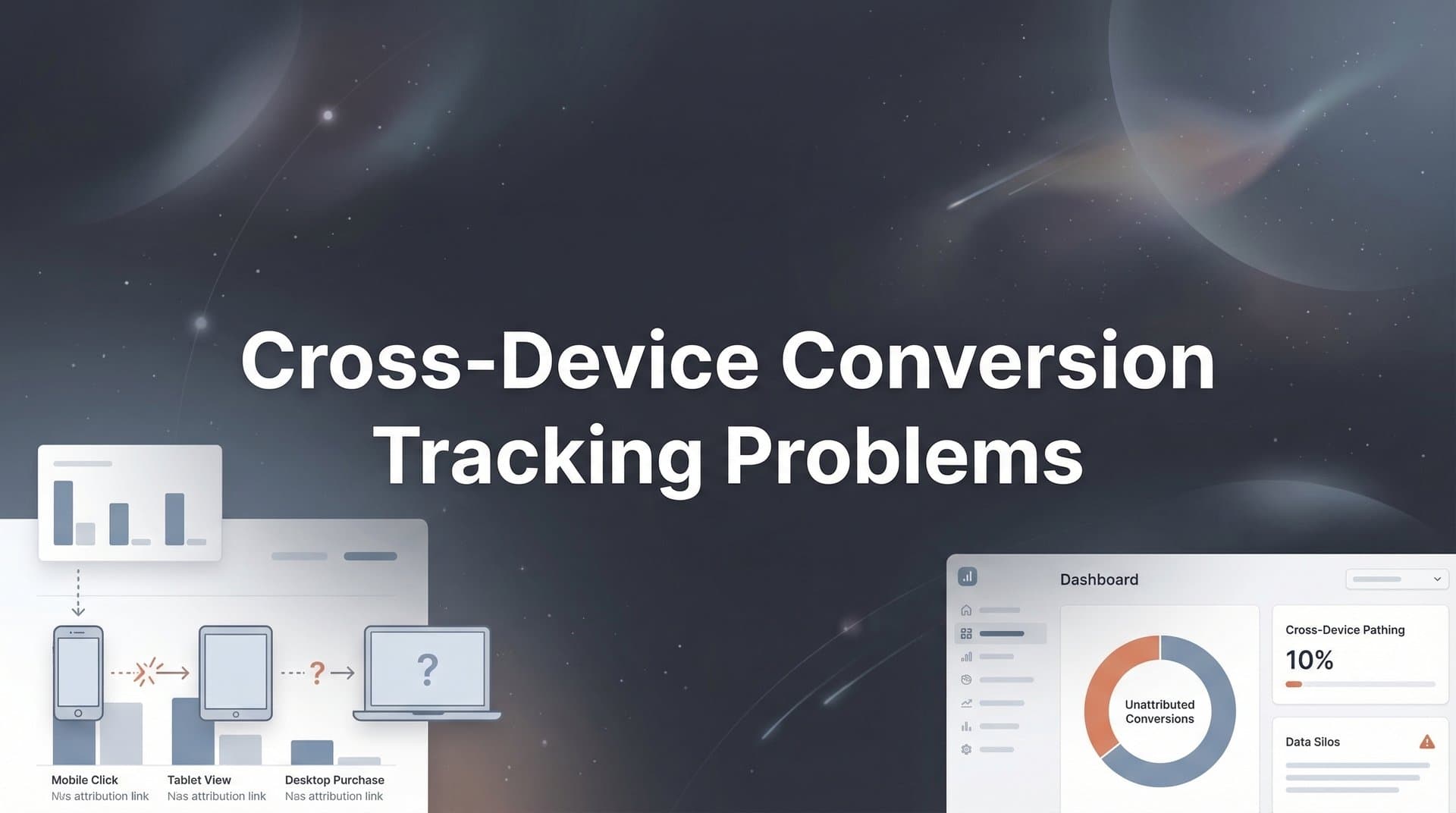
Picture this: A potential customer scrolls through Facebook on their phone during lunch, sees your ad, and clicks through to learn more. Later that afternoon, they're back at their desk, Googling your product on their work laptop, reading reviews, and comparing options. That evening, relaxing on the couch with their tablet, they finally decide to buy. Three devices. One customer journey. But here's the question that should keep you up at night: How many of those touchpoints is your tracking actually capturing?
If you're like most marketers, the answer is probably "not all of them." And that's a massive problem.
The modern customer journey doesn't happen in a straight line on a single device. It zigzags across smartphones, tablets, laptops, and desktops as people research, compare, and eventually convert. But here's the disconnect: most tracking systems treat each device as a completely separate anonymous user. Your analytics sees three different people in that scenario above, not one person taking three steps toward a purchase.
This creates enormous blind spots in your attribution data. You're making budget decisions based on incomplete information, crediting the wrong channels, and missing the true drivers of your conversions. The channels that actually influenced the purchase often go completely unrecognized, while the final touchpoint gets all the credit simply because it happened to be the last device the customer used.
The Multi-Device Reality Modern Marketers Face
The way people shop, research, and buy has fundamentally changed. The average customer journey now involves multiple devices before conversion, and this isn't just happening occasionally. It's the norm. Users start their research on their smartphones during commutes, continue on work laptops during breaks, and complete purchases on tablets or desktops at home. This device-hopping behavior spans hours, days, or even weeks.
The technical challenge behind this is straightforward but brutal: each device generates its own separate cookies and identifiers. When someone visits your website on their phone, their browser creates a cookie that lives only on that phone. When they come back on their laptop, that's a completely different cookie on a completely different device. Traditional tracking systems have no way to connect these two sessions to the same person, which is why cross-device conversion tracking issues have become such a critical concern for marketers.
Think of it like this: imagine if every time you walked into your favorite coffee shop wearing different clothes, the barista treated you as a brand new customer. They wouldn't remember your usual order, your loyalty points, or the fact that you've been coming in every morning for six months. That's exactly what's happening with your marketing data across devices.
The business impact of this fragmentation is staggering. Without cross-device visibility, your attribution reports are fundamentally flawed. They typically credit the last device used before conversion, which means the channels that actually influenced the purchase go completely unrecognized. That Facebook ad your customer saw on their phone during lunch? It sparked their interest and started the journey. But if they converted on their laptop three days later after a Google search, your tracking probably gives all the credit to Google and none to Facebook.
This isn't just a data cleanliness issue. It directly affects where you spend your budget. When you cannot connect mobile awareness campaigns to desktop conversions, your top-of-funnel channels look like they're underperforming. You start cutting budget from the very campaigns that are actually driving interest and consideration, while pumping more money into bottom-funnel channels that are simply capturing demand that already exists.
Five Core Problems Breaking Your Cross-Device Attribution
Let's break down exactly why cross-device tracking is so difficult and what's causing these massive blind spots in your data.
Cookie Limitations and Fragmentation: Third-party cookies, which used to be the backbone of cross-site tracking, are now blocked or automatically deleted by most browsers. Safari blocks them by default. Firefox blocks them by default. Chrome is phasing them out. But even first-party cookies, which your own website sets, cannot travel between devices. When someone visits your site on their phone and then on their laptop, those are two separate first-party cookies that have no connection to each other. Each device becomes an isolated data silo, and there's no technical bridge between them without additional identification methods. Understanding these cookie tracking problems in advertising is essential for developing effective solutions.
Privacy Regulations and Browser Restrictions: The tracking landscape has been fundamentally reshaped by privacy initiatives. Apple's App Tracking Transparency, which launched in April 2021, requires apps to request explicit permission before tracking users across apps and websites. Most users decline. Safari's Intelligent Tracking Prevention limits third-party cookies and caps first-party cookie lifespans to just seven days for some scenarios. Firefox's Enhanced Tracking Protection blocks known trackers by default. GDPR consent requirements mean many European users never consent to tracking in the first place. Each of these restrictions individually creates tracking gaps. Combined, they create canyons.
Probabilistic Matching Failures: When deterministic matching (using logged-in user IDs) isn't available, many platforms fall back on probabilistic matching. This approach uses statistical models to guess that two devices belong to the same person based on factors like IP addresses, device characteristics, browser settings, and behavioral patterns. The problem? These guesses are often wrong. Someone using their work laptop shares an IP address with hundreds of coworkers. Device fingerprinting becomes less reliable as browsers add privacy protections. Behavioral patterns can look similar across different people. The error rates in probabilistic matching can be substantial, meaning your attribution data includes a significant percentage of incorrect connections.
Walled Garden Data Silos: Google, Meta, Amazon, and other major platforms have extensive cross-device data within their own ecosystems. When someone is logged into their Google account, Google knows that person across all their devices. Same with Meta. But here's the catch: they keep this data locked within their platforms. They don't share it with advertisers, and they don't allow it to be combined with data from other sources. You cannot take Meta's cross-device insights and merge them with Google's cross-device insights to build a unified customer view. Each platform becomes its own isolated attribution universe, and you're left trying to piece together a complete picture from fragments that don't connect.
Anonymous Traffic Dominance: A large percentage of your website visitors never log in, never create an account, and never provide an email address. They browse anonymously across multiple devices, and there's simply no identifier to connect their sessions. Without some form of authentication or voluntary identification, these cross-device journeys remain invisible. You can see the sessions, but you cannot see that they belong to the same person moving toward a conversion. This is one of the most common reasons why conversions are not tracking properly in your analytics.
How These Tracking Gaps Distort Your Marketing Decisions
The consequences of broken cross-device tracking go far beyond messy reports. They fundamentally distort the decisions you make about where to invest your marketing budget.
Budget Misallocation Becomes Inevitable: When mobile awareness campaigns cannot be connected to desktop conversions, your reporting makes top-of-funnel channels look like they're failing. That Instagram campaign that's actually introducing thousands of people to your brand appears to have terrible ROI because the conversions are happening days later on different devices. Meanwhile, your branded search campaigns look incredibly efficient because they're capturing people who are already ready to buy, regardless of what originally sparked their interest. The result? You cut budget from awareness and pour more into search, not realizing you're starving the top of your funnel and just fighting over the same pool of existing demand.
Customer Acquisition Costs Get Inflated: Here's a math problem that's costing you money: when your tracking system counts the same person as three different people across three devices, your customer acquisition costs become artificially inflated. You're dividing your revenue by an inflated customer count. Worse, you might be attributing the same conversion to multiple channels if each device's last touchpoint gets credit, making it look like you spent more to acquire that customer than you actually did. This makes profitable campaigns look marginal and marginal campaigns look unprofitable. These conversion tracking accuracy issues can lead to significant budget waste over time.
Ad Platform Optimization Breaks Down: Modern ad platforms use machine learning to optimize toward conversions. But they can only optimize based on the conversion data they receive. When that data is incomplete because cross-device conversions aren't being captured, the algorithms are learning from a distorted reality. Meta's algorithm thinks your mobile ads aren't converting when they actually are, just on different devices. Google's algorithm optimizes toward audiences that convert on the same device they clicked, missing the larger audience that converts cross-device. The optimization signals you're feeding back to these platforms are fundamentally flawed, causing them to optimize toward the wrong audiences and placements.
These aren't theoretical problems. They're happening right now in your campaigns, quietly eroding your marketing efficiency and leading you to make decisions based on incomplete information.
Server-Side Tracking: A Foundation for Better Cross-Device Data
Let's talk about one of the most powerful solutions to these tracking challenges: server-side tracking. This approach fundamentally changes where and how conversion data gets collected.
Traditional client-side tracking relies on JavaScript code running in the user's browser. It's vulnerable to ad blockers, browser restrictions, and cookie limitations. Server-side tracking bypasses all of that by collecting data directly from your backend systems rather than relying on client-side scripts. When a conversion happens, your server sends that information directly to your ad platforms and analytics tools, regardless of what's happening in the user's browser. This represents a shift toward conversion tracking beyond pixels that many marketers are now embracing.
Here's why this matters for cross-device tracking: server-side events can include identifiers that persist across devices. When someone creates an account or provides an email address, that identifier lives in your database, not in a browser cookie. When they later convert on a different device while logged in, your server can connect that conversion back to the same user profile, along with all their previous touchpoints across all devices.
This creates a more complete picture of the customer journey. Your CRM knows that customer@email.com clicked a Facebook ad on mobile, visited from organic search on desktop, and eventually purchased on tablet. By connecting your CRM, payment processor, and ad platforms through server-side events, you can piece together the full story in a way that browser-based tracking simply cannot.
There's another critical benefit: server-side conversion data improves ad platform optimization. When you send clean, accurate conversion events directly from your server to Meta, Google, and other channels, you're feeding their algorithms better signals. These platforms can then optimize more effectively, even when browser-based tracking is limited. The conversion data includes the original click IDs that connect back to specific ads, campaigns, and audiences, allowing the platforms to understand which targeting strategies are actually working. Implementing conversion API tracking software is one of the most effective ways to achieve this.
Server-side tracking isn't a complete solution to cross-device attribution on its own, but it's a foundational piece that makes other solutions possible. It creates a more reliable data pipeline that isn't subject to the same browser restrictions that break client-side tracking.
Building a Cross-Device Attribution Strategy That Works
Solving cross-device tracking requires a strategic approach that combines multiple tactics. Here's how to build an attribution system that actually captures the full customer journey.
Prioritize First-Party Data Collection: The most reliable way to connect users across devices is through authenticated experiences. When someone logs into an account, that identifier follows them across all their devices. This is why first-party data strategies have become so critical. Encourage account creation early in the customer journey. Offer value in exchange for email signups. Build loyalty programs that give customers a reason to identify themselves. The more of your audience you can connect to persistent identifiers, the more complete your cross-device tracking becomes. This isn't just about tracking; it's about building direct relationships with your customers that give you data independence from third-party cookies and platform restrictions. These approaches align with privacy-compliant conversion tracking methods that respect user preferences while maintaining measurement accuracy.
Adopt Multi-Touch Attribution Models: Move beyond last-click attribution, which almost always credits the wrong touchpoint in cross-device journeys. Multi-touch attribution models distribute credit across the entire customer journey, even when some touchpoints occur on different devices. Linear models give equal credit to all touchpoints. Time-decay models give more credit to recent interactions. Position-based models emphasize first and last touchpoints. Data-driven models use algorithms to determine credit distribution based on actual conversion patterns. The specific model matters less than the shift away from last-click thinking. When you start attributing value to earlier touchpoints, you begin to see which channels are actually influencing purchases, not just capturing existing demand.
Implement Unified Analytics Platforms: Your ad platform data, website analytics, and CRM events need to live in a single source of truth that can connect touchpoints across the customer journey. This means consolidating data from Meta, Google, your website, your email platform, and your sales systems into a unified attribution platform. These platforms use a combination of deterministic matching (when users are logged in), server-side tracking, and sophisticated modeling to connect the dots across devices. They can show you that the person who clicked your Facebook ad on mobile is the same person who later converted on desktop, even when browser-based tracking cannot make that connection. Exploring cross-device conversion tracking solutions will help you identify the right platform for your needs.
Feed Better Data Back to Ad Platforms: Use conversion APIs and server-side integrations to send enriched event data back to your ad platforms. When you sync conversion data that includes customer identifiers, transaction values, and product details, you're giving platform algorithms the signals they need to optimize effectively. This creates a feedback loop where better data leads to better optimization, which leads to better results, which generates more data. Platforms like Meta and Google have built their Conversion APIs specifically to handle this server-side data, recognizing that browser-based tracking alone is no longer sufficient.
Accept That Some Gaps Will Remain: Perfect cross-device attribution is impossible. Some percentage of your traffic will always be anonymous across devices. Some users will never log in. Some conversions will happen offline or through channels you cannot track. The goal isn't perfection; it's to capture enough of the customer journey that your attribution data becomes reliable for decision-making. Focus on fixing conversion tracking gaps that have the largest impact first, and accept that some uncertainty is inherent in marketing measurement.
Putting It All Together: From Fragmented Data to Clear Attribution
Cross-device conversion tracking problems are not going away. If anything, they're getting more complex as privacy restrictions tighten and the device ecosystem continues to expand. But these challenges are solvable when you approach them strategically.
Start by acknowledging the multi-device reality. Your customers are not shopping on a single device, and your tracking needs to reflect that. Implement server-side tracking to create a more reliable data foundation that isn't subject to browser restrictions. Prioritize first-party data collection through authenticated experiences that create persistent identifiers across devices. Adopt multi-touch attribution models that distribute credit across the entire journey rather than giving everything to the last click.
Most importantly, consolidate your data into a unified attribution platform that can connect the dots across all your marketing channels and customer touchpoints. This isn't just about having cleaner data. It's about making confident budget decisions based on a complete picture of what's actually driving your results. It's about scaling the campaigns that truly work, not just the ones that happen to capture the last click before conversion.
When you solve cross-device tracking, you stop flying blind. You see which channels are genuinely influencing purchases. You understand the true customer journey. You allocate budget to the touchpoints that matter, not just the ones that are easiest to measure.
Your Next Steps Toward Complete Attribution
The shift from cookie-dependent tracking to server-side, first-party data strategies isn't optional anymore. It's the foundation of modern marketing measurement. If you're still relying on client-side tracking alone, you're missing a significant portion of your customer journeys, and that's costing you revenue.
Take time to audit your current attribution setup. Where are the cross-device blind spots in your data? Which channels might be undervalued because their conversions happen on different devices? How much of your traffic is anonymous versus authenticated? These questions will reveal where your biggest opportunities lie.
The good news is that the technology to solve these problems exists. Unified attribution platforms can capture every touchpoint across devices, channels, and customer interactions, giving you a complete view of what's driving revenue. They connect your ad platforms, CRM, and analytics into a single source of truth that shows you the real customer journey, not just the fragments that browser-based tracking can see.
Ready to elevate your marketing game with precision and confidence? Discover how Cometly's AI-driven recommendations can transform your ad strategy. Get your free demo today and start capturing every touchpoint to maximize your conversions.


