

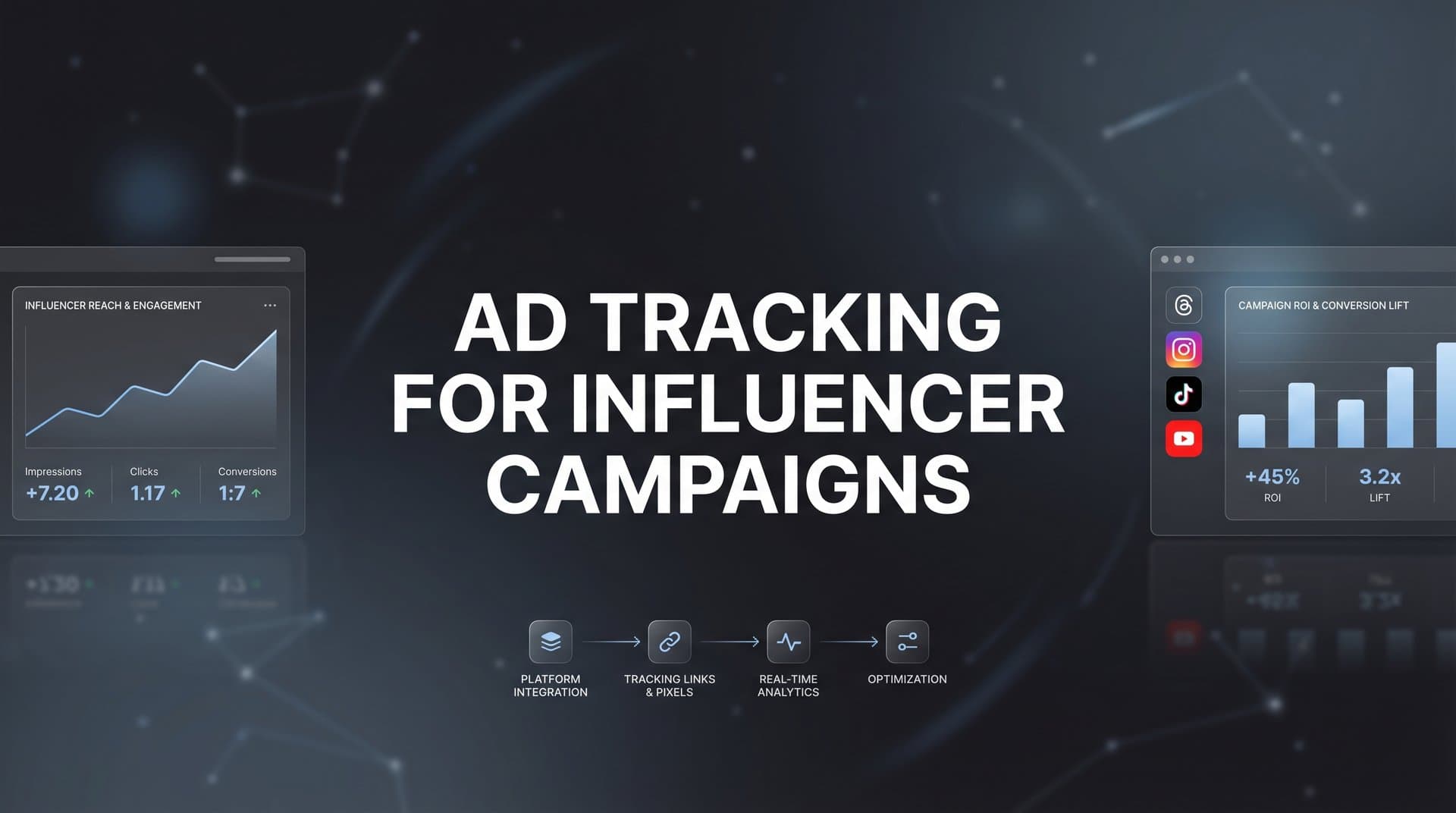
You just closed a deal with three influencers for your Q2 campaign. The content goes live, engagement looks promising, and traffic spikes. Two weeks later, your boss asks the inevitable question: "What revenue did we actually generate from these partnerships?" You pull up Google Analytics, see some referral traffic, but connecting those visits to actual purchases? That's where the trail goes cold.
This scenario plays out in marketing teams every day. Influencer marketing has become a core channel for brands, but measuring its true impact remains one of the biggest challenges marketers face. Unlike traditional paid ads with built-in tracking, influencer content often lives on third-party platforms where your standard pixels and UTM parameters fall short.
The result? Marketing teams struggle to connect influencer-driven traffic to actual conversions, making it nearly impossible to calculate ROI or justify budget increases.
This guide walks you through a proven system for tracking influencer campaigns with the same precision you expect from your paid advertising. You'll learn how to create unique tracking links, implement server-side tracking for better data accuracy, connect influencer touchpoints to your CRM, and analyze performance across multiple attribution models.
Whether you're running campaigns with a handful of micro-influencers or managing enterprise-level partnerships, these steps will help you capture every touchpoint and understand which influencer relationships actually drive revenue.
Step 1: Define Your Tracking Goals and KPIs Before Launch
Before you reach out to a single influencer or draft a content brief, you need absolute clarity on what success looks like. This isn't about vanity metrics like impressions or likes. You're building a tracking system that connects influencer content to business outcomes.
Start by identifying your primary conversion events. What specific actions do you want influencer audiences to take? For e-commerce brands, this might be completed purchases. SaaS companies often track demo requests or trial sign-ups. Mobile apps focus on installs and in-app purchases. Be specific about which events matter most to your business model.
Document these conversion events in order of priority. Your tracking infrastructure will capture multiple events, but knowing which ones directly impact revenue helps you focus your analysis later.
Next, establish baseline metrics for comparison. What's your current conversion rate from other marketing channels? What does customer acquisition cost look like across paid search, social ads, and email? These benchmarks give you context when evaluating influencer performance. Without them, you're flying blind when someone asks whether a 2% conversion rate from an influencer campaign is good or terrible.
Now comes a critical decision: which attribution model fits your campaign goals? If you're using influencers primarily for brand awareness at the top of the funnel, first-touch attribution shows you which influencers introduce new audiences to your brand. If influencers play a role throughout the customer journey, multi-touch attribution reveals how their content assists conversions even when it's not the final click.
Think about your typical sales cycle. Do customers usually convert on their first visit, or do they research for weeks before purchasing? Longer consideration periods demand attribution models that credit multiple touchpoints rather than just the last click. Understanding influencer marketing attribution tracking principles will help you make this decision.
Document all of this before reaching out to influencers. When you send them tracking links, you'll need those links configured correctly from day one. Retrofitting tracking after content goes live means lost data you can never recover.
Create a simple tracking requirements document that outlines your conversion events, attribution approach, and any special parameters you need influencers to include. This becomes your blueprint for the technical implementation in the next steps.
Step 2: Build Your Unique Tracking Link Structure
Your tracking link structure is the foundation of everything that follows. Get this right, and you'll have clean, organized data that makes analysis straightforward. Get it wrong, and you'll spend hours trying to untangle messy attribution data.
Start with a consistent UTM naming convention. UTM parameters are the tags you add to URLs that tell analytics platforms where traffic originated. For influencer campaigns, you need four key parameters working together.
utm_source: This identifies the specific influencer. Use their handle or a shortened version of their name. Keep it lowercase with no spaces. Example: utm_source=sarahfitness or utm_source=techreviewjohn
utm_medium: This categorizes the channel type. For influencer content, use "influencer" consistently across all campaigns. This lets you compare all influencer traffic as a group against other channels like "paid_social" or "email".
utm_campaign: This identifies the specific campaign or product launch. If you're running a Q2 summer collection campaign with multiple influencers, they all get the same campaign tag. Example: utm_campaign=summer2026 or utm_campaign=product_launch_may
utm_content: This differentiates between multiple posts from the same influencer in the same campaign. If an influencer creates both a story and a feed post, you need to know which performed better. Example: utm_content=story or utm_content=reels or utm_content=post1
Generate individual tracking links for each influencer and each piece of content they create. This granularity is what allows you to isolate performance data later. When you can see that Sarah's Instagram story drove 47 conversions while her feed post drove 12, you know which content format works best with her audience.
Use a URL builder tool to create these links systematically. Many analytics platforms offer free UTM builders that prevent typos and maintain consistency. Build all your links in a spreadsheet first, then validate them before distribution. If you're managing attribution tracking for multiple campaigns, this systematic approach becomes even more critical.
Consider setting up branded short links or custom domains. A link like "yourbrand.co/sarah" looks more trustworthy than a long URL filled with tracking parameters. This improves click-through rates because audiences are more likely to click clean-looking links. Many link shortening services let you add UTM parameters behind the scenes while displaying a clean branded URL.
Before sending links to influencers, test every single one. Click through each link and verify it lands on the correct page. Check that your analytics platform is capturing the UTM parameters correctly. Open your analytics dashboard and confirm the source, medium, campaign, and content values appear exactly as you intended.
Create a master tracking sheet that lists each influencer, their assigned links, content delivery dates, and any special notes. This becomes your reference document when analyzing performance later. You'll thank yourself when you can quickly look up which link was used for which piece of content three months after the campaign ended.
Step 3: Implement Server-Side Tracking for Accurate Data Collection
Here's the uncomfortable truth about browser-based tracking: you're missing a significant portion of your conversions. iOS privacy updates, ad blockers, and cookie restrictions mean that traditional pixel-based tracking has become increasingly unreliable for capturing the full picture.
When an influencer's audience clicks through to your site, many of those visitors have privacy settings that block your tracking pixels from firing. They browse your products, add items to cart, and complete purchases, but your analytics platform never records their journey because the client-side tracking code couldn't execute in their browser.
This is where server-side tracking for marketing changes everything. Instead of relying on JavaScript code running in a visitor's browser, server-side tracking captures events at the server level. When someone completes a purchase, your server sends that conversion data directly to your analytics platform, bypassing browser restrictions entirely.
The technical implementation varies depending on your platform, but the concept remains consistent. You're moving tracking logic from the client side (browser) to the server side (your backend infrastructure). This requires coordination between your marketing team and development team, but the data accuracy improvement makes it worth the effort.
Start by identifying which events you need to track server-side. Purchases and lead submissions are the most critical because these are your conversion events. Page views and clicks can often remain client-side, but any event that represents business value should have server-side tracking as a backup.
Configure your server-side tracking to capture the same UTM parameters that your links include. When someone clicks an influencer's tracking link, those UTM values should be stored (typically in a cookie or session) and then passed along with the server-side conversion event. This connects the influencer touchpoint to the final conversion even when client-side tracking fails.
Many marketing attribution platforms now offer server-side tracking as a core feature. These tools provide tracking code that your development team can implement in your checkout process, form submissions, or app events. The platform handles the complexity of matching server-side events back to the original traffic source.
Test your server-side implementation thoroughly before relying on it for campaign tracking. Complete a test purchase yourself using an influencer tracking link. Verify that the conversion appears in your analytics platform with the correct source attribution. Try the same test with an ad blocker enabled to confirm that the server-side tracking captures the conversion even when client-side tracking is blocked.
Check that your server-side events include all the data you need for analysis. Beyond just recording that a conversion happened, you want to capture the conversion value, product details, customer information, and the complete attribution chain showing every touchpoint in the journey. Leveraging first-party data tracking for ads ensures you maintain data accuracy in a privacy-first environment.
Server-side tracking isn't just about accuracy. It's about having confidence in your data when making budget decisions. When you can prove that influencer campaigns drive conversions even among privacy-conscious audiences, you're working with a complete dataset rather than a partial picture that undervalues influencer impact.
Step 4: Connect Influencer Touchpoints to Your CRM and Ad Platforms
Tracking the click and the conversion is just the beginning. The real power comes from connecting influencer touchpoints to your entire marketing ecosystem, creating a unified view of how influencer content impacts the customer journey from first interaction through closed deal.
Start by integrating your tracking data with your CRM. When a lead comes in from an influencer campaign, your CRM should automatically capture that source information. This lets your sales team see that a high-value prospect discovered you through a specific influencer partnership, informing how they approach the conversation.
Most modern CRMs offer native integrations with analytics platforms, or you can use middleware tools to sync data between systems. The goal is simple: every lead record should include fields that identify the original traffic source, campaign, and specific influencer if applicable. Implementing a robust marketing performance tracking system makes this integration seamless.
Create custom fields or tags in your CRM specifically for influencer attribution. Beyond the standard source field, consider adding fields for influencer name, content type, and campaign name. This granular data becomes invaluable when analyzing which influencers drive leads that actually convert to customers versus leads that stall in the pipeline.
Set up conversion sync to feed influencer-driven conversions back to your ad platforms. This is particularly powerful if you're running paid campaigns alongside influencer partnerships. When Meta, Google, or TikTok receive conversion data from influencer-driven purchases, their algorithms learn what high-value customers look like, improving targeting across all your campaigns.
Many attribution platforms now offer conversion sync as a feature, sending server-side conversion events back to ad platforms via their conversion APIs. This ensures ad platforms receive accurate conversion data even when browser tracking fails, giving their optimization algorithms better information to work with.
Think about the downstream value of this integration. When you can track an influencer-sourced lead through your entire sales funnel, you're not just measuring immediate conversions. You're seeing lifetime value, repeat purchase behavior, and how influencer-acquired customers compare to those from other channels. Platforms focused on marketing attribution and revenue tracking excel at connecting these data points.
Establish data hygiene practices to maintain accurate attribution over time. Create documentation for your team on how to handle edge cases: what happens when someone clicks multiple influencer links before converting? How do you attribute conversions when someone interacts with both an influencer post and a paid ad? Define these rules upfront so your attribution remains consistent.
Set up automated alerts for data quality issues. If UTM parameters suddenly stop flowing into your CRM, or if conversion sync fails, you want to know immediately rather than discovering the problem weeks later when analyzing campaign results.
Review your integration setup quarterly. As you add new influencers, launch new campaigns, or update your tech stack, verify that data continues flowing correctly between all systems. A broken integration that goes unnoticed for months can create gaps in your attribution data that you can never fully reconstruct.
Step 5: Configure Multi-Touch Attribution for Influencer Campaigns
Here's where influencer tracking gets interesting. Unlike direct response ads where someone clicks and immediately converts, influencer content often plays a supporting role in a longer customer journey. Someone might discover your brand through an influencer, research your products, see a retargeting ad, read reviews, and then purchase days or weeks later.
Single-touch attribution models miss this complexity entirely. Last-click attribution gives all credit to whatever touchpoint happened right before the conversion, often undervaluing the influencer who introduced the customer to your brand. First-click attribution does the opposite, potentially overvaluing awareness touchpoints while ignoring the content that actually drove the purchase decision.
Multi-touch attribution solves this by distributing credit across all touchpoints in the customer journey. This reveals how influencers contribute at various funnel stages, even when they're not the final click. Mastering cross-platform marketing performance tracking is essential when influencer content spans multiple channels.
Start by setting up attribution windows that reflect your typical consideration period. If you sell impulse-purchase products, a seven-day attribution window might capture most customer journeys. If you're selling enterprise software with a three-month sales cycle, you need a 90-day window to see the full impact of early-stage touchpoints like influencer content.
Your attribution platform should let you define these windows separately for different conversion events. Demo requests might have a 30-day window, while actual purchases get 60 days. Configure these based on your historical data about how long customers typically take to convert.
Compare different attribution models side by side to understand how influencers contribute. Run reports showing the same campaign data under first-touch, last-touch, linear, time-decay, and position-based models. The differences reveal important insights about influencer impact.
Linear attribution gives equal credit to every touchpoint. If a customer's journey included an influencer post, a Google search, and a retargeting ad, each gets 33% credit for the conversion. This model works well when you believe every interaction contributes equally to the purchase decision.
Time-decay attribution gives more credit to touchpoints closer to the conversion. This makes sense if you believe that recent interactions matter more than early awareness. An influencer post from three weeks ago gets less credit than the email campaign from yesterday.
Position-based attribution (sometimes called U-shaped) gives more credit to the first and last touchpoints, with remaining credit distributed among middle interactions. This model acknowledges that introducing someone to your brand and closing the sale are both critical moments.
Use these different models to identify which influencer touchpoints assist conversions versus which drive direct purchases. You might discover that certain influencers excel at awareness (high first-touch attribution) while others are better at converting warm audiences (high last-touch attribution). This insight should inform how you brief different influencers and what content you ask them to create.
Pay special attention to influencer touchpoints that appear early in high-value customer journeys. If your multi-touch attribution shows that customers who interact with influencer content early in their journey have higher lifetime value, that's a signal to invest more in influencer partnerships even if they don't drive immediate conversions.
Step 6: Analyze Performance and Calculate True Influencer ROI
You've built the tracking infrastructure, collected the data, and configured attribution models. Now comes the moment that justifies all that effort: turning data into insights that drive better marketing decisions.
Build dashboards that show influencer performance alongside your other marketing channels. Don't isolate influencer data in its own report. When you can see influencer campaigns performing next to paid search, paid social, and email, you gain context about relative performance and efficiency. The right tools for tracking ad performance make this cross-channel comparison straightforward.
Your dashboard should display key metrics at multiple levels. At the campaign level, show total spend, conversions, revenue, and ROAS. At the influencer level, break down performance by individual partner. At the content level, compare different post types and formats.
Calculate cost per acquisition for each influencer partnership. Take the total amount you paid the influencer (including product costs, management fees, and any production expenses) and divide by the number of conversions attributed to their content. This gives you a clear efficiency metric to compare against your other channels.
Return on ad spend tells you the revenue story. For every dollar you invested in an influencer partnership, how many dollars in revenue did you generate? ROAS of 3:1 means you generated three dollars in revenue for every dollar spent. Compare this against your target ROAS for different channels and campaign types.
Identify top-performing influencers based on actual revenue contribution, not just engagement metrics. An influencer with 500,000 followers and impressive engagement rates means nothing if their audience doesn't convert. Meanwhile, a micro-influencer with 15,000 followers might drive disproportionate revenue because their audience aligns perfectly with your ideal customer profile.
Look beyond immediate conversions to understand full customer value. If you have data on customer lifetime value, segment influencer-acquired customers and compare their long-term value against customers from other channels. Some influencers might drive customers who make repeat purchases and have higher retention rates, making them more valuable partners even if their immediate conversion metrics look average.
Use AI-powered recommendations to scale successful partnerships and pause underperforming ones. Modern attribution platforms can analyze your performance data and surface insights about which influencer characteristics correlate with success. You might discover that influencers in a specific niche, with certain audience demographics, or who create particular content formats consistently outperform others. Investing in software for tracking marketing attribution gives you these advanced analytical capabilities.
Create a systematic review process for evaluating influencer partnerships. After each campaign, pull the performance data and ask: Would we work with this influencer again? Should we increase or decrease investment? What content performed best? What should we change in the next brief?
Document these insights in a shared knowledge base so your entire team can learn from each campaign. When someone proposes working with a new influencer, you can reference similar partnerships and their results to make informed decisions about potential ROI.
Your Blueprint for Influencer Tracking Success
Tracking influencer campaigns with precision transforms how you evaluate partnerships and allocate marketing budget. By following these six steps, you now have a system to capture every touchpoint, connect influencer-driven traffic to actual revenue, and make data-driven decisions about which partnerships deserve more investment.
Here's your quick implementation checklist to get started:
Define your KPIs and attribution model before launch. Know exactly what success looks like and how you'll measure it.
Create unique tracking links for each influencer with consistent UTM structure. This granularity is what enables meaningful analysis later.
Implement server-side tracking to overcome browser limitations. Don't settle for incomplete data when accurate tracking is available.
Connect your tracking data to your CRM and ad platforms. The integration unlocks insights about customer lifetime value and improves ad targeting.
Configure multi-touch attribution to see the full customer journey. Understand how influencers contribute at different funnel stages.
Build performance dashboards and calculate true ROI. Turn data into actionable insights that drive better partnership decisions.
Start with your next influencer campaign and refine your tracking setup as you gather data. The insights you gain will help you scale the partnerships that actually drive revenue and confidently justify your influencer marketing investment.
The difference between guessing and knowing which influencers deliver results comes down to the tracking infrastructure you build. Every dollar you invest in proper attribution pays dividends in smarter budget allocation and stronger partnership negotiations.
Ready to elevate your marketing game with precision and confidence? Discover how Cometly's AI-driven recommendations can transform your ad strategy. Get your free demo today and start capturing every touchpoint to maximize your conversions.


