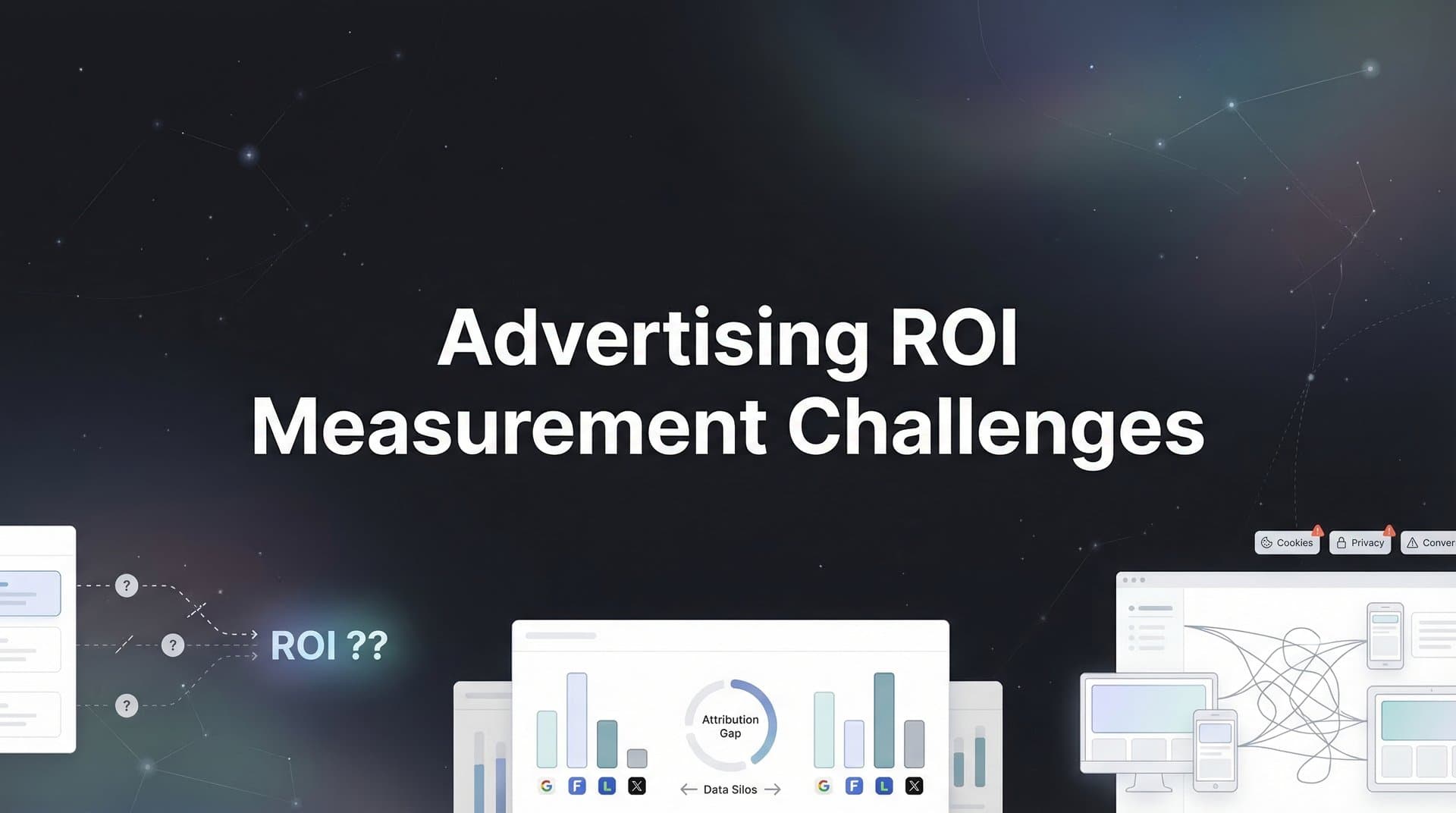
You're spending $50,000 a month on advertising. Your dashboard shows 2,000 conversions. Your CRM says 1,200. Your finance team reports revenue from 800 customers. Which number is real?
This isn't a hypothetical scenario. It's the daily reality for marketing teams trying to measure advertising ROI in 2026. You know you should be tracking return on investment. You've read the articles, attended the webinars, and your leadership expects clear answers about campaign performance. But when you sit down to calculate actual ROI, the numbers don't add up.
The frustrating truth? Advertising ROI measurement has become exponentially more complex. Privacy regulations have rewritten tracking rules. Ad platforms report conflicting data. Customer journeys span multiple devices and weeks of touchpoints. And somewhere in that maze of data, the truth about which campaigns actually drive revenue gets lost.
This isn't about a lack of effort or expertise. The measurement infrastructure itself has fractured. What worked three years ago doesn't work today. And what works today might not work tomorrow as privacy regulations continue evolving. For marketers managing substantial ad budgets, this uncertainty isn't just frustrating—it's expensive. Every dollar misattributed is a dollar that could have been invested in campaigns that actually perform.
The Data Fragmentation Problem: When Your Marketing Stack Doesn't Talk
Picture your typical marketing tech stack. Google Ads manages your search campaigns. Meta handles Facebook and Instagram. TikTok runs its own platform. Your website uses Google Analytics. Customer data lives in HubSpot or Salesforce. Email campaigns run through Klaviyo or Mailchimp.
Each platform tracks conversions independently. Each has its own tracking pixel, its own attribution window, its own definition of what counts as a conversion. The result? You're not looking at one source of truth—you're looking at six different versions of reality.
Here's where it gets messy. A customer clicks your Google ad, visits your site but doesn't convert. Three days later, they see your Facebook retargeting ad and click through. They browse again but still don't purchase. A week later, they search your brand name directly, click your Google ad again, and finally make a purchase.
Google Ads reports this as a conversion—the customer clicked their ad before purchasing. Facebook reports it as a conversion—their retargeting ad was in the journey. Your Google Analytics might attribute it to direct traffic or organic search, depending on your attribution settings. Who's right? They all are. And none of them are.
The technical reality is that each platform only sees its own touchpoints. Google doesn't know about the Facebook interaction. Facebook doesn't know about the Google search. Your analytics platform might capture the website visits but not the ad clicks that preceded them. You're essentially trying to solve a puzzle where each piece comes from a different box. Understanding these marketing data consolidation challenges is the first step toward solving them.
When you try to aggregate this data manually—pulling reports from each platform and combining them in spreadsheets—you face an impossible choice. Do you add up all the conversions, knowing you're counting the same customer multiple times? Do you try to deduplicate manually, knowing you'll miss connections? Do you trust one platform over others, potentially ignoring valuable touchpoints?
The delay compounds the problem. By the time you've pulled reports from six platforms, reconciled the numbers, and identified patterns, you're making decisions based on week-old data. In fast-moving advertising environments, that lag means you're constantly optimizing yesterday's campaigns instead of today's opportunities.
Marketing teams often spend hours each week just trying to create a coherent picture of performance. That's time not spent on strategy, creative development, or actual optimization. The infrastructure meant to enable better marketing decisions has become a bottleneck preventing them.
Privacy Changes Have Rewritten the Tracking Rulebook
Remember when tracking was straightforward? A user clicked your ad, a cookie tracked them across the web, and you could see exactly what they did before converting. That world is gone.
iOS App Tracking Transparency changed everything. When Apple gave users the ability to opt out of cross-app tracking, most users did exactly that. Industry reports suggest opt-in rates remain below 25% for many apps. That means roughly three-quarters of iOS users are invisible to traditional tracking methods.
For advertisers, this created an immediate visibility gap. Conversions still happened—people still bought products after seeing ads—but the connection between ad exposure and purchase became invisible. Facebook's Aggregated Event Measurement tried to fill the gap, but it comes with significant limitations: only eight conversion events per domain, 24-72 hour reporting delays, and probabilistic modeling instead of deterministic tracking.
Browser cookie restrictions added another layer of complexity. Safari's Intelligent Tracking Prevention limits cookie lifespan to seven days for first-party cookies and blocks third-party cookies entirely. Firefox follows similar policies. Chrome's third-party cookie deprecation, repeatedly delayed but still approaching, will affect the majority of web users. Marketers must now develop post-cookie advertising measurement strategies to maintain visibility.
What does this mean practically? A customer who clicks your ad today might not be trackable when they convert next week. The cookie that would have connected those events either expired or was blocked. Your attribution breaks. The conversion happens, but it appears as direct traffic or organic search rather than paid advertising.
The gap between reported conversions and actual customer journeys has widened dramatically. Ad platforms increasingly rely on modeled data—statistical estimates of what probably happened based on aggregate patterns. These models can be directionally useful, but they're not precise. You're making budget decisions based on educated guesses rather than actual user behavior.
Cross-device tracking has become particularly problematic. A user might see your ad on their iPhone, research on their iPad, and purchase on their desktop. Without cookies or tracking identifiers connecting those devices, they appear as three separate users. Your attribution shows three touchpoints that never converted rather than one customer journey that did. These cross-device tracking challenges require sophisticated solutions beyond traditional methods.
The challenge isn't just technical—it's strategic. When you can't accurately measure which campaigns drive conversions, you can't confidently allocate budget. You might be cutting campaigns that actually perform while scaling campaigns that don't. The invisible conversions represent invisible opportunities and invisible waste.
The Multi-Touch Attribution Maze
Most customer journeys don't look like marketing textbooks suggest. They're not linear paths from awareness to consideration to purchase. They're messy, multi-channel experiences spanning days or weeks with multiple touchpoints across different platforms.
Single-touch attribution models try to simplify this complexity by giving all credit to one touchpoint. Last-click attribution credits the final interaction before conversion. First-click credits the initial touchpoint. Both approaches fundamentally misrepresent how marketing actually works.
Consider a B2B software purchase. A potential customer might first discover your product through a LinkedIn ad. They visit your website but aren't ready to buy. Two weeks later, they see a retargeting ad on Facebook and download a whitepaper. A week after that, they attend your webinar promoted via email. Finally, they search your brand name on Google, click your ad, and request a demo.
Last-click attribution gives all credit to that final Google search ad. But would they have searched for your brand if they hadn't seen the LinkedIn ad first? Would they have been ready to request a demo without the webinar? First-click attribution credits only the LinkedIn ad, ignoring everything that nurtured the lead toward conversion.
The reality is that each touchpoint played a role. The LinkedIn ad created awareness. The Facebook retargeting maintained consideration. The webinar built trust. The Google search ad captured intent. Giving all credit to one touchpoint means systematically undervaluing the others—and potentially cutting budget from campaigns that are actually working. Implementing attribution modeling for paid advertising helps distribute credit more accurately across the customer journey.
Multi-touch attribution tries to solve this by distributing credit across touchpoints. But implementation gets complicated quickly. Should each touchpoint get equal credit? Should earlier touchpoints get more credit for initiating the journey? Should later touchpoints get more credit for closing the conversion? Different models produce dramatically different results.
Device switching compounds the challenge. That customer journey we described? It probably happened across a smartphone, tablet, and desktop computer. Without a way to connect those devices to the same person, they appear as separate users. Your attribution shows three incomplete journeys instead of one complete path to conversion.
Long buying cycles create additional blind spots. In B2B marketing, the time from first touchpoint to closed deal can span months. Attribution windows—the time period during which platforms track post-click behavior—typically max out at 30 days. If someone clicks your ad in January but doesn't convert until March, that conversion falls outside the attribution window. It happened, but your tracking missed the connection. These common attribution challenges in B2B marketing require specialized approaches.
Offline conversions present another measurement gap. Someone might see your ads, research online, but ultimately call your sales team or visit a physical location. Unless you have systems connecting phone calls and in-store visits back to digital touchpoints, those conversions appear as if they happened independently of your advertising. You're generating conversions you can't measure.
Platform Self-Reporting Bias: Can You Trust the Numbers?
Ad platforms are businesses optimizing for their own success. When they report attribution data, they're not neutral observers—they're participants with incentive to demonstrate their own value. This creates systematic bias in how conversions get attributed.
Think about it from the platform's perspective. Google wants to show that Google Ads drive conversions. Facebook wants to prove Facebook advertising works. TikTok needs to justify budget allocation to their platform. Each has strong incentive to attribute as many conversions as possible to their own channels.
The technical implementation reflects this bias. Attribution windows favor the platform. Google Ads uses a 30-day click window and 1-day view window by default. Facebook uses similar windows. If a customer interacted with ads on both platforms before converting, both platforms will likely claim the conversion. There's no coordination between them to prevent double-counting. This is why understanding marketing channel overlap measurement is essential for accurate reporting.
This leads to a common scenario: you add up conversions reported across all your ad platforms and get a total that's 150% of your actual conversions. The math doesn't work because you're counting the same customers multiple times. Each platform is technically correct based on its own attribution rules, but collectively they're painting an inflated picture.
View-through attribution adds another layer of uncertainty. This credits conversions to users who saw an ad but didn't click. The theory is sound—ad exposure influences behavior even without clicks. The practice is problematic. How do you verify that someone who saw your ad and later converted actually converted because they saw the ad? Correlation doesn't prove causation.
Modeled conversions introduce additional questions about reliability. As tracking limitations have grown, platforms increasingly use statistical modeling to estimate conversions they can't directly measure. These models use aggregate patterns and machine learning to predict what probably happened. They're better than nothing, but they're not facts—they're educated guesses.
The challenge is that you can't easily verify platform reporting against ground truth. You don't have access to the underlying data or algorithms. You can't audit how conversions were attributed or how models were built. You're essentially accepting the platform's word that their numbers are accurate. Addressing these marketing data accuracy challenges requires independent verification systems.
This isn't to suggest platforms are deliberately misleading advertisers. But the incentive structure creates systematic bias toward over-attribution. When in doubt, the platform's attribution logic tends to favor crediting its own ads. Understanding this bias is essential for interpreting platform reports accurately.
Bridging the Gap Between Ad Spend and Actual Revenue
Marketing metrics and business outcomes often exist in separate universes. Your advertising dashboard shows clicks, impressions, and conversions. Your CRM tracks leads, opportunities, and closed deals. Your finance team measures revenue and profitability. These systems rarely connect seamlessly.
The disconnect creates a fundamental measurement problem. You might be generating hundreds of "conversions" that never turn into paying customers. Or you might be generating fewer tracked conversions but higher-quality leads that close at better rates. Without connecting advertising data to revenue outcomes, you're optimizing for the wrong metrics.
Consider a lead generation campaign. Platform reporting shows 500 conversions at $20 cost per conversion. Looks efficient. But when you connect to your CRM, you discover only 50 of those leads were qualified. Of those 50, only 5 became customers. Your actual cost per customer isn't $20—it's $2,000. The campaigns you thought were performing are actually burning budget.
This revenue attribution gap affects strategic decisions. Should you increase budget on campaigns driving cheap conversions or campaigns driving valuable customers? Without connecting ad touchpoints to actual revenue, you're making that decision blind. You might be scaling campaigns that generate junk leads while cutting campaigns that drive your most profitable customers. Implementing a marketing ROI tracking tool helps bridge this critical gap.
The technical challenge of connecting these systems is significant. Your ad platforms, website analytics, and CRM speak different languages. They use different identifiers for the same people. They track events at different stages of the customer journey. Building infrastructure that reliably connects a Google ad click to a CRM opportunity to a closed deal requires sophisticated data integration.
Server-side tracking has emerged as a critical solution to this challenge. Instead of relying on browser-based pixels that can be blocked or deleted, server-side tracking sends conversion data directly from your servers to ad platforms. This maintains tracking accuracy even as browser restrictions increase. It also allows you to send richer conversion data—not just that a conversion happened, but the revenue value, customer lifetime value, or other business metrics.
First-party data strategies complement server-side tracking. By collecting data directly from customers with their consent—through account creation, email subscriptions, or purchase history—you build a customer database that isn't subject to cookie restrictions or platform limitations. This first-party data becomes your source of truth for understanding customer behavior.
Connecting CRM data back to advertising platforms creates a powerful feedback loop. When you can tell Facebook or Google which leads actually became customers and how much revenue they generated, the platforms' machine learning algorithms can optimize for actual business outcomes instead of proxy metrics. You're training the AI to find more customers like your best customers, not just more clicks like your cheapest clicks.
The marketers who solve this connection problem gain significant competitive advantage. They can confidently allocate budget to campaigns driving real revenue. They can identify which channels and messages resonate with their most valuable customers. They can optimize for profit, not just conversions. The infrastructure investment pays for itself through better decision-making.
Building a Measurement Framework That Actually Works
Solving advertising ROI measurement challenges requires more than better tools—it requires a systematic framework that addresses the fundamental problems we've discussed. The goal is creating a single source of truth that connects ad exposure to actual business outcomes.
Start by establishing unified tracking infrastructure. This means implementing server-side tracking that isn't dependent on browser cookies. It means using first-party identifiers that persist across devices and sessions. It means building data pipelines that connect your ad platforms, website analytics, and CRM into one cohesive system. A unified marketing measurement approach becomes the foundation for accurate measurement.
Choose attribution models that reflect your actual customer journeys. If you're in B2B with long sales cycles, you need attribution that accounts for multiple touchpoints over extended time periods. If you're in e-commerce with shorter consideration windows, your attribution can be more immediate. The key is matching the model to your reality, not forcing your reality into the model's limitations.
Multi-touch attribution that weighs touchpoints based on their role in the journey provides more accurate insights than single-touch models. Position-based attribution that gives more credit to the first and last touchpoints while acknowledging middle touches often works well. Time-decay models that give more credit to recent touchpoints can be effective for shorter cycles. Test different models against your closed revenue to see which best predicts actual outcomes.
Create feedback loops between your measurement system and your ad platforms. When you identify which conversions turned into valuable customers, feed that data back to the platforms. Use conversion value optimization to teach algorithms what "good" looks like for your business. This transforms ad platform AI from optimizing for any conversion to optimizing for profitable conversions.
Establish regular reconciliation processes between platform reporting and actual business outcomes. Weekly or monthly, compare what your ad platforms report to what your CRM shows as closed revenue. Identify patterns in the gaps. If certain campaigns consistently show conversions that don't turn into customers, adjust your optimization strategy. If certain campaigns show fewer tracked conversions but higher revenue per conversion, protect and potentially scale those campaigns. Following advertising attribution best practices ensures consistency in your measurement approach.
For agencies managing multiple clients, using dedicated agency client reporting tools can streamline this reconciliation process and make it easier to communicate ROI clearly to stakeholders.
Build measurement into your campaign planning from the start. Don't launch campaigns and figure out tracking later. Define what success looks like in business terms—not just clicks or conversions, but revenue, customer lifetime value, or profit. Then build tracking infrastructure that measures those outcomes. This proactive approach prevents the measurement gaps that plague reactive tracking implementations.
The marketers who master measurement gain clarity that transforms decision-making. They know with confidence which campaigns to scale and which to cut. They can forecast ROI accurately because they understand the true relationship between ad spend and revenue. They optimize for business growth, not vanity metrics. In competitive advertising environments, this clarity is the difference between profitable growth and expensive guessing.
Taking Control of Marketing Measurement
Advertising ROI measurement challenges aren't temporary obstacles waiting for a simple fix. They're structural realities of modern digital marketing shaped by privacy regulations, platform fragmentation, and complex customer journeys. These challenges will continue evolving as regulations tighten and consumer expectations around data privacy increase.
The marketers who succeed in this environment are those who stop hoping for measurement to get easier and instead invest in infrastructure that addresses the root problems. They build unified tracking systems that connect every touchpoint. They implement server-side tracking that maintains accuracy despite browser restrictions. They create feedback loops between advertising data and revenue outcomes.
This isn't just about better reporting—it's about competitive advantage. While competitors make budget decisions based on incomplete platform data, you're making decisions based on actual revenue impact. While they optimize for conversions that may or may not matter, you're optimizing for profitable customer acquisition. While they struggle to justify marketing spend, you can demonstrate clear ROI tied to business growth.
The gap between marketers who have solved measurement and those who haven't will widen. Ad platforms are getting more sophisticated, requiring better data to optimize effectively. Budgets are under increasing scrutiny, requiring clearer proof of value. Customer acquisition costs are rising, making efficiency improvements more valuable. Measurement isn't a nice-to-have capability—it's a competitive necessity.
The good news? The tools and strategies to solve these challenges exist today. Unified attribution platforms can connect your fragmented data sources. Server-side tracking can maintain accuracy despite privacy restrictions. First-party data strategies can create reliable customer databases. The question isn't whether solutions exist—it's whether you'll implement them before your competitors do.
Taking control of marketing measurement means accepting that perfect attribution isn't possible, but dramatically better attribution is. It means prioritizing infrastructure investments that pay dividends through better decisions. It means connecting the dots between ad clicks and actual revenue so you can confidently answer the question every marketer faces: which campaigns actually drive business growth?
Ready to elevate your marketing game with precision and confidence? Discover how Cometly's AI-driven recommendations can transform your ad strategy—Get your free demo today and start capturing every touchpoint to maximize your conversions.