

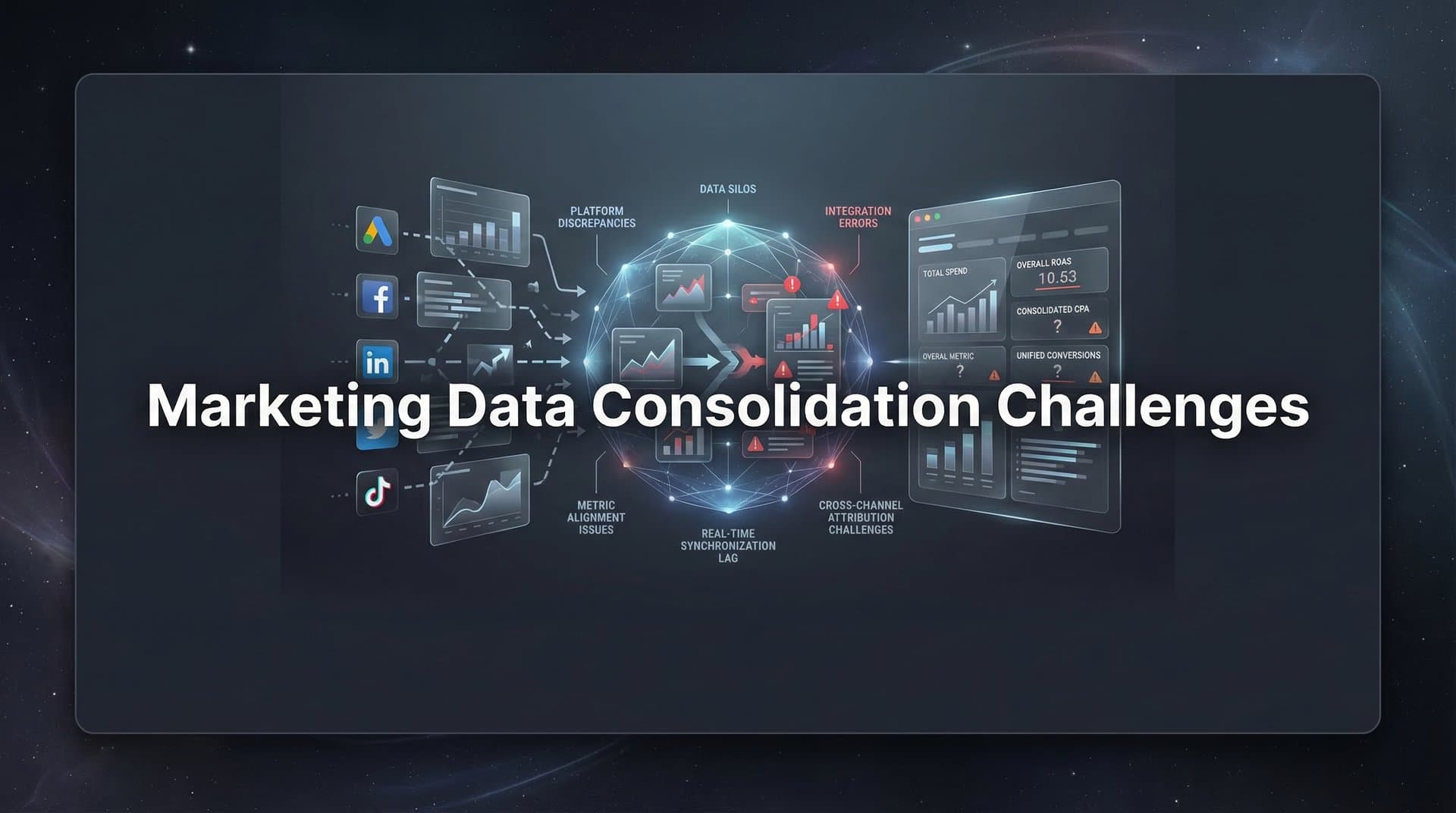
You open your laptop Monday morning with a simple goal: figure out which marketing channels are actually working. But instead of answers, you're greeted by a familiar maze. You log into Meta Ads Manager to check Facebook performance. Then Google Ads for search campaigns. Then your email platform for nurture metrics. Then your CRM to see which leads actually converted. An hour later, you're staring at three different spreadsheets with conflicting numbers, and you still don't have a clear answer about where to invest your next dollar.
This isn't a workflow problem. It's a data consolidation problem.
When your marketing data lives in disconnected silos, every decision becomes a guess. You waste budget on channels that get credit they don't deserve. You miss opportunities in channels that are actually driving revenue but don't show up in last-click reports. And worst of all, you spend hours each week manually stitching together reports instead of optimizing campaigns.
The challenge isn't that marketers lack data—it's that the data is scattered across platforms that were never designed to work together. This article breaks down exactly why marketing data consolidation is so difficult, what it's costing you, and how to build a system that finally gives you a unified view of what's driving results.
The Fragmented Reality of Modern Marketing Stacks
The average marketing team today operates with a tech stack that would make a software engineer wince. You've got Meta Ads for social campaigns. Google Ads for search. LinkedIn for B2B targeting. Your CRM tracking leads and deals. Google Analytics monitoring website behavior. Email platforms managing nurture sequences. Maybe a chat tool capturing conversations. Possibly an SMS platform for direct outreach.
Each platform excels at its specific function. But here's the problem: they weren't built to talk to each other.
Meta Ads Manager gives you detailed metrics about ad performance within Facebook and Instagram. Google Ads shows you search campaign data with its own attribution logic. Your CRM knows which leads closed into revenue, but it has no idea which ad they clicked three weeks ago. Google Analytics tracks website sessions, but it can't connect those sessions to the actual revenue in your CRM.
Every platform operates in its own universe with its own data format, its own definition of success, and its own reporting methodology. What Meta calls a "conversion" might be completely different from what Google defines as a conversion. The timestamp on a click in one platform doesn't match the session start time in another. The user ID from your website doesn't connect to the customer ID in your CRM without custom integration work.
This fragmentation isn't accidental. It's the natural result of how marketing technology evolved. Each platform was built to solve a specific problem—run better Facebook ads, manage email campaigns, track website analytics. As marketing became more sophisticated and channels multiplied, teams added more specialized tools to their stack. The explosion of marketing channels over the past decade has dramatically outpaced the development of unified data infrastructure to connect them.
The result? Marketing teams are drowning in data while starving for insights. You have more information than ever before, but it's locked in separate systems that don't communicate. Understanding marketing data integration challenges is the first step toward solving this fragmented reality. It's like having all the pieces of a puzzle scattered across different rooms—you know the complete picture exists somewhere, but assembling it requires running between rooms with armfuls of pieces, hoping you don't drop any along the way.
Five Core Obstacles Standing Between You and Unified Data
Understanding why consolidation is difficult starts with recognizing the specific barriers that make it so challenging. These aren't minor technical hiccups. They're fundamental structural problems in how marketing platforms operate.
Data Silos by Design: Major advertising platforms have a vested interest in keeping you inside their ecosystem. Meta doesn't want you to easily compare Facebook ad performance against Google Ads performance because they're competing for your budget. So they make their data accessible within their platform but difficult to export and integrate elsewhere. APIs exist, but they're often limited in what data they expose, how frequently you can access it, and how far back historical data extends. The platforms give you enough access to feel like you have control while maintaining enough friction to keep you logging in daily.
Inconsistent Metrics and Definitions: Ask five different platforms what counts as a conversion, and you'll get five different answers. Meta might count a conversion based on a 7-day click or 1-day view window. Google Ads uses a different attribution window entirely. Your analytics platform defines conversions based on goal completions that may or may not align with actual revenue. Your CRM considers a conversion to be a closed deal, which happens weeks after the initial ad click. When every platform uses different rules to measure success, comparing performance across channels becomes an exercise in translation rather than analysis.
Privacy Regulations and Tracking Limitations: Apple's App Tracking Transparency framework fundamentally changed mobile advertising by requiring explicit user permission to track across apps and websites. The majority of iOS users opted out, creating an immediate blind spot in mobile campaign data. Third-party cookie deprecation is doing the same thing for web tracking. GDPR and similar privacy regulations add consent requirements that fragment data even further—some users consent to tracking, others don't, creating incomplete datasets. These privacy changes don't just reduce the volume of data available; they create inconsistencies that make consolidation harder because you're working with partial information that varies by user, device, and geography.
Technical Complexity: Connecting disparate marketing systems requires technical skills that many marketing teams simply don't have in-house. You need to understand APIs to pull data from platforms. You need data warehouse knowledge to store it somewhere centralized. You need ETL (Extract, Transform, Load) expertise to clean and standardize the data so it's actually comparable. You need SQL skills to query it and visualization tools to make it understandable. Building a consolidated data infrastructure from scratch is essentially a software engineering project, not a marketing task. Most teams either lack these skills entirely or have one technical marketer who becomes a bottleneck trying to maintain fragile custom integrations.
Real-Time vs. Batch Data: Different platforms update their data on different schedules, creating timing mismatches that produce conflicting snapshots of performance. Your ad platforms might show real-time spend and clicks. Your analytics tool processes data in batches every few hours. Your CRM updates when sales reps manually enter information, which could be days after a deal closes. When you try to compare data across these systems, you're often looking at different time windows. A conversion that shows up in Google Ads today might not appear in your CRM until next week. This asynchronous data flow makes it nearly impossible to get a truly current, unified view of campaign performance.
Why These Obstacles Compound
The real challenge isn't any single obstacle—it's how they interact and multiply. Privacy limitations reduce the data available, making accurate attribution harder. That forces you to rely more heavily on platform-specific reporting, which reinforces data silos. The technical complexity of solving these problems means most teams resort to manual workarounds like spreadsheet exports, which only work with batch data and introduce human error. Each obstacle makes the others worse, creating a consolidation challenge that feels insurmountable without purpose-built solutions. For a deeper dive into these compounding issues, explore the broader marketing data challenges that teams face today.
The Hidden Costs of Scattered Marketing Data
Fragmented data isn't just an inconvenience. It's actively costing you money and opportunities every single day.
Wasted Ad Spend from Duplicated Attribution: When multiple platforms claim credit for the same conversion, you're making budget decisions based on inflated performance metrics. Meta Ads Manager shows 100 conversions this month. Google Ads also reports 100 conversions. Your email platform claims another 50. Add them up and you'd think you generated 250 conversions. But your CRM only shows 120 actual customers. What happened? Attribution overlap. The same customer clicked a Facebook ad, then a Google search ad, then opened an email before converting. All three platforms claimed credit. Without consolidated data showing the full customer journey, you're optimizing toward metrics that double or triple-count results. You might increase Facebook budget based on its reported conversions, not realizing that most of those customers also touched Google and email—meaning Facebook's isolated performance looks better than its actual incremental contribution.
Slow Decision-Making: Speed matters in digital marketing. Ad platforms update their algorithms constantly. Competitor activity shifts daily. Market conditions change by the hour. But if it takes you three hours every Monday to manually compile a performance report, you're making decisions based on stale data. By the time you've exported CSVs from five platforms, cleaned the data, merged it in spreadsheets, and created charts, the opportunity to act has often passed. Your competitors who have real-time consolidated dashboards are adjusting bids, reallocating budget, and pausing underperforming campaigns while you're still building your weekly report. The opportunity cost of slow decision-making compounds over time—small delays in optimization accumulate into significant performance gaps.
Missed Revenue Opportunities: The most expensive cost of fragmented data is what you never see—the revenue you could have generated if you knew which channels and touchpoints actually drive conversions. Maybe your display ads rarely get last-click credit, so you've been cutting that budget. But in reality, display ads are crucial early touchpoints that introduce prospects who later convert through search. Without multi-touch visibility, you optimize for the wrong metrics and systematically underfund channels that play essential supporting roles in your customer journey. Understanding why marketing data accuracy matters for ROI reveals just how much revenue slips through the cracks when you can't see the complete picture.
The Compounding Effect
These costs don't exist in isolation. Wasted spend reduces your overall marketing budget, which means less data to work with, which makes consolidation even harder. Slow decision-making means you miss optimization windows, which reduces campaign performance, which creates pressure to cut costs instead of investing in better infrastructure. Missed opportunities mean you're leaving revenue on the table while your competitors capture market share. Fragmented data creates a downward spiral where each problem makes the others worse.
Building a Practical Data Consolidation Strategy
Solving consolidation doesn't require a complete rebuild of your marketing stack. It requires a methodical approach focused on creating one authoritative source of truth for the metrics that matter most.
Start with a Single Source of Truth: The foundation of any consolidation strategy is choosing one system to be your authoritative record for conversions and revenue. For most businesses, this should be your CRM or revenue database—the system that tracks actual customers and money, not just clicks and sessions. Once you've designated your source of truth, every other platform becomes a supporting data source that feeds into or validates against that central record. This doesn't mean abandoning platform-specific reporting. It means establishing a hierarchy where CRM revenue is the ultimate measure of success, and ad platform metrics are evaluated based on how well they predict or contribute to that revenue.
This single source of truth becomes your reference point for resolving conflicts. When Meta reports 50 conversions but your CRM shows 40 new customers, you trust the CRM number and investigate the 10-conversion discrepancy. Maybe some conversions were duplicates. Maybe some were low-quality leads that didn't close. The point is having one system you trust completely, so you can identify and fix data quality issues in other systems. Learning how to unify marketing data sources provides a practical roadmap for establishing this foundation.
Prioritize Server-Side Tracking: Browser-based tracking is increasingly unreliable due to ad blockers, privacy settings, and cookie restrictions. Server-side tracking captures data directly from your server when conversions happen, bypassing browser limitations entirely. When a customer completes a purchase, your server knows it happened regardless of whether their browser allows tracking cookies. This server-side data is more complete and more accurate than client-side tracking alone. Implementing server-side tracking requires technical setup, but it's become essential for maintaining data quality in the post-cookie era. The investment pays off through more reliable conversion data that actually reflects customer behavior rather than what browsers allow you to see.
Server-side tracking also enables you to enrich conversion events with additional context before sending them to ad platforms. You can include customer lifetime value, product categories, or CRM status—data that helps ad platforms optimize more effectively than basic conversion signals alone.
Connect Your Ad Platforms to Your CRM: The gap between ad clicks and revenue is where most attribution falls apart. A prospect clicks your Facebook ad on Monday. They visit your website and fill out a form. That lead goes into your CRM. A sales rep follows up. Two weeks later, the prospect becomes a customer worth thousands of dollars. Without connecting your ad platforms to your CRM, Facebook only knows about the initial click and form fill. It has no idea that click turned into significant revenue. By integrating your CRM with your ad platforms, you close this loop. Facebook learns which clicks led to high-value customers, not just form fills. Google Ads understands which keywords drive revenue, not just leads. This connection transforms your ad platforms from optimizing for vanity metrics into optimizing for actual business outcomes. Explore how to connect all marketing data sources for detailed implementation guidance.
The technical implementation varies by platform, but the concept is consistent: use APIs or integration tools to send CRM conversion events back to your ad platforms. When a lead becomes a customer in your CRM, that event gets passed back to Facebook, Google, and any other platform that contributed to the journey. This feedback loop improves ad platform algorithms while giving you unified visibility into which channels drive real revenue.
How Attribution Platforms Solve Consolidation at Scale
While you can build custom consolidation infrastructure with enough technical resources, purpose-built attribution platforms exist specifically to solve this problem for marketing teams.
Unified Data Aggregation: Attribution platforms connect to all your marketing channels, your website, and your CRM to aggregate data into one centralized system. Instead of logging into five different platforms to see performance, you have a single dashboard showing how every channel contributes to conversions and revenue. These platforms handle the technical complexity of API connections, data standardization, and real-time synchronization. They're built to overcome the obstacles we discussed earlier—working around platform limitations, reconciling inconsistent metrics, and providing unified reporting despite fragmented data sources. A robust marketing data analytics platform eliminates the manual work of stitching together reports from disparate systems.
The key advantage is completeness. An attribution platform captures the full customer journey from first touch to revenue, connecting ad clicks to website sessions to CRM conversions. It tracks every touchpoint across every channel, creating a complete picture that no single platform can provide in isolation.
Multi-Touch Attribution Models: Traditional last-click attribution gives all credit to the final touchpoint before conversion, ignoring everything that happened earlier in the customer journey. Multi-touch attribution distributes credit across all the touchpoints that contributed to a conversion based on configurable models. You can see which channels work as effective first touches that introduce prospects. Which channels are strong mid-funnel influencers that nurture consideration. Which channels close deals effectively. This reveals how channels work together rather than competing for credit in isolated reports. You might discover that display ads rarely close deals directly but are crucial for initial awareness, while search ads excel at capturing high-intent prospects who were introduced through other channels. This insight changes how you allocate budget—instead of cutting display because it has poor last-click performance, you maintain it as an essential top-of-funnel driver.
Multi-touch attribution also solves the duplication problem. When the same conversion appears in three different platform reports, attribution platforms identify it as a single conversion and distribute credit appropriately across the touchpoints rather than counting it three times. Understanding common attribution challenges in marketing analytics helps you appreciate why these models are essential for accurate measurement.
Feeding Enriched Data Back to Ad Platforms: Modern attribution platforms don't just aggregate data for reporting—they send enriched conversion data back to your ad platforms to improve their optimization algorithms. When you connect Cometly to Facebook and Google, it passes back detailed conversion events that include revenue value, customer type, and other contextual data your ad platforms can't access on their own. This conversion sync helps ad platform algorithms understand which clicks lead to valuable customers, enabling smarter bidding and better audience targeting. The platforms optimize toward actual business outcomes rather than surface-level metrics. Over time, this feedback loop improves campaign performance as ad algorithms learn to identify and target prospects who resemble your best customers based on complete conversion data rather than partial browser-based signals.
Your Path Forward: From Fragmented Data to Unified Intelligence
Marketing data consolidation challenges are real, widespread, and expensive. But they're not insurmountable.
The marketers who solve consolidation gain a decisive competitive advantage. They make faster decisions based on complete data. They allocate budget to channels that actually drive revenue rather than channels that claim credit they don't deserve. They identify optimization opportunities that competitors miss because they can see the full customer journey, not just isolated touchpoints.
Start by acknowledging that consolidation is a process, not a one-time project. You don't need to solve everything immediately. Begin with your source of truth—establish which system authoritatively tracks conversions and revenue. Implement server-side tracking to capture more reliable data. Connect your ad platforms to your CRM to close the loop between clicks and revenue. Each step improves your data infrastructure and makes the next step easier.
For teams ready to move beyond manual consolidation, purpose-built attribution platforms eliminate the technical barriers and provide unified visibility across your entire marketing stack. They handle the complexity of connecting disparate systems, standardizing inconsistent data, and maintaining real-time synchronization. Most importantly, they reveal what's actually driving revenue so you can confidently scale what works and cut what doesn't.
The question isn't whether to invest in data consolidation—it's whether you can afford not to. Every day you operate with fragmented data is another day of wasted spend, missed opportunities, and decisions based on incomplete information. Your competitors who have solved consolidation are already pulling ahead.
Ready to elevate your marketing game with precision and confidence? Discover how Cometly's AI-driven recommendations can transform your ad strategy—Get your free demo today and start capturing every touchpoint to maximize your conversions.



