You open your laptop Monday morning, pull up your campaign performance reports, and immediately feel that familiar knot in your stomach. Meta Ads Manager says you got 127 conversions last week. Google Analytics shows 94. Your CRM logged 156 new leads. Same campaign. Same time period. Three completely different numbers.
Which one is right? Which dashboard should guide your $50,000 budget decision this month?
If this scenario feels painfully familiar, you're not alone. Marketing data challenges have become one of the most persistent frustrations in digital advertising—and they're not a reflection of your skills or your team's capabilities. These problems are systemic, affecting everyone from solo consultants to enterprise marketing departments. The tools we rely on to track performance are fundamentally disconnected, privacy regulations have rewritten the rules of data collection, and the result is a landscape where making confident decisions feels like guessing in the dark.
The good news? These challenges are solvable. Understanding why your numbers don't add up is the first step toward building a data foundation you can actually trust. Let's break down what's really happening behind those conflicting dashboards—and more importantly, how to fix it.
The Data Fragmentation Problem: When Your Tools Don't Talk to Each Other
Picture your marketing stack as a relay race where no runner can see the next one. Your ad platforms hand off data to your website. Your website passes information to your analytics tool. Your analytics tool tries to sync with your CRM. Each handoff loses a little context, a little accuracy, a little truth.
This is data fragmentation in action, and it's the root cause of most marketing data challenges.
Modern marketing requires multiple specialized tools. You need Meta Ads Manager to run Facebook campaigns. Google Ads for search traffic. Google Analytics to understand website behavior. A CRM like HubSpot or Salesforce to manage leads. Maybe a landing page builder, an email platform, and a call tracking system on top of that. Each tool excels at its specific job—but they were never designed to work seamlessly together.
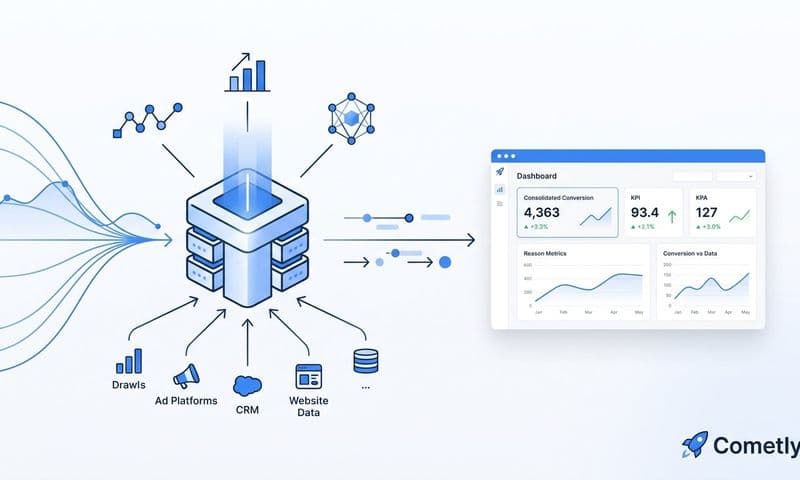
The result? Data silos everywhere. Your ad platforms know which ads people clicked but can't see what happened after they reached your website. Your analytics tool sees website behavior but struggles to connect it back to specific ad campaigns. Your CRM knows which leads converted to customers but has no visibility into the marketing touchpoints that influenced them. Understanding the marketing data silos problem is essential for any team trying to unify their reporting.
Here's where it gets worse: even when these tools technically integrate, the data degrades in translation. Think of it like a game of telephone played across five different systems, each with its own tracking methodology, its own definition of a "conversion," and its own attribution logic. By the time information flows from ad click to final sale, the story has been rewritten multiple times.
Consider what happens when someone clicks your Meta ad on their phone during lunch, browses your website, then returns that evening on their laptop to complete a purchase. To you, that's one customer journey. To your disconnected tools, that's two completely separate visitors with no obvious connection. Your Meta pixel might claim credit for the conversion. Google Analytics might attribute it to direct traffic. Your CRM might log it as an organic lead.
Same customer. Same purchase. Three different stories about how it happened.
The challenge of matching anonymous website visitors to known customers compounds this problem. When someone first lands on your site, they're just an anonymous session in your analytics. Only after they fill out a form or make a purchase do they become a known entity in your CRM. Connecting that known customer back to their anonymous browsing sessions—and back to the original ad that brought them in—requires sophisticated identity resolution that most marketing stacks simply can't handle.
This fragmentation doesn't just create reporting headaches. It fundamentally undermines your ability to understand what's working. When you can't reliably connect ad spend to revenue, every optimization decision becomes a shot in the dark.
Privacy Changes That Broke Traditional Tracking
If data fragmentation created cracks in the foundation, privacy changes blew a hole straight through it.
Apple's iOS 14.5 update in 2021 marked a turning point for digital marketing. With App Tracking Transparency, iPhone users could now opt out of cross-app tracking with a single tap—and most did. Suddenly, the tracking pixels that powered Facebook and Instagram advertising lost visibility into huge swaths of user behavior. Campaigns that previously reported detailed conversion data started showing "Aggregated Event Measurement" instead of granular results.
We compare the leading options in our Instagram advertising specs roundup.
The impact was immediate and severe. Marketers watching their dashboards saw conversion tracking drop by 30-50% overnight—not because performance actually declined, but because the tracking infrastructure could no longer see what was happening. The conversions were still occurring. The tools just couldn't measure them anymore.
Google's ongoing efforts to deprecate third-party cookies in Chrome have created similar uncertainty, even as the timeline keeps shifting. These cookies have been the backbone of cross-site tracking for years, enabling remarketing campaigns and attribution across the web. As they disappear, another pillar of traditional marketing measurement crumbles.
This creates a massive gap between what ad platforms report and what's actually happening. Meta might show 80 conversions because that's all their pixel could track within iOS restrictions. Google Ads might claim 65 conversions based on their own limited visibility. Meanwhile, your actual sales data shows 140 purchases. The platforms aren't lying—they're working with incomplete information. These attribution challenges in digital marketing affect virtually every advertiser today.
The problem compounds when you realize ad platforms use their own conversion data to optimize campaigns. If Facebook's algorithm only sees half of your actual conversions, it's optimizing toward an incomplete picture of success. It might scale ads that look like winners in its limited view while cutting budget from campaigns that are actually driving revenue—revenue it simply can't see.
This is why server-side tracking has become essential rather than optional. Instead of relying on browser-based pixels that privacy restrictions can block, server-side tracking captures conversion data on your own servers and sends it directly to ad platforms. It bypasses the limitations of client-side tracking, providing more complete and accurate data even as privacy regulations tighten.
The shift from client-side to server-side tracking isn't just a technical upgrade—it's a fundamental change in how marketing data gets collected and shared. Marketers who haven't made this transition are essentially flying blind, making decisions based on data that's increasingly unreliable.
Attribution Model Confusion: Same Data, Different Stories
Even if you solve data fragmentation and privacy challenges, you still face a third problem: attribution models that contradict each other.
Let's say a customer's journey looks like this: They see your Facebook ad, click it, browse your site but don't buy. Two days later, they Google your brand name, click your search ad, and visit again. A week later, they type your URL directly into their browser and make a purchase. Which campaign deserves credit for that sale?
It depends entirely on which attribution model you use—and that's the problem.
Last-click attribution would credit the direct visit, suggesting your paid campaigns contributed nothing. First-click attribution would give all credit to the Facebook ad, ignoring the role of search in bringing them back. Linear attribution would split credit evenly across all three touchpoints, which sounds fair but doesn't reflect that some interactions matter more than others. For a deeper dive into these issues, explore our guide on common attribution challenges in marketing analytics.
Each model tells a radically different story about campaign performance. A Facebook campaign might look like a star performer under first-click attribution and a complete waste under last-click. Your Google Search campaigns might appear essential in one model and redundant in another. Same data. Different conclusions. Different budget decisions.
Attribution windows add another layer of complexity. Meta Ads Manager defaults to a 7-day click and 1-day view attribution window. Google Ads uses different windows. Your analytics platform might use yet another. When someone converts 10 days after clicking your ad, some platforms will count it as a conversion while others won't.
These different windows can create dramatic discrepancies in reported performance. A campaign with a longer sales cycle might look terrible in a 7-day attribution window but strong in a 28-day window. If you're comparing platforms with different default windows, you're essentially comparing apples to oranges.
The challenge intensifies when customers interact with multiple channels before converting. In today's fragmented media landscape, this is the norm rather than the exception. Someone might see your Instagram ad, later encounter your YouTube video, then click a Google search ad before finally converting through an email campaign. Which touchpoint deserves credit? Which campaign should you scale?
There's no objectively "correct" attribution model—each one emphasizes different aspects of the customer journey. The problem isn't that attribution models exist. It's that most marketers are unknowingly using multiple conflicting models across their tools, then wondering why the numbers don't match.
This confusion paralyzes decision-making. When you can't agree on which campaigns are actually driving results, how do you confidently allocate budget? How do you know which channels to scale and which to cut?
The Real Cost of Unreliable Marketing Data
Bad data isn't just frustrating—it's expensive.
When your attribution is unreliable, you inevitably misallocate ad spend. You scale campaigns that look like winners in your incomplete data but are actually underperforming. You cut budget from channels that appear ineffective but are quietly driving significant revenue. Every budget decision based on faulty data compounds the problem.
Think about the math. If you're spending $100,000 monthly on paid ads and your data is off by even 20%, you could be wasting $20,000 every single month on the wrong campaigns. Over a year, that's $240,000 in misallocated spend. For smaller businesses, even a few thousand dollars of waste can mean the difference between profitability and failure. Learning marketing budget allocation based on data becomes critical when every dollar counts.
The damage extends beyond your budget decisions. Ad platform algorithms rely on conversion data to optimize campaigns. When you feed Facebook or Google incomplete or inaccurate conversion signals, their machine learning systems optimize toward the wrong goals. They might maximize clicks when you need purchases, or drive low-quality leads because they can't see which leads actually convert to customers.
This creates a vicious cycle. Bad data leads to poor algorithmic optimization, which leads to worse campaign performance, which generates more bad data. The longer this cycle continues, the harder it becomes to break out of it.
Then there's the time cost—the hours your team spends each week trying to reconcile conflicting reports instead of actually optimizing campaigns. You pull data from five different sources, export it all to spreadsheets, and manually try to piece together what really happened. By the time you finish, the week is over and you need to start the process again. Many teams still rely on a marketing campaign tracking spreadsheet when they should be using automated solutions.
This isn't just inefficient—it's demoralizing. Your team signed up to be marketers, not data archaeologists. When they spend more time questioning the data than using it to make decisions, burnout follows quickly.
Perhaps most damaging is the erosion of confidence. When you can't trust your data, you can't trust your decisions. That hesitation slows everything down. You second-guess campaign changes. You delay budget shifts. You avoid testing new channels because you won't be able to accurately measure the results anyway.
Meanwhile, competitors who've solved their data challenges are moving faster, testing more aggressively, and scaling winners with confidence. The gap widens not because they're smarter marketers, but because they have data they can actually trust.
Building a Foundation for Trustworthy Marketing Data
So how do you fix this? Not with another dashboard or reporting tool—those just add to the fragmentation. The solution requires rethinking your entire approach to data collection and attribution.
Start with server-side tracking as your new baseline. This isn't optional anymore—it's foundational. Server-side tracking captures conversion data on your own infrastructure and sends it directly to ad platforms, bypassing the browser-level restrictions that break client-side pixels. It gives you more complete visibility into actual conversions, even as privacy regulations continue to tighten.
Implementing server-side tracking means you're no longer at the mercy of cookie restrictions and iOS limitations. You capture the full picture of what's happening, then share that enriched data with the platforms that need it. This doesn't just improve your reporting—it improves ad platform optimization by feeding their algorithms better conversion signals. Implementing marketing data accuracy improvement methods should be a priority for every growth team.
Next, focus on connecting your disparate data sources into a unified view. Your ad platforms, website analytics, and CRM need to speak the same language and share information bidirectionally. This means more than just technical integrations—it requires a system that can match anonymous website visitors to known customers, track touchpoints across devices and channels, and attribute conversions accurately across the entire journey.
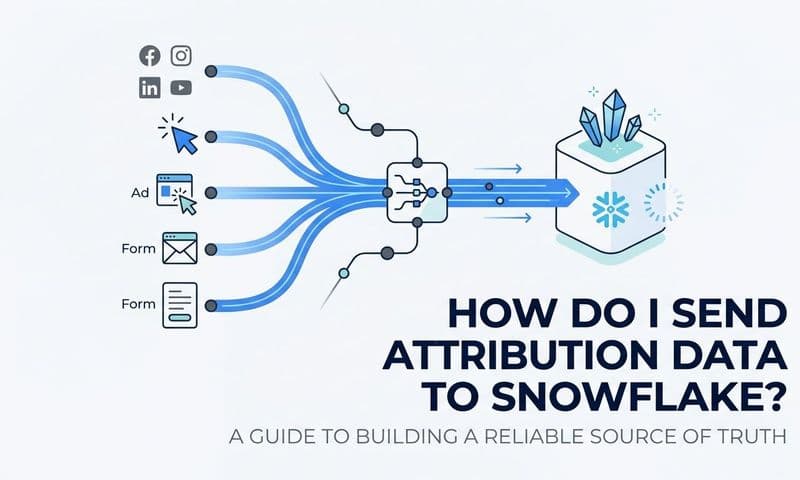
This unified approach solves the fragmentation problem at its source. Instead of data degrading as it passes between systems, you maintain a single source of truth that all your tools can reference. When Meta asks "did this ad drive a conversion?" and your CRM asks "where did this customer come from?" they're both looking at the same underlying data. A centralized marketing data warehouse solution can serve as that single source of truth.
Feeding enriched conversion data back to ad platforms closes the optimization loop. When you can tell Facebook not just that a conversion happened, but that it came from a high-value customer who's likely to generate recurring revenue, the platform's algorithm can optimize toward better outcomes. You're not just improving your reporting—you're actively improving campaign performance by giving ad platforms the information they need to find more customers like your best ones.
This is where modern attribution platforms provide the most value. They don't just report on what happened—they actively improve your data foundation by capturing every touchpoint, connecting it to actual business outcomes, and syncing that enriched data back to your ad platforms. The result is both more accurate reporting and better algorithmic optimization. Choosing the right marketing data analytics software can make all the difference in achieving these outcomes.
The goal isn't perfect data—that's impossible in today's privacy-conscious landscape. The goal is data that's accurate enough to make confident decisions. Data that tells a consistent story across your tools. Data that helps you identify winners and losers with enough clarity to act decisively.
Moving Forward with Confidence
Marketing data challenges aren't going away, but they're no longer an unsolvable problem. The fragmentation, privacy restrictions, and attribution confusion that plague most marketing teams have clear solutions—if you're willing to modernize your approach to data collection and attribution.
The key insight is this: you can't fix data problems by adding more tools to your stack. You fix them by fundamentally changing how you capture, connect, and utilize marketing data. Server-side tracking, unified attribution, and enriched conversion signals aren't nice-to-haves anymore—they're the baseline for effective marketing in 2026. Embracing data driven marketing strategies is no longer optional for teams that want to compete.
Take a hard look at your current data stack. If you're still relying primarily on client-side pixels, if your tools don't communicate bidirectionally, if you're spending hours each week reconciling conflicting reports, it's time for a change. The cost of maintaining your current approach—in wasted ad spend, missed opportunities, and team frustration—far exceeds the effort required to build a better foundation.
The marketers who thrive in the coming years won't be those with the biggest budgets or the fanciest creative. They'll be the ones who solved their data challenges early and built systems they can trust. They'll move faster, test more confidently, and scale winners aggressively because they know what's actually working.
Ready to elevate your marketing game with precision and confidence? Discover how Cometly's AI-driven recommendations can transform your ad strategy—Get your free demo today and start capturing every touchpoint to maximize your conversions.