Picture this: you're managing campaigns across Meta, Google, TikTok, and LinkedIn simultaneously. Each platform has its own dashboard, its own attribution logic, and its own set of alerts screaming for your attention. You've got dozens of active ad sets, multiple creative variants in rotation, and a budget that needs to work harder every month. Somewhere in all of that data is the answer to your next performance breakthrough. The question is whether you can find it before your competitors do.
This is the reality for most digital marketers today. The sheer volume of data generated by modern advertising campaigns has outpaced what any human analyst can process in a reasonable timeframe. By the time you've pulled reports, cross-referenced platform data, and mapped out a plan of action, the optimal window for that change may have already closed.
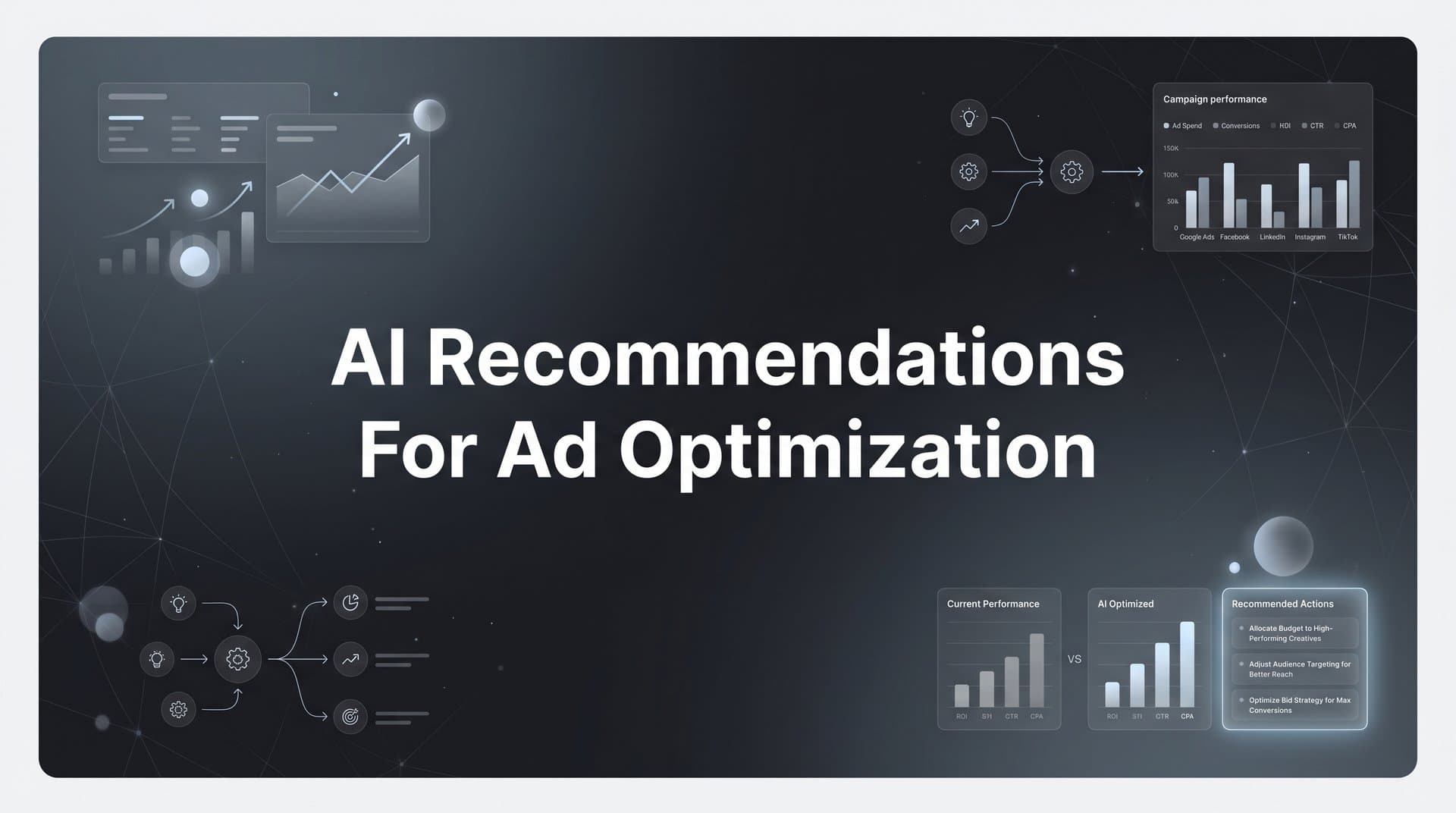
AI recommendations for ad optimization change this equation entirely. Instead of waiting for you to ask the right question, these systems continuously analyze your campaign data across every channel, surface patterns you might never spot manually, and tell you exactly where to focus your energy. This article breaks down how these systems work, what kinds of recommendations they generate, and how to make sure you're acting on signal rather than noise.
Why Manual Ad Optimization Hits a Ceiling
There's a complexity problem at the heart of modern paid advertising, and it compounds quickly. A single campaign on Meta might have five ad sets, each targeting a different audience segment, with three creative variants per set. Multiply that across Google, TikTok, and LinkedIn, factor in different bidding strategies, seasonal dynamics, and creative fatigue cycles, and you're looking at hundreds of variables interacting simultaneously. No spreadsheet can hold all of that context at once.
The human brain is remarkably good at pattern recognition in familiar environments. But when the number of variables grows exponentially, cognitive limits kick in fast. Marketers end up focusing on the metrics that are easiest to see, the ones right in front of them in whatever dashboard they happen to have open. That's not a failure of skill. It's a structural limitation of manual analysis.
Data fragmentation makes the problem significantly worse. Each ad platform reports using its own attribution model. Meta might credit a conversion to a view-through interaction while Google credits the same conversion to a search click that happened three days later. Without a unified view that normalizes these differences, you're not comparing apples to apples. You're comparing apples to something that doesn't even have a name yet. This is a common scenario where ad platforms take credit for the same conversion, leaving marketers with inflated numbers and unclear insights.
The result is that optimization decisions often get made on incomplete information. A campaign might look underperforming in its native platform dashboard while actually playing a critical role in the broader customer journey. Budget gets pulled from channels that were quietly driving conversions, and the downstream impact doesn't show up until weeks later when pipeline numbers start to soften.
Then there's the speed gap. Paid media moves fast. Auction dynamics shift. Audience saturation creeps in. A creative that was generating strong results on Monday can start fatiguing by Thursday. By the time a marketer runs their weekly report, spots the trend, and implements a change, days of suboptimal spend have already happened. In competitive markets, that lag adds up to real money. Understanding these ad performance optimization blind spots is the first step toward addressing them.
Manual optimization isn't going away entirely. Strategic judgment, creative instinct, and brand knowledge are things algorithms still can't fully replicate. But the tactical, data-driven layer of campaign management has clearly exceeded what humans can handle alone. That's exactly where AI steps in.
How AI Generates Ad Optimization Recommendations
Understanding how AI recommendation systems actually work helps you trust them more and use them better. These aren't black boxes spitting out arbitrary suggestions. They're pattern recognition engines operating at a scale that humans simply cannot match.
At the core of any AI recommendation system is data ingestion. The model continuously pulls in performance data from across your campaigns: impressions, clicks, conversions, cost per result, audience overlap metrics, creative performance signals, and more. The more complete and accurate this data is, the better the outputs. Think of it like a chef working with ingredients. Better ingredients produce better dishes. Incomplete or inaccurate data produces recommendations you can't trust. This is precisely why ad optimization without accurate data consistently leads marketers astray.
Pattern recognition at scale: AI models look for correlations across thousands of data points simultaneously. They can identify that a specific creative performs significantly better with a particular audience segment on Tuesday afternoons, or that campaigns targeting a certain demographic consistently hit diminishing returns after a specific frequency threshold. These are the kinds of micro-patterns that take human analysts days to surface, if they find them at all.
Predictive modeling: This is where AI moves beyond reporting what happened to forecasting what's likely to happen next. Rather than waiting for a campaign to overspend before flagging it, a predictive model can identify the trajectory and alert you while there's still time to act. Similarly, it can spot an emerging high-performer before it becomes obvious in the data, giving you an early-mover advantage.
The attribution layer: This is the piece most marketers underestimate. AI recommendations are only as good as the attribution data for ad optimization feeding them. If your system only captures last-click conversions, the AI will optimize toward whatever channel gets the last touch, regardless of what drove the customer into the funnel in the first place. Multi-touch attribution that captures the full customer journey gives the AI the context it needs to make recommendations that reflect reality rather than a distorted version of it.
Server-side tracking plays a critical role here. Browser-based pixel tracking has become increasingly unreliable due to iOS privacy changes, browser restrictions, and ad blockers. When conversions go untracked, the AI is working with a partial dataset, and partial datasets produce partial recommendations. Server-side tracking captures conversion signals that client-side pixels miss, giving the AI a more complete picture of what's actually happening in your funnel.
The combination of scale, prediction, and accurate attribution is what separates AI-generated recommendations from the kind of gut-feel optimization that most marketers default to when the data gets overwhelming.
Five Types of AI Recommendations That Move the Needle
Not all AI recommendations carry equal weight. Some are tactical tweaks. Others can fundamentally reshape how your budget is allocated. Here are the five categories that tend to have the most meaningful impact on campaign performance.
Budget reallocation suggestions: This is often where AI delivers its most immediate value. When you're managing campaigns across multiple platforms, it's easy to get siloed. You optimize within Meta, then separately within Google, without ever stepping back to ask whether the budget split between platforms is actually optimal. AI systems that unify cross-platform data can identify when a Google campaign is consistently underperforming relative to a Meta campaign targeting the same goal, and recommend a budget shift before the opportunity cost grows. Platforms built for automated budget optimization for paid media excel at surfacing these cross-channel recommendations that are nearly impossible to generate manually.
Creative and audience insights: Creative fatigue is one of the most common sources of performance decline in paid social, and it often goes undetected until results have already dropped significantly. AI can track engagement and conversion signals at the creative level and flag when an ad is starting to lose effectiveness, often before the decline is obvious in top-line metrics. Beyond fatigue, AI can identify which creative formats resonate with specific audience segments and surface audience overlap issues that are causing your campaigns to compete against themselves.
Bidding and timing optimizations: Conversion rates aren't uniform across the day or week. AI can analyze when your target audience is most likely to convert and recommend bid adjustments or dayparting strategies that concentrate spend during high-value windows. Exploring best practices for real-time marketing optimization can help you take full advantage of these timing-based insights across your campaigns.
Audience expansion and exclusion recommendations: As campaigns mature, audience targeting often needs refinement. AI can identify lookalike segments that are performing above expectations and recommend scaling them, while also flagging audience segments that are consuming budget without contributing meaningfully to conversions. Exclusion lists in particular are often neglected in manual optimization workflows, and AI can systematically surface where you're wasting impressions on audiences who are unlikely to convert.
Pacing and spend efficiency alerts: Campaigns that are underpacing or overpacing relative to their goals create compounding problems. Underpacing means you're leaving impressions on the table during high-demand periods. Overpacing means you're burning through budget before the end of the month with no runway left when it matters most. AI recommendation systems can monitor pacing in real time and suggest adjustments before the situation becomes a problem rather than after.
What Separates Useful AI Recommendations from Noise
Here's a challenge many marketers run into: recommendation fatigue. When every tool you use is generating alerts, suggestions, and optimization tips, the volume itself becomes a barrier. You stop reading them carefully. You start dismissing them reflexively. The signal gets buried in the noise.
The quality of AI recommendations varies enormously depending on a few key factors, and understanding those factors helps you evaluate which systems are actually worth acting on.
Data quality is the foundation: An AI system built on broken or incomplete tracking data will confidently point you in the wrong direction. If your pixel is missing conversions because of iOS restrictions or browser blocking, the AI is optimizing toward a distorted version of your performance. This is why server-side tracking and accurate multi-touch attribution aren't just nice-to-have features. They're prerequisites for AI recommendations that you can actually trust. Garbage in, garbage out applies here more than almost anywhere else in marketing technology.
Cross-platform context matters enormously: Single-platform AI recommendations have an inherent blind spot. They can only see what's happening within their own ecosystem. A recommendation engine that unifies data from Meta, Google, TikTok, LinkedIn, and your CRM can understand how channels interact with each other. It can recognize that a Google search ad is consistently assisting Meta retargeting conversions, and factor that relationship into budget recommendations rather than evaluating each channel in isolation. Dedicated AI marketing optimization platforms are designed specifically to deliver this kind of cross-channel intelligence that is genuinely impossible to generate manually.
Actionability over abstraction: The best AI recommendation systems don't just tell you that something is wrong. They tell you what to do about it, and they give you enough context to evaluate whether the recommendation makes sense. "Your cost per acquisition on Campaign X has increased over the past seven days and is trending above your target. Consider shifting $500 of daily budget to Campaign Y, which is currently constrained and performing below its cost per acquisition goal." That's an actionable recommendation. "Your performance could be improved" is not.
Prioritization by impact: Not every optimization opportunity is worth acting on immediately. The most effective AI systems rank recommendations by their potential impact on your key metrics, so you know where to focus first. A recommendation that could save you significant budget waste deserves more urgent attention than one that might improve click-through rate by a marginal amount. When recommendations are presented without prioritization, marketers tend to act on the easiest ones rather than the most important ones. Understanding how to improve your ad optimization decision making process ensures you're consistently acting on what matters most.
Putting AI Recommendations Into Practice Across Your Ad Accounts
Understanding how AI recommendations work is one thing. Building the infrastructure to act on them effectively is another. Here's how to approach implementation in a way that sets you up for compounding returns over time.
Start with a unified data foundation: Before any AI system can generate reliable recommendations, it needs a complete view of your marketing data. That means connecting all your ad platforms, your CRM, and your website tracking into a single source of truth. When these data sources are siloed, the AI is working with fragments. When they're unified, the AI can trace the full customer journey from first touch to closed revenue and generate recommendations that reflect the actual contribution of each channel and campaign.
Prioritize accurate conversion tracking: This is the single most important step you can take before leaning on AI recommendations. Implement server-side tracking to capture conversions that client-side pixels miss. Set up multi-touch attribution that gives appropriate credit to every touchpoint in the customer journey, not just the last one. The more complete your conversion data, the more reliable your AI recommendations will be. Marketers focused on conversion optimization for paid search have seen particularly strong results when pairing accurate tracking with AI-driven insights.
Use a feedback loop to improve the system over time: AI recommendation engines get better when you feed them results. When you act on a recommendation and see the outcome, that signal should flow back into the system so it can calibrate future recommendations. This is also where syncing enriched conversion data back to ad platforms like Meta and Google creates a compounding effect. When platforms receive better conversion signals, their own targeting and optimization algorithms improve, which improves the quality of the data your AI is working with, which improves the recommendations it generates. The loop builds on itself.
Balance AI guidance with strategic judgment: AI excels at data-driven tactical optimization. It can tell you where your budget is leaking, which creatives are fatiguing, and which audiences are converting efficiently. What it cannot do is understand your brand positioning, anticipate a competitor's strategic move, or know that you're about to launch a product that changes your target audience profile. Marketers who get the most value from AI recommendations treat them as a powerful input into their decision-making, not a replacement for it. Use the AI to handle the data-heavy tactical layer so you can focus your strategic energy where it matters most.
The Future of AI-Driven Ad Optimization
The current state of AI recommendations, where the system surfaces insights and a human decides whether to act, is already a significant improvement over purely manual optimization. But it's only the beginning of where this technology is heading.
Autonomous execution is moving from concept to reality. AI systems are increasingly capable of not just recommending changes but implementing them automatically within marketer-defined guardrails. Pause a campaign when cost per acquisition exceeds a threshold. Reallocate budget from underperformers to high-performers when certain conditions are met. The evolution toward a fully automated ad optimization platform can mean the difference between capturing an opportunity and missing it entirely for marketers managing large portfolios of campaigns.
Conversational AI interfaces are changing how marketers interact with their data. Instead of building custom reports or navigating complex dashboards to answer a specific question, marketers can now ask in plain language: "Which campaigns drove the most pipeline last month?" or "Where are we overspending relative to our conversion goals?" and receive instant, data-backed answers. This makes AI-powered optimization accessible to teams that don't have dedicated analytics resources, lowering the barrier to acting on data significantly.
The direction is clear: AI is moving from a tool that helps marketers analyze data to a system that actively participates in campaign management. The marketers who build the right data infrastructure now, accurate tracking, unified attribution, clean conversion signals, will be the ones positioned to take full advantage of these capabilities as they mature. The foundation you build today determines how much leverage you get from AI tomorrow.
The Bottom Line
AI recommendations for ad optimization represent a genuine shift in how effective campaign management works. The move from reactive, report-based analysis to proactive, real-time recommendations isn't just a productivity improvement. It's a fundamentally different relationship between marketers and their data.
But the quality of every recommendation traces back to one thing: the quality of the data feeding the system. Accurate tracking, multi-touch attribution, and unified cross-platform data aren't prerequisites that you can defer. They're the foundation that determines whether AI recommendations steer you toward better results or confidently point you in the wrong direction.
If you're not sure where your tracking gaps are, that's the right place to start. Audit your conversion data, evaluate whether your attribution model reflects how customers actually make decisions, and identify where fragmented platform data is creating blind spots in your optimization process.
Once that foundation is solid, AI can do what it does best: find the patterns you'd never spot manually, surface the opportunities you'd otherwise miss, and help you make faster, smarter decisions with every dollar you spend on paid media.
Ready to elevate your marketing game with precision and confidence? Discover how Cometly's AI-driven recommendations can transform your ad strategy. Get your free demo today and start capturing every touchpoint to maximize your conversions.