

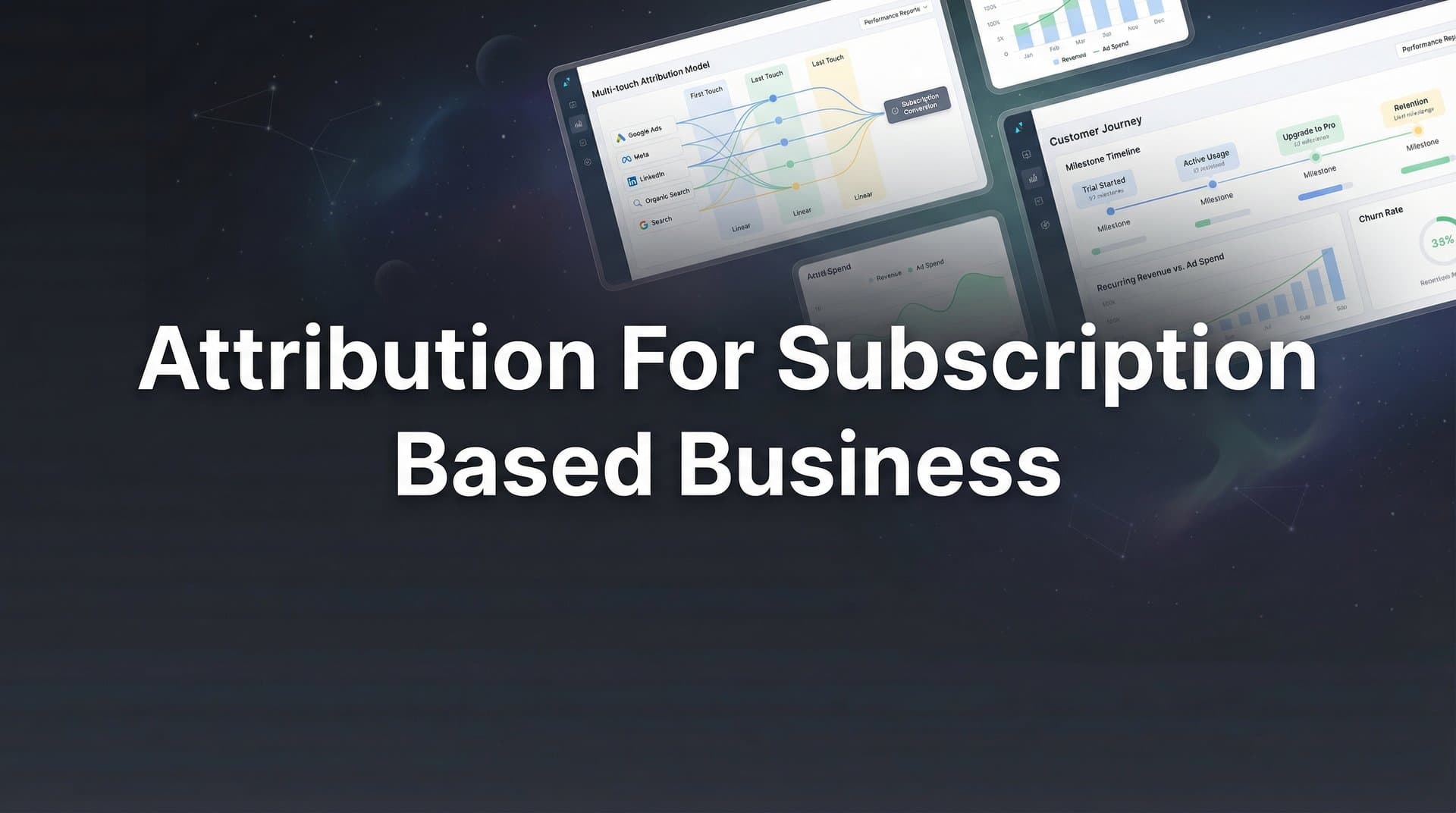
You've spent thousands on ads this month. Trial signups are rolling in. Your dashboard shows solid conversion numbers. Everything looks great—until you check your revenue three months later and realize half those trials churned before their first payment cleared.
Sound familiar?
Subscription businesses face a problem that traditional attribution models were never designed to solve. A customer might see your LinkedIn ad in January, read three blog posts in February, watch a webinar in March, start a free trial in April, and finally convert to paid in May. Then they stay for three years, generating $15,000 in lifetime value.
Which marketing touchpoint deserves credit for that revenue? Your analytics platform says it was the last click. Your CFO wants to know why you're still spending on channels that "don't convert." And you're left trying to explain why cutting the budget on awareness campaigns would be a massive mistake.
The truth is, subscription revenue attribution isn't about tracking a single purchase. It's about connecting every touchpoint across months of engagement to years of recurring revenue. It's about understanding which marketing efforts drive subscribers who actually stay, upgrade, and become your most profitable customers.
This guide breaks down exactly how to build an attribution system that works for recurring revenue models. You'll learn which metrics actually matter, how to connect fragmented data sources, and how to use attribution insights to scale the campaigns that drive real, sustainable growth.
The Attribution Gap in Subscription Business Models
Traditional attribution was built for ecommerce. Someone clicks an ad, lands on a product page, adds to cart, and checks out—all in one session. The conversion happens fast, the revenue is immediate, and attribution is relatively straightforward.
Subscription businesses work nothing like this.
Your customer journey spans weeks or months with multiple touchpoints before conversion. A prospect might interact with your brand ten times across three different channels before they even start a trial. They're reading comparison articles, watching demos, joining webinars, and talking to sales. Each interaction influences their decision, but most attribution models only credit one.
Here's where it gets more complex: the initial signup isn't where the real value lies. A free trial signup costs you money—server costs, support time, onboarding resources. The actual revenue comes later, after they convert to paid. And the real profit comes much later, after they stay for months or years.
This creates a fundamental problem with traditional metrics. You might see that Facebook ads drive 500 trial signups at $20 per signup while LinkedIn ads drive only 100 signups at $50 each. The obvious decision seems to be scaling Facebook, right?
But what if those LinkedIn signups convert to paid at 40% while Facebook converts at 15%? What if LinkedIn subscribers stay for an average of 24 months while Facebook subscribers churn after 6 months? Suddenly, the channel that looked expensive is actually your most profitable source.
Free trials, freemium tiers, and upgrade paths create even more complexity. A user might sign up for your free plan through an organic search, upgrade to a paid starter plan after clicking a retargeting ad, then expand to an enterprise plan after a sales call. Which channel gets credit for that enterprise customer generating $50,000 annually?
Single-touch attribution models—whether first-click or last-click—completely miss this reality. They force you to make budget decisions based on incomplete data, often leading to the exact opposite of what you should do. You end up scaling channels that drive volume but poor quality, while cutting budget from channels that drive your best customers. Understanding subscription business attribution fundamentals is essential to avoiding these costly mistakes.
The Metrics That Actually Matter for Subscription Revenue
If you're still measuring success by trial signup volume, you're optimizing for the wrong outcome. Subscription businesses need metrics that connect marketing spend to actual recurring revenue, not just top-of-funnel conversions.
Customer Acquisition Cost by True Payback Period: Your CAC calculation needs to account for the entire journey, not just the cost to get a trial signup. Include the cost of every touchpoint from awareness to paid conversion. More importantly, calculate your payback period by channel. A channel with a $200 CAC might look expensive until you realize those customers pay back their acquisition cost in two months and stay for two years. That's a channel you should be scaling aggressively.
Trial-to-Paid Conversion Attributed to Source: This is where most subscription businesses discover their attribution blind spots. You need to track not just which channel drove the trial signup, but which original marketing source drove the users who actually convert to paid. This metric often reveals that your highest-volume channels are also your lowest-converting channels.
When you segment trial-to-paid conversion by acquisition source, patterns emerge quickly. Content marketing might drive lower trial volume but higher conversion rates. Paid search might bring in users ready to buy. Social ads might generate awareness that converts much later through other channels.
Lifetime Value Segmented by Acquisition Channel: This is the metric that changes everything. LTV by channel tells you which marketing sources drive subscribers who stay, upgrade, and become your most valuable customers. Implementing proper subscription business revenue attribution helps you connect these insights to actual recurring revenue.
Many subscription businesses find that their highest LTV customers come from channels that look expensive on a cost-per-signup basis. Enterprise customers might come through sales-assisted channels with high upfront costs but generate 10x the lifetime value of self-serve signups. Content-driven organic signups might convert slower but stay longer than paid ad signups.
Revenue Retention by Acquisition Cohort: Track how long subscribers stay based on which channel brought them in. Calculate monthly recurring revenue retention for each acquisition source. You'll often discover that channels driving the most volume also drive the highest churn. This insight alone can save thousands in wasted ad spend.
Expansion Revenue Attribution: Don't forget about upgrades. Which marketing channels drive customers who expand their subscriptions over time? Some channels might bring in starter plan customers who rarely upgrade, while others bring in users who consistently move to higher tiers. This expansion revenue should be attributed back to the original acquisition source.
When you start measuring these metrics instead of just signup volume, your entire marketing strategy shifts. You stop chasing vanity metrics and start building a customer acquisition machine that drives real, sustainable revenue growth.
Choosing the Right Attribution Model for Subscription Journeys
No single attribution model is perfect, but some work far better than others for subscription businesses. The key is choosing a model that reflects how your customers actually buy and how your business actually generates value.
Linear Attribution: This model gives equal credit to every touchpoint in the customer journey. If someone interacted with five different marketing touchpoints before converting, each gets 20% of the credit. For subscription businesses with long, complex sales cycles, linear attribution often provides the most balanced view. It acknowledges that awareness content matters just as much as bottom-of-funnel conversion campaigns.
Linear attribution works particularly well when you're trying to understand the full ecosystem of your marketing. It prevents you from over-crediting last-click conversions while under-crediting the awareness and consideration content that made those conversions possible.
Time-Decay Attribution: This model gives more credit to touchpoints closer to conversion. The logic is that recent interactions had more influence on the decision than earlier ones. For subscription businesses, time-decay can work well when you have a clear conversion event you're optimizing for—like trial-to-paid conversion rather than initial trial signup.
The challenge with time-decay is that it can undervalue top-of-funnel awareness campaigns that start the customer journey. If you're running brand awareness campaigns that plant seeds months before conversion, time-decay might make those campaigns look less effective than they actually are. Learning about choosing attribution model for business needs helps you avoid these pitfalls.
Position-Based Attribution: Also called U-shaped attribution, this model gives the most credit to the first and last touchpoints, with the remaining credit distributed among middle interactions. Typically, 40% goes to first touch, 40% to last touch, and 20% is split among everything in between.
For subscription businesses, position-based attribution acknowledges two critical moments: the first interaction that brought someone into your ecosystem, and the final touchpoint that converted them to paid. This can be particularly useful when you want to optimize both awareness campaigns and conversion campaigns without sacrificing one for the other.
Custom Multi-Touch Models: The most sophisticated subscription businesses build custom attribution models that weight touchpoints based on their specific funnel stages. You might assign higher weights to awareness content, trial activation events, and upgrade triggers based on your own data about what actually drives conversions. A comprehensive multi-touch marketing attribution platform can help you implement these sophisticated models.
For example, you might discover that webinar attendance is a strong predictor of trial-to-paid conversion. Your custom model could give webinar touchpoints extra weight compared to other middle-funnel interactions. Or you might find that users who engage with your help documentation during their trial convert at higher rates, so you weight those touchpoints accordingly.
Connecting Post-Conversion Events Back to Acquisition: Here's what separates good subscription attribution from great subscription attribution: tracking everything that happens after the initial conversion and connecting it back to the original marketing source. When a customer upgrades from a starter plan to an enterprise plan six months after signing up, that expansion revenue should be attributed to whatever channel brought them in originally.
The same applies to renewals, referrals, and long-term retention. Your attribution model needs to capture the full lifetime value journey, not just the moment of initial conversion. This requires connecting your CRM, billing system, and attribution platform so you can see the complete picture of how each marketing channel performs over time.
Building the Technical Foundation for Subscription Attribution
Getting accurate attribution data for subscription businesses requires solving some serious technical challenges. Browser limitations, iOS restrictions, and fragmented data sources all work against you. Here's how to build a foundation that actually works.
Server-Side Tracking: Client-side tracking through browser pixels is increasingly unreliable. Safari's Intelligent Tracking Prevention, iOS App Tracking Transparency, and ad blockers all limit what you can track through the browser. For subscription businesses with long customer journeys, losing tracking data at any point breaks your attribution.
Server-side tracking solves this by sending conversion data directly from your server to ad platforms, bypassing browser limitations entirely. When someone converts to a paid subscription, your server sends that event directly to Facebook, Google, and other platforms with all the necessary attribution parameters. This ensures you're feeding complete, accurate data to both your analytics and your ad platform algorithms.
Syncing Subscription Events to Ad Platforms: Your ad platforms need to know about more than just trial signups. They need data about trial-to-paid conversions, upgrades, renewals, and churn. This enriched conversion data helps their algorithms optimize for the outcomes you actually care about, not just top-of-funnel volume.
When you sync subscription events back to ad platforms, you enable them to optimize for customer quality rather than just conversion quantity. Facebook and Google can learn which audiences are most likely to become long-term subscribers and automatically find more people like them. This creates a feedback loop that continuously improves targeting and campaign performance.
Closed-Loop Reporting: The goal is connecting ad spend directly to monthly recurring revenue. This means building reporting that shows exactly how much you spent on each channel and exactly how much MRR those channels generated—not just this month, but over the entire customer lifetime. Effective revenue tracking for subscription businesses requires this closed-loop approach.
Closed-loop reporting requires integrating your ad platform spend data with your subscription revenue data. You need to see that the $10,000 you spent on LinkedIn ads in January generated 50 customers who are now producing $5,000 in MRR six months later. This level of visibility transforms how you make budget allocation decisions.
First-Party Data Strategy: With third-party cookies disappearing, subscription businesses need to rely on first-party data. This means capturing and storing your own customer data, then using it to track journeys and power attribution. Email addresses, user IDs, and CRM records become your primary identifiers for connecting touchpoints across sessions and devices.
A strong first-party data strategy also improves match rates when syncing conversions back to ad platforms. When you can pass a hashed email address or phone number along with a conversion event, platforms can more accurately match that conversion to the original ad interaction, even if cookies were blocked.
Connecting Your Subscription Tech Stack
Accurate attribution requires connecting multiple systems that don't naturally talk to each other. Your ad platforms, website analytics, CRM, and billing system all hold pieces of the customer journey puzzle. Here's how to unify them.
Essential Integration Points: Start with your core systems. Connect your ad platforms (Facebook, Google, LinkedIn) to track spend and campaign performance. Integrate your website tracking to capture visitor behavior and initial conversions. Link your CRM to track lead progression and sales interactions. Connect your billing platform to capture subscription revenue events.
Each integration should pass data bidirectionally when possible. Your attribution platform needs to pull data from these systems to build complete customer journeys. But it also needs to push data back—sending conversion events to ad platforms, updating CRM records with attribution data, and syncing revenue information across systems. Understanding how to resolve multiple ad platforms attribution confusion becomes critical when managing these integrations.
Unified Customer Journey View: The power of attribution platforms lies in their ability to stitch together fragmented data into a single, unified view of each customer journey. Someone might click a Facebook ad on their phone, visit your website from their laptop, sign up for a trial on their tablet, and convert to paid after a sales call. Your attribution platform needs to recognize that all these interactions belong to the same person and connect them to a single customer record.
This unified view is what enables you to see the complete path from first touchpoint to long-term subscriber. Without it, you're looking at disconnected data points that tell you nothing about how your marketing actually drives revenue. A robust cross platform attribution tracking solution makes this unified view possible.
AI-Powered Attribution Insights: Modern attribution platforms use AI to identify patterns you'd never spot manually. They can analyze thousands of customer journeys to determine which combinations of touchpoints drive the highest conversion rates and lifetime value. They can predict which new subscribers are most likely to churn based on their acquisition path and early behavior.
AI-powered insights help you move beyond simple reporting to predictive optimization. Instead of just knowing which channels performed well last month, you can identify which campaigns are currently driving high-value subscribers and scale them in real time. You can spot warning signs in acquisition cohorts before they show up in your churn metrics.
Cometly's Approach to Subscription Attribution: Cometly unifies your entire marketing tech stack to track every touchpoint from ad click to recurring revenue. The platform captures ad interactions, website behavior, CRM events, and subscription milestones in one place, building a complete view of how your marketing drives long-term value.
With server-side tracking, Cometly ensures accurate data capture despite browser limitations. Conversion sync feeds enriched subscription events back to your ad platforms, helping their algorithms optimize for customer quality. And AI-powered recommendations identify which campaigns drive your highest-value subscribers, so you can confidently scale what's working.
Turning Attribution Data Into Revenue Growth
Having attribution data is one thing. Using it to make better decisions is what actually drives growth. Here's how to put your subscription attribution insights into action.
Budget Reallocation Based on LTV-to-CAC Ratios: Stop allocating budget based on conversion volume. Instead, calculate the LTV-to-CAC ratio for each channel and campaign. Industry benchmarks suggest aiming for a 3:1 ratio—every dollar spent on acquisition should generate three dollars in lifetime value.
When you analyze your channels through this lens, you'll often find that your assumptions were wrong. The channel driving the most signups might have a 1.5:1 ratio because those customers churn quickly. Meanwhile, a channel you considered too expensive might have a 5:1 ratio because it brings in customers who stay for years. Platforms designed for marketing attribution platforms revenue tracking make these calculations straightforward.
Reallocate budget aggressively toward high-ratio channels. If a campaign is generating a 6:1 LTV-to-CAC ratio, you should be scaling it until the ratio drops to your target threshold. This is how you maximize the efficiency of every marketing dollar.
Optimizing for Subscriber Quality: Shift your campaign optimization from signup volume to subscriber quality. Use your attribution data to identify the characteristics of high-value subscribers—which channels they come from, which content they engage with, which campaigns convert them.
Then use these insights to refine your targeting. If you discover that subscribers who engage with educational content before signing up have higher retention rates, create more educational content and promote it to cold audiences. If webinar attendees convert at 3x the rate of other trial users, invest in webinar promotion.
Quality optimization also means being willing to reduce spend on channels that drive volume but poor retention. It's counterintuitive, but cutting your highest-volume channel can increase profitability if that channel was bringing in churning customers.
Creating Continuous Improvement Loops: The most powerful use of attribution data is creating feedback loops that continuously improve performance. When you sync enriched conversion data back to ad platforms, their algorithms learn which audiences produce the best subscribers. Over time, this improves targeting automatically without manual optimization.
Build similar feedback loops in your own optimization process. Review attribution data weekly to spot trends early. Test new channels with small budgets and scale quickly when you see strong LTV-to-CAC ratios. Create cohort reports that track how each month's acquired customers perform over time, so you can identify changes in channel quality before they impact revenue.
Use attribution insights to inform creative decisions too. If you notice that certain ad messaging or landing page variations attract higher-quality subscribers, double down on those approaches. Attribution data can guide everything from campaign strategy to creative execution.
Building Your Competitive Advantage Through Attribution
Subscription businesses that master attribution gain a significant competitive advantage. While competitors are guessing which channels work and making budget decisions based on incomplete data, you're operating with clarity. You know exactly which marketing efforts drive subscribers who stay, upgrade, and generate the highest lifetime value.
This advantage compounds over time. Every month, you're reallocating budget toward channels with proven high LTV-to-CAC ratios. You're feeding better data to ad platform algorithms, improving their targeting. You're identifying and scaling winning campaigns faster than competitors who are still optimizing for vanity metrics.
The result is a customer acquisition engine that gets more efficient over time rather than less efficient. Your CAC stays stable or decreases while competitors see rising costs. Your customer quality improves while competitors chase volume. You build sustainable growth while others burn through budgets on channels that don't deliver real value.
Getting attribution right isn't optional for subscription businesses anymore. The channels that drive trial signups aren't always the channels that drive revenue. The campaigns that look expensive often deliver the best ROI. And the only way to know the difference is through attribution that connects every touchpoint to long-term recurring revenue.
Ready to elevate your marketing game with precision and confidence? Discover how Cometly's AI-driven recommendations can transform your ad strategy. Get your free demo today and start capturing every touchpoint to maximize your conversions.



