You're staring at your dashboard, and something doesn't add up. Facebook says it drove 50 conversions this month. Google Ads claims 45. Your email platform is taking credit for 30. Add those numbers together, and you've apparently generated 125 conversions—except your CRM shows only 60 actual sales.
Welcome to the attribution puzzle that keeps marketers up at night.
Every platform wants to be the hero of your conversion story, but the truth is messier. Your customers don't convert in neat, linear paths. They see your Facebook ad on Monday, Google your brand on Wednesday, click an email on Friday, and finally convert after seeing a retargeting ad on Saturday. Who deserves the credit? More importantly, where should you invest your next dollar?
This is exactly what marketing attribution solves. It's not just about collecting data—it's about understanding which marketing efforts actually drive revenue so you can make confident decisions about where to scale and where to cut back. In this guide, we'll break down what attribution really means, explore the models that matter, and show you how to build an attribution system that reveals the truth about your marketing performance.
The Core Concept: How Marketing Attribution Connects Ads to Revenue
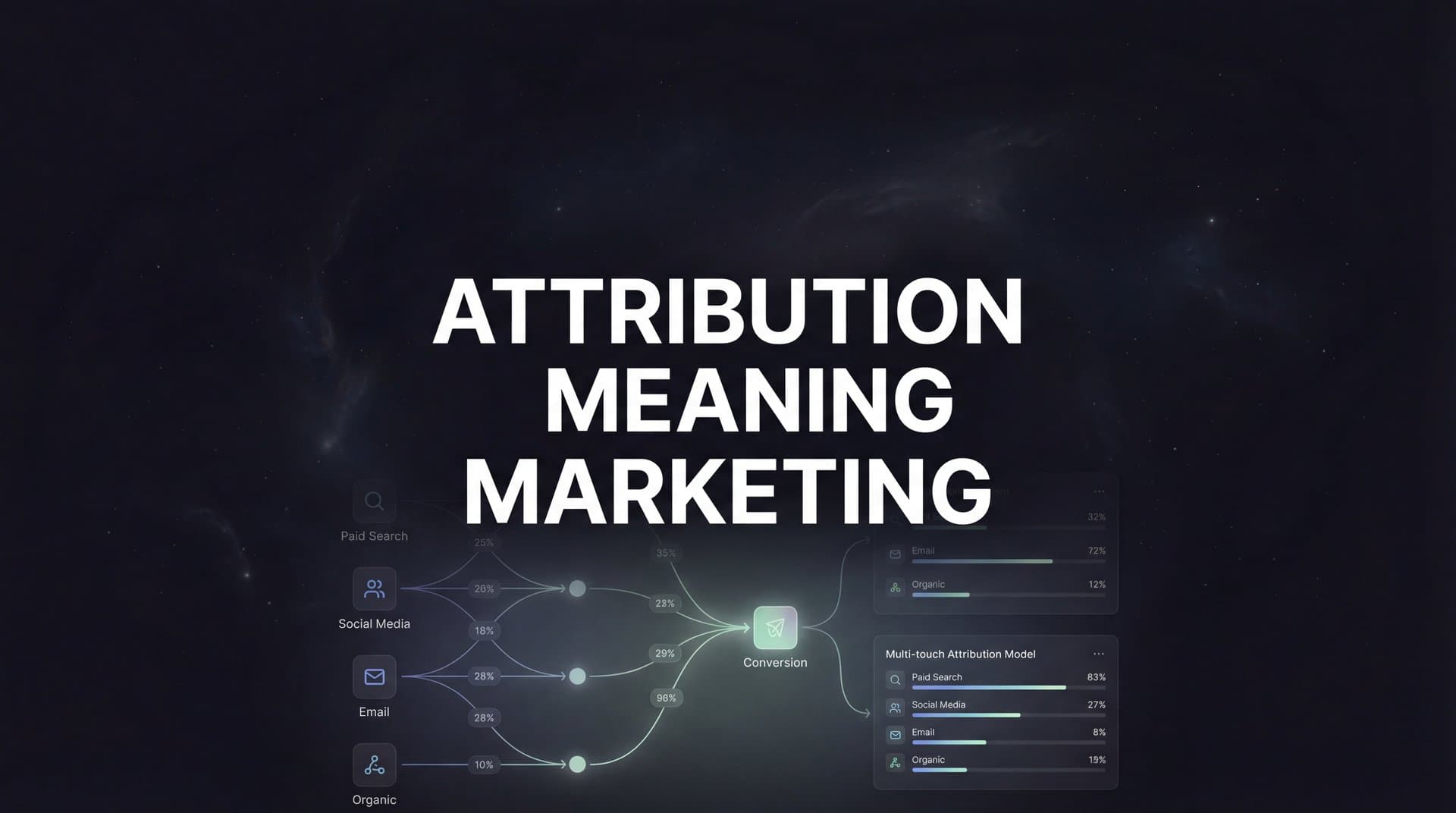
Marketing attribution is the process of identifying which touchpoints in your customer's journey contribute to conversions and revenue. Think of it as connecting the dots between every interaction someone has with your brand and the moment they become a customer.
Here's the reality: buyers rarely convert on their first interaction with your brand. They might discover you through a Facebook ad, research your product on Google, read a few blog posts, sign up for your email list, and finally convert after clicking a retargeting ad. Each of these touchpoints plays a role in the decision-making process, but understanding which ones matter most requires attribution.
The difference between tracking and attribution is crucial. Tracking tells you what happened—someone clicked your ad, visited your website, filled out a form. Attribution tells you why it matters—which of those actions actually contributed to revenue, and how much credit each touchpoint deserves. Understanding attribution marketing tracking fundamentals is essential for any modern marketer.
Without attribution, you're flying blind. You might see that your Facebook ads generated 1,000 clicks and your Google Ads generated 500, but clicks don't pay the bills. Attribution connects those clicks to actual revenue, showing you that maybe those 500 Google clicks generated twice as much revenue as the 1,000 Facebook clicks because they captured high-intent searchers at the perfect moment.
This distinction becomes critical when you're allocating budget. Should you double down on the channel with the most clicks, or the one that drives the most revenue? Attribution gives you the answer by following the money backward through every touchpoint that influenced the sale.
The complexity increases when you consider that different customers take different paths. Some convert quickly after a single touchpoint. Others take weeks or months, interacting with dozens of touchpoints across multiple devices before making a decision. Attribution systems need to capture all of these variations and make sense of them so you can see patterns in the chaos.
Modern attribution goes beyond simple cause-and-effect. It recognizes that marketing works as a system where different channels play different roles. Some channels excel at awareness and discovery. Others are better at nurturing consideration. Still others close the deal. Attribution helps you understand these roles so you can optimize each channel for what it does best rather than judging everything by the same last-click metric.
Attribution Models Explained: From First Touch to Data-Driven
Attribution models are the rules that determine how credit gets distributed across the touchpoints in a customer journey. Choosing the right model shapes how you understand your marketing performance and where you invest your budget.
Single-Touch Attribution Models
First-touch attribution gives 100% of the credit to the first interaction a customer has with your brand. If someone discovers you through a Facebook ad, clicks around your site, leaves, comes back through Google three times, and finally converts through an email—the Facebook ad gets all the credit.
This model makes sense when you're focused on top-of-funnel performance and want to understand which channels are best at generating awareness and bringing new prospects into your ecosystem. It's particularly useful for businesses with long sales cycles where the initial discovery moment is genuinely valuable, even if conversion happens much later.
Last-touch attribution does the opposite—it gives all credit to the final touchpoint before conversion. In the same scenario above, the email would get 100% credit. This model is popular because it's simple and focuses on what directly drove the conversion, but it completely ignores the journey that got the customer there.
Last-touch works well for businesses with short sales cycles or when you're primarily focused on conversion optimization. If most customers convert within a day or two of discovery, the last touchpoint probably does deserve most of the credit. For a deeper dive into these approaches, explore the types of marketing attribution models available to marketers today.
Multi-Touch Attribution Models
Linear attribution distributes credit equally across all touchpoints. If a customer interacted with five different channels before converting, each channel gets 20% credit. This model acknowledges that multiple touchpoints contribute to the sale, but it assumes they all contribute equally—which is rarely true in practice.
Time-decay attribution gives more credit to touchpoints that happened closer to the conversion. The logic is sound: interactions that happened yesterday probably influenced the decision more than interactions that happened three weeks ago. This model works well when you want to emphasize bottom-of-funnel performance while still acknowledging the full journey.
Position-based attribution (also called U-shaped) typically assigns 40% credit to the first touch, 40% to the last touch, and splits the remaining 20% among all the middle touchpoints. This model recognizes that discovery and closing moments are often the most critical, while still acknowledging that middle-funnel nurturing plays a role. Many businesses find success with a multi-touch marketing attribution platform that supports these various models.
The challenge with all rule-based multi-touch models is that they apply the same logic to every customer journey, regardless of whether that logic actually matches reality. A journey where someone converts immediately after discovery shouldn't be credited the same way as a journey with dozens of touchpoints over several months.
Data-Driven Attribution
Data-driven or algorithmic attribution uses machine learning to analyze patterns across thousands of customer journeys and determine how much credit each touchpoint type actually deserves based on its statistical impact on conversion probability.
Instead of applying predetermined rules, data-driven models learn from your actual data. They might discover that email touchpoints in the middle of the journey increase conversion probability by 15%, while certain types of content visits increase it by 30%. The model then distributes credit accordingly. Understanding what is predetermined in marketing attribution models helps clarify why data-driven approaches often outperform rule-based alternatives.
This approach is becoming the standard for sophisticated marketers because it adapts to your specific business reality rather than forcing your data into generic rules. The trade-off is complexity—you need sufficient conversion volume for the algorithms to identify meaningful patterns, and the model can be harder to explain to stakeholders who want simple answers.
Why Traditional Tracking Falls Short in Modern Marketing
The attribution challenge has intensified dramatically over the past few years as privacy changes and technical limitations have created massive blind spots in marketing data.
Apple's iOS 14.5 update fundamentally changed mobile tracking by requiring apps to ask permission before tracking users across other apps and websites. The result? Most users opt out, which means a huge percentage of mobile traffic can no longer be tracked using traditional methods. If someone sees your Facebook ad on their iPhone, visits your site, and converts later on their laptop, connecting those dots becomes nearly impossible with browser-based tracking alone.
Cookie deprecation is creating similar problems. Third-party cookies—the technology that enabled tracking users across different websites—are being phased out by major browsers. Chrome, which represents the majority of web traffic, has announced the end of third-party cookie support. This means the cross-site tracking that powered much of digital advertising attribution is disappearing. These represent some of the most significant attribution challenges in marketing analytics that teams face today.
The cross-device challenge compounds these issues. Your customers don't live on a single device. They research on mobile during their commute, continue on their work computer during lunch, and convert on their tablet in the evening. Traditional tracking treats each device as a separate user, fragmenting the customer journey into disconnected pieces that make attribution impossible.
Even when tracking works, platform-reported metrics create a different problem: overcounting. Each ad platform uses its own attribution window and methodology. Facebook might claim credit for any conversion that happens within 28 days of an ad click. Google Ads uses different windows. Your email platform has its own rules. When all these platforms independently claim credit for the same conversion, you end up with the scenario from our introduction—where reported conversions far exceed actual sales.
This overcounting isn't malicious; it's a natural result of each platform optimizing for its own metrics without visibility into the full customer journey. But it makes it impossible to understand true performance when you're looking at platform dashboards in isolation. The digital marketing attribution problem continues to grow as the ecosystem becomes more fragmented.
The gap between ad platform data and actual revenue data is where businesses lose money. Your Facebook Ads dashboard might show a 3x ROAS based on its attribution, but when you compare ad spend to actual revenue in your CRM, the real ROAS might be 1.5x. That difference determines whether you're scaling a profitable channel or throwing money away.
Browser-based tracking also struggles with ad blockers, which a significant percentage of users employ. These tools block tracking pixels and scripts, creating invisible holes in your data where conversions happen but can't be attributed to any source. You know the revenue came from somewhere, but your attribution system has no record of the journey.
The combination of these challenges means that traditional tracking approaches—installing a pixel on your website and trusting platform reports—no longer provide the accuracy needed for confident decision-making. Modern attribution requires a more sophisticated approach that works around these limitations.
Building an Attribution System That Actually Works
Creating accurate attribution in today's environment requires connecting multiple data sources and using server-side tracking to overcome the limitations of browser-based methods.
The Foundation: Server-Side Tracking
Server-side tracking moves data collection from the browser to your server, bypassing many privacy restrictions and ad blockers. Instead of relying on cookies and pixels that users can block, your server captures interactions and sends that data directly to your analytics and ad platforms.
This approach provides more reliable data because it's not subject to browser restrictions or user privacy settings in the same way. When someone converts on your website, your server records that conversion and can connect it to earlier touchpoints using first-party data that you control.
Server-side tracking also enables you to enrich conversion data before sending it to ad platforms. Instead of just telling Facebook that a conversion happened, you can include the actual revenue value, customer lifetime value prediction, or other business metrics that help ad platforms optimize for what actually matters to your business.
Connecting Your Marketing Stack
Effective attribution requires integrating your ad platforms, website analytics, CRM, and any other systems that capture customer interactions. Each system holds pieces of the puzzle, and attribution only works when you can see the complete picture. The right marketing attribution platforms for revenue tracking can unify these disparate data sources.
Your ad platforms know about clicks and impressions. Your website analytics tracks on-site behavior. Your CRM records leads, opportunities, and closed deals. Your email platform captures engagement. Attribution connects these data sources so you can follow a customer from their first ad click through every interaction to the final sale and beyond.
This integration is where many attribution efforts fail. Companies implement tracking on their website but never connect it to their CRM, so they can see which ads drive form fills but not which ads drive actual revenue. Or they track everything but don't sync data back to their ad platforms, missing the opportunity to improve algorithmic optimization.
Capturing the Complete Customer Journey
Modern attribution systems need to track more than just ad clicks and website visits. They should capture email opens, content downloads, webinar attendance, sales calls, demo requests, and any other meaningful interaction that might influence a purchase decision.
The goal is creating a timeline for each customer that shows every touchpoint in chronological order. When someone converts, you can look back at their complete journey and understand which interactions contributed to the decision. This comprehensive view is what enables sophisticated attribution models to work effectively.
User identity resolution becomes critical here. You need to recognize when the same person interacts with your brand across different channels and devices. This might involve matching email addresses, phone numbers, or other identifiers to connect fragmented data into unified customer profiles. Implementing cross-channel marketing attribution software helps solve these identity resolution challenges.
Feeding Data Back to Ad Platforms
One of the most powerful applications of modern attribution is conversion sync—sending enriched conversion data back to your ad platforms to improve their optimization algorithms. When you tell Facebook not just that a conversion happened, but that it generated $5,000 in revenue and came from a high-value customer segment, the platform can optimize for those valuable conversions rather than treating all conversions equally.
This creates a feedback loop where better attribution leads to better ad targeting, which leads to better results, which provides more data to improve attribution further. Platforms like Cometly specialize in this type of integration, connecting your full marketing stack to capture accurate attribution data and sync it back to ad platforms for improved performance.
Turning Attribution Data Into Smarter Marketing Decisions
Attribution is only valuable if it changes how you allocate budget and optimize campaigns. The insights matter less than the actions they enable.
Revealing True Channel Performance
Attribution shows you which channels drive revenue, not just which ones generate clicks or impressions. This distinction transforms how you evaluate performance. A channel might have a low click-through rate but consistently attract high-intent buyers who convert at high values. Another channel might generate tons of traffic that rarely converts.
Multi-touch attribution also reveals which channels play supporting roles versus closing roles. You might discover that LinkedIn ads rarely get last-touch credit but frequently appear early in high-value customer journeys, making them essential for awareness even though they don't show strong last-click performance. Without attribution, you might cut that budget and unknowingly eliminate a critical top-of-funnel source. A comprehensive marketing attribution report can illuminate these hidden channel dynamics.
The inverse is also true—some channels might look great on last-click metrics but rarely contribute to journeys that don't involve other touchpoints. If a channel only works when customers have already been warmed up by other marketing, you need to account for that dependency when evaluating its true contribution.
Budget Reallocation Based on Revenue Impact
Once you understand true revenue contribution by channel, budget decisions become clearer. Instead of spreading budget equally or optimizing for vanity metrics like impressions, you can allocate based on actual ROI.
This might mean shifting budget from channels with high traffic but low revenue contribution to channels that drive fewer conversions but at much higher values. Or it might mean increasing investment in channels that consistently appear in high-value customer journeys, even if they don't get last-touch credit. Understanding cross-channel attribution and marketing ROI relationships is essential for making these budget decisions confidently.
Attribution also helps you identify when you've hit diminishing returns in a channel. You might see that the first $10,000 per month in a channel drives strong ROI, but scaling beyond that point drops efficiency dramatically. This insight lets you cap spending at the optimal level and deploy excess budget where it will generate better returns.
Identifying Scaling Opportunities
Perhaps the most valuable application of attribution is finding channels and campaigns that are ready to scale. When you can confidently attribute revenue to specific sources and see that increasing investment consistently drives proportional returns, you know you've found a scaling opportunity.
Attribution data also reveals successful patterns you can replicate. If certain ad creative consistently appears in high-value customer journeys, you should create more content in that style. If specific audience segments show strong attribution across multiple touchpoints, you should expand targeting to similar audiences.
The confidence that comes from accurate attribution enables aggressive scaling. Instead of cautiously testing budget increases and hoping they work out, you can make bold moves backed by data showing exactly what drives revenue. This is how businesses break through growth plateaus—by identifying what's working and scaling it decisively rather than spreading budget thin across uncertain bets.
Attribution also prevents scaling mistakes. Without it, you might scale a channel that appears to perform well in isolation but actually cannibalizes performance from other channels. With attribution, you can see these channel interactions and make smarter decisions about where growth will come from new revenue versus shifted attribution.
Making Attribution Work for Your Business
Attribution meaning in marketing ultimately comes down to one thing: knowing what actually drives revenue so you can invest with confidence rather than guessing.
We've covered the progression from basic tracking to sophisticated multi-touch attribution, explored why traditional methods fall short in the face of privacy changes and technical limitations, and outlined how to build an attribution system that overcomes these challenges. The companies that master attribution gain a decisive advantage—they know exactly where their revenue comes from and can scale their best channels while cutting waste from underperformers.
The future of marketing belongs to businesses that can accurately connect their marketing investments to revenue outcomes. As privacy regulations tighten and tracking becomes more complex, the gap between companies with sophisticated attribution and those relying on platform reports will only widen. The time to build a real attribution system is now, before that gap becomes insurmountable.
Ready to elevate your marketing game with precision and confidence? Discover how Cometly's AI-driven recommendations can transform your ad strategy—Get your free demo today and start capturing every touchpoint to maximize your conversions.