You're running campaigns on Google, Meta, TikTok, and LinkedIn. Your email sequences are converting. Your retargeting ads are working. But when leadership asks which channel is actually driving revenue, you hesitate. Was it the Facebook ad that introduced them to your brand? The Google search that brought them back? Or the email that finally pushed them over the edge?
This isn't just a reporting problem—it's a strategic blind spot that costs businesses millions in misallocated ad spend every year. Without a clear framework for assigning credit to marketing touchpoints, you're essentially flying blind, making budget decisions based on incomplete data or gut feelings rather than evidence.
Attribution models solve this problem by providing systematic rules for distributing conversion credit across the customer journey. Understanding how these models work—and which one aligns with your business goals—is the difference between optimizing based on assumptions and scaling based on what actually drives revenue.
The Framework Behind Marketing Credit Assignment
An attribution model is a rule-based system that determines how conversion credit gets assigned to the various marketing touchpoints a customer encounters before taking a desired action. Think of it as the scoring system that decides which players on your marketing team get credit for the win.
Here's why this matters beyond just reporting: your attribution model directly influences where you invest your budget, which campaigns you scale, and how you prove marketing's impact on revenue. Get it wrong, and you'll systematically underfund your best-performing channels while pouring money into touchpoints that look good on paper but don't actually drive conversions.
Let's walk through a real customer journey to see how this plays out. Imagine a potential customer first discovers your brand through a Facebook ad. Three days later, they search for your company name on Google and click an organic result. A week after that, they receive your email newsletter and click through to a product page. Finally, they see a retargeting ad on LinkedIn and complete their purchase.
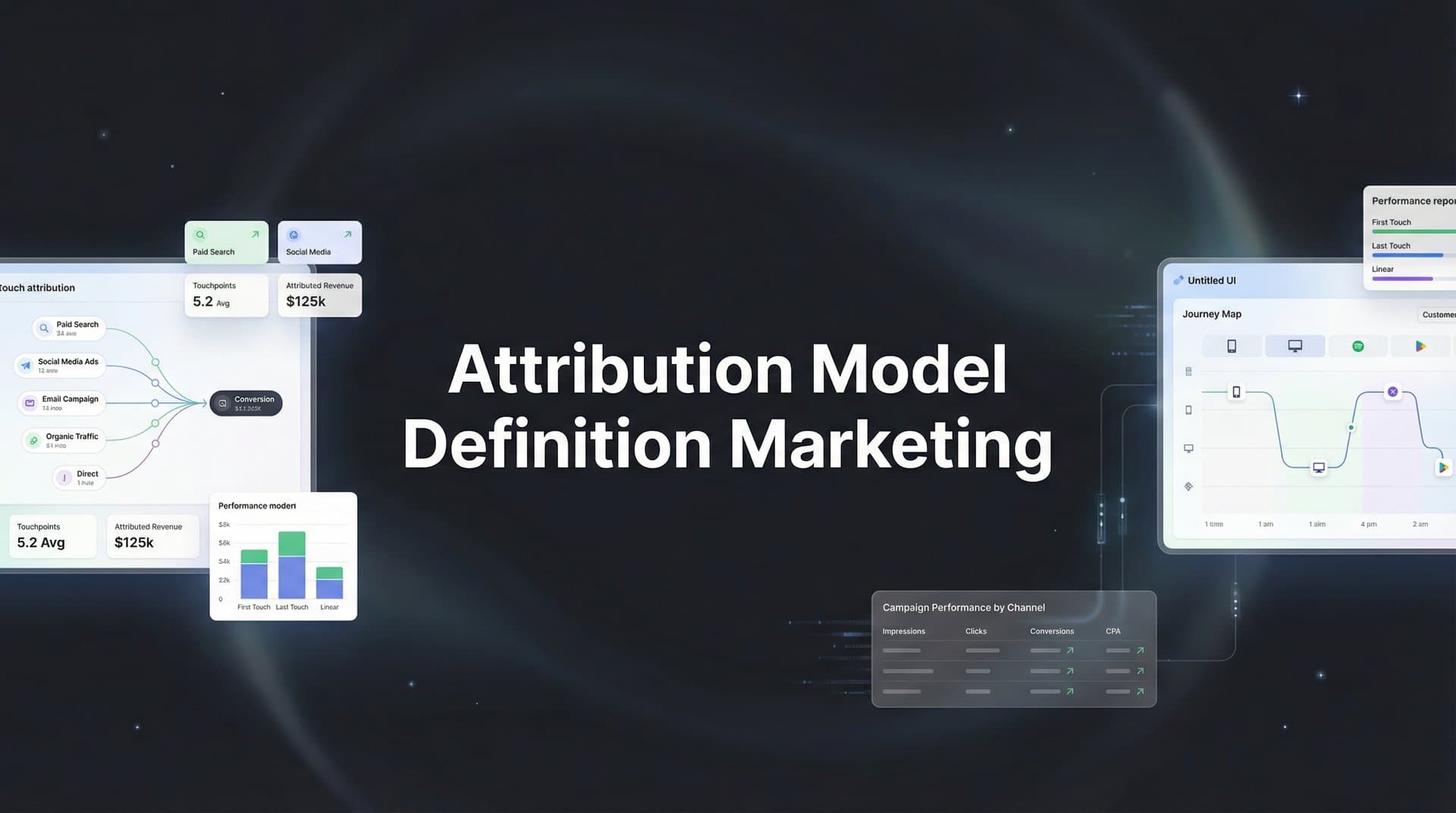
That single conversion involved four distinct touchpoints across four different channels. Different attribution models would assign credit completely differently—and each would tell you a different story about what's working. First-click attribution would give Facebook all the credit. Last-click would credit LinkedIn entirely. A linear model would split credit equally among all four touchpoints. A data-driven model using machine learning might weight the email most heavily based on historical conversion patterns.
The model you choose shapes your entire understanding of campaign performance. It determines which channels appear to have the highest ROI, which campaigns get budget increases, and ultimately, how you build your marketing strategy. This isn't just an academic exercise—it's the foundation of data-driven marketing decision-making.
Single-Touch Attribution Models: First and Last Click Explained
Single-touch attribution models take the simplest possible approach: they give 100% of the conversion credit to one touchpoint, ignoring everything else in the customer journey. While this might sound overly reductive, these models remain popular because they're straightforward to implement and easy to explain to stakeholders.
First-Click Attribution: This model assigns all credit to the very first interaction that introduced a customer to your brand. If someone discovered you through a YouTube ad, then visited your site five more times through various channels before converting, first-click gives YouTube 100% of the credit.
This approach makes sense when your primary goal is brand awareness and top-of-funnel optimization. If you're trying to understand which channels are most effective at introducing new prospects to your business, first-click attribution provides clear answers. It helps you identify which campaigns are best at generating initial interest and starting customer relationships.
The limitation? It completely ignores everything that happened after that first interaction. In reality, that initial touchpoint rarely closes the deal alone. Most customers need multiple exposures, different types of content, and various persuasion points before they're ready to convert. First-click attribution gives you zero visibility into which nurture campaigns, retargeting strategies, or bottom-of-funnel tactics actually sealed the deal.
Last-Click Attribution: This model flips the script, giving 100% credit to the final touchpoint before conversion. If a customer's last interaction was clicking a Google search ad, that ad gets all the credit—regardless of the five touchpoints that came before it.
Last-click attribution dominated digital marketing for years, largely because it was the default model in Google Analytics and most ad platforms. It's particularly useful when you're optimizing for direct response and want to understand which channels are best at closing deals. For businesses with short sales cycles and single-session conversions, last-click can provide actionable insights.
But here's the problem: last-click systematically undervalues all the marketing work that happened earlier in the journey. It ignores the brand awareness campaigns that made someone search for your company name. It dismisses the educational content that built trust. It overlooks the retargeting that kept you top-of-mind. In multi-touch customer journeys—which describes most modern marketing—last-click attribution creates a distorted view that overinvests in bottom-funnel tactics while starving top-of-funnel channels.
The verdict? Single-touch models provide clarity and simplicity, but they sacrifice accuracy. They're useful for specific optimization goals, but they shouldn't be your only lens for understanding marketing performance.
Multi-Touch Attribution Models: Distributing Credit Across the Journey
Multi-touch attribution models acknowledge what single-touch models ignore: conversions are rarely the result of a single interaction. These models distribute credit across multiple touchpoints, providing a more complete picture of how different channels work together to drive conversions.
Linear Attribution: The most straightforward multi-touch approach, linear attribution splits credit equally among all touchpoints in the conversion path. If a customer had four interactions before converting, each touchpoint receives 25% of the credit. For businesses exploring this approach, linear model marketing attribution software can help implement this methodology effectively.
This model's strength is its democratic approach—every interaction matters equally. It prevents any single channel from being completely ignored and ensures that both early-stage awareness and late-stage conversion tactics receive recognition. For businesses trying to understand their full marketing ecosystem, linear attribution provides a balanced starting point.
The weakness? Not all touchpoints are created equal. The reality is that some interactions have more influence on the conversion decision than others. A customer reading a detailed case study likely has more impact than them seeing a generic display ad for the third time. Linear attribution treats both identically, which can lead to overvaluing low-impact touchpoints and undervaluing critical conversion moments.
Time-Decay Attribution: This model recognizes that touchpoints closer to the conversion are typically more influential. It assigns credit using a weighted system that gives more value to recent interactions while still acknowledging earlier touchpoints.
Think of it like a half-life decay: the touchpoint immediately before conversion might get 40% of the credit, the one before that gets 30%, the next gets 20%, and the earliest gets 10%. The exact weighting varies, but the principle remains consistent—recency matters.
Time-decay makes intuitive sense for many businesses. The retargeting ad that reminded someone about your product right before they purchased probably had more direct influence than the blog post they read three weeks earlier. This model is particularly useful for businesses with longer sales cycles where you want to emphasize the closing stages without completely ignoring the awareness phase.
However, time-decay can undervalue the critical work of top-of-funnel marketing. That initial touchpoint that introduced a customer to your brand might have been the most important moment in the entire journey—without it, nothing else would have happened. Time-decay attribution risks systematically underfunding your acquisition channels in favor of your nurture and retargeting efforts.
Position-Based Attribution (U-Shaped): This model takes a middle-ground approach, giving the most credit to the first and last touchpoints while still acknowledging everything in between. A common implementation gives 40% credit to the first touch, 40% to the last touch, and splits the remaining 20% among all middle interactions.
The logic here is compelling: the first touchpoint deserves credit for starting the relationship, the last touchpoint deserves credit for closing the deal, and the middle touchpoints played a supporting role. For businesses that want to optimize both acquisition and conversion without ignoring the nurture phase, position-based attribution provides a balanced framework.
The challenge with U-shaped attribution is that it makes assumptions about which touchpoints matter most. In some customer journeys, a middle interaction—like attending a webinar or reading a detailed comparison guide—might be the true turning point. Position-based models can miss these critical moments by systematically devaluing middle-funnel content.
Data-Driven Attribution: The most sophisticated approach, data-driven attribution uses machine learning algorithms to analyze your actual conversion data and determine which touchpoints have the strongest correlation with conversions. Instead of applying predetermined rules, it learns from your specific customer behavior patterns. Understanding what is predetermined in marketing attribution models helps clarify why data-driven approaches offer such significant advantages.
This model examines thousands of conversion paths, identifies patterns, and assigns credit based on what actually drives results for your business. If your data shows that customers who engage with a specific piece of content are significantly more likely to convert, that touchpoint receives more credit. If certain channel combinations consistently lead to conversions, the model recognizes and weights those patterns accordingly.
Data-driven attribution represents the future of marketing measurement, but it comes with requirements. You need sufficient conversion volume for the algorithms to identify statistically meaningful patterns—typically hundreds of conversions per month at minimum. You also need comprehensive tracking across all touchpoints, which becomes increasingly challenging with privacy restrictions and cross-device journeys.
Choosing the Right Attribution Model for Your Marketing Strategy
There's no universally "correct" attribution model—the right choice depends on your business goals, sales cycle, and marketing strategy. The key is matching your attribution approach to what you're trying to optimize. A thorough comparison of attribution models for marketers can help you evaluate which approach fits your specific situation.
Match Attribution to Your Primary Marketing Objective: If your main goal is brand awareness and introducing new prospects to your business, first-click attribution provides clear insights into which channels excel at acquisition. If you're focused on direct response and closing deals, last-click helps you optimize bottom-funnel performance. For businesses balancing both objectives, multi-touch models provide the necessary nuance.
Consider your sales cycle length carefully. Businesses with short, single-session conversions—like e-commerce impulse purchases—can often work effectively with simpler attribution models. The customer journey is compressed enough that last-click or linear attribution captures most of the story. But for B2B companies with three-month sales cycles involving dozens of touchpoints across multiple stakeholders, you need multi-touch marketing attribution software to understand what's actually working.
Factor in Your Channel Mix: The more diverse your marketing channels, the more important multi-touch attribution becomes. If you're only running Google search ads, attribution modeling is straightforward. But when you're coordinating paid social, organic content, email marketing, retargeting, influencer partnerships, and offline events, you need a framework that acknowledges how these channels work together.
Think about where you need the most actionable insights. If you're trying to optimize your paid advertising budget allocation across platforms, you need an attribution model that clearly differentiates channel performance. If you're trying to understand content marketing's impact, you need a model that gives credit to middle-funnel educational touchpoints, not just first and last clicks.
Here's a practical approach: don't rely on a single attribution model. Most sophisticated marketing teams compare multiple models side-by-side. They might use first-click to understand acquisition, last-click to optimize conversion campaigns, and position-based to guide overall budget allocation. The discrepancies between models often reveal the most interesting insights about how your marketing ecosystem actually functions.
The real question isn't which attribution model is "right"—it's which model helps you make better decisions. If your attribution approach leads to budget reallocations that improve overall marketing ROI, you've chosen well. If it creates confusion or leads to counterproductive optimizations, it's time to reconsider your framework.
Common Attribution Challenges and How to Overcome Them
Understanding attribution models is one thing. Implementing them accurately in today's privacy-first, multi-device marketing landscape is another challenge entirely. Even the most sophisticated attribution model is worthless if your underlying tracking data is incomplete or inaccurate. For a deeper dive into these obstacles, explore common attribution challenges in marketing analytics.
Cross-Device Tracking Gaps: Modern customer journeys rarely happen on a single device. Someone might discover your brand on their phone during their morning commute, research on their work laptop during lunch, and convert on their tablet that evening. Traditional cookie-based tracking struggles to connect these interactions as a single customer journey, leading to fragmented attribution data that dramatically underestimates multi-touch influence.
Privacy changes have made this problem significantly worse. iOS updates limiting app tracking and browser restrictions on third-party cookies mean that large portions of customer journeys now happen in tracking blind spots. Your attribution model might be sophisticated, but if you're only capturing 60% of actual touchpoints, your insights will be fundamentally flawed.
The solution requires first-party data strategies and user identification methods that don't rely on third-party cookies. This means implementing authentication systems, using customer IDs consistently across platforms, and building direct relationships with customers that allow you to track their journey with their consent.
Offline Conversions and CRM Integration: Many businesses have conversion events that happen outside their website entirely. Phone calls from ads, in-store purchases influenced by digital marketing, or deals closed by sales teams after marketing qualified leads—these all represent attribution blind spots if they're not properly connected to your marketing data. Implementing marketing attribution for phone calls tracking is essential for businesses where calls drive significant revenue.
Solving this requires tight integration between your marketing platforms, CRM system, and analytics tools. You need systems that can track when a marketing touchpoint generates a lead, follow that lead through your sales process, and ultimately attribute revenue back to the original marketing interactions. Without this closed-loop tracking, your attribution models will systematically undervalue campaigns that generate high-quality leads rather than immediate online conversions.
Why Server-Side Tracking Has Become Essential: Browser-based tracking—where pixels fire from users' browsers to send data to analytics platforms—is increasingly unreliable. Ad blockers, browser privacy features, and user consent requirements mean that significant portions of your conversion data never reach your analytics tools.
Server-side tracking solves this by sending conversion data directly from your server to analytics and ad platforms, bypassing browser-based limitations. This approach captures more complete data, improves accuracy, and provides the foundation for reliable attribution modeling. It's no longer optional for businesses that need accurate marketing measurement—it's become a prerequisite for any meaningful attribution analysis.
The challenge is implementation complexity. Server-side tracking requires technical setup, ongoing maintenance, and careful attention to privacy compliance. But the payoff—significantly more accurate attribution data—makes it worthwhile for any business serious about understanding marketing performance.
Putting Attribution Models Into Practice
Theory is valuable, but attribution models only deliver ROI when you actually use them to make better marketing decisions. Here's how to move from understanding to action.
Start With Comparison Analysis: Don't commit to a single attribution model immediately. Instead, run multiple models simultaneously on the same data and compare the results. Look at how first-click, last-click, linear, and position-based attribution differ in their assessment of channel performance. The discrepancies reveal important insights about your customer journey.
If first-click attribution shows Facebook driving significantly more value than last-click suggests, it indicates Facebook is strong at acquisition but weak at closing. That insight should inform your strategy—maybe Facebook ads should focus on brand awareness and lead generation rather than direct conversion campaigns. These comparative insights only become visible when you examine multiple attribution perspectives.
Use Attribution Insights for Budget Reallocation: Attribution modeling isn't just an academic exercise—it should directly influence where you invest your marketing budget. If your multi-touch attribution reveals that email marketing consistently plays a critical role in conversion paths but receives only 5% of your budget, that's a clear signal to reallocate resources.
Look for channels that are undervalued by your current measurement approach. Often, you'll discover that content marketing, organic social, or email nurture campaigns drive significantly more value than last-click attribution suggested. These insights should guide quarterly budget planning and campaign strategy. The right marketing attribution platforms for revenue tracking can surface these opportunities automatically.
Feed Better Conversion Data to Ad Platforms: Here's where attribution becomes truly powerful: modern ad platforms use machine learning to optimize delivery, but they can only optimize based on the conversion data you send them. If you're only passing back last-click conversions, you're training the algorithms on incomplete information.
By implementing comprehensive tracking that captures all conversion touchpoints and feeding that enriched data back to Meta, Google, and other ad platforms, you improve their optimization algorithms. The platforms can better identify which audiences and placements contribute to conversions—even when they're not the last click—and adjust delivery accordingly. This creates a virtuous cycle where better attribution data leads to better algorithmic optimization, which drives better results.
Building Your Attribution Foundation
Understanding attribution model definitions is foundational knowledge, but the real value comes from implementation. No attribution model—no matter how sophisticated—can deliver meaningful insights if your underlying tracking infrastructure is incomplete or inaccurate.
The most important step isn't choosing between first-click and multi-touch attribution. It's ensuring you're capturing complete, accurate data across every customer touchpoint. That means implementing server-side tracking to overcome browser limitations. It means integrating your ad platforms, website analytics, and CRM system so you can follow the entire journey from first touch through revenue. It means building first-party data strategies that work within privacy regulations while still providing the visibility you need.
Once you have that foundation, attribution models transform from theoretical frameworks into practical tools that guide real marketing decisions. You'll know which channels to scale, which campaigns to optimize, and which touchpoints deserve more investment. You'll stop making budget decisions based on gut feelings and start allocating resources based on what actually drives revenue.
The marketing landscape will continue evolving. Privacy regulations will get stricter. Customer journeys will become more complex. New channels will emerge. But the fundamental principle remains constant: you can't optimize what you can't measure, and you can't measure accurately without the right attribution framework and tracking infrastructure.
Ready to elevate your marketing game with precision and confidence? Discover how Cometly's AI-driven recommendations can transform your ad strategy—Get your free demo today and start capturing every touchpoint to maximize your conversions.