

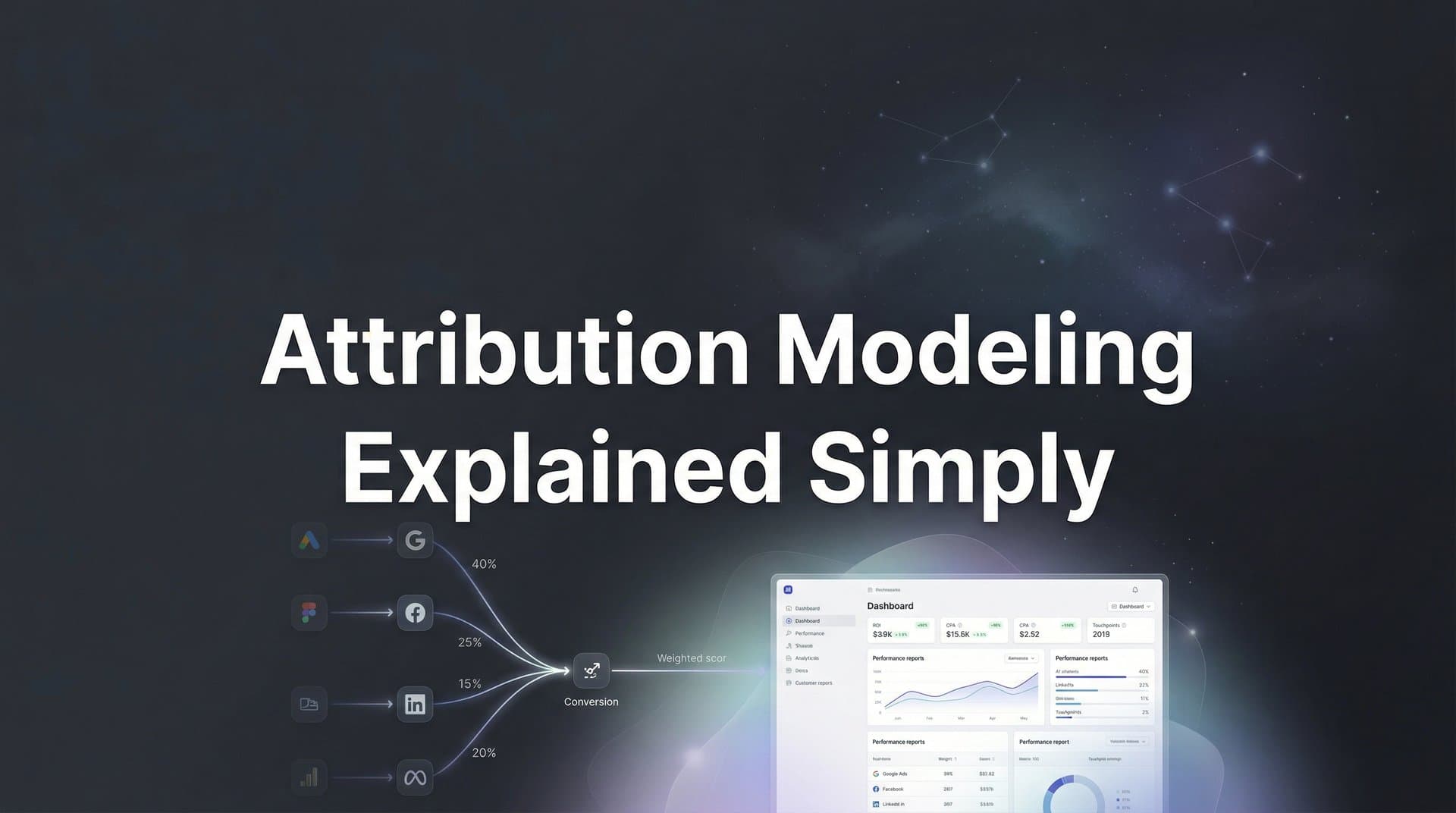
You're staring at your marketing dashboard. The numbers look good—conversions are coming in, revenue is up this month. But there's a nagging question you can't shake: which of your ten active campaigns actually drove those sales?
Was it the Facebook ad they clicked last week? The Google search they did yesterday? That email you sent three days ago? Or maybe it was the LinkedIn post they saw two weeks back that planted the seed?
Without a clear answer, you're flying blind. You might be doubling down on channels that look like heroes but are really just taking credit for someone else's work. Or worse, you could be cutting budgets from the campaigns that are actually doing the heavy lifting.
This is where attribution modeling comes in. It's the framework that connects the dots between every marketing touchpoint and the revenue they generate. And despite what you might have heard, it doesn't require a data science degree to understand or implement effectively.
This guide will walk you through attribution modeling in plain language—what it is, why it matters, and how to use it to make smarter budget decisions. No jargon, no complex formulas, just practical insights you can apply to your marketing today.
The Customer Journey Problem Every Marketer Faces
Here's the reality of modern marketing: your customers don't see one ad and immediately buy. They research. They compare. They get distracted and come back later. They interact with your brand across multiple channels before finally converting.
The typical buyer today touches six to eight different marketing touchpoints before making a purchase decision. For B2B or high-ticket items, that number climbs even higher. Each interaction plays a role in moving them closer to conversion, but traditional analytics only shows you the last thing they clicked.
Think about your own buying behavior. When was the last time you bought something significant after seeing just one ad? You probably saw a social media post, searched for reviews, visited the website multiple times, maybe signed up for an email list, and then finally purchased after a retargeting ad reminded you.
Every one of those touchpoints contributed to your decision. But if the company only looked at last-click attribution, they'd give all the credit to that final retargeting ad and miss the entire story.
This creates a dangerous blind spot. Without understanding the full journey, marketers make flawed decisions. They over-invest in bottom-of-funnel tactics that get the last click while starving the awareness campaigns that actually introduced prospects to their brand. Understanding marketing channel attribution helps you avoid these costly mistakes.
The cost of this guesswork adds up fast. You waste spend on channels that look effective but are really just intercepting customers who were already going to buy. Meanwhile, the campaigns doing the real work of building awareness and consideration get underfunded or eliminated entirely.
Here's the thing: your marketing doesn't work in isolation. It works as a system. Attribution modeling is how you understand that system so you can optimize it intelligently instead of making decisions based on incomplete data.
How Attribution Models Assign Credit to Your Marketing
Attribution models are frameworks for distributing credit across the touchpoints in a customer's journey. Different models assign credit differently, and understanding these approaches helps you see your marketing from multiple angles.
Let's start with the simplest approaches: single-touch models. These assign all the credit to one touchpoint, ignoring everything else.
First-Click Attribution: Gives 100% of the credit to the first interaction a customer had with your brand. If someone discovered you through an organic search, that channel gets all the credit even if they later clicked five ads before converting. This model is useful when you want to understand what's driving initial awareness, but it completely ignores everything that happened after that first touch.
Last-Click Attribution: The opposite approach. All credit goes to the final touchpoint before conversion. This is the default in most ad platforms because it makes their performance look good. If someone converts after clicking a retargeting ad, that ad gets full credit even though they might have been nurtured by email campaigns and organic content for weeks.
Single-touch models work in limited scenarios. If you're running impulse-buy products with very short sales cycles, last-click might give you decent insights. If you're purely focused on brand awareness campaigns, first-click can show you what's bringing new people into your ecosystem. But for most businesses with any complexity in their customer journey, single-touch models miss too much.
That's where multi-touch attribution modeling comes in. These models recognize that multiple touchpoints contribute to a conversion and distribute credit accordingly.
Linear Attribution: Splits credit evenly across all touchpoints. If a customer had five interactions before converting, each gets 20% of the credit. This is democratic but potentially misleading—it assumes every touchpoint had equal impact, which is rarely true. The email that introduced your product probably mattered more than the retargeting ad they saw for the third time.
Time-Decay Attribution: Gives more credit to touchpoints closer to the conversion. The logic here is that recent interactions had more influence on the final decision. A touchpoint from yesterday gets more weight than one from three weeks ago. This model works well when you believe recency matters most, but it can undervalue the early touchpoints that created initial interest.
Position-Based (U-Shaped) Attribution: Assigns 40% of the credit to the first touch, 40% to the last touch, and splits the remaining 20% among the middle interactions. This recognizes that both discovery and closing matter most. It's a balanced approach that gives proper weight to both ends of the funnel while acknowledging that middle touches play a supporting role.
Each of these models tells you something different about your marketing. Linear shows you which channels appear most frequently in converting journeys. Time-decay highlights what's closing deals. Position-based reveals what's driving both awareness and conversion.
Then there's the most sophisticated approach: data-driven attribution. Instead of using predetermined rules, this model analyzes your actual conversion data to determine how much credit each touchpoint deserves based on its real impact.
Data-driven attribution compares converting paths to non-converting paths. It looks at thousands of customer journeys and identifies which touchpoints actually increase the likelihood of conversion. If people who interact with a specific campaign convert at higher rates than those who don't, that campaign gets weighted more heavily. Learn more about algorithmic attribution modeling to understand how these advanced systems work.
This approach requires significant data volume to work effectively—typically thousands of conversions—but when you have that data, it provides the most accurate picture of what's actually driving results. It adapts automatically as your marketing mix changes and customer behavior evolves.
Choosing the Right Model for Your Business
There's no universal "best" attribution model. The right choice depends on your business model, sales cycle, and what questions you're trying to answer.
Start by considering your sales cycle length. If you sell products with short consideration periods—think impulse purchases or low-cost items—simpler models often suffice. A last-click or position-based model can give you actionable insights without overcomplicating things. Customers make quick decisions, so the touchpoints closest to conversion probably do carry the most weight.
But if you're in B2B, SaaS, or any business with longer sales cycles, you need multi-touch attribution. Your prospects might research for weeks or months, engaging with content, attending webinars, talking to sales, and evaluating alternatives. Single-touch models would completely miss the nurturing work that moved them through the funnel. For complex sales cycles, explore attribution modeling for B2B specifically.
Consider your marketing mix complexity too. Running just two or three channels? You might get away with simpler attribution. But if you're active across paid search, paid social, display, email, content marketing, and retargeting, you need a model sophisticated enough to untangle those interactions.
Here's a practical approach: don't choose just one model. Compare multiple models side by side to see your marketing from different perspectives.
Look at last-click to understand what's closing deals. Check first-click to see what's driving awareness. Review position-based to balance both. If you have enough data, layer in data-driven attribution to see what the numbers actually tell you.
When you compare models, patterns emerge. If a channel performs well across all models, that's a strong signal it's genuinely effective. If a channel only looks good in last-click but disappears in other models, it's probably intercepting conversions rather than creating them.
Pay attention to channels that show up strongly in first-click or position-based but get ignored in last-click. These are your unsung heroes—the campaigns building awareness and consideration that never get credit because they don't close the deal directly. Cutting these budgets would hurt your pipeline even though the impact wouldn't show up immediately.
Your attribution model should also match your business goals. Focused on scaling customer acquisition? Prioritize models that highlight top-of-funnel performance. Optimizing for efficiency and ROI? Look at models that show you the complete journey cost per conversion.
The key insight: attribution modeling isn't about finding one perfect answer. It's about understanding your marketing from multiple angles so you can make informed decisions instead of relying on incomplete data.
Common Attribution Pitfalls That Skew Your Data
Even with the right attribution model, your insights are only as good as your data. And in today's privacy-focused landscape, getting complete, accurate data is harder than ever.
The biggest challenge? Tracking gaps created by privacy restrictions. Apple's App Tracking Transparency and the ongoing deprecation of third-party cookies have fundamentally broken traditional browser-based tracking.
When iOS users opt out of tracking, you lose visibility into their cross-app journey. When browsers block third-party cookies, you can't follow users across domains. This creates blind spots in your attribution data—touchpoints that happened but never got recorded. Understanding attribution modeling accuracy issues helps you identify and address these gaps.
The result: your attribution models work with incomplete information. You might think a customer had three touchpoints when they actually had seven. You're trying to connect dots, but half the dots are invisible.
Another major issue is data silos. Your ad platforms, CRM, and website analytics all track conversions independently, but they don't talk to each other automatically. Facebook claims credit for a conversion. Google claims credit for the same conversion. Your email platform takes credit too.
They're all partially right, but when you look at each platform in isolation, you're triple-counting revenue. Your total attributed revenue might be 300% of your actual revenue because every platform is claiming full credit for shared conversions.
This fragmentation makes it impossible to understand the true customer journey. Someone might click a Facebook ad, search on Google, sign up via email, and then convert through a retargeting campaign. Without a unified view connecting these interactions to the same person, you can't build accurate attribution.
Platform-reported conversions create another layer of confusion. Ad platforms use their own attribution windows and models, optimized to make their performance look as good as possible. Facebook might use a 7-day click and 1-day view window. Google might use 30-day click. They're measuring different things and calling them the same metric.
When you compare platform-reported numbers to your actual revenue, they rarely match. The platforms over-report because they're each claiming credit independently, without accounting for overlap.
Then there's the challenge of offline conversions. If customers call your sales team, visit a physical location, or convert through channels that aren't directly trackable online, those conversions might never connect back to the marketing touchpoints that drove them.
You run ads that generate phone calls, but if you're not tracking those calls back to specific campaigns, your attribution model thinks those campaigns failed. The marketing worked—you just can't see it.
These pitfalls compound. Incomplete tracking plus data silos plus platform over-reporting equals attribution data you can't trust. And when you can't trust your data, you can't make confident budget decisions.
Building an Attribution System That Actually Works
Accurate attribution requires more than choosing the right model. You need infrastructure that captures complete data and connects it across your entire marketing ecosystem.
Start by unifying your data sources. Your ad platforms, CRM, email system, and website analytics need to feed into a single source of truth. This means implementing tracking that follows the same user across channels and connects their touchpoints into coherent journeys. A proper attribution modeling setup is essential for this foundation.
The foundation is consistent user identification. When someone clicks an ad, signs up for your email list, and later converts, you need to recognize that these actions came from the same person. Use a combination of first-party cookies, user IDs when people log in, and probabilistic matching to stitch together fragmented data.
This is where server-side tracking becomes essential. Browser-based tracking is increasingly unreliable due to privacy restrictions and ad blockers. Server-side tracking captures events on your server before they ever reach the browser, bypassing many of these limitations.
When a conversion happens, your server records it directly and sends that data to your attribution system and back to your ad platforms. This creates a more complete picture than relying solely on browser pixels that might get blocked or fail to fire.
Server-side tracking also lets you enrich conversion data before sending it anywhere. You can attach customer lifetime value, product categories, subscription tiers, or any other business context that makes attribution more meaningful. Instead of just knowing someone converted, you know they became a high-value customer who bought premium products.
Once you're capturing complete data, the next step is feeding it back to your ad platforms. This is called conversion sync or server-side conversion tracking, and it's critical for two reasons.
First, it gives ad platforms more accurate data to optimize against. When Facebook or Google only sees conversions that happened within their attribution windows, they're optimizing on incomplete information. When you send them all conversions that were influenced by their ads—even if they weren't the last click—their algorithms get smarter.
Second, it helps ad platforms work around privacy restrictions. By sending conversions from your server, you're providing data they can't collect themselves anymore. This improves their targeting and optimization, which ultimately improves your campaign performance. For businesses running paid campaigns, attribution modeling for paid advertising is particularly crucial.
Your attribution system should also connect online and offline data. If you have a sales team, integrate your CRM so conversions that happen through sales calls get attributed back to the marketing touchpoints that generated those leads. If you have physical locations, implement store visit tracking or use promo codes to connect in-store purchases to digital campaigns.
Build regular data quality checks into your process. Compare your attribution system's conversion counts to your actual revenue. Investigate discrepancies. Look for patterns in missing data—specific campaigns, traffic sources, or user segments that aren't being tracked properly.
The goal is creating a closed-loop system where every marketing touchpoint gets captured, every conversion gets recorded, and all of it connects back to real business outcomes. This takes effort to set up, but it's the difference between attribution data you can trust and numbers that lead you astray.
Turning Attribution Insights Into Better Marketing Decisions
Attribution data only matters if you use it to make smarter decisions. Here's how to turn insights into action.
Start by identifying which channels assist conversions versus which close them. Look at your position-based or data-driven attribution to see the full picture. You'll often find that channels like content marketing, organic social, or display ads show up early in journeys but rarely get last-click credit. These are your awareness builders.
Meanwhile, channels like retargeting, branded search, or email often dominate last-click attribution. They're effective at closing deals, but they're working with audiences that other channels introduced to your brand.
This distinction changes how you allocate budget. Don't just pour money into last-click winners. Invest in the top-of-funnel channels that feed your pipeline, even if they don't get direct conversion credit. Cut them, and your entire funnel suffers—you just won't see the impact until weeks or months later when your pipeline dries up. Leveraging AI-powered attribution modeling can help automate these budget optimization decisions.
Use attribution data to identify high-performing campaigns worth scaling. When you see a campaign that appears frequently in converting journeys across multiple attribution models, that's a signal to increase investment. It's not just intercepting conversions—it's genuinely driving them.
Conversely, find the underperformers you can confidently cut. If a campaign shows up rarely in any attribution model and doesn't assist or close conversions effectively, that budget is better spent elsewhere. Attribution gives you the confidence to make these cuts without second-guessing.
Look for unexpected patterns in your attribution data. Maybe you'll discover that customers who interact with a specific piece of content convert at much higher rates. Or that a particular ad creative assists conversions even though it doesn't drive many last clicks. These insights reveal opportunities to double down on what's working in ways you wouldn't see from last-click data alone.
Pay attention to channel interactions. Attribution modeling can show you which combinations of channels work best together. You might find that people who see both paid social and paid search convert at higher rates than those who only see one. This suggests running coordinated campaigns across both channels rather than treating them as independent efforts. Understanding multi-channel attribution models helps you optimize these cross-channel strategies.
Make attribution analysis a regular part of your optimization routine, not a one-time exercise. Review your attribution data monthly or quarterly. Look for shifts in how credit distributes across channels as your marketing mix evolves. Adjust budgets based on what the data tells you about true performance.
Set up automated reports that surface attribution insights without requiring manual analysis. Create dashboards that show you multi-touch attribution alongside traditional last-click metrics so you're always seeing the complete picture.
The most important shift is moving from asking "Which campaign got the conversion?" to "Which combination of campaigns drove this conversion?" That mindset change—seeing marketing as a system rather than isolated tactics—is what transforms attribution from interesting data into competitive advantage.
Your Path to Data-Driven Marketing Confidence
Attribution modeling doesn't need to be complicated. At its core, it's simply about understanding which marketing touchpoints contribute to your results so you can invest wisely instead of guessing.
The modern customer journey is complex, spanning multiple channels and touchpoints before conversion. Single-touch attribution misses most of that story. Multi-touch models give you a fuller picture by distributing credit across the journey. Data-driven attribution takes it further by letting your actual conversion data determine what matters most.
But models alone aren't enough. You need complete, accurate data flowing through a unified system that captures every touchpoint, connects them to real conversions, and feeds insights back to your ad platforms. That infrastructure is what transforms attribution from theory into actionable intelligence.
The payoff is marketing confidence. Instead of wondering which campaigns are working, you know. Instead of making budget decisions based on incomplete last-click data, you see the full picture. Instead of optimizing in the dark, you have clear visibility into what drives revenue.
This shift from guesswork to data-driven decision-making is what separates marketing that scales profitably from marketing that burns budget without clear returns. Attribution modeling is how you make that shift.
Ready to elevate your marketing game with precision and confidence? Discover how Cometly's AI-driven recommendations can transform your ad strategy—Get your free demo today and start capturing every touchpoint to maximize your conversions.



