You've just wrapped a campaign review meeting. Revenue is up. Conversions are flowing. But when someone asks which channels actually drove those results, the room goes quiet. Was it the Facebook ad they clicked last week? The Google search that started their journey? The retargeting ad that brought them back? Without a clear answer, you're essentially flying blind with your marketing budget.
This is where attribution theory comes in. It's not just academic jargon—it's the systematic framework that helps you assign credit to the marketing touchpoints that genuinely influence conversions. Instead of guessing which channels matter, attribution theory gives you a structured way to understand how customers move through your funnel and which interactions actually push them toward a purchase.
In this guide, we'll break down how attribution theory works in practice, explore the models that marketers actually use, and show you how to apply these concepts to make smarter budget decisions. By the end, you'll understand exactly how to credit the channels that drive real revenue.
The Psychology Behind Marketing Attribution Theory
Attribution theory didn't start in marketing. It originated in social psychology through the work of Fritz Heider in the 1950s, who studied how people explain the causes of events and behaviors. Heider wanted to understand why we attribute actions to certain factors—whether we credit internal motivations or external circumstances when something happens.
Marketing borrowed this concept and adapted it to answer a critical question: when a customer converts, which marketing touchpoints caused that conversion? Just as Heider examined how people assign causation in daily life, marketers needed a framework to assign causation across complex customer journeys. Understanding marketing attribution theory provides the foundation for making these determinations systematically.
Here's the core concept: customers rarely convert after a single interaction. They might discover your brand through a social media ad, research your product via Google search, read reviews on a third-party site, and finally convert after clicking a retargeting ad. Attribution theory provides systematic methods for determining which of these interactions actually influenced the decision.
This matters more than ever because modern marketing operates across multiple channels simultaneously. A customer might see your Instagram ad on mobile during their morning commute, research your product on desktop at work, and complete the purchase on their tablet that evening. Without attribution theory, you'd have no way to connect these dots or understand which touchpoint deserved credit.
The challenge is that unlike Heider's psychological framework—which dealt with observable human behavior—marketing attribution must track and analyze digital interactions across devices, platforms, and time periods. This complexity is exactly why marketers can't rely on gut instinct or simple assumptions about what's working.
Think of attribution theory as the bridge between data collection and decision making. Your analytics tools capture touchpoint data, but attribution theory tells you how to interpret that data and assign value to each interaction. Without this framework, you're just collecting information without extracting actionable insights.
Single-Touch vs. Multi-Touch Attribution Models Explained
Attribution models fall into two broad categories: single-touch and multi-touch. Understanding the difference is crucial because choosing the wrong model can lead to wildly inaccurate conclusions about channel performance.
Single-Touch Models: Simple But Often Misleading
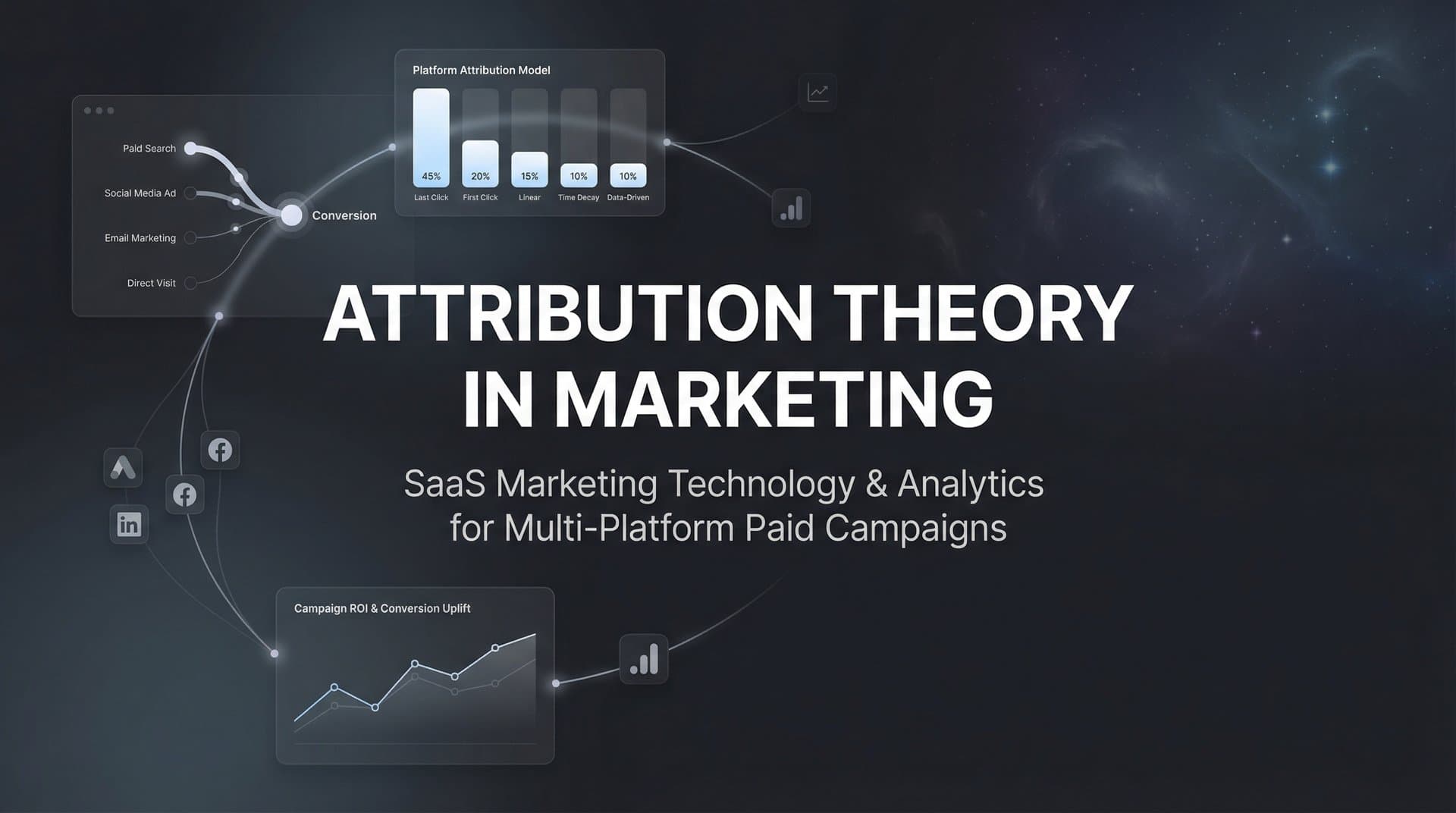
Single-touch attribution assigns 100% of conversion credit to one touchpoint, ignoring everything else. The two most common versions are first-click and last-click attribution.
First-click attribution credits the initial touchpoint that introduced the customer to your brand. If someone discovered you through a Facebook ad, that ad gets full credit even if they interacted with five other channels before converting. This model makes sense when you're primarily focused on awareness and want to understand which channels bring new prospects into your ecosystem.
Last-click attribution does the opposite—it credits the final touchpoint before conversion. If a customer clicked a Google search ad right before purchasing, that ad gets 100% credit regardless of previous interactions. This has been the default model for many marketers because it's straightforward and aligns with how most ad platforms report conversions.
The problem? Both models ignore the complete customer journey. Last-click attribution systematically undervalues awareness and consideration-stage channels. First-click attribution ignores the nurturing and conversion-focused touchpoints that actually closed the deal. If you're running multi-channel campaigns—and most marketers are—single-touch models give you an incomplete picture.
Multi-Touch Models: Distributing Credit Across the Journey
Multi-touch attribution acknowledges that multiple interactions contribute to conversions and distributes credit accordingly. Implementing a multi-touch marketing attribution platform allows you to capture this complexity and understand how touchpoints work together.
Linear Attribution: Every touchpoint receives equal credit. If a customer had five interactions before converting, each gets 20% credit. This model is democratic but assumes all touchpoints contribute equally, which rarely reflects reality.
Time-Decay Attribution: Recent touchpoints receive more credit than earlier ones. The logic is that interactions closer to conversion had more influence on the final decision. This model works well for campaigns with short consideration cycles where recency matters.
Position-Based (U-Shaped) Attribution: Typically assigns 40% credit to the first touchpoint, 40% to the last touchpoint, and distributes the remaining 20% among middle interactions. This model recognizes that awareness and conversion moments are crucial while still acknowledging mid-funnel engagement.
When Each Model Makes Sense
Your product complexity, sales cycle length, and channel diversity should guide your choice. For simple products with short sales cycles, last-click attribution might suffice because customers often convert quickly after initial discovery. For complex B2B products with long consideration periods, multi-touch models become essential because customers interact with numerous touchpoints over weeks or months. If you're in the B2B space, exploring B2B marketing attribution fundamentals can help you navigate these longer sales cycles.
If you're running campaigns across multiple channels—paid search, social media, display ads, email—multi-touch attribution is almost always more accurate. The more touchpoints in your typical customer journey, the more misleading single-touch models become.
Data-Driven Attribution: Moving Beyond Rule-Based Models
All the models we've discussed so far are rule-based. They follow predetermined formulas for distributing credit. Linear attribution always splits credit equally. Time-decay attribution always favors recent touchpoints. These rules apply regardless of your actual conversion data.
Data-driven attribution takes a fundamentally different approach. Instead of following fixed rules, it analyzes your actual conversion patterns and uses algorithms to calculate how much credit each touchpoint deserves based on observed behavior.
Here's how it works: the algorithm compares the conversion rates of customers who interacted with specific touchpoints versus those who didn't. If customers who engaged with a particular mid-funnel touchpoint convert at significantly higher rates, that touchpoint receives more credit. The model continuously learns from your data and adjusts credit distribution as patterns change. Understanding data science for marketing attribution helps you leverage these advanced algorithmic approaches effectively.
This approach has a major advantage—it reflects your specific customer journey rather than generic assumptions. Rule-based models assume that first and last touchpoints are most important, or that all touchpoints contribute equally. Data-driven attribution discovers what actually matters for your business.
The Data Requirements
Data-driven attribution isn't universally accessible. You need sufficient conversion volume for the algorithms to identify meaningful patterns. Platforms like Google Analytics 4 typically require at least 400 conversions per month and 20,000 interactions to generate reliable data-driven models.
You also need comprehensive touchpoint tracking. If your tracking only captures some channels while missing others, the algorithm works with incomplete data and produces skewed results. This means implementing proper tracking across your website, ad platforms, CRM, and any other customer interaction points. Learning how to use GA4 for marketing attribution can help you establish this foundation.
What Data-Driven Attribution Often Reveals
When marketers switch from rule-based to data-driven attribution, they frequently discover that mid-funnel touchpoints contribute more than expected. That blog post a customer read three weeks before converting? Data-driven attribution might reveal it significantly increased conversion probability, even though last-click attribution gave it zero credit.
Display ads often get revalued upward. Under last-click attribution, display campaigns typically look inefficient because customers rarely click display ads and immediately convert. Data-driven attribution can show that display ads play a crucial role in moving customers through the consideration phase, even if they don't generate final clicks.
The key insight: rule-based models force your data into predetermined frameworks. Data-driven attribution lets your actual conversion patterns tell the story.
Common Attribution Challenges and How to Overcome Them
Even with solid attribution theory and the right models, practical challenges can undermine your ability to track and credit marketing touchpoints accurately. Let's address the biggest obstacles marketers face in 2026. For a deeper dive into these issues, explore our guide on common attribution challenges in marketing analytics.
Cross-Device Tracking Gaps
Your customer discovers your brand on mobile during lunch, researches on desktop at work, and converts on a tablet at home. Without cross-device tracking, these look like three separate users. Your attribution model can't connect the dots because it doesn't recognize that all three interactions came from the same person.
This creates attribution blindness. That mobile ad that started the journey gets zero credit because the conversion happened on a different device. Your data suggests mobile campaigns don't work, when in reality they're driving awareness that converts elsewhere.
The solution requires user identification across devices. This typically means implementing authentication systems where customers log in, allowing you to track their journey regardless of device. For anonymous users, probabilistic matching—using signals like IP address, browser characteristics, and behavior patterns—can help connect cross-device activity, though it's less precise than authenticated tracking.
Privacy Changes and Cookie Deprecation
iOS privacy updates, browser restrictions on third-party cookies, and regulations like GDPR have fundamentally changed how tracking works. Third-party cookies—which powered much of traditional attribution—are increasingly blocked or restricted.
When Safari or Firefox blocks tracking cookies, you lose visibility into significant portions of your customer journey. A user might interact with multiple touchpoints, but your analytics only captures some of them because browser restrictions prevented cookie-based tracking on others.
This creates incomplete attribution data. Your models assign credit based on the touchpoints you can see, but they're blind to blocked interactions. The result? Channels that rely heavily on cookie-based tracking appear less effective than they actually are.
Server-Side Tracking as a Solution
Server-side tracking has emerged as the most reliable approach for capturing attribution data in the privacy-focused landscape. Instead of relying on browser cookies, server-side tracking captures data at the server level using first-party cookies and direct server-to-server connections.
Here's why this matters: browser restrictions primarily target third-party cookies, but they don't block first-party cookies set by your own domain. Server-side tracking uses first-party cookies to identify users, then sends that data directly from your server to your analytics platform—bypassing browser restrictions entirely.
This approach provides more complete and accurate attribution data. You capture touchpoints that browser-based tracking would miss, giving your attribution models the comprehensive view they need to assign credit accurately. Understanding how marketing attribution software compares to traditional analytics helps clarify why these modern approaches deliver better results.
Platforms that implement server-side tracking typically see 20-30% more tracked events compared to browser-only tracking. That's not just more data—it's more accurate attribution that helps you understand which channels genuinely drive conversions.
Applying Attribution Theory to Optimize Ad Spend
Understanding attribution theory is valuable, but the real payoff comes from applying these insights to improve campaign performance and budget allocation. Here's how to turn attribution data into actionable optimization.
Reallocating Budget Toward High-Influence Channels
Attribution insights reveal which channels genuinely influence conversions, not just which ones happen to be present at the end. This distinction is critical for budget decisions. Effective channel attribution in digital marketing helps you understand the true revenue contribution of each touchpoint.
Let's say your last-click data suggests that branded search campaigns drive most conversions. That's not surprising—customers who already know your brand name and search for it are highly likely to convert. But if you cut budget from the awareness channels that introduced those customers to your brand in the first place, your branded search volume will eventually decline.
Multi-touch or data-driven attribution shows you which upper-funnel and mid-funnel channels feed your conversion channels. You might discover that LinkedIn ads don't generate many last-click conversions but significantly increase the likelihood that someone will later search for your brand and convert. With this insight, you can justify maintaining or increasing LinkedIn spend because you understand its role in the overall journey.
The optimization process involves comparing channel performance across different attribution models. If a channel performs well under last-click but poorly under multi-touch attribution, it's probably capturing demand created by other channels. If a channel looks weak under last-click but strong under multi-touch models, it's contributing to conversions but not getting proper credit.
Feeding Better Data to Ad Platform Algorithms
Modern ad platforms use machine learning to optimize delivery, but they can only optimize based on the conversion data you send them. If your conversion tracking is incomplete or inaccurate, their algorithms optimize toward the wrong signals.
Accurate attribution tracking lets you send comprehensive conversion data back to platforms like Meta and Google. Instead of only reporting conversions that happened immediately after ad clicks, you can feed them data about assisted conversions and multi-touch journeys. Leveraging AI-powered marketing attribution tools can automate and enhance this data feedback loop.
This improves algorithmic performance in two ways. First, the platforms receive more conversion data, giving their algorithms more signals to learn from. Second, they understand which audience segments and creative approaches contribute to conversions even when those conversions don't happen immediately.
The result is better targeting and optimization. When Facebook's algorithm knows that certain users who saw your ad eventually converted through another channel, it can find more users with similar characteristics. Your campaigns become more efficient because the platforms optimize toward actual conversion influence, not just last-click conversions.
Building a Testing Framework
Attribution models are frameworks, not absolute truth. Different models will give you different answers about channel performance. The key is validating which approach best reflects your actual customer journey.
Start by comparing results across multiple attribution models. Run the same campaign data through last-click, linear, time-decay, and data-driven models if available. Look for patterns in how credit distribution changes. Channels that consistently receive credit across models are genuinely driving results. Channels whose credit varies dramatically depending on the model require deeper investigation.
Test your attribution insights through controlled experiments. If multi-touch attribution suggests that a particular mid-funnel channel significantly influences conversions, try increasing spend in that channel and measure the downstream impact on conversion volume. If conversions increase proportionally, your attribution model is accurately identifying influence.
The goal isn't finding the "perfect" attribution model—it's finding the model that produces insights that lead to better business outcomes when you act on them. If optimizing based on a particular attribution approach consistently improves ROAS and overall revenue, that model works for your business regardless of theoretical purity.
Putting Attribution Theory Into Practice
Attribution theory transforms marketing from educated guesswork into evidence-based decision making. Instead of wondering which channels drive revenue, you have systematic frameworks for assigning credit and understanding customer journeys. Instead of optimizing based on incomplete last-click data, you can see the full picture of how touchpoints work together to generate conversions.
The right attribution approach depends on your specific business model and customer journey complexity. Simple products with short sales cycles might work fine with straightforward models. Complex B2B offerings with long consideration periods need sophisticated multi-touch or data-driven attribution to capture the full journey.
What matters most is moving beyond default last-click attribution and implementing tracking that captures comprehensive touchpoint data. Without accurate data collection—especially in the face of privacy restrictions and cross-device behavior—even the most sophisticated attribution model produces unreliable insights.
Start by evaluating your current attribution setup. Are you relying solely on last-click data? Do you have visibility into cross-device journeys? Is your tracking comprehensive enough to support multi-touch attribution? These questions determine whether your attribution insights reflect reality or just the limited portion of the journey you can see.
Ready to elevate your marketing game with precision and confidence? Discover how Cometly's AI-driven recommendations can transform your ad strategy—Get your free demo today and start capturing every touchpoint to maximize your conversions.