You're staring at a dashboard full of metrics. Clicks are up. Impressions look solid. Your CEO walks into the room and asks the question that makes every marketer's stomach drop: "Which of our marketing channels are actually working?"
You know the last-click report says Google Ads drove 60% of conversions. But you also know customers saw your Facebook ads, read your blog posts, and clicked through from an email before they finally converted. So which channel really deserves the credit? And more importantly, where should you invest your next dollar?
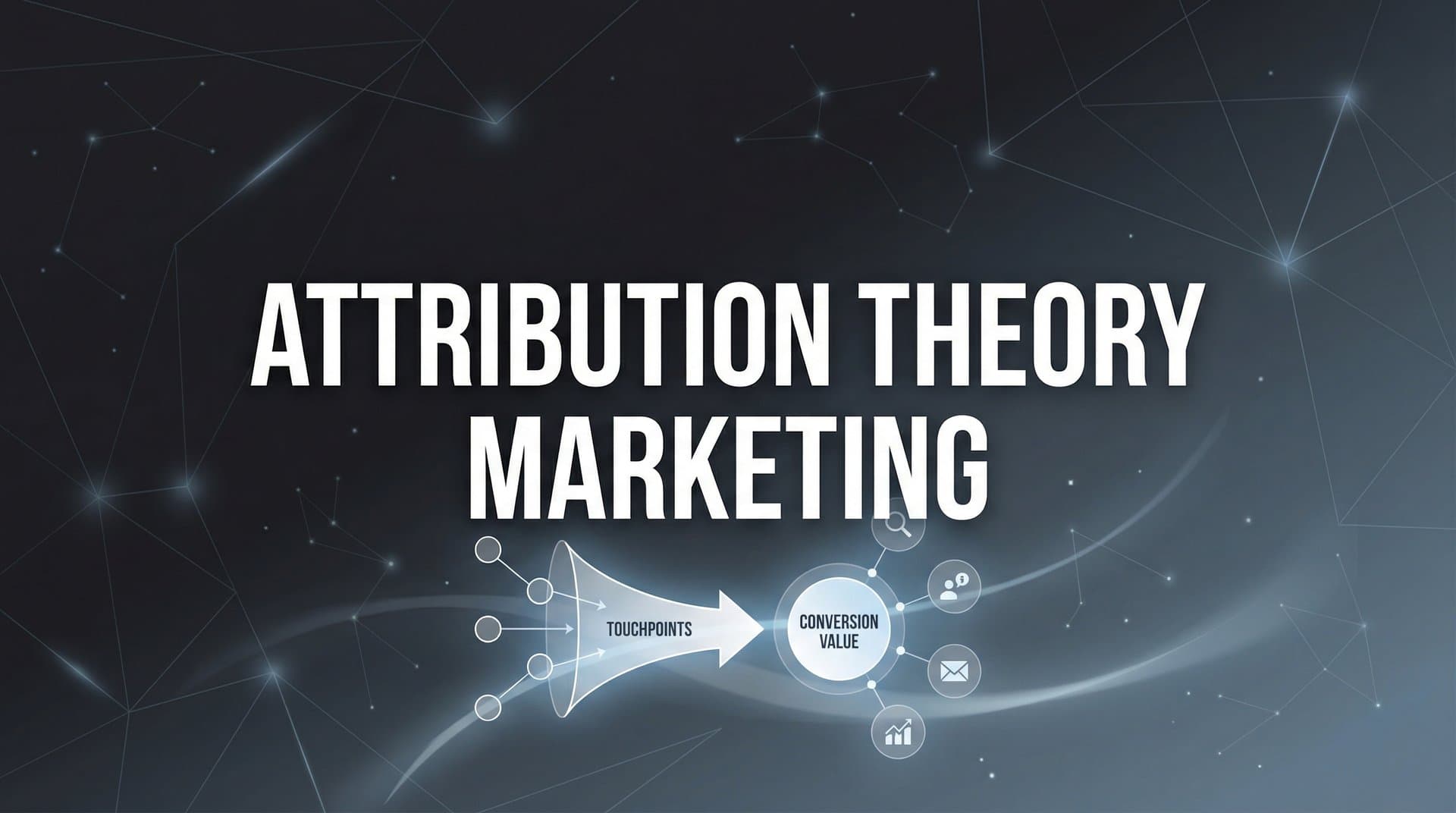
This is where attribution theory marketing comes in. It's the framework that helps you systematically assign credit to every touchpoint along the customer journey—not based on guesswork or whichever platform shouts loudest, but on how customers actually behave. When you understand attribution theory, you stop making budget decisions in the dark and start allocating spend based on what genuinely drives revenue.
The Psychology Behind Marketing Attribution Theory
Attribution theory didn't start in a marketing department. It began in 1958 when psychologist Fritz Heider published work on how people explain causality in social situations. He wanted to understand how humans decide what caused an event—whether they credit internal factors like personality or external factors like circumstances.
Marketers borrowed this framework and flipped it toward business: instead of asking "Why did that person behave that way?" we ask "Which marketing interactions caused this customer to convert?" The core insight remains the same—people don't make decisions in a vacuum. They process multiple signals over time before taking action.
Here's what that means for your marketing: customers don't convert from a single touchpoint. They experience a journey of interactions that collectively influence their decision. Maybe they first discovered your brand through a Facebook ad. Then they saw a retargeting banner while reading news. Later, they Googled your brand name and clicked through from organic search. Finally, they opened an email promotion and purchased.
Which touchpoint "caused" the conversion? All of them played a role. Marketing attribution theory gives you a systematic way to distribute credit across this journey instead of arbitrarily awarding everything to the last click.
This matters enormously for budget allocation. Without a framework for crediting touchpoints, you face two bad options. Either you over-invest in last-click channels like branded search—which gets credit but often just captures demand created elsewhere—or you spread budgets too thin because you can't distinguish high-impact channels from low-impact ones.
The marketers who master attribution theory don't just measure better. They allocate smarter. They identify which channels genuinely create demand versus which ones simply harvest it. They spot undervalued touchpoints that assist conversions but rarely get last-click credit. And they make budget decisions based on the full picture of customer behavior rather than a single snapshot.
Common Attribution Models and When to Use Each
Attribution models are the practical tools that put attribution theory into action. Each model represents a different philosophy about how to distribute credit across touchpoints. Understanding when to use each one is critical—the wrong model can lead you to completely opposite conclusions about channel performance.
Single-Touch Models: First-Click and Last-Click
First-click attribution gives 100% credit to the initial touchpoint that introduced the customer to your brand. Last-click gives everything to the final interaction before conversion. These models are appealingly simple. You can explain them in one sentence. Your boss immediately understands the logic.
But they're often misleading. First-click overvalues top-of-funnel awareness channels while ignoring everything that happened afterward. Last-click does the opposite—it credits bottom-funnel channels while treating earlier touchpoints as irrelevant. For most businesses, neither extreme reflects reality.
That said, single-touch models work well in specific situations. If you have a short sales cycle—think impulse purchases or low-consideration products—customers may genuinely convert from one or two interactions. In these cases, last-click attribution provides quick directional data without overcomplicating analysis. First-click makes sense when your primary goal is understanding which channels generate new customer awareness rather than measuring full-funnel impact.
Multi-Touch Models: Linear, Time-Decay, and Position-Based
Multi-touch attribution distributes credit across multiple touchpoints in the journey. Linear attribution splits credit evenly—if a customer had five interactions, each gets 20%. Time-decay gives more weight to recent touchpoints, reflecting the idea that interactions closer to conversion had stronger influence. Position-based (also called U-shaped) credits the first and last touchpoints more heavily while distributing remaining credit to middle interactions.
These models better reflect complex customer journeys. They're particularly valuable for B2B businesses or high-consideration purchases where customers research extensively before buying. When your sales cycle spans weeks or months and involves many touchpoints, multi-touch attribution reveals which channels contribute throughout the journey rather than just at the beginning or end.
The challenge with multi-touch models is choosing which one. Linear attribution assumes all touchpoints contribute equally, which is rarely true. Time-decay assumes recent interactions matter most, which works for some businesses but not others. Position-based assumes first and last touchpoints are most important, which may or may not match your customer behavior.
Data-Driven Attribution: Let Machine Learning Decide
Data-driven attribution uses machine learning to analyze your actual conversion patterns and assign credit based on which touchpoints statistically correlate with higher conversion rates. Instead of applying a predetermined formula, it learns from your data which interactions genuinely influence outcomes.
This approach provides the most accurate picture because it's customized to your specific customer behavior. If your data shows that customers who see both Facebook ads and email campaigns convert at 3x the rate of those who see only one, data-driven attribution weights those touchpoints accordingly. Understanding how machine learning can be used in marketing attribution helps you leverage these advanced capabilities.
The catch is volume. Data-driven attribution requires sufficient conversion data to identify meaningful patterns—typically hundreds of conversions per month minimum. If you're a smaller business or running limited campaigns, you may not have enough data for machine learning to work reliably. In those cases, start with a multi-touch model and graduate to data-driven attribution as your data volume grows.
Building Your Attribution Framework: A Step-by-Step Approach
Understanding attribution models is one thing. Actually implementing an attribution framework that guides budget decisions is another. Here's how to build one that works for your business.
Step 1: Map Your Customer Journey
Start by documenting how customers actually move from first awareness to conversion. Don't map the journey you wish customers took—map the one they actually take. Pull data from your analytics platform and identify the most common touchpoint sequences.
Do customers typically discover you through paid ads, then visit your website multiple times before converting? Do they start with organic search, then engage with social media, then respond to an email? Do they interact across multiple devices—starting on mobile and finishing on desktop?
List every trackable touchpoint across channels: paid search clicks, paid social impressions, organic search visits, email opens and clicks, website visits, content downloads, retargeting ad views, CRM interactions. The goal is comprehensive visibility into every interaction that might influence conversion.
Step 2: Choose Your Attribution Model
Match your attribution model to your sales cycle and customer behavior. If you have a short sales cycle with few touchpoints, last-click attribution may suffice. If customers research extensively before buying, multi-touch attribution better reflects their journey. This guide on what is marketing attribution model can help clarify your options.
Here's a practical decision framework. Sales cycles under one week with typically fewer than three touchpoints? Start with last-click. Sales cycles one to four weeks with multiple touchpoints across channels? Use position-based or time-decay attribution. Sales cycles longer than four weeks with complex multi-channel journeys? Implement data-driven attribution if you have sufficient volume, or start with position-based and evolve.
Don't feel locked into one model forever. Many sophisticated marketers compare multiple attribution models side-by-side to understand how different frameworks value their channels. The differences between models often reveal important insights about customer behavior.
Step 3: Implement Tracking Infrastructure
Your attribution framework is only as good as the data feeding it. You need tracking infrastructure that captures cross-device and cross-platform interactions without gaps. This means implementing proper UTM parameters on all campaigns, setting up conversion tracking pixels correctly, and ensuring your analytics platform can stitch together user journeys across sessions.
The biggest tracking challenge is identity resolution—connecting interactions from the same customer even when they switch devices or clear cookies. This requires a combination of first-party data (like email addresses or account logins) and probabilistic matching techniques that identify likely same-user patterns based on behavior. Proper attribution marketing tracking is essential for accurate measurement.
Server-side tracking has become essential as browser-based tracking degrades due to privacy changes. Instead of relying solely on pixels and cookies, server-side tracking sends event data directly from your server to analytics platforms, bypassing browser restrictions and providing more reliable data capture.
Overcoming Modern Attribution Challenges
Even the best attribution framework faces obstacles in the current marketing environment. Privacy changes, platform fragmentation, and data silos have made accurate attribution harder than ever. Here's how to navigate these challenges.
Privacy Changes Have Created Blind Spots
iOS 14.5 introduced App Tracking Transparency, requiring apps to ask permission before tracking users across other apps and websites. Most users opt out. Cookie deprecation timelines from browsers like Safari and Firefox have eliminated third-party cookies entirely, with Chrome following suit. These changes have created massive blind spots in traditional pixel-based tracking.
The solution is shifting toward server-side tracking and first-party data strategies. Server-side tracking captures events directly from your server rather than relying on browser pixels, making it immune to browser restrictions. First-party data—information customers provide directly like email addresses or account details—becomes your most valuable attribution asset because it doesn't depend on cookies or device identifiers.
Marketers who adapt their tracking infrastructure to these privacy realities maintain visibility into customer journeys. Those who don't increasingly operate with incomplete data, making attribution less reliable over time. Learning about fixing common marketing attribution challenges helps you stay ahead of these obstacles.
Cross-Platform Fragmentation Fragments Attribution
Customers don't stay within one platform ecosystem. They see your ad on Meta, search for you on Google, watch your video on TikTok, and convert after clicking an email. Each platform reports conversions within its own silo, often claiming credit for the same conversion multiple times.
This creates attribution chaos. When you add up platform-reported conversions, the total exceeds your actual conversion count because platforms use last-click attribution by default and can't see interactions outside their ecosystem. You end up with a distorted picture of channel performance.
Unified tracking solves this by connecting disparate journeys into single customer paths. Instead of relying on platform-reported conversions, you track all touchpoints in a centralized system that sees across platforms. Implementing cross channel marketing attribution software gives you a single source of truth for attribution rather than conflicting reports from different platforms.
CRM Integration Bridges Clicks to Revenue
The gap between ad clicks and actual revenue is where many attribution frameworks fail. You can track which ads drove website conversions, but if you don't connect those conversions to downstream revenue—especially in B2B where deals close weeks or months later—you're optimizing for vanity metrics rather than true ROI.
CRM integration bridges this gap by linking initial marketing touchpoints to final revenue outcomes. When a lead converts, your CRM tracks them through the sales pipeline until they become a customer and generate revenue. By connecting CRM data back to marketing touchpoints, you can attribute revenue to campaigns instead of just attributing conversions.
This transforms attribution from a measurement exercise into a strategic advantage. You stop optimizing for cheap leads and start optimizing for high-value customers. You identify which channels drive not just volume but quality. Understanding channel attribution in digital marketing revenue tracking helps you make budget decisions based on revenue impact rather than cost per acquisition.
Turning Attribution Insights Into Budget Decisions
Attribution data is only valuable if it changes how you allocate budget. Here's how to translate attribution insights into smarter spending decisions.
Identify Undervalued Assist Channels
Last-click attribution systematically undervalues channels that assist conversions but rarely get final credit. Display advertising, social media awareness campaigns, and content marketing often fall into this category. They introduce customers to your brand and keep you top-of-mind, but customers typically convert through search or direct traffic later.
Multi-touch attribution reveals these undervalued touchpoints. Look for channels with high assist rates but low last-click conversion rates. These are channels you might cut based on last-click data but that actually play critical roles in customer journeys. When you recognize their contribution, you protect budget that drives long-term growth rather than just harvesting existing demand.
Reallocate Spend From Over-Credited Channels
Just as some channels get too little credit, others get too much. Branded search is the classic example. It gets last-click credit for conversions, but customers often search your brand name because they discovered you elsewhere. You need some branded search presence, but over-investing here means paying for demand you already created.
Attribution analysis helps you right-size investment in over-credited channels. Compare last-click attribution to multi-touch or data-driven models. Channels that lose significant credit when you switch models are likely over-credited by last-click. Consider reallocating some budget from these channels to higher-assist performers. Exploring cross channel attribution marketing ROI reveals where your spend truly delivers value.
This doesn't mean eliminating branded search or other last-click winners. It means optimizing investment levels based on their true contribution rather than inflated last-click credit. You still capture demand, but you invest more in creating it.
Feed Better Data Back to Ad Platforms
Here's where attribution becomes a performance lever, not just a measurement tool. Ad platforms like Meta and Google use conversion data to optimize their algorithms—targeting users more likely to convert and adjusting bids automatically. When you feed them accurate, complete conversion data, their optimization improves. When you feed them incomplete or misleading data, they optimize toward the wrong outcomes.
Accurate attribution ensures you're sending the right conversion signals back to platforms. Instead of only reporting last-click conversions, you can use conversion sync features to send all conversions that platforms influenced—even if they didn't get last-click credit. This gives ad platform algorithms better training data, improving targeting and optimization over time.
The result is a virtuous cycle. Better attribution leads to better conversion data. Better conversion data improves ad platform optimization. Better optimization drives more efficient conversions. More conversions provide more data to refine attribution. Each cycle compounds the advantage.
Putting Attribution Theory Into Practice
Understanding attribution theory is one thing. Actually implementing it is another. Here's how to start applying these concepts to your marketing today.
Start with your highest-spend channels first. That's where attribution clarity delivers the biggest ROI impact. If you spend $50,000 per month on paid search and $5,000 on display advertising, getting attribution right for paid search matters ten times more. Focus your initial implementation effort where it moves the needle most.
Compare attribution model outputs side-by-side. Don't just pick one model and treat it as gospel. Run last-click, position-based, and data-driven attribution simultaneously if possible. Look at how different models value your channels. The differences reveal insights about customer behavior and highlight which channels are over-credited or under-credited by simpler models. Resources on comparing marketing attribution software features can help you evaluate your options.
Iterate monthly. Attribution isn't set-and-forget. Customer journeys evolve as you launch new campaigns, enter new markets, or shift your marketing mix. What worked as an attribution framework six months ago may not reflect current reality. Review your attribution model monthly, compare it to actual business outcomes, and adjust as needed.
Test incrementally. Don't overhaul your entire budget allocation based on a new attribution model in week one. Start by shifting 10-20% of budget based on attribution insights and measure the results. If performance improves, shift more. If it doesn't, investigate why before making larger changes. Attribution theory provides direction, but testing validates whether that direction is correct for your specific business.
The Path Forward
Attribution theory marketing transforms gut-feel budget decisions into data-driven strategy. It replaces the endless debate about which channels "work" with a systematic framework for understanding how channels contribute to customer journeys and revenue outcomes.
The goal isn't perfect attribution. That's impossible in a world of cross-device behavior, privacy restrictions, and platform fragmentation. The goal is better attribution than you had before—moving from single-touch models that mislead to multi-touch frameworks that reveal, from platform-siloed reporting to unified customer journey tracking, from optimizing for conversions to optimizing for revenue.
Every step toward better attribution compounds over time. You make smarter budget decisions. You protect high-value assist channels from being cut. You feed better data to ad platform algorithms. You connect marketing activity to actual revenue instead of vanity metrics. Each improvement builds on the last until you've transformed marketing from a cost center into a measurable growth driver.
The marketers who master attribution theory don't just measure better. They compete better. They outspend competitors on channels that others undervalue. They optimize campaigns based on revenue impact rather than surface-level metrics. They answer the CEO's question—"Which marketing channels are actually working?"—with confidence and data.
Ready to elevate your marketing game with precision and confidence? Discover how Cometly's AI-driven recommendations can transform your ad strategy—Get your free demo today and start capturing every touchpoint to maximize your conversions.